
A Soul in Ruins

Samhain                                                           Winter Moon

It was nine years ago the first of November that I left for Southeast Asia, visiting Mary when George Bush again won the presidency.  Mary and I went to the American Club for brunch around 8 a.m. to watch the polls close and night-time punditry begin.

Later a Singapore taxi-driver, Chinese, explained how much he disliked Bush and how much an American election, 12 time zones and 12,500 miles away, affected him.  It was, he said, a strange and not a good feeling to have so much of your future tied up with a foreign land and its peculiar decision making about leadership.

Singapore has a distinctly pro-Western bent for all its declaiming about Asian values; it is capitalist and materialist to its fingernails.  Mary and I experienced Diwali, the Hindu Festival of Lights, saw firewalking in a Hindu temple and broke the Ramadan fast in Arabtown.

Bangkok came next, a $60 introductory rate flight by Tiger Air, a cut-rate airline beginning to service Southeast Asia.  Bangkok’s ChinaTown, my home base for the two weeks I spent there had sidewalk fold-up restaurants at night, vendors during the day and always people, lots of people and cars streaming by on Yaowarat.  The neon lights gave the after dark old main street of Bangkok a garish look, but also made it enticing.  Exotic.

After some time in Bangkok, I got on a Bangkok Air flight for Siem Reap, Cambodia.  We landed next to a plane from the Republic of Vietnam.  On the flight from Bangkok bomb craters had been easy to pick out in the fields below.  Taxiing up to a spot beside that plane, in Cambodia, brought back anti-war memories from the 60’s.

The highlight of this trip was still ahead.  Angkor.  Most people identify this complex with
the name Angkor Wat although all that means is Angkor Temple and there are many, many temples.  The temple widely known as Angkor Wat is closest to the small Cambodian city of Siem Reap.  It is huge and well preserved.  I spent a full morning climbing its ritual and mythic architecture, it recapitulates a sacred landscape, and took most of my time at the object that made me travel all this way:  the churning of the sea of milk.

(This bas relief, carved intricately at all points, runs round the bottom most walls of the temple, roughly 1/4 of a mile.  The panels are maybe 12 feet high.)

This sentence from the Unesco world heritage website will give you an idea of why Angkor Wat is just a taste of what’s in the area.  “(Angkor) extends over approximately 400 square kilometres and consists of scores of temples, hydraulic structures (basins, dykes, reservoirs, canals) as well as communication routes.”

This is not a week’s journey, not even a month’s.  Three months would be a good start, especially since early morning and late afternoon are the only times you can really visit since the temperatures are so intense in midday.  I had four days.

All my photographs are on an old hard drive and I haven’t retrieved them yet, a project ahead of me. There are a lot of photos: Bantay Serai, Ta Phrom, Bayon, Preah Khan.

Morning and night for four days I explored, dodging scorpions, nodding to saffron robed monks, amazed by the kapok tree roots reclaiming these 9th through 14th century sites.

A memory that stands out came on evening the third day.  I had clambered around the temple mountain of Bayon, the temple with the four-faced stone monuments you’ve probably seen in pictures.  Incense drifted over from a contemporary Buddhist temple across the dirt road, following the smoke was music from cymbals and gongs.

Sitting on tumbled down stones near Bayon’s west entrance, a reverie overcame me and I drifted back, back, back in time to the days of the Khmer and the god-kings who built these monuments to politics and divinity.  To a time when the Khmer carved living rock from quarries far-away and floated the carved rock down river to these sites, using an elaborate system of canals.

(Bayon’s west side.)

This was when I realized a strong part of me was a soul in ruins, captured by the past, most alive while picking my way through Ephesus, Angkor, the Forum, Delphi, Delos. Through ancient texts like the Metamorphoses and the Odyssey and the Iliad.  Learning the ancient Roman language.  That realization has shaped much of my work since then.


Please Help Stop This Mine

Samhain                                                           Winter Moon

Today’s Star-Tribune has an excellent article by Lee Schafer, business columnist:  PolyMet mine report has a giant hole in it.

An excerpt:

“Late last week, the voluminous environmental impact report for the first project in what could be a major expansion of mining in Minnesota, PolyMet Mining’s proposed copper-nickel mining operation near Hoyt Lakes, was released, but without much that was meaningful about financial assurance.

(William Ervin)

It’s baffling that over a decade into the project’s evolution, the public still knows next to nothing about the financial assurance provision. It’s hardly trivial, given that the proposed mining and processing operation could require the treatment of water for more than 500 years.

The idea behind requiring financial assurance to make sure there’s money to contain and clean up polluted sites is really pretty simple. A mine is operated by a corporation that could go bankrupt, or fold up like a circus and leave town once the money has all been made and the mine is played out…

It takes up a little over three pages in a report so big that just the glossary alone is nearly five times bigger. It has a one-line table, showing estimates of cost if the mine were to close at the end of year one, at the end of year 11, or at the end of year 20. The high end of the cost-estimate range is $200 million….

If operating a water treatment facility costs $1 million a year, the financial assurance for PolyMet should be easily manageable, he said. “But if that operating cost got up to $10 million a year, that is pushing $1 billion to pay for that. That’s why at PolyMet it becomes an issue.””

Financial assurance connects directly to the question of tailings runoff.  PolyMet will claim that its estimates are correct because their new, never-before-proven technology will create safer tailings and tailing’s ponds.  No sulfide mine ever, anywhere has created a safe tailing’s situation.

The basic problem is simple.  The overburden and the rock not containing copper, nickel and other valuable metals contains sulfur. When rain and snow and sleet fall, melting water runs through the massive hills of tailings.  The water which runs off the tailings creates a sulfuric acid load.  But, it’s water, too.  So it flows into the watershed around the Hoyt Lake’s plant.

That sulfates can kill manoomin is evidenced by the Wild Rice Dead Zone – a stretch that begins where the Bine-ziibi (Partridge River) enters into Gichigamiwi-ziibi (St. Louis River) and extends 140 miles to the Anishinaabeg-Gichigami Maamawijiwan (Lake Superior Basin). The Wild Rice Dead Zone is the result of extremely high concentrations of sulfate released by U.S. Steel’s Keetac and Minntac taconite mines. Sulfide mining will add yet more sulfates into rivers and lakes thereby affecting the food that grows on water.”   (IC Magazine, Supporting Indigenous People)

A bonus feature of this area is that a confluence of continental divides makes some water head down the Mississippi to the dead zones of the Gulf, some water heads into Lake Superior on ies way to the Atlantic, while other water drains out of the tailings ponds into streams headed for Hudson Bay.  That way one mine can pollute three different large bodies of water and streams and rivers along the way.

Thus, to prevent acid drainage over the potentially 500 year long exposure to toxic runoff either requires a lot of money or excellent unproven technology.  Or, ideally, both.

As Schafer points out in a video discussion, Shakespeare was writing 500 years ago.  500 years is a long time.  The iron range gets 20 years of jobs against centuries of ruinous pollution.  Public policy must weigh the balancing benefits.


Bunny Lives Close By

Samhain                                                     Winter Moon

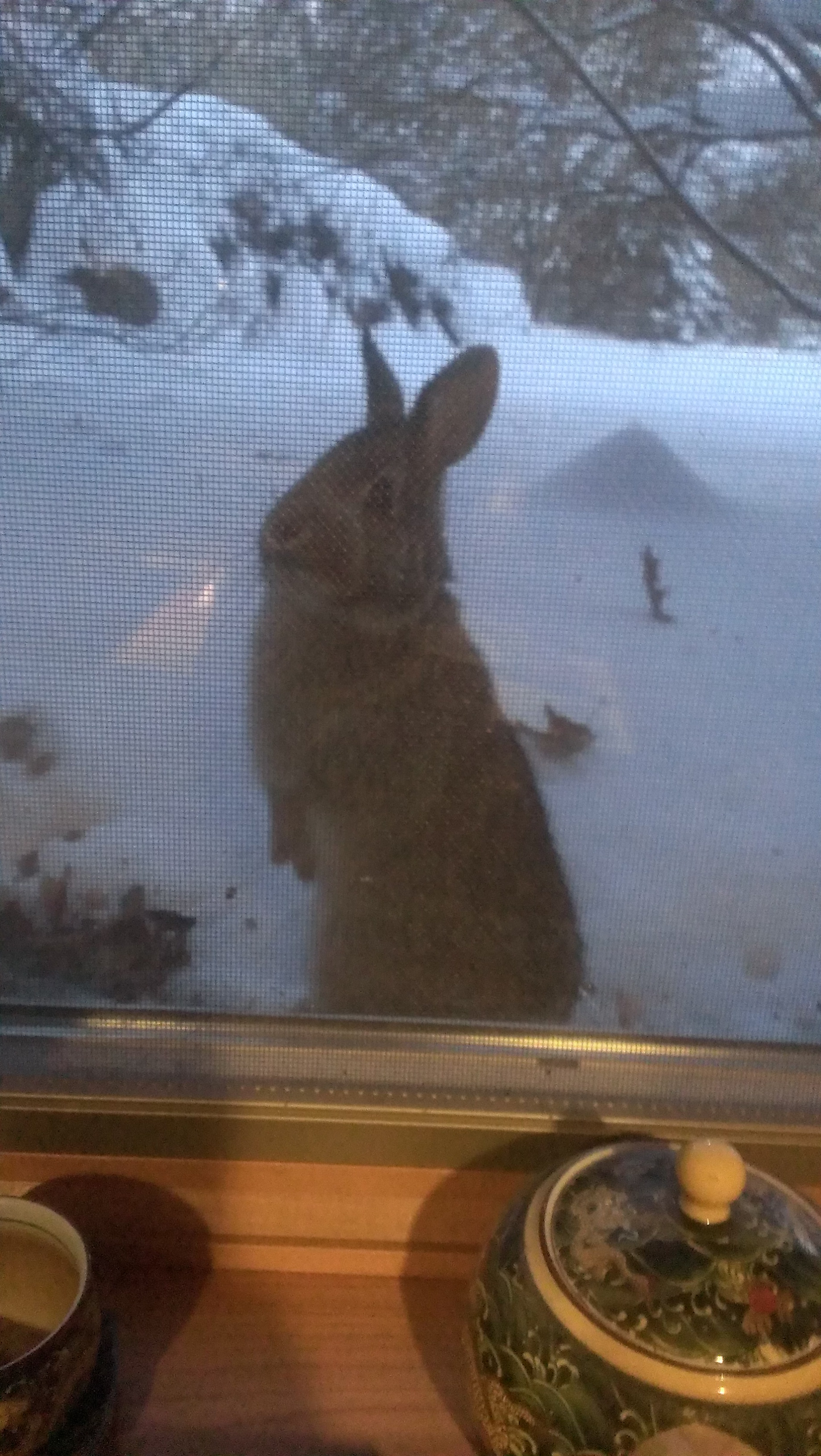
That bunny buddy lives under the boulder wall just to the west of my north facing IMAG1224window.  He came out this morning, stopped to look in the window a couple of times, stared at me, then proceeded on down the bunny trail.  This not so ancientrail takes him along the north side of the house and out to a part of the front which slopes up to seven oaks.  At least I imagine that’s where he’s headed since there are dogwoods, spirea and new ash saplings on the hillside.  Good rabbit food.

This entire week stays cold, then we hit some mid-twenties next Saturday.  Plus new snow today.  This could be another old-fashioned Minnesota winter.  I hope so.  It shaves off some of the pain of global warming.