The Whistle Pig Story. The next day.

Lughnasa                                                                   Lugnasa Moon

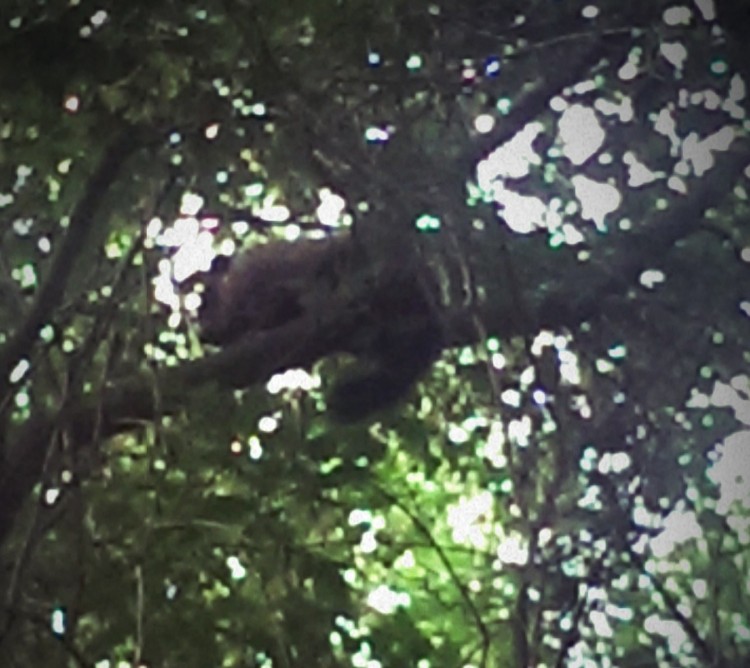
Not a great image, I admit. But as you can see, the land-beaver remains high in the tree where we assume he (or she) spent the night. This fact occasioned much barking this morning when the dogs discovered their playmate had hung around (groan) for another round.

BTW: Whistle-pig comes from the distress call, a high pitched squeak which we heard several times yesterday.

IMAG0470

Art

Lughnasa                                                               Lughnasa Moon

Lunch with Margaret Levin and her year old son, Art, today. Art spent the lunch talking in his way, waiting politely for us to say something, then adding his own thoughts. Of course, his thoughts came out in a language too advanced for adults to understand and I could the occasional wave of frustration cross his brow as he explained and explained.

When not conversing, he engaged the perennial favorite activity of children who can now move, find the electrical outlet. He was very happy to discover a power strip not far from our booth. So happy that when returned to the booth and set down, he promptly found it again.

Margaret’s a working mom, directing the Northstar Chapter of the Sierra Club. She’s a friend and I count myself lucky to know her.


It’s a whistle pig or a land-beaver!

Lughnasa                                                               Lughnasa Moon

Hot times outside this afternoon.

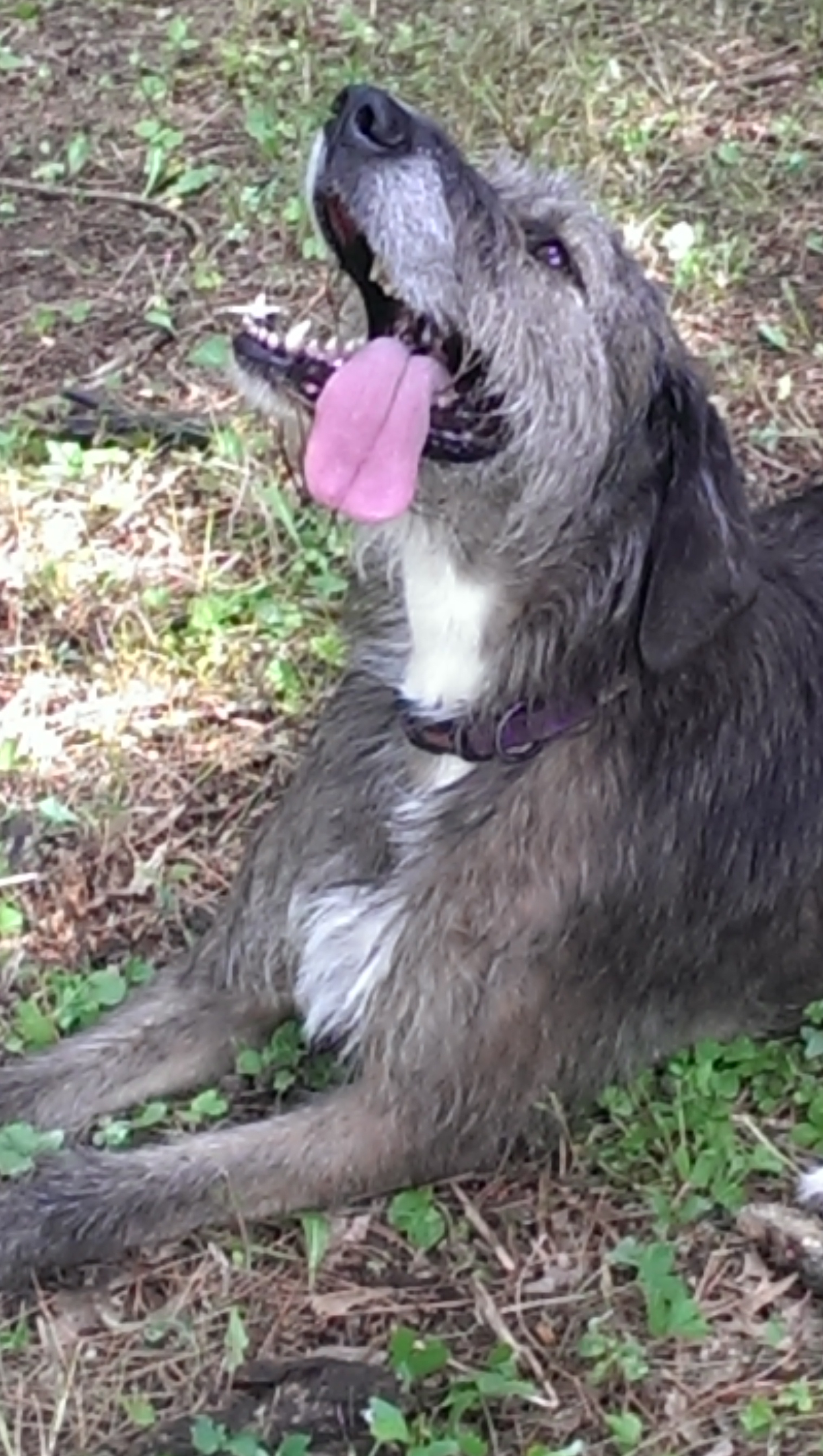
What does Rigel see?

IMAG0454


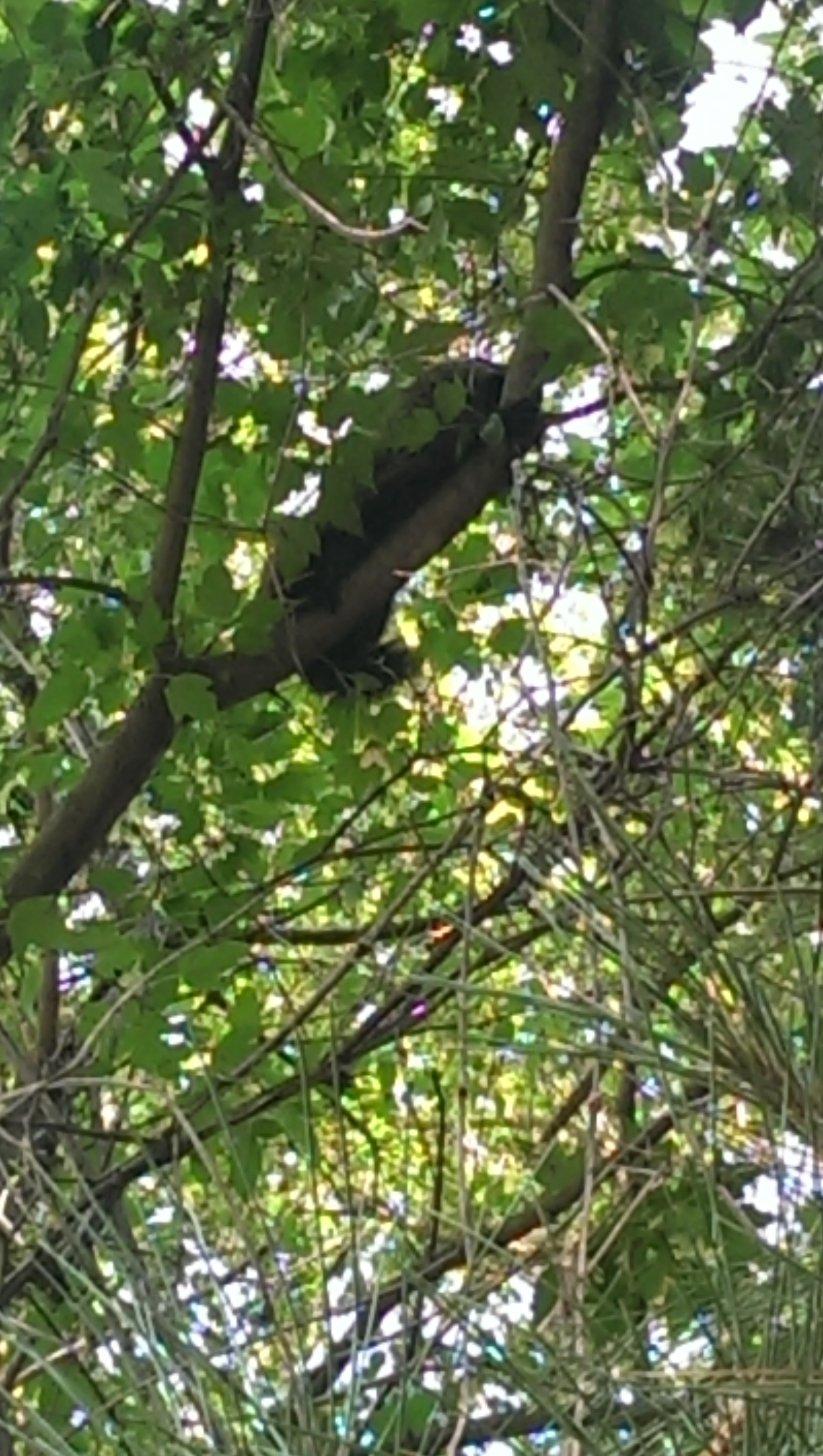
It appears she (and the other three) have treed a woodchuck. Yes, it is, as Wikipedia says a groundhog, a land-beaver, or a whistle pig. They’re a member of the Marmot family.

IMAG0452The dogs seem to think that if they bark loud enough and long enough the land-beaver will drop out of the tree into their mouths. Doubtful.


Chicken and Egg

Lughnasa                                                                 Lughnasa Moon

Sorting files. Lotsa stuff in files, stuck there in case of, well, something. Case in point. Year 2000 maps of Ontario, Michigan, Minnesota. One of the circle tours I took. They went out with the recycling on Tuesday. Another one with my favorite letter from a medical professional, ENT doc Tom Christansen. In it, after diagnosing my left ear deafness, he writes about my interesting inner ear bones, “They would make a good study, but I hope the opportunity for that doesn’t arise for some time.” Me, too.

The files that always get my attention, though I come to them rarely, but once in several years, are old psychological reports from my seminary days. Seminaries and religious denominations are big consumers of psychological testing and interpretation. Cue the recent Catholic scandals for one good reason.

In my case the materials tells a story mostly familiar to me by now. Likes to work on his own. Interested in academic pursuits. Creative. Skill in two primary areas: creating and influencing. I said mostly because that second skill area seems to slip below the surface of my awareness. Which is odd given what it describes.

Influencing, according to the Campbell Interest and Skill Survey, values “the opportunity to be a change agent, moving organizations forward. Influencing types crave visibility and desire to take charge of activities that interest them and make things happen. Enjoying the give and take of negotiating and debating, they are often drawn to vocations such as company presidents, corporate managers and attorneys.” Tangible results are important to him, and he is aware that lack of such results can increase his level of impatience, the interpretation of these results add specifically about me.

I’m belaboring this, which may be obvious to those who know me well, because it points to the specific struggle, the big one, which engages me these days. Tangible results. Writing. Lack of. Hmmm. Journey before destination. Can I retire from writing without having published anything? Except, of course, for millions of words here. To ask this question puts the influencing aspect of my personality into an impossible chicken-egg cycle, one I’ve not been able to break.

So, I’ve written. A lot. You know the story by now. Novels, short stories, etc. But since writers see publication, not writing, as the “tangible result” I have not, for all that, achieved tangible results. Which, at various points, does raise my level of impatience. With myself of course since I’m the only actor in this mini-drama.

much better now

Lughnasa                                                         Lughnasa Moon

Remember when you used to have to go to the store, pick out items, stand in line to pay and then pack them up in your own car and take them home? Of things I recall as emblematic of the past-dial phones, transistor radios, cold winters-this is something I miss not at all.

When the Sears and Montgomery-Ward catalogs came (speaking of things of the past) to rural areas of the U.S. back in the early 20th century, it must have been a similar feeling. Without a long trip to a city an order could be placed by mail and the train would deliver it right to the station. I imagine a dray man would bring it on out to the farm for a price.

Today I got moving supplies: bankers boxes, plastic file boxes and specialized boxes for moving art. The UPS guy brings the boxes to the doors, rings the bell to let me know they’re here and all I have to do is bring them inside. So much better than that old fashioned trip to the mall.


Summer’s Exhaust

Lughnasa                                                              Lughnasa Moon

Summer’s exhaust has begun to hit our nights as warmer days recede slowly toward the equator.  The light has begun to change, especially in the evenings, but visible during the day as well, coming to us at a different angle. The change is noticeable now, a month and a half after the sun’s greatest height of the year on the Solstice. These subtle clues cue birds and other animals to begin edging toward migration or fur growing or nut gathering. They come to each living thing in a scale appropriate to the action needed, less subtle to the birds and the bees, more subtle to us large mammals.

I’m celebrating the ending of my last northern summer, one I’ll trade next year for a mountain summer, which must be as distinctive in its own way. When I moved north, now 45 years ago, I wanted cleaner breaks between seasons. And I got them. I’ve appreciated the heat and humidity of summer here. The cool blue of fall. The icy depths of winter and the explosive coming of spring. Moving west into the mountains, I’m hoping to modulate the heat and humidity of summer and lessen the brutality of the winter.

It might have been my August trips to Stratford, Ontario as a boy that made me yearn for the northern summer. Along Lake Huron then the skies were heart-breaking, a mix of faded heat and oncoming chill. I felt stimulated, alive both to the weather and to the cultural tradition of Shakespeare and the theater. It was then, too, in 1963 at the Black Swan Coffee House in Stratford that I first heard a radical critique of American policy in Vietnam. Perhaps those things forged a bond, the northern summer and activism, because they’ve been joined since my move to Wisconsin in 1969 only six years later.


Progress

Lughnasa                                                                Lughnasa Moon

I’ve made substantial progress on the garden study. Two bookshelves empty, the other sorted and now awaiting only a new round of boxes from G-will Liquors. One file cabinet liquor boxesis empty, too, as are most of the other pieces of furniture in the room. What remains are two full drawers of a four drawer horizontal file cabinet and part of the third, though the files in that drawer will go in the trash, so no decisions to be made.

It’s the decisions that slow me down. And the memories. And sometimes the memories make the decisions hard. Sometimes not. I found a young picture of Jon from a camping trip he and I took about ten years ago. Bridget, Emma’s sister, and given to Jon as a companion when he lived alone, stood there healthy and alert, a beauty. The pictures all stayed, of course. In other cases I found old copies of colonoscopy prep instructions. Out. Ah, the memories those invoked.

Tomorrow I have to review my Latin for a Friday session with Greg. On Thursday I have lunch with Margaret and Justin from the Sierra Club. On Friday, breakfast with Mark before my time with Greg.

This means I probably won’t finish the study until the weekend. Later than I wanted, but not by much. After that, a rest and then I’ll tackle the main event. Editing my life’s ambitions down to a size befitting the time and energy that remains. Believe it or not, I look forward to it.

Shorter, More Intense

Lughnasa                                                          Lughnasa Moon

Did some climatological research yesterday about the Idaho Springs area. This is life a 7,500 feet +. It’s cooler when Minnesota is hotter and warmer when Minnesota is colder. So far, perfect. Still winter, but not so brutal. The gardening zone, based on winter low temps is 5a. That’s roughly what Andover is said to be these days though I find it more like 4b. Still, let’s call it equivalent.

The big differences are in rainfall, about half of Andover’s in Idaho Springs, and growing season. The first frost in Idaho Springs is between September 1st and September 10 over against October 5-10 for Andover. The last frost was the big surprise to me-between June 21 and June 31. An early last frost would come on the Summer Solstice!

So. This will be a far different gardening environment from Andover, one requiring either starting of plants  or protecting plants planted outside or both. One factor I haven’t researched because I’m not sure how to is the strength of the sun. Elevation both thins the air and puts the garden closer physically to the sun. This results in a higher UV index overall and I imagine (and stepson Jon says it’s so) this will result in accelerated plant growth. If I can prevent the sun from burning the plants.

This will all require a lot of new learning, but it will be that learning that will eventually marry me to a new spot on the planet. I’m looking forward to it.

This Old Body

Lughnasa                                                              Lughnasa Moon

This Old Body. Wouldn’t that be the perfect name for a boomer aging show on PBS? Bob Villa could come on with Deepak Chopra and help us develop renovation plans. Hips aching? Consider hip replacement surgery with titanium and ceramic parts. Be sure to sure to use quicksetting glue. How about that hand that just doesn’t grip like it used to? Do we have a surgery for you. In and out in under a day, cast on for a couple of months and you’ll feel better than you’ve felt for years.

(this is the show’s tag line from old friend Ralph Emerson)

Prospect of imminent death depressing? Let’s talk reincarnation. Or just plain old acceptance. Chakras and auras out of whack? We have a tune-up special we’ll talk about later in the program.

Come back next week when we talk knees, elbows and those sudden lapses in memory on This Old Body. Cue the end.

Family Themes and Existential Aloneness

Lughnasa                                                                Lughnasa Moon

Two widely divergent thoughts today. The first about family. Families have themes, melodies that play themselves out in different keys and different arrangements, using the instruments available.

Take mine for instance. Both mom and dad had a desire to travel, to see the world. Mom realized hers, making it to Italy and northern Africa as a WAC during WWII. Dad had a dream, a boat, some time in the Gulf of Mexico, then a book about it. Yet he never left the U.S. with the exception of Canada until very late in life when he flew to Singapore to visit my sister. He did, however, take short trips to odd places in Indiana, making do with what was available.

So, travel is a theme. I’m the less traveled of my siblings, only visiting foreign countries, never staying anywhere longer than a week. Mary has traveled a lot, spending years in Southeast Asia working, visiting Tibet, India, Indonesia, Europe, the Emirates. Mark has lived the travel theme most adventurously. He’s been across Russia on the Trans-Siberian railway, picked olives in a kibbutz in Israel, taught in Thailand, Cambodia and Saudi Arabia. We’re a gradation of the wanderer archetype, the one who visits but doesn’t stay.

Then, there’s the fascination with writing and language. Dad was a journalism major and well thought of at Oklahoma State University, a school with a respected journalism department. He wrote professionally, as a reporter and an editor, most of his life.

Mary and Mark advanced this theme by teaching English as a second language (ESL). I’ve advanced this theme through novels, short stories, sermons, essays, this blog. In this instance we’re a spectrum of the Hermes archetype, the one who takes messages and delivers them.

Mom was a teacher. Many of my cousins are teachers, on both sides of the family. Mark has taught ESL as an instructor while Mary has advanced from that role to that of University professor, teaching teachers of ESL for the nation of Singapore. I’ve never taught formally, but many of my roles have involved teaching of one kind or another. Here, we’re a spectrum of the elder archetype, when the elder is one who passes on the tradition.

There are other themes, some more subtle, but these three: wanderer, Hermes and elder seem most predominant. We did not engage these archetypes; these archetypes engaged us, shaped us, set us on our paths.

The second thought is about being alone in our interior. Reading an article in the New York Times today about Hinduism, a comment made me stop, think. The interior life is one path to liberation, the interviewee said, but at bottom the life of devotion and meditation is decidedly anti-individual. What? Yes, he said, at bottom we find in ourselves a deep oneness with all creation, with the brahma. So, at our most interior we are also at our most connected.

So this bounced around for a while. Then, a thought occurred to me. How does he know?  We can say for certain that we know each person’s interior life is unique and private. We can say this much based on our own experience and the mediation of other’s interior experience through interaction. Since those interactions are not identical, hardly identical, we can infer with confidence that the interior life of those we know is different from ours and different from others. It is also self-reported as different by those we know.

It’s an attractive idea, the idea of a substrata of oneness to be found at the end of our meditation, an idea known in the west through Carl Jung’s notion of the collective unconscious. But I don’t see how it can possibly be proven and without proof the notion of a layer of oneness underneath it all seems far fetched to me; as does, too, a layer of oneness that transcends our individual state.