Imbolc Hare Moon
Realized the other day that I’m going to be driving to Arizona in late March. At 67 that makes me a cliche, the stereotypical white-haired escapee from the frozen lands of the north. I worked for a while at Unity-Unitarian Church in St. Paul. Roy Phillips, senior minister there for 23 years, always referred to Minnesota as the frozen tundra. His last church was in Tucson.
(Sun City Florida ad image)
In 1960 developer Del Webb opened the first homes in what would become Sun City. Sun City soon became a byword for retirement Valhalla, a place where the worthy dead-to-the-work-world could gather and each day play 18 holes. After golf they could climb in the cart and drive home to a feast celebrating having crossed work’s finish line.
Sun City was nothing more than a name and a cultural symbol to me when I married Kate. Her parents, though, had retired there, so I had more than one opportunity to see it from the resident’s perspective. The first time we visited the flat, uniform plats stood out, small single level homes interspersed with golf courses, tennis courts and services like churches, funeral homes and a recreational center. The colors were muted, desert pastels and the streets eerily quiet. The ubiquitous golf carts with their electric motors made little noise and there were few of those in sight. (Sun City Florida ad image)
The longer I was around Sun City the more aberrant it seemed to me. With a minimum age of 55 there were no children. No young families. No teenagers. This was seen as a blessing by many, maybe most who lived there, but it did something odd to the character of the place.
It meant your friends and neighbors were all old. Dinner table conversation often turned to deaths and illness, frailty. There was no future there. Only death. After that, the desert. Sun City felt hermetically sealed off from the ongoing world, a sort of vestibule for the life hereafter; when it was meant to be, I think, the life hereafter work.
A rarely mentioned but frequently experienced dilemma occasioned by this flight to Arizona was absent family. In this case it wasn’t the kids who had moved away from home, following work or a spouse, but the parents. At first, I imagine, it was exhilarating, all the time with no kids, no grandkids. No birthdays and holidays, no Thanksgiving. Free at last.
But when the inevitable decline set in, then the anguished calls would go out. And they went out to children in Minneapolis, in Boston, in New York. Sons and daughters had to do long distance elder care while Mom and Dad suffered and sometimes died alone.
Whether those more carefree years of early retirement balanced out the difficulties of the latter years differs from person to person, of course. But I know in the case of Kate’s parents, both of them, their final illnesses were difficult on all parties, a difficulty not only exacerbated by distance, but also created by it.
These early emigres to Sun City were experimenters, pioneers of the new model for healthy life after the end of work. But the lessons that could have been learned, I’m afraid were not.
Just visit the Del Webb site for proof that this kind of elder dispersal continues to this day.
Communities need their older citizens, for memory, for continuity, for child rearing, for role modeling, for what has been learned. Age graded communities deprive both the old and the young of necessary interaction. Life with children is life with a future; life without them is a sterile desert. Likewise for children life without older neighbors and grandparents is life without a living link to the past.
I feel this keenly because Kate and I are here in Minnesota with our children and grandchildren far away. To magnify that our nuclear and extended families are also far away. This is not a complaint, we’ve made our choices and they have made theirs, but the net effect is for us to be in our mini-Sun City, an aging exurban development with no children. Strange when I look at it that way, but it’s true.

 where, 24 years ago, we spent the night before boarding a PanAm (yes, PanAm, can you imagine?) flight for Rome.
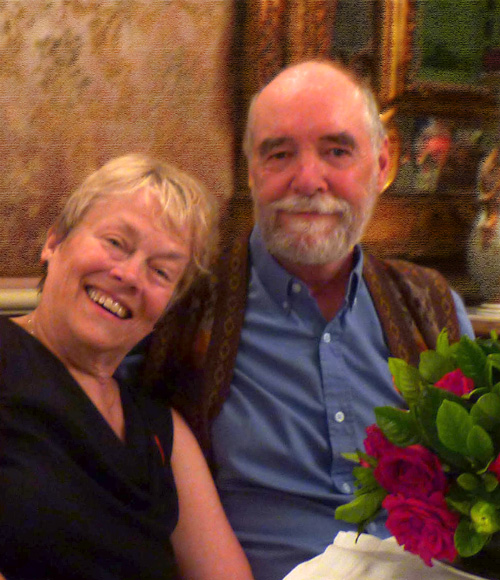 bringing us together. We looked at the things that could have gone badly like Kate earning a lot and me earning much less, then nothing. I said, “I think the thing we’ve done, all along, is nurture the best in each other. I don’t see how you can ask for more in a relationship.” Kate agreed. Somehow we have seen the highest and best in each other, staying out of each other’s way in some instances, stepping in with a helping hand at others.