Nocturne

Lughnasa                                                                 College Moon

A certain softness, a wistfulness has begun to creep into the Woolly meetings for me. If we buy a house and move in January, only three more third Mondays remain.

The depth of feeling I have for these guys will last, I know that, but the relationships will grow more tenuous. That’s inevitable. They will not disappear, of that I’m sure, but without the regular gatherings things will change.

The circus tent ropes have gone slack and some of the canvas sides have begun to fold in on themselves, the tent poles are still in place: the home in Andover, the Woolly’s, the personal Twin Cities created by 40 years of memories, but each of these tent poles will eventually come down, too.

Feeling it tonight.

A Man, A Monument

Lughnasa                                                            College Moon

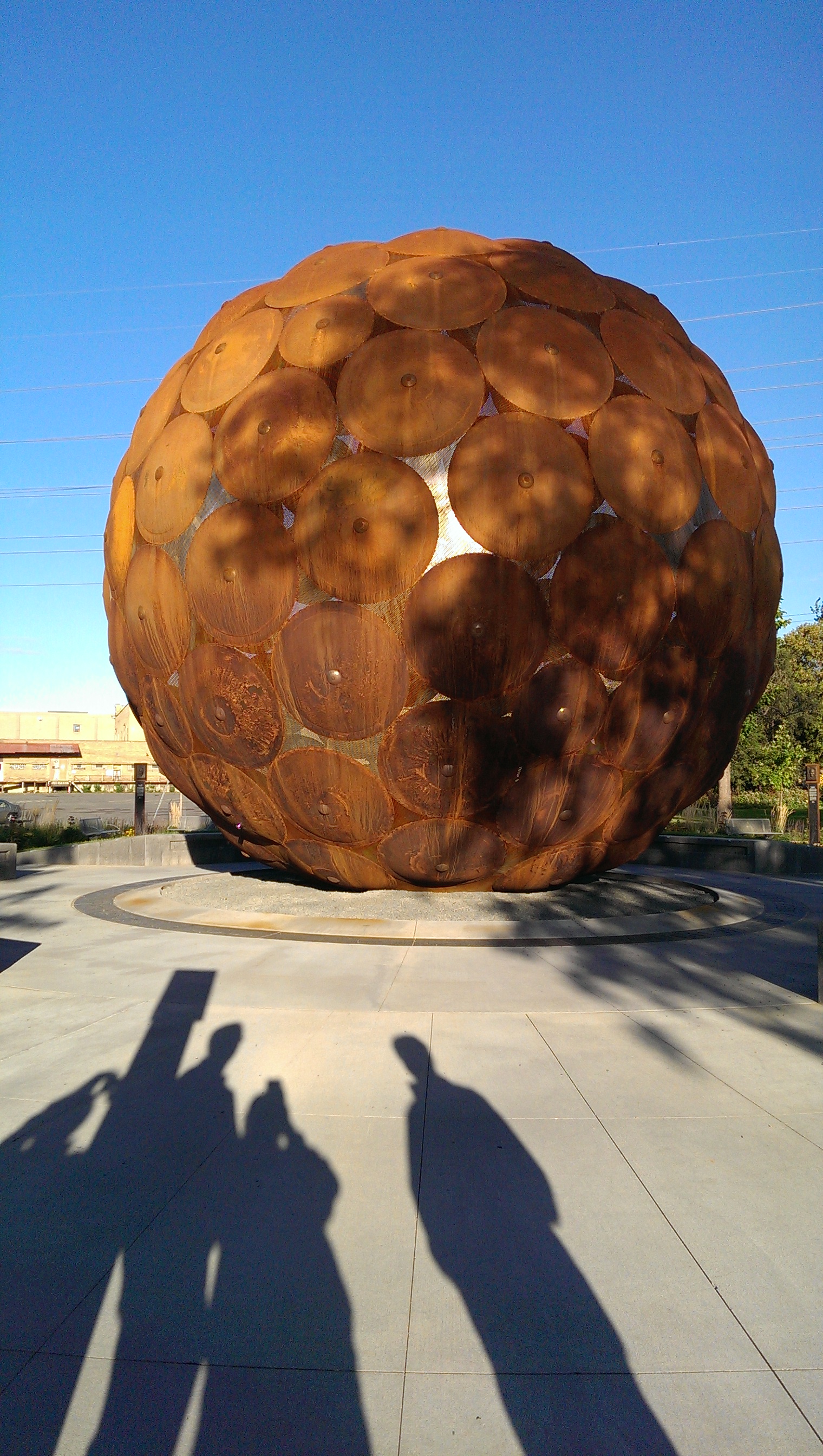
IMAG0657Third Monday of the month. It’s been the Woolly meeting night for years, over 25. Bill Schmidt suggested we visit a memorial related to war, a memorial in a neighborhood park in northeast Minneapolis, right on the Mississippi behind the old Grain Belt Brewery and its wonderful castles of yellow brick. The memorial is in an odd, very out of the way location, almost as if its hidden. And it is a monument to the effect one man can have on history.

That one man is Woolly Mark Odegard, a Vietnam War Veteran, who became part of this project and as part of it shaped its content in important ways. When the group gathered to consider it began, all the veterans wanted to honor the war and their service. This is after all the public script about how to notice veterans. We honor the historical event, the war, and their participation in the war. But Mark knew there was more beneath the public script.

When probed, the veterans admitted that war was ugly, painful and often confusing. Mark said the monument should show that side of war, too. He got this element added by interviewing veterans from various wars and putting their quotes on marble stelae along with historical facts about the war. Commenting on the Spanish-American War one man said, when the fighting against the Filipino’s began he realized the war “was about greed.” Unusual and telling language at a war memorial.

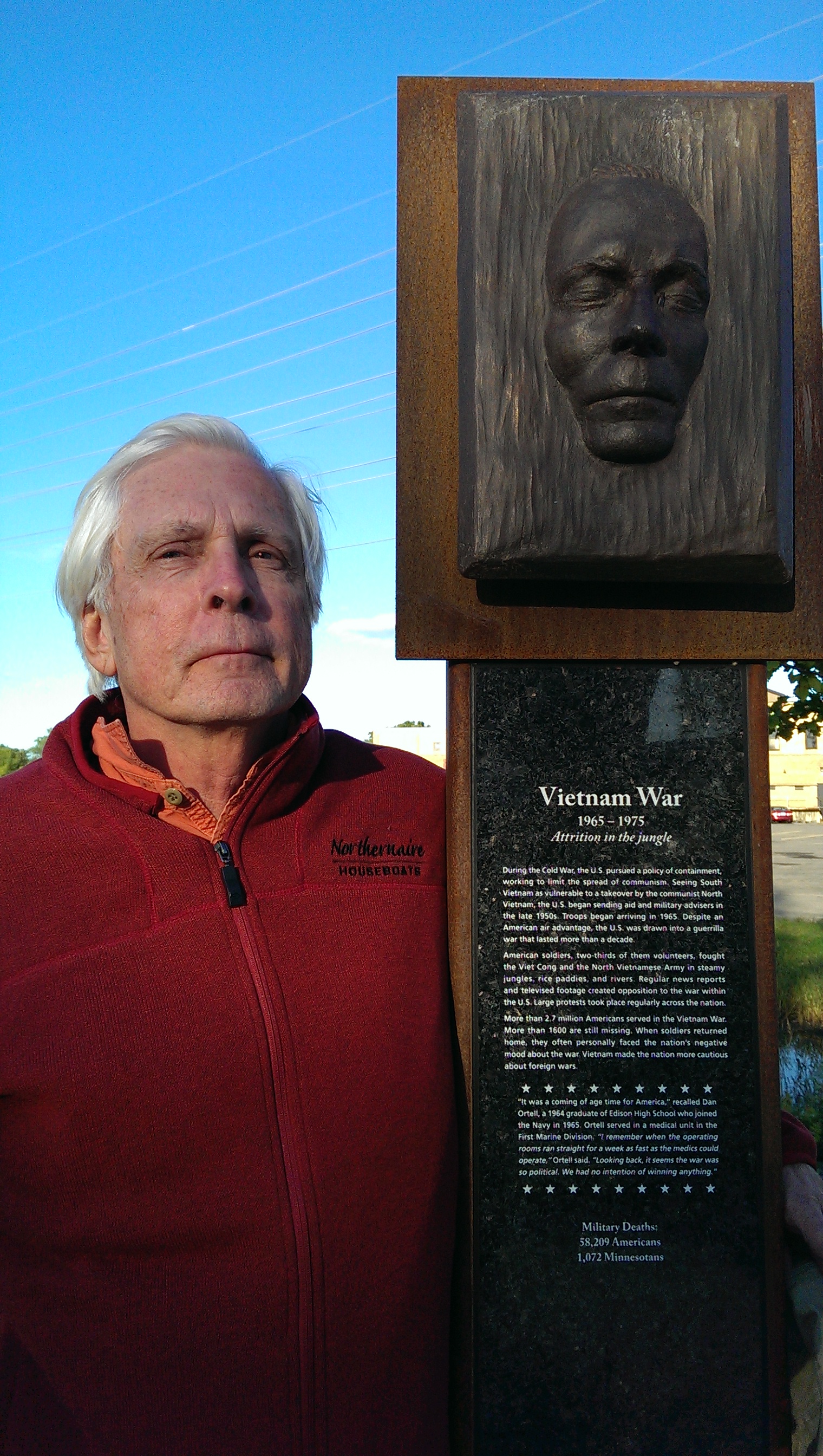
Each stelae is a slab of black granite with text acid etched into it and a face above it IMAG0661bronzed from living subjects, when possible veterans from the wars memorialized. Mark suggested that the monument start with the Dakota war in 1862 since that was the first war with Minnesotans serving. To particularize it further Mark suggested that the stelae have the number of Americans who died and the number of Minnesotans.

(Mark next to the Vietnam War stelae topped by his face in bronze.)

This monument will be in place for a long, long time and Mark’s effort to personalize war through the words of veterans will bring an element of realism to a too often romanticized human endeavor.


Widdershins

Lughnasa                                                                       College Moon

We’ve cleared out the three sheds. This morning the dog barrier on the orchard fence (which never worked) came down, the hardware going in a plastic bucket. The new place will have fence, too. All of the electric fence parts, from the charger to the plastic clips for the fence line and the electrified rope will go with us, too. Bears, mountain lions, mule deer, elk to keep out and dogs to keep in.

It feels like we’re walking widdershins around our property, unwinding twenty years of presence, trying to neutralize the most intimate space of all, home. Doing this now, in the fall when the air is cooler, makes it all seem appropriate. The growing season has begun to walk widdershins around the plants, seeing them revert to their ground level selves or to bare their branches, fatten up roots and otherwise end the time of producing.

We are undoing the enchantment we have created here. This place has become, through vigorous effort and the work of many, a place where we could enjoy life. It has become our home. Fires in the firepit, vegetables in the raised beds, apples and cherries and pears in the orchard, meals on the brick patio or out on the deck. Years of dogs creating paths in the woods and in our hearts. Now this enchantment has to be undone and stored for use in another location.

We will, I have no doubt, do the same in Colorado. It will be a different same of course, the paradox of home being where the heart is, not one physical place. We will have a smaller garden, but we will have one. We will still need to contain dogs. Our new home will be xeriscaped as soon as possible, so flowers, unless native, will not be part of it. We will still need a study and workout room for me, a sewing room with space for the long arm quilter for Kate. And in creating these spaces and functions we will become one with a new place. A new spell will be cast, one with Western themes instead of Northern.


A Minor Leftie Memoir

Lughnasa                                                                   College Moon

Groveland UU has asked me to speak on December 14th. Their theme for the year is social justice. They wanted me to talk about restorative justice, a topic about which I know little. Instead I suggested this:

Social Justice: Reflections       Looking back at work for affordable housing, neighborhood organizing and neighborhood economic development, against corporate control of neighborhoods, organizing for jobs, for equity in philanthropy, for a sustainable human presence on the earth, for undocumented immigrants, for progressive politicians like Wellstone, Karen Clark and Peter McLaughlin, against the Vietnam War, for women’s rights, against the draft.

Looking forward at work necessary to retain and expand gains made.

When looking at it again, I realized it had the character of a summing up about my political work over the years, mostly in Minnesota. Sort of a minor leftie memoir, but not for the purpose of the memories, or not mostly for them, but mostly for teasing out the themes, the underlying rationales, the whys. What worked, what didn’t. What might work now, what might not.

This topic came to me because I realized it would be my last time at Groveland, with whom I’ve shared a two decade plus relationship and possibly my last time speaking in Minnesota, maybe ever. I don’t, at least right now, intend to find a religious community in Colorado since such institutions no longer interest me.

There is a modest bolus of energy in reviewing a body of political work that arose mostly in response to individual issues and moments of time, that never followed a straight path and that, like most serious political work, had some successes and many failures.

Where I wondered, did all this energy and effort come from? It wasn’t a good career move, yet the political path was the one I followed anyhow, pushing away more logical trajectories. There was, of course, my father’s role as a newspaper editor and his often weekly airing of his Rooseveltian liberal opinions, basically pro-social welfare and anti-communist, pro strong defense. That may have shaped my willingness to be seen publicly as a representative of unpopular points of view.

Also important was the nature of my hometown’s work force, the parents of my friends. With few exceptions, my parents being among those exceptions, my friend’s parents were either factory workers or stay-at-home moms. It was the 1950’s after all. As factory workers, a very high percentage worked for General Motors, others often in suppliers to the auto industry or other vehicle related manufacturers like Allison-Chalmers. They were members of the UAW.

These folks, the majority by far from the hills of West Virginia, Tennessee, Arkansas and other southern states, usually had not finished high school, but had jobs in General Motors, jobs that, thanks to the UAW, had health care, pensions, regular vacations, good wages and decent working conditions. As a result, Alexandria, Indiana hummed. When the auto industry went into decline and the UAW with it, Alexandria crashed into a ghost town.

A third factor was my mother’s unwavering compassion all people, no matter their condition in life or the color of their skin. Her example shaped me profoundly in that way.

The final ingredient came when the U.S. went full force into Vietnam. I started college in 1965 and would be in higher education for the duration of the war. The struggle against the war radicalized many students and I was one of them.