The Blood of the Lamb

Spring                                                   Mountain Spring Moon
There are historic occasions that are of major cultural significance, then there are occasions of historic significance on a smaller scale. Last night Jen  hosted her first seder. It felt good to drive over to their home (see above for the route) for a holiday, especially passover. One of the characteristics of Judaism that has long appealed to me is its emphasis on worship and holidays centered in the home.

Many of the most memorable holidays like Hannukah and Sukkoth are observed in the home. And, in fact, passover, a key holiday for Jewish identity along with Rosh Hoshanah Purim and Yom Kippur, is largely a home based celebration. I’ve been to several over the years, but none of them were as sweet as this one.

A Rabbinic Haggadah guides those gathered through this old, old ritual. Traditional estimates place the Exodus, the story at the heart of pesach, or passover, in 1300 B.C.E. Perhaps three thousand years old pesach links each Jewish family and their seder guests to a time of liberation from bondage, making freedom from slavery an essential part of Jewish identity.

To join family in a celebration with this much history makes my heart glad. Though the metaphysics of Judaism do not appeal to me, the long march, the ancientrail of Jewish identity held constant throughout millennia by these very same observances does. And I felt privileged to be there.


Seasonal Visitation

Spring                                            Mountain Spring Moon


Drive down the mountain to Aspen Park, get on Hwy 285 to Denver, get just past the ring road, Highway 470, and suddenly you’ve located spring. Pastures in the horse enclosures are green. Lawns on the houses tucked into the eastern facing slope of the foothills. Green.

In Denver itself, on residential streets, gay daffodils and colored hyacinths add yellows and pinks and blues and whites to the green. Nature’s most festive season is underway. At 5280 feet. Not so much at 8,800. Here the snow lingers, what lawns there are, not many, remain brown. There is not the earth shaking itself awake after a long winter’s slumber here. Not yet. No mountain spring for now. But the season can be visited not far away.

Habitual

Spring                                          Mountain Spring Moon

New morning habit in process of forming. I’m going to protect the time from 5:45-11:00 am for work with timeout for breakfast. After long experience, I know that I don’t do well if my work times get interrupted. This means I’ll need to make appointments for the afternoons in the future. Yes, this potentially interferes with my workout regimen, which begins at 4:00 pm each day. And, yes, it could disrupt my nap, but I think the advantages outweigh the hassles.

It also means I’ll not be posting here until mid-day, nor will I check e-mails, do other kinds of work on the computer until the afternoon or evening.

What will I be doing in those morning hours? Latin. Moving forward with my translation of Book VII which I plan to be my first complete book translated. There are 15. Writing. I’ll be working on Superior Wolf, writing and researching.

It’s odd, but the sunny disposition of Colorado really leans toward the outdoors, not like the cold and gloomy winters and early springs in Minnesota, where staying inside just made sense. This focus on mornings spent with the mind will have outside interference. I’ll have to focus harder on getting in hikes, plant identification, exploration in the time I have available.

I’ve been taken over the last few weeks with an idea from the Baghavad Gita, action with out attachment to the results. In the Gita this notion prunes karma, since it is the entrapment of desire that bends karma one way or the other. With no focus on the result the action cannot produce bad karma. This is not the way I see it though I understand this more orthodox approach.

Instead I find the idea of action without attachment to the result as a way to cut the final cord tying me to the bourgeois desire for achievement. It was this strain of thinking that cut across my cerebral cortex when living large popped up. In other words I learn Latin with no final end in mind. Being an amateur classicist is what I will do, defining the realm in which I will act. Just so the writing. Writing novels, being a writer is what I will do, what I have done. But the results of that action? Not important. Grandparenting. Gardening. Bee keeping. All the same.

So creating the atmosphere in which I can act is critical. Creating an atmosphere in which I succeed, not so much so.

Living Large

Spring                                                   Mountain Spring Moon

Over the last couple of days an e-mail exchange between two friends used, twice, the phrase living large. As sometimes happens, this time I looked at it and said, huh? What does that mean? So I looked it up in the urban dictionary and another online slang dictionary. Here’s what they had:

able to pay for and enjoying a very expensive style of living.  Vacations in the hot spots, a huge apartment in the city, cars, servants – that’s my idea of living large!

phr. Doing okay. (The response to How ya living?) I’m living large. How you doing?

Living with an extravagant or self-indulgent lifestyle.

In a cascade came another phrase: How then, shall we live? then, Peter Singer’s new book: Doing the Most Good. Then, what? And, living well is the best revenge.

I’ve always been struck by the power of unspoken, perhaps even unknown motivators, things that might have entered our psychic world unnoticed, sort of sliding in under our usual filters. My suspicion is that living large is such an unspoken, often unknown motivator.

The idea of being able to spread out in your world, to recline at your ease where and when you want underlies many an entrepreneur’s aspirations. It drives many during the long years of getting professional degrees, especially in the law and medicine. Those kids shooting hoops on inner-city asphalt, the rapper with the gold medallion around the neck, even the drug dealers and pimps, all want to live large. And, you might say, why not?

Yes, there’s the American dream. And, now the Chinese dream. In both cases you might say the dream is to live large in relation to poverty, to the uncertain rungs on society’s socioeconomic ladders. In that original dream the goal is a stable life, one with a home, enough food, savings, health care, education for the kids. And, yes, for many, maybe most of humanity, over most of history that goal would have been unattainable. In that sense these modest dreams represent living large.

But these kind of dreams have a way of metastasizing, like body builders on steroids, like an unchecked cancer. Instead of being a dream they become a nightmare of needs turned into desires and desires turned into lust. In this, its more usual sense, I think living large represents the corrupting influence of late-stage capitalism, where to gain more becomes its own rationale. Living large is not an aim, it’s a manifesto of unchecked wants that will, somehow, be satisfied.

Living small. Now there’s an aim.

Tourists

Spring                                   Mountain Spring Moon

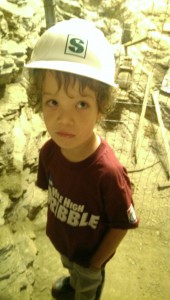
IMAG1001Gabe and I had an adventure yesterday. We went to the Agro Mine Tour, ate lunch at Beau Jo’s Pizza in Idaho Springs and finished off the day with a soporific soak at the Indian Hot Springs, also in Idaho Springs.

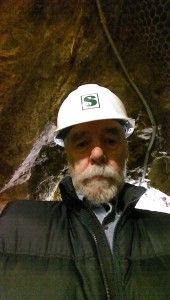
The mine tour itself is a cheesy, tourist-trappy thing with a clunky video, corny presentations and a self-guided tour after that. Still, the Double Eagle Mine, Gage is at its face (end) in this photo is remarkable in that it was dug by hand, by two men over the course of one year. About three hundred feet long, maybe five and a half feet tall and about 4 feet or so in width, it’s a monument to persistence, if nothing else.

The rest of the tour focuses not on a mine, but on the Agro mill, which in its prime, produced $100,000,000 worth of gold when gold was at $18-35 an ounce. It was fed by the Agro tunnel, a 4.5 mile tunnel dug through solid rock to remove waste water from various mines and to create a small railroad to deliver ore buckets to the Agro mill.

The Agro mill closed in 1943 when, on the last blast of the day, four unlucky miners IMAG1000dynamited a wall holding back water filling up an abandoned silver mine. The resulting flood geysered water from the tunnel for 9 hours. In addition to killing the miners the flood weakened walls and caused cave-ins along the tunnels length making the railroad tracks no longer usable.
The mill itself went down in stairstep like levels since most of the work proceeded through the aid of gravity. The Agro tunnel fed ore in from the top of the mill and the processing went in stages toward the bottom. A structure made of wood it looked like an unsafe place to have worked.

Idaho Springs is about 30 minutes outside of Denver to the west and well into the mountains. The Colorado Mineral Belt, which begins in the San Juan Mountains in the far southern part of the state, makes an arc up through Leadville and finds its terminus just a bit further north from Idaho Springs. Along this arc lie most of the mines in Colorado, many of them producing, like the mines the Agro Mill serviced gold, silver, copper, lead and zinc. Some have molybdenum and other metals. There’s a big, working molybdenum mine outside of Leadville.

Idaho Springs is a tourist town, primarily, located on either side of a long main street paralleling I-70. It has some residential housing, but not much. Service stations, inexpensive motels, restaurants, curio shops, a knife shop, a hardware store which sells gold panning supplies, that sort of thing.

And the Indian Hot Springs. The facilities, both the main building and the adjoining motel, saw their better days many years ago. The springs, though, deliver. Gabe and I swam in a large pool of water, 100 degrees +. There are, too, hot springs caves, a men’s and a women’s cave where clothing is optional.  Kids under 16 are not allowed in the caves.

After all that, it was back to Denver and a quick exit so Grandpop could beat the rush hour traffic on the way home.