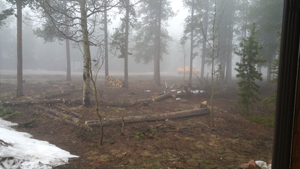
Topped all the felled trees, finished the limbing on them, too. Began the hauling to the front. Wore myself out. Tomorrow I’ll start cutting them up.
Rain today. Cloudy. Our solar production is far behind what was predicted, due in large part to the heavy snowfall, but also to cloud cover. Payout may take more time than we have here, but the intimate connection between the sun and our electrical use is worth it anyhow; as is severing, to the maximum extent we can, the link between our electrical use and coal generated power.
Chain saws whir all over the neighborhood here on Shadow Mountain. Fire mitigation is the mountain spring equivalent of planting a garden. Weeding, really, on a large scale. A weed is a plant out of place. Of course, you could argue that those of us who live up here are the weeds. Perhaps the trees should be plucking us out. Which is, of course, exactly what a wildfire does. Complex, man.
“…I am at home in the West. The hills of the coastal ranges look “right” to me, the particular flat expanse of the Central Valley comforts my eye. The place names have the ring of real places to me. I can pronounce the names of the rivers, and recognize the common trees and snakes. I am easy here in a way that I am not easy in other places.” Joan Didion, California Notes, NYRB, 5/26/2016
Front, May 6th
Becoming native to a place implies the opposite of what Joan Didion recalls in this fine article taken from notes she made in 1976 while attending the Patty Hearst trial for Rolling Stone. The becoming process implies not being easy where you are, not knowing the place names as real, not knowing the common trees and snakes.
The Black Canyon of the Gunnison is not a real place to me. Neither is Four Corners nor Durango nor the summit of Mt. Evans, only 14 miles away. The owls that hoot at night, the small mammals that live here on Shadow Mountain. No. The oak savannah and the Great Anoka Sand Plain. Familiar. Easy. The Big Woods. Yes. Lake Superior. Yes. The sycamores of the Wabash. Yes. Fields defined by mile square gravel roads. Pork tenderloin sandwiches. Long, flat stretches of land. Lots of small towns and the memories of speed traps. Yes.
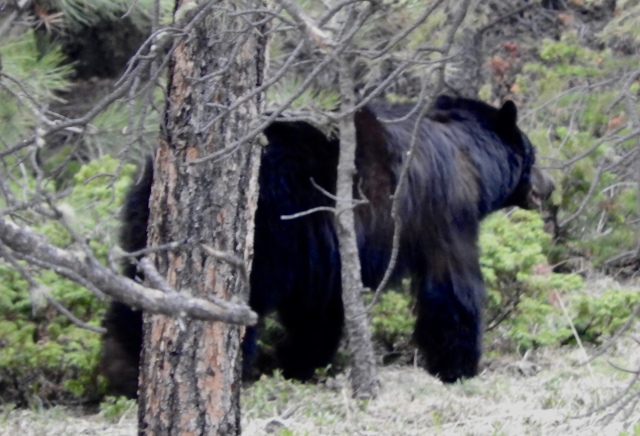
A local photographed yesterday near here. from pinecam.com by serendipity888
With the fire mitigation this property here on Shadow Mountain is becoming known. It has three, maybe four very fine lodgepole pines, tall and thick. A slight downward slope toward the north. Snow, lots of snow.* Rocky ground, ground cover and scrubby grass.
Denver. Slowly coming into focus. The front range, at least its portion pierced by Highway 285, too. The west is still blurry, its aridity, mountains, deep scars in the earth, sparse population. The midwest clear, will always be clear.
Becoming native to a place is the ur spiritual work of a reimagined faith. First, we must be here. Where we are.
*”Snowfall for the season on Conifer Mountain now stands at 224 inches (132% of average).” weathergeek, pinecam.com