
Friends

Fall                               Waning Back to School Moon

October 3nd, Western Hotel, Camp Chesterfield 8:35 am

Had breakfast again in the Maxon Cafeteria, just east of the Western Hotel. It was late enough that the crowd here for John “Medicine Bear” Doerr’s workshop, Becoming a Spiritual Warrior, had already eaten, so I dined alone. Oatmeal and bacon.

A good nap after the laundromat yesterday followed by a quick visit to the gift shop here at the Camp. It reopens at noon today. Lots of interesting books and gee-gaws from a wide range of religious traditions. I’ll spend some money.

Big doings last night at the south room of the Norwood Bowl. A cement block addition to the bowling alley, the south room has a parquet dance floor, seating for around 70 which we filled 45norwood-bolw-10-02_0402and a kitchen area;/wet bar raised above the dining and dancing floor by about three feet. It was a perfect space for this event.
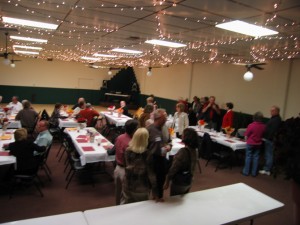
Having the homecoming parade float and the impromptu meal at the Curve on Friday night, the Historical Society meeting yesterday morning followed by the tented champagne brunch at Steve Kildow’s place before this sit down meal allowed a lot of mixing and story telling to happen over an extended time. It made for a real sense of having gathered together again as a class.

Toni Fox, a self-described “a bit plump but still cute as a button,” was an early crush of mine. By early I mean first/second grade. She’s retired now and set to go on a 1940’s train ride to Memphis with her now cancer free husband. Louie Bender worked his charm on the ladies as he always did, vying at times with Toni for the attention of the crowd.

Jerry Ferguson, an old buddy with whom I apparently had more good times than I recall, and I had a lot of laughs remembering crazy stuff we did. Jerry remembers, and others did too so I’ll take their word for it, that we painted 1965 on the water tower. He said, “I turned to you and you were high-tailing it for the truck. I yelled, Charlie, what are you doing?” “Man with a shotgun,” I shouted over my shoulder. Tom Urban got behind the wheel of Jerry’s green pickup, we dived in the back and Tom drove across the railroad track. Tony Fisher said, “We could see the whites of the engineer’s eyes.” Big fun. Lucky I survived childhood.

Tom Friend was there. He played coronet in high school and had a way with the ladies like Louie. Tom lived near the Nickel Plate tracks north just off Harrison.

Frank Johnson and Susan Mahoney, high school sweethearts and married since college, live in Fort Wayne. Frank had a benign brain tumor, quadruple by-pass surgery and prostate cancer. “I’m getting all the bad stuff out of the way before retirement.” He should be almost bullet proof. Susan, who looks like she did in high school, now works in admissions for a private school. They attend 1st Presbyterian in Fort Wayne, a congregation that tasted blood about 4 clergy ago and have continued to chum the water with each new pastor. A typical pattern for churches that succeed in ousting a minister, usually to devastating affect on the congregation.

Larry Stafford workdd for GM at Guide Lamp for 42 years until they shut down five or so years ago. Now, at 63, he’s out of a job and trying to find something new, “But, Charlie, there just aren’t any jobs out there. I got my associate degree in information management, too.” A tough spot.

Tony Fisher sells insurance in Liggonier, Indiana. A couple of years ago he won $2,000 dollars at an insurance convention, money for a trip. He chose New York City. “I didn’t know Central Park was so big you could drive through it. I saw Ellis Island and the Statue of Liberty, Ground Zero. I always wanted to see them. Course I also saw the wax museum and Ripley’s Believe or Not, too. I’d go back.”

Traveling is on his to do list. He wants to go Las Vegas for “all the glitz and glamor” and he also intends to take the South Bend to Chicago train and see the Shedd Aquairum and all that stuff. “Ive gotten interested in that stuff as I’ve gotten older.”

Steve Kildow, who paid for and hosted the champagne brunch yesterday worked at GM and lost a good bit of money when GM’s stock tanked. Looks to me like he compensated for it in other areas.

Old groups that hung out together 45 years ago reformed, catching up in the years since 1965 and reliving the ones before. Memories were the token of exchange over the weekend and each person came with a full account and left even richer in them.

A photographer took shots of the whole class, then broke us down by feeder schools: Orestes and Cunningham were outside Alexandria’s city limits, Tomlinson and Clarke were for the southern and northern parts of the city for elementary school. I didn’t even know Clark existed. We were only in Tomlinson and Clark for first and second grades then we merged at what is now Thurston Elementary.

Miss Thurston would come in to the lunch room, go student by student, rapping each on the shoulder, “Now Charles Paul. Eat your peas.”

Toni Fox recalled that when we went to Tomlinson the school took us home for lunch because the school was on Highway 9 and we couldn’t walk home. I didn’t remember that.

Richer Howard told me the saddest story of the evening. Richard Lawson, a good buddy while I was in High School, went to Vietnam and came back disabled. He married, had a couple of kids. A divorce took him hard and he lost his job, became homeless. Richie gave him money now and then.

It got to the point where Richard was living out of his car. He had a stroke and that made getting around difficult. During a recent very cold winter he had returned to his car, opened the door, then slipped and slid under it. They found him there the next morning, blue and solid.

Richie also told a tale about Richard. Richard joined the Navy after his discharge from the Army. Richie got a call at 3 am, “Hey, Richie. What’s you doin’?” “Sleeping.” “Hey, man. How do you cook a turkey?” “What?” Turns out Richie and some other sailors had washed up on the shore of Spain somehow and a farmer gave them a turkey, but non of them knew how to cook it.; Richie put his wife, Becky (Ellis, no relation), on the phone and she walked him through the steps.

There were, as there always are, those who couldn’t come. Ronnie Montgomery I missed most since we had stayed in contact through college. Zane Ward and Larry Cummings, part of the poker playing crew, I’ve not seen since high school. Zane runs the junk-yard and Larry has bait shop in Arkansas.

Jerry said Jack Staley has his own engineering firm specializing in heating and cooling systems. Jack has the controls for Budweiser’s beer storage warehouses in his basement in Indianapolis. The warehouses are in St. Louis. Mike Taylor, the only African-American in our class, who moved before high school, also became and engineer specializing in high-end kitchens.

Willard Grubb, another poker player, is a pharmacist nearby.

We’ve had deaths, mostly cancer and brain tumors, but a heart attack whiled driving, too. That was Rodney Frost, the guy with whom I had my one and only fist fight. Mike Gaunt, my doctor’s kid, died a couple of years ago. One of the pretty girls in our class, Sherry Basset, died in 1989. Two died in Vietnam. I don’t whether 20 or so is a lot or a little for a class of 120. Since we’re all 63, the number will grow faster between reunions now.

The woman I met here yesterday from Bogota said that one of the things she admired about Americans was their loyalty to groups. “Coming all the way from Minnesota for people you knew 45 years ago. In Colombia it’s just go and live your life. That’s it.”

There were, too, the objects and places to which memories adhere, the house on the corner of Harrison and John that has the stone wall running along the sidewalk. When Mom and I would go downtown, I walked up the flat mortared slope and then along the top, watching my mom from high above. At the point where some steps broke up the run of the wall, I always looked in the yard and so the big doghouse built for their St. Bernard. The hill, which felt so big back then, down which I rode my skateboard. I got pulled over by the police and ticketed for being in the street. At city hall I looked up the ordinance and found that wheeled vehicles were required to be in the street.

Those two numinous blocks of Monroe Street where I lived from age 4 or 5 to age 12 were the terrain of magic for me, where nights became playgrounds for hide and seek and kick the can, where a field nearby became a fort, a hide-out, a place of refuge, where Mike Hines and I performed our experiments where explosion was the mark of success.

In 1957 Mike and I were out back in our backyard, we lived across the alley from each other. We looked up and saw three silver shaped objects high in the late afternoon sky. To my recollection this was September or October. We watched those objects for a while, then they went behind the moon. That’s right, behind the moon. Mike and I reported this to my dad who wrote a small article in the paper about it. This was the time of the UFO’s and Mike and I saw some. Nothing ever came of our sighting.

Mike left the US during the Vietnam War for Canada. According to Toni, who saw Mike’s sister Susan not long ago, he’s still there.

Some of us had grown up on the same street together, then gone to elementary, junior high and high school together. We passed from children to youth to teen-agers together. Those memories, those years together in the same place are a powerful bond, one not broken by time or physical separation. We proved that all over again at this weekend.
Here Comes the Parade

Fall                               Waning Back to School Moon

Had no internet connection at camp Chesterfield.

October 1st, 2010 9 pm

Chesterfield Spiritualist Camp, Chesterfield Indiana Rm 219, The Western Hotel

Drove down from Lafayette taking interstates because I wanted to have time for a nap. Got here about 2 and took an hour long nap. The room is basic. A bed, a small chest of drawers, a lamp and a bathroom. No three pronged plugs and no internet. A retreat environment.

In Alexandria I saw Tim Lockwood and Mike Lynch hanging out in front of the Alexandria Historical Society. My folks. When I went inside there were about 15 people in the room, many of whom I didn’t recognize.

Teddy Bryant I did recognize. He told me about Saturday being the devil’s night, long ago. He’s a real estate agent now after a career as an electrician. “I had two careers, both of them I looked forward to going to work in the morning. Not many people can say that.”

Then, he added, “I have a bone to pick with you.” Huh. “One night after we got done with the truck at Coxes I walked over and asked Vicky Moore out. But. When I asked her again the next day, she said, Charlie told me what you said. She never went out with me.” Gee, Ted. A while ago. I don’t remember the incident or Vicky Moore for that matter.

Jay Kantner was there, short as ever with a beard and a hearing aid. He lives in Oregon, fishes the Columbia and hunts in the area. When I asked him if it was salmon, he said, “All five species.”

Larry Maple, the original organizer with Becky Ellis, looked pretty beat up. He had a bladder taken out and replace, then a swollen lymph gland that they just drained three weeks ago. He looks thin and weak.

Tony Fox came up and asked for her flowers and honey. I plain forgot. She hugged me to her now ample bosom and gave me a kiss.

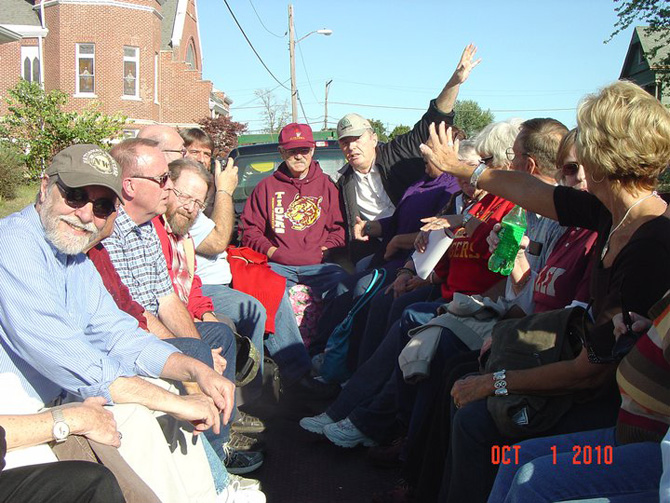
After a bit more like that, they organized us for the homecoming parade. We had a float which consisted of a flat bed trailer with hay bales and a few chairs. About 20 of us got on and rode 670class-of-1965-floatthrough town doing the wave and old Alexandria Tigers cheers. Along the way we played remember what used to be there along Harrison Avenue, many of the store fronts are empty and only Cox’s Supermarket and Broyle’s furniture remain of the businesses from our childhood: The Rexall Drug Store, Danners, Murphys, PN Hirsch, Bailey’s pharmacy, Furman’s, Baumgartners, Mahoney’s.

It was fun and bittersweet, being with old friends, childhood friends, sharing memories but noticing that this was our 45th reunion, lots of gray hair, 20% of the class now dead.

After the parade wound its way out to the newer Alexandria High School, Larry Etchison drove us back into town. We got our cars and drove out to the curve. I saw Bill Kildow. Geez. Been a real long time. His brother, Steve, was in my class, but Bill and I had a special bond. It was good to see him. The Kildow’s lived on Monroe Street in the late 50’s and so did I.

We sat around swapping stories. Where do you live now? What do you do? Any grandkids? You have great grandchildren! Louie Bender, extroverted as ever, went up and hugged a woman, said, “Tamara, Don’t you remember me? Louis Bender.” It wasn’t Tamara.

October 2nd. A laundromat across from what used to be the Roller Rink, at one time the best in the nation and site of national competitions. Now it’s an Eagles. The only skating is, as someone said last night, “after there’s been a lot of drinking.”

Breakfast this morning at the Maxon cafeteria, just across from the Western Hotel. It serves guests and residents of Chesterfield. At the table I talked with two women, professors of Spanish and Spanish Literature at Depauw, one from Colombia and the other from Argentina, Buenos Aires. They had a similar reaction to the Camp, about which they’d known nothing before they got there. It’s a great setting for a book, like being back in the 19th century, down to the little floral decals on the light bulb holder in the bathroom.

“I’m interested in how people form their worlds,” I said, “And this is a particular world. We all have them, but here the line are so clear.” After I said that, I realized it was exactly what I’m interested in, how people form, give definition to their weltenschaung. How do you become and sustain a belief in spiritualism, in the non-physical plane? You have to ignore or explain away a lot of evidence to the contrary.

After breakfast, it was back to the Alexandria Historical Society for coffee and another meet up. I looked at a 1965 spectrum, our yearbook. Gee, it was a long time ago. A lot of things were different back then. I had hair. Juvenile delinquency was a problem. Remember j.d.’s? How innocent, almost quaint they seem in light of rap music, meth and general ornerynesss of our time.

Steve Kildow had a huge tent with catered food and lots of booze. A lot folks were there including Jerry Ferguson, who looked a lot different, enough that I didn’t recognize him. Steve lives two miles west of town off Hwy 28, a big spread with a fancy house and lots of horses. Steve looks like he enjoys his groceries.

Now I’m at the laundromat, getting enough clean clothes together for the rest of the trip. I decided to spend this time to pack a bit—a lot—lighter. I’m glad I did. Well, the dryers are coming to a stop and I have folding and rolling to do.

On the Banks of the Wabash

Fall                              Waning Back to School Moon

Lafayette, Indiana on the banks of the Wabash River.  Home of Purdue, the Boilermakers.

Got in here at 8:58 last night Minnesota time.  But, this being Indiana, it was 9:58 here.  Indiana suffers from chronic ambichronicity with the rest of the country and from county to county within the state.  A pleasant night for a stroll took me past the county courthouse and several college bars to the Holiday Inn.

Tuckered out, as we say in Indiana, I went to bed not long after.

Up this morning with a significant amount of work to do for the Sierra Club; we’re in the legislative priority setting process, so I ordered room service breakfast and tap, tap, tapped my way through saving files, sending attachments and setting up a meeting wizard for a late October meeting.

After that the friendly folks at Enterprise entertained me by sending a man who stood right next to me talking to Kate and asking her where I was.  When he realized it was me, he hung up, saying, That was your wife.  Well.

Now back at the  Hotel, finishing up this and that before heading out to Chesterfield Spiritualist Camp.  If you feel any spiritual vibrations, it means I’ve arrived.  At the camp.  Not the great beyond.

BTW:  I carry this netbook with me as well as my Blackberry and my  Kindle.  An electronic menage a trois.  Keeps me connected, informed and well read.  Not bad for under 2 pounds.

Booming One More Time

Fall                                 Waning Back to School Moon

Metro Lounge                  Union Station

This is the first class lounge, folks who’ve bought rooms.  My next trip to Lafayette had no rooms, but I convinced the lady here to let me in since I had rooms on the Empire builder both ways.

Old folks pass by, some in the early years of aging, like me, others in the thin, papery skin and tottering walk phase.  How many of them in the former, I wonder, marched in Washington, fought for student rights, worked hard to end the Vietnam war, protested to achieve civil rights for African-Americans?  Age and accommodation hide the former marks of my kind, the long hair, the frayed jeans, the combat boots, the green book bags, the peace symbol pins,the flower print dresses and plaited hair.

We walk past each other, joined by other links, the cane, the gray hair, balding pates, bum knees, expanded middles.  Makes me think of another addition to symbolic logic:  the law of the expanded middle.

One of our own, Tom Brokaw, wrote a book, the Greatest Generation, talking up the folks of the WWII era as saviors of our culture.  Maybe they were, I don’t know, history is difficult to judge; but, the next spate of articles and books focused on how the Baby Boomers are not the Greatest Generation.  Somehow we have failed to live up to pundits self-made expectations of us.  Balderdash.

An article this month in the Atlantic offers a guide as to how we can retrieve our lost promise by solving the economic crisis at home.  C’mon.  A minimum sized group of greedy bastards almost sunk the American economy, a breed that, like the poor, has always been with us.  It is the chattering class that needs to fix the economy and they’ve worked at it in fits and starts.  The economy never was our forte.

No,we fought our battles for change at the level of the personal,the local, the national foreign policy level, not in the canyons of wall street or the board rooms of the Forbes 500.  We challenged US military policy so successfully that a generation of military leaders has vowed never again to make the same mistakes as Vietnam.  We supported the African-American community among us and Lyndon Johnson in a push for civil rights.  Women and men of our generation took the gender controversy into our private lives, struggling for a just place for women one bag of garbage, one diaper and one sink full of dishes at a time.

We have had our share, more than our share, of brilliant scientists and innovative artists.

Where we still have a big opportunity is not in the stock market or its ancillary phenomenon like the Department of Treasury.  No, our opportunity lies in the self same area we did early work in during the 60’s when we took the advice of such gurus as Scott and Helen Nearing and tried to go “back to the land.”

Climate change, local food, energy independence, forest and water health, these are the areas where our generation can still act and act forcefully, this time for the future of the unborn generations who will suffer from the profligacy of our time.  We know how to use the levers of popular power.  We know how important it is to speak truth to power and to use our personal lives as leverage in the pursuit of deep social change.

I hope we take the challenge and begin to acknowledge each other in the metro lounges and streets and lobbies and town halls and legislatures of our country.

The Great Wheel in the City

Fall                               Waning Back to School Moon

How can city dwellers, big city dwellers, stay in touch with the natural cycles, with the rhythms of the Great Wheel?  This was on my mind yesterday as I walked around the loop.  There are, of course, the occasional plantings decorating outdoor cafes, the greenery of Grant Park and Millennium Park, even a lushly planted median on the boulevard of Michigan Avenue, yet these seem like captive specimens, botanical exhibits in a zoo for denizens of concrete, stone, metal and glass.

When I went out for a walk this morning, wandering down Jewelers Row, out to Michigan Avenue and down to State Street, building facades began to show themselves.  Here there were floral inspired Prairie School designs.  There were viny elements in tile and plaster ascending the column of a building.

At 30 Michigan Avenue an idea began to form.  There on a frieze perched above a  soulless slab of polished marble that defined a Walgreens were small medallions punctuated by a familiar face, the Greenman.  He looked like this one.  There were four, separated by the flowery medallions.  After that, the plant inspired architectural design appeared, as if by magic.  For those who have eyes to see, let them see.

In a flash I realized what I dislike so much about Modernist architecture.  It does not acknowledge the real context in which it exists.  This Bauhaus influence attempted to rid the world of the Greenmen, the vines, the flowers, the sinuous riverine shapes that the late 19th and early 20th century architects considered essential.

And they were essential.  Why?  In our cities we put on a brave front, raising  our forests of buildings that shade out the sun, paving over the earth so trucks and cars can move about with ease.  Tunneling electricity so even the night cannot dominate us.

We still need to eat. Our lives depend on the vast unbuilt land where the primary things that spring from the earth are corn stalks and wheat fronds.  Where animals may outnumber humans and the humans work with and for the plants.

We still need to breathe.  The lungs of mother earth, the circulatory system that cleans our air consists in large part of trees.  The forests lie outside our urban boundaries, though they do join their city cousins in their work.

We still need to drink.  Fresh water comes from rivers, lakes, streams and aquifers either far away from city centers or buried deep beneath them.  Care for the source of our drinking water means  caring for those ends of the earth from which it comes.

Thus, it is not an idle question to wonder how we connect with the Great Wheel, with the changes of season and the growing of food, the cleansing of water and air.

The design motifs inspired by green leafy beings recognized that dependence and writ its continuing message on the walls of the buildings which we use and which we see each day.  They inspire us and help us recall mother nature in  her beyond the city state.

There was. too, another reminder.  I looked down Washington from Wabash and my gaze carried up the  building led me to a patch of blue sky.  There was the moon, a half moon, the Back to School moon, framed by buildings with leaves and greenmen and flowers.  These are enough.

One thing more.  Remember Ozymandias, King of Kings.  Recall the ruins of Babylon, Xi’ang, Epheseus, Athens.  Cities do not last.  Nature reclaims them all at some point.  What seems so permanent, so imposing, so there only awaits its end.  Which will come, sooner or later.

Change of Venue

Fall                        Waning Back To School Moon

Sorry, all, but wordpress or somebody ate my Nick Caspers file. I’m putting this here until I get this sorted out.

JENNY MICHAEL Bismarck Tribune | Posted: Wednesday, September 29, 2010 11:57 am | (3) Comments

A man accused of murder in McIntosh County will stand trial in Bismarck in late November.

The trial for Nicholas Caspers is slated to begin Nov. 30 in Bismarck. It is scheduled as a four-day trial.

Caspers, 27, faces a Class AA felony murder charge in the death of Paul Varner, 30, who died in the early morning hours of Feb. 28 after an altercation at his home in Wishek. Caspers, who is free on bond, was arrested after Varner was taken to the hospital by ambulance.

Defense attorneys for Caspers had moved for a change of venue, arguing it would be impossible to get a fair jury in the sparsely-populated community due to the notoriety of the case.

McIntosh County State’s Attorney Terry Elhard initially opposed the motion but dropped his opposition after preliminary juror surveys came back. He said the surveys indicated it would have been difficult to get a jury.

South Central District Judge Bruce Haskell will preside over the trial.

(Reach reporter Jenny Michael at 250-8225 or jenny.michael@bismarcktribune.com.)

Stories Straight from the Shoulder

Fall                                           Waning Back to School Moon

Writing bounces up off city streets, whizzes down from building tops and comes straight from the shoulder of each person on the street.  Each person walks by trailing a life time of stories, agony, love, joy, despair, fear, exultation.  I can feel them as I wander these streets of Chicago, these stories.  They make a walk thick with meaning and feeling, so many stories walking past each other, not knowing the narrative of the other.  We are a universe, those of us walking here on Wabash Avenue under the el.

Each building has a story, too.  The ambition of the people who conceived it, the gritty world of those who built it and the disconnected worlds of those who inhabit it.   Theodore Dreiser found a compelling story in the elevated railroads and the tycoon who built them  The Haymarket riot.  Saul Alinsky.  Rockefeller and the founding of the University of Chicago.

No wonder stories fall off the trees here like ripe fruit.

I’ve not had enough time here.  I need a week, maybe two, a chance to slow down and make my pace synch with the city, not feel rushed by the train, by getting here and there, having those movements compressed by the demands of travel on, headed somewhere else.

An Odd Frugality

Fall                                    Waning  Back to School Moon

Over to Sushi/Hot Wok for supper.  Lee waited on me with the kind of deference and almost invisibility that only Japanese can manage.  The food was good, I looked out over Michigan Avenue toward Millennium Park.

Here’s a weird note.  Suddenly my right hip has begun to act up.  Made being on my feet for a long time or going for long walks painful.  Tired tonight as a result.

Got a recommendation for a jazz place, The Backroom, but the first show starts at 9:00 pm.  We don’t have anything that starts at 9:oo pm in Andover.  The concierge gave me a promotional pass for the $20 cover charge and it’s only a $6 cab ride away, but I find myself unwilling to get up and go.

I have these odd notions of frugality.  If I spend money getting somewhere, I should see as much as I can. That leads me to overdo it.  So, I feel guilty about not going.  I also turn off my cell phone to save the battery.  I discovered Kate thought it was because I didn’t want to talk to anybody.  Well, maybe a little, but more the frugality part.

The energy here is good.  The city is busy, people rushing here and there with serious intent, a few loitering, one older black man  sitting on his soft-sided suitcase, head in his hands.  The trains rattle by overhead and the Lake sends in a breeze from not far away.  Buildings here reach up, they do scrape the sky.

A Baroque Morning

Fall                                 Waning Back to School Moon

Down to Ada’s Deli this am for fried matzo and egg with onions and lox.  My mystery guest (Kate’s retirement gift) told me her kids loved fried matzo with syrup.  Hmm…not with lox and onions for this gentile.

We had a spirited hour long discussion.  Very high energy, Deb is.  Her fiance deals in the secondary metals market, aluminum.  She’s in favor of retirement, wants to travel with her new love.  She used to live in Hyde Park and brightened when I said we could have met at Jimmie’s.  Gonna be good, I know for sure.

When we finished, I walked out on Wabash to Washington.  Orthodox Jewish men here with black satchels.  Jeweler’s Row.  Up Washington to Michigan Avenue, south a block of Michigan and over to the Art Institute.  Great weather and I considered just heading into Grant Park, but the Institute was right there.

Wandered in the European Art before 1900, finding many Baroque paintings, some wonderful Renaissance works, too.  Overall, our collection compares well, not in quantity but in quality.  Baroque is a propaganda art form like Socialist Realism; the Roman Catholic church wanted to counter the rising tide of the Protestant Reformation.  One branch of that counter reformation effort emphasized images that spoke of particularly Catholic themes, at least as the Catholic church saw it:  forgiveness, assumption of Mary, saints, crucifixion scenes.

They were lucky that some of the very best painters in the Western tradition came to the task with energy and invention.  Many well known names were Baroque painters:  Vermeer, Rembrandt, Caravaggio, Poussin, Rubens and Vermeer.

The Baroque painters select the climactic moment to depict. They use rich, deep colors, often lots of shadow. wanting to arouse emotion, a commitment of faith in the religious insistence.

Religious painting does not exhaust Baroque themes, however.  Our own Lucretia by Rembrandt is a Baroque work that features a historical them from Roman history.

These are wonderful paintings, romantic in a sense, calling the viewer to participate, to feel, to decide.  Glad I had the chance to see more examples here in Chicago.