Onion Drying, the Next Stage

72  bar steady 29.81 1mph NE dew-point 65  sunrise 6:00  sunset 8:37  Lughnasa

Waxing Crescent of the Corn Moon

A writing day so far.  I have started writing Heresy Moves West.  It will take a bit longer than I imagined, maybe quite a bit, because I have this propensity to place things in context, deep context.  In this case for example I have established the Protestant Reformation as the sine qua non of the development of Unitarianism and its westward expansion, at least I have established that to my content.   Not too much further along I intend to swing back to Abraham who listened to YHWH and left his Canaanite Gods for monotheism.  Since you can not just go back into the past and then jump into the present, the intervening time takes a paragraph or two (at least) to describe, and all this in service of the actual topic, the history of Unitarian and Universalist churches in Minnesota.

Why do I do this?  Sheer cussedness in part.  Simplistic explanations that ignore real historical paths irritate me.  I do not like to emulate them.  That means rooting my thesis about U-U expansion in Minnesota in the soils from which it sprang.  They have lots of topsoil, gathered from diverse times and places.  The process is sort of like archaeology.  In order to explain the top, most recent layer of artifacts requires continuing to dig down, down, down until the physical culture either stops or changes to something completely different.

Anyhow, all this means I’ll be writing for some time, maybe as long as 2 or 3 days.  That eats into posting time.  So, for the next few days it might be a little sparse here.  Might not.

In the past week AncienTrails had 2100 unique visits, about 300 a day.  You are not alone.

Kate and I carried the old sliding door screen into the front shed.  We had to take all the onions off it to get it inside, then move the onions back on it.  In addition I had to remove the remaining stalks so my hands smell like onions.  The onions must remain in the shed for two to three weeks, then they will go in tangerine crates.  Once in the crates the onions will await their turn in the kitchen on an old book shelf in the furnace room.  The garlic hangs not far from their future home.

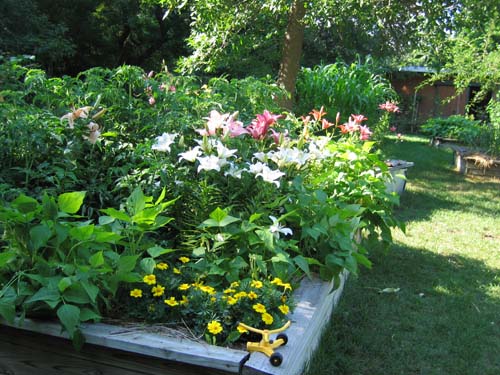
When dead heading the last of the Lilium today, I found one that had bulbils.  These form at the junction between stalk and leaf.  They are another means of propagating lilies.  I will cut this plant down and use the bulbils inside to create stock for next spring.
Primal Eating

71  bar rises 29.87 0mph NE dew-point 58  sunrise 6:00  sunset 8:38 Lughnasa

New (Corn) Moon

A vegetarian meal  tonight.  Spaghetti squash, golden beets, cucumber tomato and onion salad and cooked whole onion.  Colorful and healthy.  All but the tomatoes were from our garden, including the garlic and cilantro sauteed in olive oil as a dressing for the squash.  After the OMG tomatoes the plants have settled into production with many fruits, but none mature right now.

I know some perhaps many of you who read this cook things straight out of your garden or meat from your stock, but I haven’t done it much.  Flowers and shade plants, shrubs and trees have occupied my time.  I love them and will always tend them but the vegetables now have my attention.

Primal eating happens when you go pluck five beets out of the earth, take them into the sink and wash them off, trim the leaves and roots away, then slice these hardy roots into smaller pieces, add tarragon and balsamic vinegar, some salt, cook and eat them.  The same tonight with the spaghetti squash, the cucumber, the onion, both in the salad and the one I cooked whole.   I knew these plants when they were tiny seeds, barely bigger than the lead in a pencil or when they were small potted specimens.  The onions and the garlic went into the ground as what they would become, only larger.  In each case though the same hands that harvested them prepared for eating.

10,000 years ago some hunters and gatherers first planted seeds and tended crops.  The effect on human culture still gathers momentum even today.  Nomadic life began to disappear for those people.  Settled villages sprang up around the fields.   The keeping of animals for food was more predictable than the hunt.  In both cases though our ancestors had to give up the moving from place to place depending on season and game patterns.  Our bodies, developed in the paleolithic to survive predators and hunt for prey, found themselves out of place.

They still do.  So, while gathering and cooking goes far back in our history, it does not go all the way back to that earlier phase of the moveable feast.  This fall, however, when Kate and I pick wild grapes that grow in our woods and turn them into jam we will travel back to those ancient times, the ancient trail of seeking food where it decides to be rather than where we care for it.

This meal tonight was a Lughnasa meal, a meal of first fruits, the harvest we do not plan to store either through drying or canning.  As a Lughnasa meal, it put us in contact with those early Celts whose gardens might spell the difference between survival and starvation.  We live in a wealthier time, but not in one any less dependent on the gifts of mother earth.

Spaghetti Squash and a Scimitar Cucumber

81  bar steady 29.93 1mph NE  dew-point 51  sunrise 5:59  sunset 8:38

New (Corn) Moon

Tao is the way without a way;
It is the path with no tracks.
You start walking the way of Tao when you erase anything – good or bad – you learned about Tao.

“If you steal from one author, it’s plagiarism; if you steal from many, it’s research.” – Wilson Mizner

This quote from Mizner amuses me since I’ve just read many authors to tease out the history of Unitarian and Universalist churches in Minnesota.  Research, not plagiarism.   I put down Freedom Moves West this morning after read it, mostly, from beginning to end.  It is rare when researching a topic as outside the mainstream as this one to find a whole book exactly on point by Freedom Moves West is such a book.  It offers up the history of the Western Unitarian Conference from 1852 to 1952, the period when Minnesota churches came into being and the context nationally and regionally that surrounded their creation.

Of course, such a lot of material on point requires a good deal of sifting and weighing, matching with other sources, like church histories written by individual congregation, still it provides an overall narrative that makes the whole task better.

After my nap, I plan to sit down and organize my notes and thoughts on Heresy Moves West (yes, I sort of borrowed the notion from the book).  If I can, I hope to get to writing.  If not, tomorrow.  That will feel good.

Last night I harvested a spaghetti squash and a long, scimitar shaped cucumber.  This morning I pulled golden beets and Nante carrots.  Later on I’ll pluck one of the drying onions off the screen and a head of garlic to use in cooking supper.  This will be a vegetarian meal, one made in  honor and celebration of Lughnasa.  Celtic holy days lasted a week or more, occasioned as they usually were by markets, dances, rituals and general collectivity.

A lovely, blue sky day with reasonable dew-point and temperature.  Good deal.

A Bell That Cannot Be Unrung

61  bar rises 29.87  0mph N dew-point 53  sunrise 5:59  sunset 8:39  Lughnasa

New (Corn) Moon

Outside tonight the sky has no moon.  This illustrates the paradoxical nature of light.  We think of light as illumination enabling us to see, but it has another, not often recognized property; it can obscure as well as reveal.   The night sky during the dark moon shines with stars, many invisible when the moon is brightest.  A cool night with a clear sky, a panoply of stars, ancient messages from faraway places gives a northern summer its true character.  Able to burn with heat in the daytime, the northern summer can cool down, remind us of the coming fall, just as Lughnasa, the Celtic first fruits holy day does.  A convergence of a new moon, Lughnasa and cooling temperatures make this a night made for myth.

The research for Heresy Moves West will probably end tomorrow.  I hope I can get at writing, too, but I doubt it.  Sunday.  This is a big task, one I set for myself, but I’d like to get a first draft done, so I can set it aside for awhile.  I have Stefan’s poems to edit and the Africa tour, too.  Not to mention a firepit to dig, hemerocallis iris and lilium to move.

A piece of this project troubles me.  Maybe troubles is not the right word, provokes, that could be it.  When Channing and the others split from the Standing Order Calvinist orthodoxy in New England, they started a cascade of controversy that has not ended.  Not long after the Unitarians had left the congregationalists behind, Emerson began writing his essays and giving his lectures.  With the strong push Transcendentalism got from Theodore Parker, there was soon a split over natural religion versus theistic religion.  The Civil War obscured this problem for the first half of the 1860’s, but it re-emerged as the Western issue as the more radical, Parkerite ministers began to dominate the Western Unitarian Conference.  This led to constant conflict with Eastern conservatives (used to denote those who wanted to retain Jesus as Christ, keeping Unitarianism’s original perception of itself as liberal Christianity).  The Free Religious Association and The Ethical Culture movement kept the Western issue alive in the east.  This split healed with a broad understanding of liberal religion, only to be sundered again in the 1920’s with the rise of humanism.  Humanism set aside theism for good in the interest of a scientific and humanistic approach to the ethical life.

Here’s the problem.  Conservatives predicted the gradual erosion of religious sentiment if there was not at least the glue of Jesus to hold the center.  Their predictions came true as the shift away from theism took its incremental, but, looking backward, inevitable progress toward an essentially secular movement focused on ethical living.  This leaves the field free for radical inquiry into the nature of the human experience.  A great, not small thing.

But, it can lose the faith that burns in the heart, that seeks the reality next to or beyond this reality; it can lose it in the same kind of scientistic move that linguistic analysis made, that Richard Dawkins and Sam Harris make.  It is, though, a bell that cannot be unrung, so we must seek this faith that burns in the heart elsewhere than in tradition.  Good.  Emerson thought so, too.  The question is, where?

Investigating this question will occupy some time, perhaps the next few years.

When I went out to check the drying onions, I found one with a bit of a soft spot.  I brought it inside to cut up for a salad for lunch.  Cut open I put my fingers on the white flesh.  It was very warm, almost hot.  That drying would take place inside the onion had not occurred to me.

The Beginning of Summer’s End

77  bar rises 29.83 3mpn NNW dew-point 61  sunrise 5:58  sunset 8:39  Lughnasa

New (Corn) Moon

As I note in the Lughnasa entry now posted on the Great Wheel page, we have come to the beginning of summer’s end.  The Celtic word for summer’s end is Samhain, also the name for the last of the harvest festivals celebrated on October 31st.  August 1st finds those of us with gardens and farms involved in some manner or another with our early harvests.  The first tomatoes, the garlic already in here, beans, beets, carrots and onions.  This is a time of thanksgiving, a day of gratefulness for the earth and for the plant life which offers itself to us and to our fellow creatures so that we might live.

A dish of green beans, onions in a salad perhaps garnished with tomatoes, garlic used to flavor a sautee all remind us that food does not emerge from the ether, rather it grows with care and attention, care and attention meted out over a growing season, not all at once.  It is not a matter of a moment to grow food.  Vegetables only reward those willing to practice attentiveness, to stay in the now.  The plant needs what it needs today, not tomorrow.  The pests that infest today will become worse tomorrow.  Act now.

Today is an all Heresy Moves West day.   The story of Unitarians and Universalist as they follow the frontier, especially the pioneers from New England, makes an American saga.  America’s exceptionalism often takes the form of manifest destiny, our version of Kipling’s White Man’s Burden, but a truer idiosyncrasy of this country lies in our embrace of religious freedom.  We take it for granted, imagine that if it’s not the case in another place, they just haven’t gotten around to it yet, but in fact we are very much the outlier when it comes to the firewall between the state and religious institutions/faith traditions.

That a peculiar brand of new thought that changed the flow of a millennia old faith tradition–the Judaeo-Christian–could not only flourish but spread as the country grew, that the new thought itself would become fractious and splinter along unpredictable lines, and that it would find its most radical expression in the Midwest rather than its place of origin in Boston and surrounds could only happen here.   The chance to tell this story makes me glad, for it is a story of vision, of unfettered thought, of reaching beyond the boundaries of the mind, a story that transcends its makers by breaking open new sources of authority for those searching for a place in this vast universe of ours.

Water, Water Everywhere. Even on Mars.

LOS ANGELES (AP) – The Phoenix spacecraft has tasted Martian water for the first time, scientists reported Thursday.

By melting icy soil in one of its lab instruments, the robot confirmed the presence of frozen water lurking below the Martian permafrost. Until now, evidence of ice in Mars’ north pole region has been largely circumstantial.

In 2002, the orbiting Odyssey spacecraft spied what looked like a reservoir of buried ice. After Phoenix arrived, it found what looked like ice in a hard patch underneath its landing site and changes in a trench indicated some ice had turned to gas when exposed to the sun.

Scientists popped open champagne when they received confirmation Wednesday that the soil contained ice.

“We’ve now finally touched it and tasted it,” William Boynton of the University of Arizona said during a news conference in Tucson on Thursday. “From my standpoint, it tastes very fine.”

Phoenix landed on Mars on May 25 on a three-month hunt to determine if it could support life. It is conducting experiments to learn whether the ice ever melted in the red planet’s history that could have led to a more hospitable environment. It is also searching for the elusive organic-based compounds essential for simple life forms to emerge.

The ice confirmation earlier this week was accidental. After two failed attempts to deliver ice-rich soil to one of Phoenix’s eight lab ovens, researchers decided to collect pure soil instead. Surprisingly, the sample was mixed with a little bit of ice, said Boynton, who heads the oven instrument.

Researchers were able to prove the soil had ice in it because it melted in the oven at 32 degrees—the melting point of ice—and released water molecules. Plans called for baking the soil at even higher temperatures next week to sniff for carbon-based compounds.

Lugnasa Entry

A note to alert any interested that there is now an entry on Lughnasa in the Great Wheel pages.  Here’s an excerpt:

This year Lughnasa falls on a new moon, the dark time associated with the Corn Moon.  In moon lore the new moon, the dark moon affords a time for travel inward along the ancient inner trails of meditation, contemplation and ritual. New projects, new fronts on old projects can linger in our thoughts since the dark energy will not quash them, rather it provides a womb in which incubation can occur.  On the one hand then this is a time that focuses on the night and on the night without illumination, on the other it is the first day of the harvest and summer’s fading presence.lilytomatobed500.jpg

Integrated Pest Management

78  bar falls 29.68  2mpn NW dew-point 65  sunrise5:57  sunset8:40  Summer

New Moon (Corn Moon or State Fair Moon)

NOAA awakened me with its trademark ululation, alerting me to the thunder storm watch declared for Anoka County.  Such notices are rare in the morning, mostly coming in the late afternoon as the heat of the day punches up cumulus clouds into congestus, then into the anvil shape of the thunderhead, sometimes 5 or 6 miles high.

This allowed plenty of time for Kate and me to conduct our family business meeting.  This included Kate’s announcement of the fourth large quarterly adjustment in a row.  She works hard and gets compensated accordingly.  She’s off right now having lunch with Penny Bond at the Istanbul Bistro.

Last night while checking the crops I found an infestation of aphids in one corn stalk’s tassel.  After checking others and only finding the one, I ripped that one of the ground and moved it far away.  This morning I found another tassel with a few aphids, this one I squeezed between fingers and thumb instead of discarding.  I’ll check it again, but I imagine that fixed it.

Watching for disease and pests is an important part of gardening.  Another important part is not overreacting. I used to overreact, head straight for the pesticide or fungicide.  Since then, I’ve learned that plants can sustain damage with no harm to their overall purpose.  The trick is to know when the balance shifts from the plant’s natural defenses to the invaders.  Even when I react, I almost never resort to pesticides (I use cygon on Iris Borers in the spring.).  Instead I look for hand removal, plant elimination or measures such as squirting with high pressure water.  That approach has served me well for the last four to five years.

Integrated pest management (IPM) encourages this kind of response.  Good cleanup in the fall, creating a soil and growing condition favorable to healthy plants and either starting or purchasing strong plants also goes a long ways toward a manageable pest and disease environment.  These are also part of an IPM strategy.

SteppenWolf

66  bar rises 29.68  0mph NNW dew-point 61  sunrise 5:57 sunset 8:42 Summer

Waning Crescent of the Thunder Moon

Sierra Club.  Numbers and names. Strategic decisions about endorsements and targeting of races.  All constrained by a set of compliance rules that would cross the eyes of a medieval theologian.  Still, this is the medium and political power is the message. 

Coffee afterward with Margaret.  We talked about organizing, but had to cut it short so Margaret could get back to her beagle.

Another wonderful summer night on the way home.  Stars in the sky.  A thin crescent moon somewhere, or not yet up. 

Still listening to Hermann Hesse’s Steppenwolf.  It is so different from what I remember, though my memory of it is fuzzy.  Makes me think of Steppenwolf, that wonderful German Sheperd who was part of my life for such a brief time.

Radical Expectations

86  bar falls 29.66 3mph N  dew-point 59  sunrise 5:56 sunset 8:42 Summer

Waning Crescent of the Thunder Moon

Lughnasa, August 1st, comes on a new moon night.  This means the first harvest festival of the Celtic year (it ends just before the last harvest festival on October 31st, Samhain.) will coincide with the dark moon.  In some pagan systems the new moon, the dark moon, is a time for introspection, for reflection.  It is a time to consider your life, to meditate and consider new beginnings.  This convergence of Lughnasa and the new moon may make for an interesting holiday.  Look to the Great Wheel posting on August 1st for some thoughts and a description of our celebration in the garden here at home.

Tonight is the second Sierra Club political committee meeting.  More endorsement work and consideration of targets for the up coming election.  I can’t talk about the details, but the political work makes a certain part of me thrum.

Speaking of cycles and elections the fall campaign has begun already.  Obama visited Europe and the Middle East.  McCain visited a German restaurant.   No kidding.  Look it up.  While my broad political sympathies lie with the Obama camp, my particular politics seem distant from the tug and pull of rhetoric which focuses on tax cuts and forcing people to buy medical insurance.  Where are the poor?  The disadvantaged?  The environment does seem to have traction in this race, part of the reason I decided to go with the Sierra Club work, but even there the radical, cut to the true bottom of an issue and deal with that, hears only faint echoes of itself.

Of course, expecting radical solutions from a political/economic system devoted to moderate policy initiatives, policy initiatives often vetted by the very industries and political interests targeted by them, remains, as it always has, an exercise in futility.  I know that.  I see it.  I feel it in my gut.

Which begs the question, why work within it?  Unlike those long ago days of movement politics drugs sex and rock and roll I sense no significant political minority roused.  The environmental advocates, who, if any, should be advancing with some power right now, seem fragmented.  In a moment without a vanguard and in a moment without a popular, even if disorganized, front clambering for change the politics of most use happen within the messy gears of our quasi-democratic process.