All posts by Charles

Change Happens

Lughnasa                                                                        Eclipse Moon
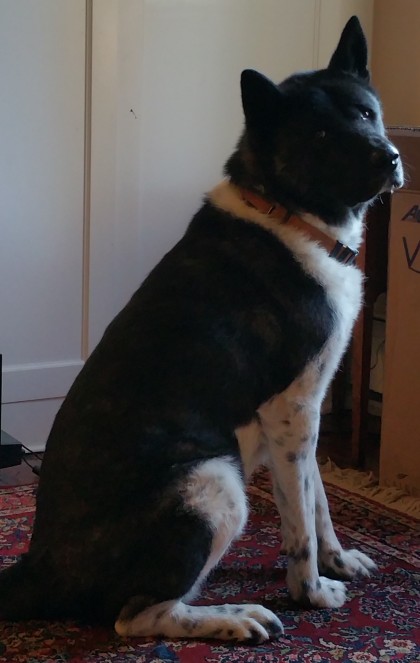
20170731_182340Kepler has kennel cough, caused by the same organism, a bordetella variety, that causes whooping cough in humans, especially children. He got the bordetella vaccination, as did Rigel and Gertie, but he either got less of a dose-he didn’t want it-or he contracted a strain resistant to the vaccine. His racking, barking cough produces tenacious. Kate says this is a medical term designating a stringy, hard to clean up secretion. Well, it’s accurate. A visit to the vet later he’s on the mend, but the symptoms may last a while, depending on whether the organism is a virus or a bacteria, longer with the virus, shorter with bacteria.

Gertie went to Aurora with Kate and me yesterday evening when we took in the sleeping mats that came here late in the afternoon. She enjoyed the ride, she likes to go, but the heat, 95 degrees when we reached the Denver heat island, had her tongue lolling out of her mouth. Ours, too.

We got to the new house a bit before the kids and Jon returned from an initial trip to Target for essentials like food and clothing for Gabe, who’d forgotten to pack any. I suggested he go naked to school and he said, “No.” Ruth came in with groceries and began putting them away in the refrigerator. Gabe, also with packages, followed her, shouting in his high-pitched voice, “Gertie! She’s going to stay all night with us, right, Grandma?” Uhh, “No.”
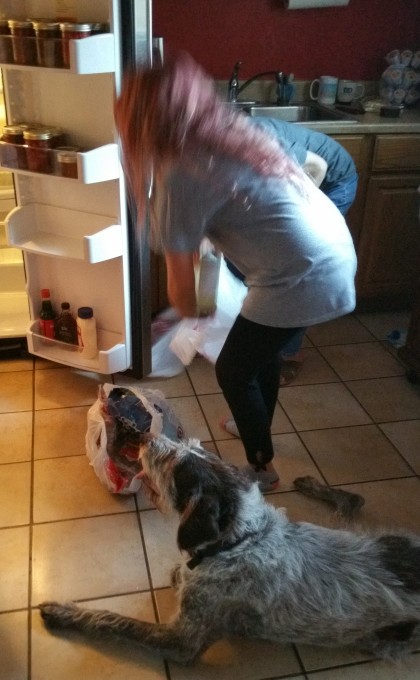
Gertie and Ruth
Gertie and Ruth

Jon looked frazzled, a full day of teaching behind him and an evening and morning of single parenting ahead of him. This will be his first week on his own with the kids, except for the June vacation, since the divorce process began a year ago May. Right now there’s excitement and promise, enough to carry them through the first week, but not enough to ensure against upset and confusion.

Single parenting, as any of you who’ve done it know, has distinct challenges occasioned by full-time work and the rest of the time responsibility for the kids. Joint custody relieves this challenge half of the time, but creates challenges of its own. Jon and Jen are in the first weeks of creating a rhythm that not only serves Ruth and Gabe, most important, but that also serves them. It will take weeks, maybe months. In the meantime there is the potential for disagreements over pick up and drop off times, medical issues, school matters and the other things, large and small, that go with being a family, but a family divided by divorce.
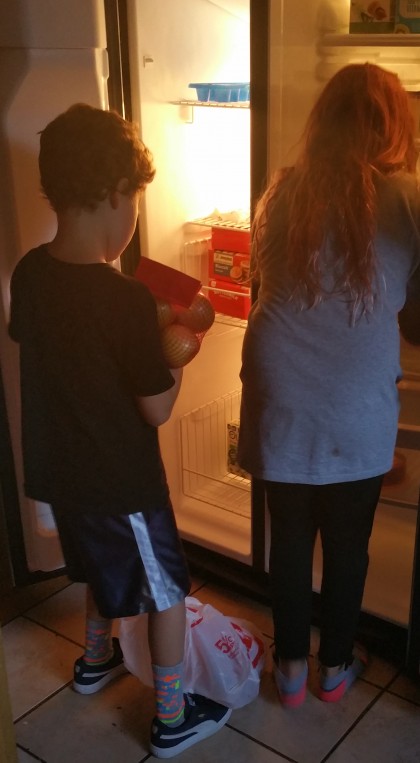
Brother and sister filling the fridge for the first time

As we drove home, back to the 35 degree cooler Shadow Mountain, both of us were a bit sad, a year plus worth of Jon living with us and the grandkids visiting on weekends behind us, memories now. There is, too, though, an exhilaration at having our house back. We can finish moving in.
 

Change

Lughnasa                                                            Eclipse Moon

Yesterday
Yesterday

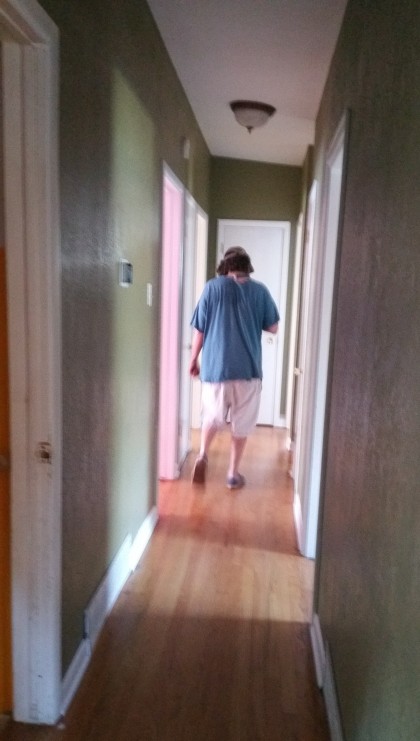
Life is changing for our family. Jon has a new house in Aurora. He and the kids will sleep in it together for the first time tonight. This is the first week of the new joint custody arrangement, a 50/50 split not possible without the new home.

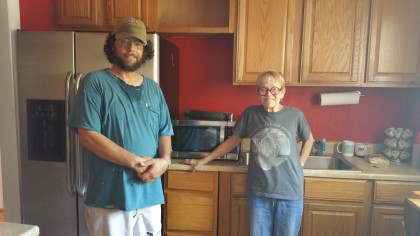
The moving in process has begun. We took a small load down yesterday, including the toaster oven and the Keurig coffee maker, its small cups of coffee and tea visible just to Kate’s left.

Not only are Jon and the kids moving into the new house, it also means Jon is leaving Shadow Mountain. His commute will shorten considerably and on the weeks he doesn’t have the kids, he’ll ride his bike. He prefers that mode of transportation. Good for the abs.

20170827_153629He has a “multi-stage development plan” that involves shipping containers, changing door jambs, cutting out concrete in the back, creating a master suite. It will take a lot of time, but he really enjoys designing and then building. His home will become a work of art, too.

We’ll see Ruth and Gabe less often; but we’re still here, still Grandma and Grandpop living in the mountains.

That move we made, from Minnesota to the mountains, has become more consequential than we originally imagined. Supporting Jon and the kids through this acrimonious divorce and now the important transition to a new normal is the sort of thing families do.

See You In September

Lughnasa                                                            Eclipse Moon

 Since 1953, life has changed for me in September. The first day of first grade at Tomlinson Elementary, out on Route 9 heading toward Anderson, began a routine that is now, 64 years later, still ingrained. Harrison was a two-story building of brick and wood, its floors and stairs and bannisters smelling of wood polish and cleaning compound. My first grade classroom with Miss Butcher had a cloak room just inside its door with hooks for our coats and cubbies for whatever else we brought.

I loved when the school supplies flier would come in the mail, knowing it meant a trip to the store for glue, crayons, number 2 lead pencils, construction paper and other necessities. That list was the signal flare for my imagination. Just think what might be drawn or colored or written or constructed! Over time, the many Septembers since then, that list changed, but the bump of excitement I got when getting ready for the new school year remains.  I’m 41 years past my last September of a new school year, that one in 1976 at United Theological Seminary in New Brighton, Minnesota, far away in time, distance and intellectual challenge from Harrison.

At the temperate latitudes in which I have lived all my life, the gradual lowering of both daytime and nighttime temperatures which begins in August (or, at least, used to begin in August), signals my body first, then my mind, that something wonderful is about to happen. A few aspen trees change their leaves, the angle of the sun gets lower in the sky, and the yellow school buses stop traffic at Shadow Mountain Drive.

My energy level increases as the vitality sapping heat diminishes. Those projects for the year, that September to May year, snap back into focus: Jennie’s Dead, Reimagining Faith, translating Typhon’s story in Ovid, reading kabbalah, learning Hebrew. Mountain hikes like the one Saturday become more fun. The High Holidays are approaching, then Sukkot and after that Simchat Torah. Later on Samain and the start of Holiseason. Thanksgiving.

See you in September. With a grin on my face.

Pinus aristata

Lughnasa                                                                   Eclipse Moon

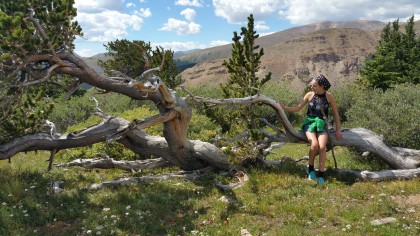
Bristlecone pines fascinate me. One of the subspecies, Pinus longaeva, has the oldest living entity on earth among its members, a tree over 5,000 years old. That puts its lifespan back before the development of Chinese civilization, a very long time ago. Pinus aristata, the Rocky Mountain Bristlecone Pine, can live only about half of that. Even so, 2,500 years is still a long, long time.

Our guides on Pennsylvania Mountain (see post below) pointed out several Bristlecones on our hike.

20170826_112438

A second year cone
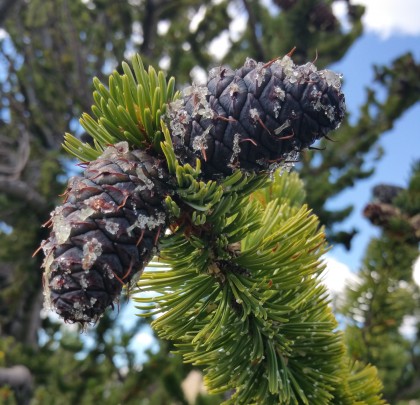
A second year cone, note the bristles
Second and third year cones. Cones have a lot of resin.
Clark's nutcracker
Clark’s nutcracker

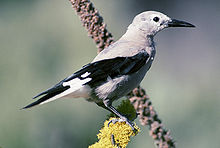
This little bird, the Clark’s nutcracker, sticks its long beak inside the third year cones and pulls out the seed, collecting them in food caches out on the open ground. In the spring when the snow melts and well before anything else is blooming, the Clark’s nutcracker has food for its family. Though it has an excellent memory for its caches, it does occasionally forget one and the bristlecone pine propagates.

If you look carefully at the second picture, you can see small white dots on the needles. These resin dots plus the bristles on the cone are sufficient to identify the species.

When bristlecones die, they can lie for as long as a thousand years before rotting.

Higher Up

Lughnasa                                                                Eclipse Moon

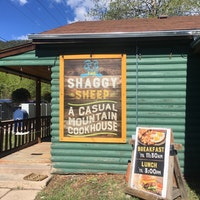
shaggy sheep2Took off yesterday morning about 7:30 am and drove west (or south) on Hwy 285 headed toward Park County, Bailey and Fairplay. I stopped at Grant, a place made visible only by its single, as near as I can tell, business, the Shaggy Sheep. There’s one of those yellow diamond signs just after it with a black silhouette of a bighorn sheep. This is one of several instances of displaced chefs seeking less frenetic lifestyles in the mountains. I mentioned the Badger Creek Cafe in Tetonia, Idaho in my eclipse post. There are others.
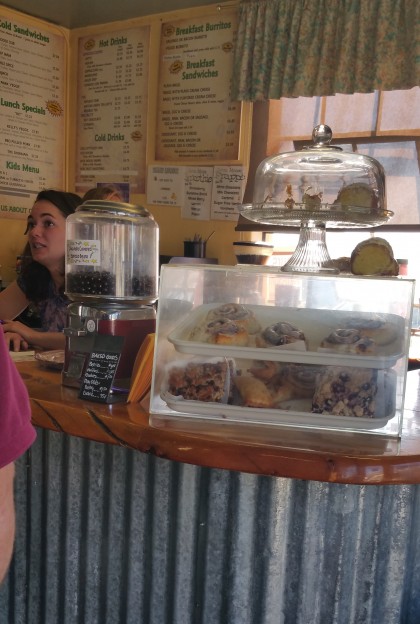
The breakfast I had was a deconstructed carnitas hash with green chili and two eggs on top. The deconstructed hash had carnitas laid over cut up chunks of potato, not mixed together as in corned beef hash. It was delicious. While I ate, I read a brand new book by an author from Boulder, Colorado, Megafire. Michael Kodas analyzes the sudden uptick of catastrophic wildfires since the 1970’s and why they’ll keep coming. It pleased me to see that the Shaggy Sheep had opened a second room, meaning they may stay in business, a far from certain conclusion for anything retail up here.

South Park (to the right) from Pennsylvania Mtn.

After breakfast, I drove on toward the Kenosha Pass, a cut through a huge granitic batholith that forms the western boundary of the Front Range. After the 9,997 foot pass, Hwy. 285 descends sharply, a 7% grade, into South Park. Yes, that South Park. At the top of the pass South Park spreads out below, a wide treeless plain that stretches to another range of mountains beyond. They mark the continental divide. That was where I was headed.

A Fairplay favorite, the Java Moose

Fairplay, the county seat of Park County, is a not unusual, for Colorado, meld of old mining town, tourist destination and current mining. A dispute reported in last week’s Flume concerns whether or not to rezone residential plots for mining so a gold mine, yes, a gold mine, can expand its operations.

Those of us hiking up Mt. Pennsylvania met at a Sinclair truck stop on the east side of Fairplay. I went in the car with our two guides and Rich Levine, a member of Beth Evergreen and the lawyer who drew up our new estate documents. On the drive we went past the disputed zoning plat. The gold mine, it’s no longer grizzled old men in long underwear with pans and picks, looked more like an aggregate pit.

Indian Paint Brush
Indian Paint Brush

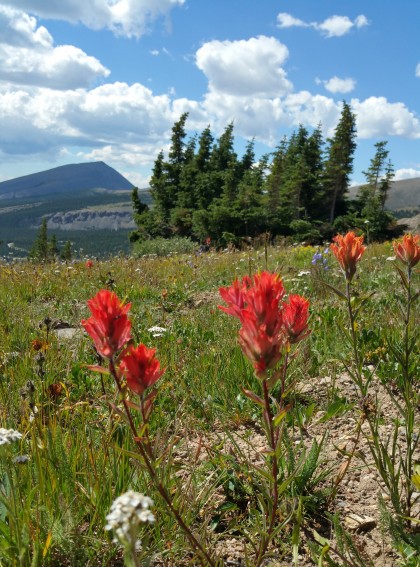
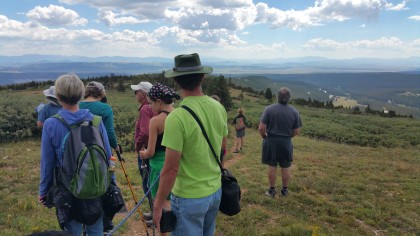
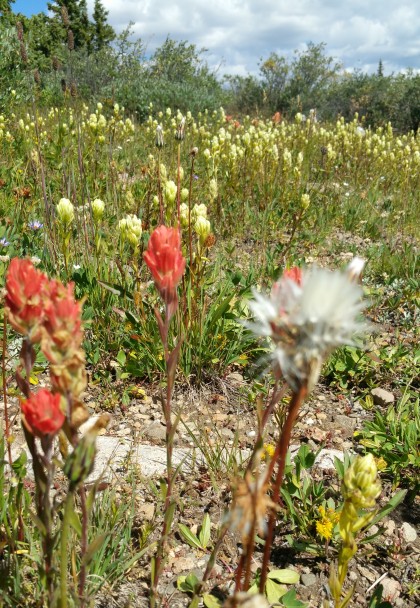
At the trailhead we began our hike at 11,700 feet through willow, lodgepole pine and a surprising abundance of wildflowers. The trail meandered a bit while traversing another 500 feet up to 12,200. We passed through the krummholz layer, crooked trees, that mark the tree line. Trees right at the tree line are stunted and crooked due to the inhospitable climate. It’s the tree line, after all.

After the krummholz comes tundra, flat and bare except for plants that hug the ground, mat plants, and a few hardy flowers. The air is thin here on Shadow Mountain at 8,800 feet, but 12,200 is thinner yet. It was a struggle to get to the highest point of the hike, requiring breath breaks for most of us; not, however, Tara’s three teenagers who seemed to run with exasperating ease (to this old guy) up the trail. As did Marley, their dog.

A tree island at the krummholz level

Those of us from Beth Evergreen were there because of the research being done on Pennsylvania Mountain. Forty years worth of investigation has been conducted there into alpine bees and some of the plants that they pollinate. Native dandelions, for instance, may be under threat from the expansion of the familiar, but invasive dandelion probably growing in your yard right now. Unfortunately, the scientists had vacated the site, presumably due to the academic year just getting underway, so we were left mostly with the stunning scenery as a benefit.

There was one other gain. The Beth Evergreen pre-school, now a wholly owned subsidiary of the congregation, has as a theme for the year, Bee Alive. It came up in the conversation that Kate and I have beekeeping experience. Rich has started two hives, which he has very cleverly suspended on steel cable high above the ground to foil bears. Otherwise an electric fence, and a strong one, is necessary. Rich invited me over to his house next week for a pre-school staff meeting. Kate and I may end up sharing some of our equipment and knowledge. Should be fun.

A full day. And a good one.

Off the Road

Lughnasa                                                                          Eclipse Moon

20170821_103631_001This old body doesn’t bounce back like it used to. Driving 13 hours from Idaho to Conifer means a slow return to normal. It’s still underway today, Saturday, after our late Wednesday night arrival back home. Not at all unexpected. Still.

On Thursday we had to return the RV, pick up the dogs and chose to attend mussar, so Thursday during the day was not a time for recuperating. Yesterday was easier, some unpacking, our business meeting and going to the post office for held packages.

Today and tomorrow are slow, too, since the grandkids are with Jen for a hemophilia walk. I’m driving to Fairplay for a hike with Beth Evergreen to see an alpine bee research project on Pennsylvania Mountain. Tomorrow Kate and I will take a load of stuff in to Jon’s new house. He has the kids during the week for the first time this coming week, so he has to get ready for them. The 50/50 parenting arrangement takes effect now that he has a house. A big change for all involved, including us. He will move in over the next couple of months.

Gradually replenishing the battery. Realized just now that I’m like an older lithium-ion battery. I take longer to recharge and the charge doesn’t last as long.


Colorado School of Mines: Space Resources

Lughnasa                                                                      Eclipse Moon

Want to know how far we are into the Buck Roger’s world? Read below.

Our Mission, Vision, and Expertise

MISSION
The Center for Space Resources (CSR) is a research and technology development center dedicated to the human and robotic exploration of space and the utilization of its resources for the benefit of our society through the joint efforts of academia, government, and the private sector.

VISION
The Center for Space Resources (CSR) pursues the study and utilization of space and planetary resources by developing technologies for prospecting, drilling, excavation and extraction, materials processing and manufacturing, and spacecraft and habitat life-support systems. In addition to the many practical uses of space exploration on Earth, the greatest achievement bringing benefits to humankind would be to develop in-space commercial applications of space technology and planetary resources. These applications will one day form the basis for new space industries that will include:

  • Harvesting of solar energy outside the Earth atmosphere
  • Development of an in-space reusable transportation infrastructure carrying payloads from Earth to geostationary orbits, the Moon, Mars and back
  • Servicing of satellites and orbiting spacecraft to extend their useful lifetimes and reduce the costs of space operations
  • Processing of value-added materials in Earth orbit based on planetary resources
  • Utilization of resources for in-situ planetary applications, such as energy, propellants, manufacturing, and habitat development

EXPERTISE
Following the distinguished tradition on Earth resources curriculum and research programs at the Colorado School of Mines, the Center for Space Resources is extending the expertise of the School outside our planet, by supporting the human and robotic exploration and utilization of resources in space, the Moon, and other planetary bodies in our Solar System. The Center pursues these objectives by establishing joint education, research, and technology development projects with other academic institutions, government agencies, international partners, and companies in the private sector in the following areas:

  • Lunar and martian regolith properties
  • Planetary soil drilling and excavation
  • Extraction and processing of volatile and solid planetary material
  • In-situ resource utilization (ISRU) technologies
  • Advanced manufacturing with planetary materials for equipment and habitat construction
  • Lunar and planetary dust characterization, management, and mitigation techniques
  • Sensors for trace-species and biogenic gas detection on the Moon and Mars
  • Life support systems on spacecraft and planetary habitats, including fire suppression, environmental monitoring and control, water processing, and energy generation from waste and fuel cells
  • Advanced materials for in-space repairs and thermal protection
  • Technical and economic analyses for identifying potential commercial developments in space