All posts by Charles

The Silversmith

Fall                                     Waning Back to School Moon

Room 901, the Silversmith Hotel, Chicago  on Jeweler’s Row

The sun had just slipped below the horizon as we approached downtown Chicago.  Red fire glinted off the window walls of the many new skyscrapers in this, the home of the skyscrapers.  As the train slid toward Union Station, I felt the city cloak itself around me.  I was back.

I love this city.  It was, my first.  My first big city.  I came here when I was 12 with a United Methodist Church see-it tour.  We visited the Chapel in the Sky, the Pacific Garden Mission and saw a lot of the poorer areas of Chicago.

This is Sister Carrie’s city.  The city of the Titan, The Genius.  The city of Big Shoulders where the fog creeps in on little cat’s feet.  This is an American city, a Midwestern city built on stockyards and the commodity exchange, a collecting point for agricultural goods from the farms of Indiana, Illinois, Iowa, Minnesota, South Dakota, Nebraska.

The steel mills of Gary used to light up the southern tip of Lake Michigan, you could see them glowing like a peek into the infernal regions.  They glowed red with the heat of General Motors, Ford and Chrysler.  A day now gone by.

The el encloses the loop and rattles just 7 floors below my hotel room here at the arts and craft decorated Silversmith.  This is a boutique hotel very near the Chicago Art Institute.

I have an appointment in Ada’s Deli, the restaurant here, at 10 tomorrow, then I’m off the Art Institute.

RailBird

Fall                       Waning Back to School Moon

45th HS Reunion

Empire Builder September 28 10:30 am St. Paul

A freight lost a knuckle (?) in North Dakota and couldn’t vacate the track for the Empire Builder coming from Seattle. Result, a 3 + hour delay. We just started rolling right now, 10:33, 3 hours and 3 minutes after our scheduled 7:30 departure. Doesn’t matter. I’m on vacation. The first since a year ago February. Visiting family has a different category for me: visiting family.

Just passed over University Avenue. Trains take you thru the alleyways and industrial districts in America, interesting to me to see how commerce’s back office works. Just saw an unusual sight, a man riding a bicycle with a load of long lumber on a cart behind him. Shades of Beijing.

Went over to Bonnie’s on University for breakfast. A great old timey breakfast joint. Specials hand lettered on signs all over the place. Truckers and construction workers, a few hunters eating.

Each trip is its own adventure, the unexpected and the mundane often of equal interest.

I asked for a riverside roomette so I can watch the Mississippi below Hastsings. Just occurred to me that I also chose the sunny side, though the delay may take care of that.

The passenger car, #2830, creaks a bit and rolls gently side to side as we pass Irvine Park where I used to live and the Science Museum. Now we’re under the odd bird-cliff nest like structure of the now vacated Ramsey County jail. Strange that the criminals got such great views.

Big barges on the Mississippi draw oohs and ahhs from passengers. We’re pulling out of St. Paul,headed south along the big river, Father of Waters.

4:44 PM Outside of Milwaukee. The train slowed to a crawl about 50-100 miles ago. The tracks were underwater; we passed over a rail-road bridge with the Wisconsin River lapping over the ties and onto the track.

My roomette is #10, at the rear of passenger car #2830./ Right behind me is a window looking out over the tracks as we pull away from them. My fellow passengers flocked back here to view the track and its soggy condition.

Since we had three hours delay, the lunch would be the last meal though we will still be well out of Chicago around supper time. The dining car got mobbed so our attendant offered to go get my lunch. I took him up on it since the dining car is as far as you can get from me within heading into the baggage cars. He brought back macaroni and cheese, salad, vanilla ice cream and bottled water. A white meal. Perfect for Wisconsin.

Later on I had him make up the bed and I took a nap, rocked to sleep by the rhythm of the train. In case you can’t tell, I’m sold on train travel. It proceeds at a civilized pace, allows for watching changes in topography and culture, all with a degree of personal service and civility long absent in plane travel.

The train has slowed as we pull into Milwaukee, a northern fall evening complete with bright sun coming in at a low angle, leaves that have just begun to change and folks with long sleeved t-shirts and light jackets.

There has been plenty of time to just stare out the window and think. As we rolled along beside the Mississippi, the clouds were gray and low, in another month they would be snow clouds. Today they were the hand of autumn, ushering in the lowering skies, the introverted season has begun.

Tomorrow is Michaelmas, the feast day of the warrior angel, Michael. It carries a sobriquet, the springtime of the soul. And so it always seems to me. Fall and winter are the time when my inner life takes on renewed energy.

Fall and winter have their analogues in the last years of life, years I have just entered. I realized that my affection for the fall and winter, the time when introspection and spirituality become dominant, augurs well for my own aging. I am in tune with this time of life, just as Carl Jung predicted I would be, all those many years ago when I first learned of his division of life into two halves, the extroverted competence and achievement phase between, say 20 and 55, and the introverted, inner life oriented second phase, 55 to death.

We passed the Miller Breweries and now sit at the train station in downtown Milwaukee. From here we turn south after a mostly west to east journey from St. Paul, though one with a southerly tilt. The well-heeled northern suburbs of Chicago will offer up their limestone train stations, brick retail centers and neatly coiffed houses before we head into the hurly burly of Chicago’s near north industrial and warehouse districts.

It’s a damned good thing I have a night or two in Chicago. My connection to Lafayette leaves Union Station at 5:15. The time it is right now. I would have missed it for sure.
Chicken Pot Pies and Memories

Fall                                                 Waning Back to School Moon

Before the Vikings game on Sunday I made two chicken pot pies, whole pies filled with chicken, vegetables and a thickened vegetable broth made in the process.  These are my second and third meat pies and I find I enjoy making them as much as I do soup.  Something about baking a pie that has meat and vegetables intrigues me.  This one had our leeks, potatoes, onions, carrots, garlic, parsley and thyme.  My favorite vegetable from this garden is the leek.  The subtle flavor and the delicate flesh of the leek both appeal to my palate.

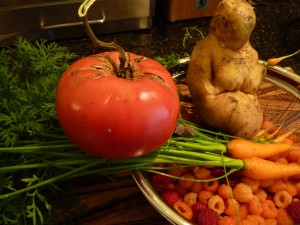
Here are a few of the ingredients plus a tomato and raspberries from our garden.  This potato looks similar to the woman of la mouthe in the MIA’s collection.  At least to my eye.670_0300 Fresh ingredients are key to Italian, Chinese and vegetarian cooking so a garden facilitates those cuisines, at least during the harvest system.  Our best meals of the summer happen in September.

Visiting Westminster today brought up all kinds of memories.  Don Meisel, former head pastor, came into the men’s room once during a Presbytery meeting.  I had a report on top of the urinal, reading it.  Don said, “My, you must get a lot of work done.”  Presbyterian humor. Another surprising Don Meisel moment.  There on the wall of a hallway was the exact same Granlund sculpture, the Tree of Life, that I bought Kate for her 50th birthday.  Don had given it to the church in memory of his wife.

Jim Campbell’s name came up, too.  Jim was a top exec of Northwest Bank and a leader on the Community Involvement Program’s board.  I worked at CIP for 4+ years, starting as a janitor and week-end staff person during seminary and moving up to Director of Residential programs.  Jim came to me at one point and asked if I would take on directing both the Residential programs and the Day Activity Centers.  I thought about it and said no.  That surprised him, I could tell.  It surprised me a bit, too.  I had no interest then or later in advancement, even though I did end up as an Associate Executive Presbyter.

Then, the chapel.  What a peaceful space,  a definite English feel to it wood, limestone, slate floor, a beautiful organ.  Wilson Yates, then professor of society and religion at United Seminary, married Raeone and me in that chapel in 1979.  Ed Berryman, the organist, refused to play the music we wanted.  I don’t remember what it was.  We had Handel’s Water Music.  Ed liked it.

There were, too, many mornings of bible study with urban clergy in the now much renovated basement area.  Bible study was always one of the fun parts because Presbyterian clergy pride themselves on their scholarly ability.

Well, off to bed.  Gotta catch the Empire Builder at 7:30 am.

High School Reunion: The Experience

Fall                                                   Waning Back to School Moon

Ancientrails hits the road again tomorrow morning at 7:30 am via Amtrak to Chicago and points south.  I spend two days in Chicago at the Silversmith Hotel near the Chicago Art Institute.  A few hours wandering the halls of the Art Institute will help me with my Baroque knowledge so I can do two Friends of the MIA tours of our Baroque collection.


On Wednesday morning I plan to head out to Hyde Park and the Oriental Museum at the University of Chicago.  Not on many lists to visit in Chicago this museum showcases the phenomenal involvement of the Oriental Institute in near eastern archaeology. “The Oriental Institute Museum is a world-renowned showcase for the history, art, and archaeology of the ancient Near East. The museum displays objects recovered by Oriental Institute excavations in permanent galleries devoted to ancient Egypt, Nubia, Persia, Mesopotamia, Syria, Anatolia, and the ancient site of Megiddo.”  Docents will recognize the winged genius on the right hand wall here.

Hyde Park has attracted me for a long time. My first wife’s brother Bob was an undergraduate at the University of Chicago, a rare creature at this primarily graduate university.  When I saw Hyde Park with Bob I did it under the influence, spending a memorable night holed up in the aluminum statue celebrating the splitting of the atom under Alonzo Stagg stadium.  That was back when the University of Chicago still played football.  Enrico Fermi was the scientist.

Later on I visited Hyde Park for several ministry related events and then earned my Doctor of Ministry through McCormick Seminary located in Hyde Park on the periphery of the University of Chicago.  Following that I commuted to Chicago once a month for two years as a student representative on the Seminary’s D.Min. committee.  While there I found and frequented the legendary Jimmy’s, a dark wood, three roomed bar noted for its highbrow clientele.  It’s a great place for a hot dog.

Some jazz, a nice evening meal and I’ll catch the Cardinal to Lafayette.  I’m skipping Indy this time around and renting a car in Lafayette.  This will let me drive through the Indiana countryside in the fall, something I’ve always enjoyed.  While in Alexandria seeing old friends from the class of 1965, I’ll be staying in an unusual location, Camp Chesterfield.  Camp Chesterfield, founded in 1886 as a Spiritualist Church, and now center for Indiana Spiritualists, has an international reputation in the Spiritualist community.

I find it a fascinating sub-culture, an almost straight dose of late 19th century Spiritualism.  They have a hotel on the grounds and I’m booked there for three nights.  I want to take in the flavor of the place from a residential perspective.  I may get a reading or two.

Ancientrails will get updated on the road, but I’m not sure about internet connections, especially at Camp Chesterfield.  They specialize in ethereal connections, ectoplasm.  So, it will be episodic, but look for new entries.  I’ll be back home on October 5th.

Global Wealth in our Gilded Age: Conclusion

Fall                                                        Waning Back to School Moon

David Little has blown into town with contemporary photography and new media at his back.  His energy gives a new breadth and depth to the photography collection.

Embarrassment of Riches demonstrates both.  He recalls seeing an Annie Leibovitz photograph, an advertisement.  Mikhail Gorbachev sits in the back of an expensive car, his hand somewhat anxiously on the door handle, looking at the Berlin Wall.  Sitting on the seat next to him is a Louis Vuitton bag.  The image exploded.  What would be the equivalent, if say the USSR had won the cold war, Ronald Reagan in a Soviet limo with a gold hammer and sickle sitting next to him, perhaps looking at the same wall from the other side?

The global reach of capitalism and the vastly increased wealth around the world had wrought an unimaginable change in an icon of our former blood enemy.  Was this how global wealth looked?  In an investigation into how photographers portray wealth and its cultural influence, Little made an interesting discovery.  Documentary photography had focused on the poor, those without wealth, and also without the power and perhaps the understanding to control their own images.  Photographers could access the despairing mother of the depression era, the projects of Chicago’s southside, the barrios of Latin America but the wealthy knew had to handle the paparazzi.  Deny them access.

Imaging wealth had a taboo feel, but wealth at unprecedented levels must have resulted in some images.  Where were they?  He knew some of them already, but had to search for others, especially others that dealt with wealth from an objective perspective, neither glorifying or chastising.  This show, which takes its name from a Simon Schama book of the same name, aims to show that other side of life, the life of those with power and money, but to show it in situ.

A traditional problem of photography, of art in general, lies in how to show the invisible, then how to do it and not be obvious, heavy handed.  The photographs in the currency section of the show wrestle with that problem and have several different answers.  Gleaming oil pipelines, stacks of gold bullion, an uber power lunch, a stock exchange, an inventory of lamps all suggest rather than tell, reveal yet also conceal.  They are not didactic, at least not in any propagandistic way.  Value, critical to each image, is ephemeral and socially determined whether by Arab men selling stocks and oil futures or the market for gold or the power carried by top level business leaders gathered in one room.

Art, too, is a currency of sorts.  It has a market, is sold in galleries and at auction and through private transactions.  Curiously, though, it has no intrinsic value, lumps of marble, paint on canvas, ink on paper, images on photo paper.  The value of art is purely transactional.  So, in this sense, each of the photographs in this exhibition participate in the thing they depict, especially since the world of art tends to be the world of the rich and powerful.

This exhibit is as much about photography and photography as art as it about the contents of the images in it, more so because the images show only a minuscule slice of the lives of the rich and powerful.  So the title Embarrassment of Riches carries at least a double meaning, it describes what the images contain, but it also describes the images as art.  Worth seeing.

Global Wealth in our Gilded Age: Rituals and Style

Fall                                                   Waning Back to School Moon

Rituals and Style

In a clever twist on two Alex Prager images, the first an upper class family in their opulent home, posed as if to reveal joints in a (dysfunctional?) family system and the second a wood-paneled room stuffed with paintings and sculpture and orchids which has an elderly man sitting and a younger man holding a dog standing with his hand on the others shoulder, Alec Soth has shot an understated, by comparison to the other two hanging next to it, interior.  Seated in the position of prominence however is not a prim, confident daughter or a posed son or lover, but Moujik IV, a French bulldog owned by Yves Saint Laurent.  Moujik IV, which means Russian peasant, is the last of four French bulldogs owned by the fashion designer and heir to a considerable fortune of his own.  His bodyguard stands off to the side.  Laurent, if told a country would not accept Moujik, refused to go.

All three of these images, which occupy a niche near the end of the exhibit, let us peak behind the gates or doorman guarded lobbies of wealthy homes.   We see their inhabitants, both canine and human, in their environments, but posed as part of a documentation ritual of wealth’s domestic codes.

Cindy Sherman dolled up and posed before an Upper Eastside apartment building (see below) stands in the Rituals and Style section along yet another Abe Morrel piece, 34 million Swiss Francs, a portrait of colorful bundles of Swiss paper currency.

Martin Parr’s three photographs complete the exhibition.  All of his evoke in-crowd ritual events available only to those with cash or connections, or both.  The first is a cocktail party in Cambridge, England.  It shows only feet, shoes, the bottom of skirts and a martini glass all posed on a white rug.  The second shows an Arab man in traditional clothing looking at a pink stroller (very expensive according to David Little) tended by a woman in a pink hijab.  Next to the Arab man stands a rubinesque Arab woman in high heels and a tight fitting body suit.  This is the lobby at a polo match.  The final picture, which reminded me immediately of Rene Magritte, has five men in bowlers watching or preparing to watch the  Prix de l’Arc de Triomphe in Paris.

The concluding portion of this review will look at the overall implications of Embarrassment of Riches.

Global Wealth in our Gilded Age: Currency

Fall                                                  Waning Back to School Moon

David Little has Embarrassment of Riches divided into three sections:  Currency, Space, Rituals and Style.

Currency

Abe Morrel makes pictures of currency.  In Embarrassment of Riches he has two photographs, one of gold bars and the other of Swiss Francs.  The photograph at the right has this title:  39 Gold Bar: $15,372,742 (11 AM/GMT-3/13/08): $988.25/oz Zurich, Switzerland.  The full title is important because Morrel, who likes the materiality of currency, also comments on value.  As the title suggests, value has an ephemeral quality, pegged to an exact moment, uncertain and socially determined.  Yesterday gold reached a new all time high of $1,300 an ounce.  Allison suggested an interesting addition to this photo:  a digital readout of the price of gold as it fluctuates.

This ephemeral quality of value made me reconsider the meaning of currency.  Currency is just that, value at the current moment.

Also in the currency section is a beautiful and initially puzzling image.  Amidst a north woods setting, pine trees and a gray sky, a glittering metal abstraction snakes just along the forest border, extending as if to infinity along with the edge it defines.  What is it?  An oil pipeline carrying oil from northern Alberta.  Ironically, and I suspect unintentionally, this image meshes with a current Sierra Club initiative aimed at bringing awareness to the very high proportion of Minnesota’s oil supply that comes from the Alberta Tar Sands, an oil source that combines wilderness despoliation with climate changing fossil fuel emissions.

An inventory of lamps, members of the Kuwaiti stock exchange sitting in white robes on red leather couches arranged in conversational squares, two cars-a Ford and a Lexus with Chinese models draped sinuously over them and the Luc Delahaye image I talk about below complete the Currency section of the show.

With one exception.  A sock.  That’s right, a man’s sock, displayed on a podium under a plastic vitrine, draped as if just taken off and perhaps thrown on the floor.  How does this fit in the currency section?

Christian Jankowski works with video installation and performance art.  He is the artist behind the sock.  In Embarrassment, in the Rituals and Style section, a Jankowksi piece called, Strip the Auctioneer, shows over and over again.  It features a genuine Christie’s auctioneer, videotaped by Jankowski in the process of selling first his pocket handkerchief, then his suit coat, a shirt, two shoes and two, wait for it, socks!  The auction was a benefit for an arts school, so the bidding was genuine.

David says he doesn’t know whether it is the right sock or the left.  It makes a difference in terms of value:  the right sock sold for $3,047 and the left for $3,324.  Of rituals associated with the life of wealth, an auction at Christies or Sothebys must be close to the top, perhaps after certain prestigious horse races.  Oh, by the way, this photograph shows the auctioneer offering the final item for sale in Jankowski’s piece, the hammer.

Photography as Art

Fall (Mabon)                                           Full Back to School Moon

Into the Sierra Club to orient a new member of the Legislative Committee.  After that, a couple of hours in the new photo exhibit, Embarrassment of Riches.  The new photography curator, David Little, has pushed forward a contemporary approach to the photography and new media department.  He’s showing color photographs, unusual against the Hartwell years of classic black and white photography.  David also has an edgy, political sensibility that insists on embracing difficult questions contemporary photography either raises or documents.  Works for me.

Ate lunch at D’Amico’s and Kwo showed up.  We discussed China and its pluriform culture, especially important as we consider its rise today in the context of other Asian countries that seem to have much more homogeneous cultures:  Japan, Korea, Vietnam, Thailand, Cambodia, Laos, Burma.  Kwo believes Confucianism and its insistence on obedience to authority has affected especially Japan and Korea, shaping their society into a perfect environment for xenophobia.

After lunch David Little gave the lecture and walk through of Embarrassment.

He began the lecture responding to a question about whether he posted information about photographs that had been photoshopped.  He does not.  His reasons reveal a good deal about contemporary photography and some of the challenges it faces.  Photography has had, David says, an obsession with technology, an obsession that has seemed to place the technical aspects of photography in the foreground.  A focus on how a photography makes a given image detracts from emphasis on the image itself, a distraction that embedded a question about photography as art within the very art historical conversation.

Do you know Degas’ paint brush?  How Goya mixed his paints and what elements he used?  Any clue about the canvas on that Rembrandt?  We do not focus first on technique and implements in the art history of other objects like painting and sculpture.  Why?  Because the image or the physical object produced commands our attention.  David suggests that the same is true of photographs, the images created by photographers.

Just as painters have long emphasized those parts of a scene that make it look beautiful, harmonious, so do photographers use various techniques to make the final image have a certain look.  Portraitists often create an image of a sitter that is not a mere copy or likeness, rather they highlight some aspects and downplay others to reveal a personality.  Photographers, as artists, have the same latitude in shaping their work.

Photoshop is only one in a long line of manipulations photographers have used.  There never has been a “straight” photograph, the real image before manipulation.  Choice of light, focus, shutter speed, subject matter manipulates the image in the camera itself.  Dark room manipulations have gone on since the development of emulsions.  David does not want to create a hierarchy of photographs in which one is more “real” and therefore a “better” image.


This image by and of Cindy Sherman is in the exhibition.  It uses a projected building facade from somewhere on the upper eastside of New York and over it Sherman has imposed one of her signature personal images.  She dresses up as many different characters in her work, this time appearing as an art patron in the coded dress of her social class.  Its creation is not the point; the point is the result, a softly satirical presentation of a type of a New Yorker.  There is no real image to find that is behind this one.  This seems evident to me in this case.

David Little’s point is that each photograph we see in the exhibition deserves the same treatment.

A Bit More Zap

Lughnasa                                        Full Back To School Moon

Over to Fleet Farm in Blaine for more electric fencing material.  This time I purchased a gate kit that will allow me to connect the fence across our large truck gate.  I’m hopeful that this represents the solution, at least for now.  I plan to extend the fence back toward the house about 8 feet and on from its current terminal on the west side of our property to the wild grape vine on our northern fence line.  Gotta  get this done before I leave since Kate will have to find and retrieve our pooch while I’m in Indiana.

We ate lunch at Axel’s Woodfired Grill, then motored over I-35 to Fleet Farm.

We have a flood watch posted since much of the ground has reached saturation levels with recent rains.  This portends bad news for the spring, too.

Following the Old Religion

Lughnasa                                            Full Back To School Moon

Summer has three endings:  Labor Day which marks the end of summer vacation for many school children; and, for many adults like myself, kicks us into serious mode as all those years of conditioning continue to affect our attitude;  Mabon, or the Fall Equinox, which comes tomorrow, that point when day and night balance each other, neither claiming dominance, though the trend matters and at this equinox, the balance tips toward night as the darkness increases, pulling us toward the longest night, the Winter Solstice on December 22nd and Samhain, or Summer’s End according to the old Celtic calendar which divided the year in half, Beltane-Samhain or the growing season, and Samhain-Beltane or the fallow season.  Samhain comes on October 31st and, like all Celtic holidays lasts a week.

The growing season has this triple farewell reflected too in the holidays of Lughnasa, the festival of first fruits, Mabon, the peak of the harvest and harvest home, and Samhain, the end of the harvest season and the end of the growing season.  No matter how you notice or celebrate it these real changes in the agricultural year still happen, they still have critical importance for our human community, and they still deserve our attention.  Why?  Because our ages old relationship with agriculture is what separates us from the hunter-gatherers.  Agriculture allows us to live in villages, towns and cities by producing surplus food on farms in much the same way that the honeybee produces surplus honey while still making enough for the colony to survive on throughout the winter.

Without those who farm, there would be no surplus food.  With no surplus food we would have to revert to subsistence agriculture, growing what we needed every year or hunting and gathering.  This would prove daunting since most of us have forgotten or never been taught how to grow food, how to hunt, how to identify edible plants.

This is the great hidden reality for many, if not most, urban dwellers, who make up, since 2008, over half of the world’s population, a projected 5 billion people by 2030.  Without  a healthy eco-system, one that can support intense tillage, that is, sustainable tillage, the world’s urban dwellers will be bereft of something they cannot do without:  food.  Add to that the pressure on the world’s fresh water supply and two fundamental sustainers:  food and water are at peril.

Granted following the holidays of the Great Wheel will not work magic–sorry to all my Wiccan friends–but it would remind us all, 8 times a year, of the source of our sustenance.  That would help.  Naming our days after these holidays (I do it in the upper left of each post) keeps that reminder fresh.  Our sustainers, mother earth and father sun, do not require us, do not need anything from us, yet they will support us if we live within their limits.  These holidays began when our ancestors realized the need to remind themselves of the delicate, fragile harmony required for human life to flourish.

Over the course of the years and centuries and millennia since, hubris has lead us further and further away from the old religion; we have replaced it with  idols, fetishes, really.  We will, at some point, pay the price for our blasphemy as we upset that harmony, creating an environment that will no longer sustain human life.  Only if we step back from our profligacy can we ensure our survival.

Knowing the rhythms of the natural world, of the agriculture that feeds us, of the systems that keep water fresh and available, is our only chance to avoid apocalypse.  Will we do it?  I don’t know.