Zoomed. We talked for over an hour, Mark, Paul, Bill and me. Each of us was in a different physical location, Paul in Maine, me in Colorado, Mark and Bill in the Twin Cities. This technology is a definite push beyond Facebook, Instagram, Twitter. It is more like letter writing in its length of interaction and interpersonal depth. In that sense it works against the grain of 140 characters, photographs and short posts. It’s more like real life in its immediacy and interactions that includes body language.
Ode
Even its limits are closer to real life. No e-mail blasts. No dashing off a quick post, then moving on to something else. This is sitting across the room from someone, though in this case the rooms can be hundreds of miles apart. Some of the social niceties are impossible of course. No shared snacks. No hugs. Different weather. It was pouring rain in the Twin Cities, dry here in the Rockies. No offering hospitality of the physical kind. We couldn’t decide to get up and go somewhere else afterwards, or, for that matter, even during the hour. If we got up, it would be as if we left the room.
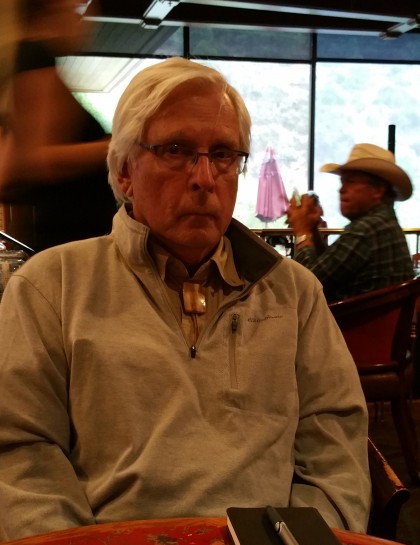
I liked it. In this mode we can nurture old friendships, share confidential news in private (at least I think it’s private, but who knows really), spark off each others sentences, laugh together. It may not be a trip to Durango or a hike at the
Bill
summit of Guanella Pass, but it’s not a short typed note either. Can this technology sustain us over time? Difficult to tell. We’re creatures, at least those of us on this Zoom session, of the old, pre-computer days when communication across distances was sporadic and limited to long distance phone calls and letters; for us this way of being with each other is novel to some extent and compares not so much, really, to social media, but to actual, in person meetings.
Me
Whether the digital natives will see in it a form of being with each other that they want to pursue, I don’t know. One of the factors that held me in the Twin Cities so long was the physical presence of and frequent visits with Woolly friends. In the important sense of in depth conversation Zoom and its like provides a very close equivalent. Perhaps it will make distance matter less, allow us to rearrange ourselves physically with less loss. I hope so.
Happy to report that the two friends with critical life moments had good news, one through medical surveillance and one through a lifetime of work brought into clear focus. May the congregation say, Amen. Or, blessed be.
Under the Woolly Mammoth Moon two natural wonders continue apace. The 416 fire, though now reporting 37% containment, has increased in size to 47,000 acres plus and further information on the inciweb site for it indicate weather conditions are favorable for the fire to continue to grow. In addition to its location only 13 miles north of Durango, where my buddies and I spent a weekend, it’s also very close to Mesa Verde and the Canyon of the Ancients. This fire began on June 1st and has lasted into the difficult fire conditions of midsummer.
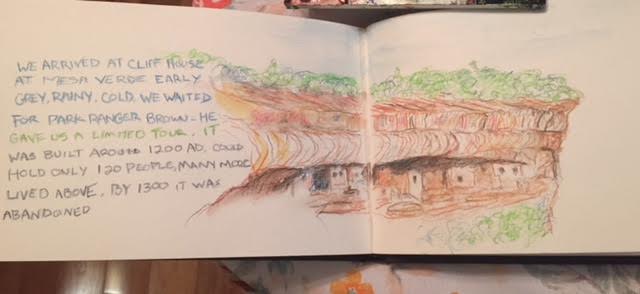
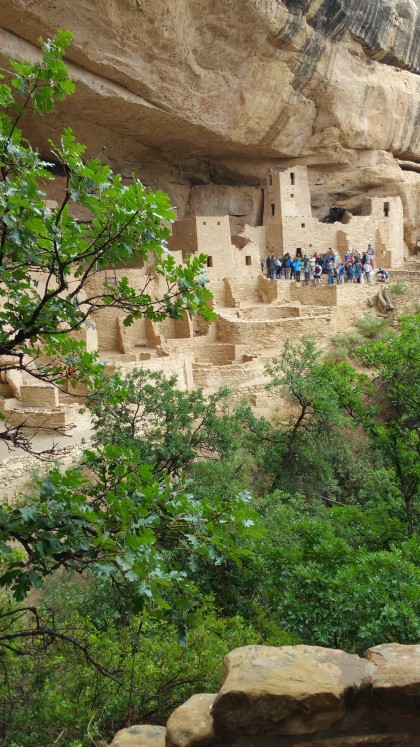
Cliff Palace of Mesa Verde, Mark Odegard
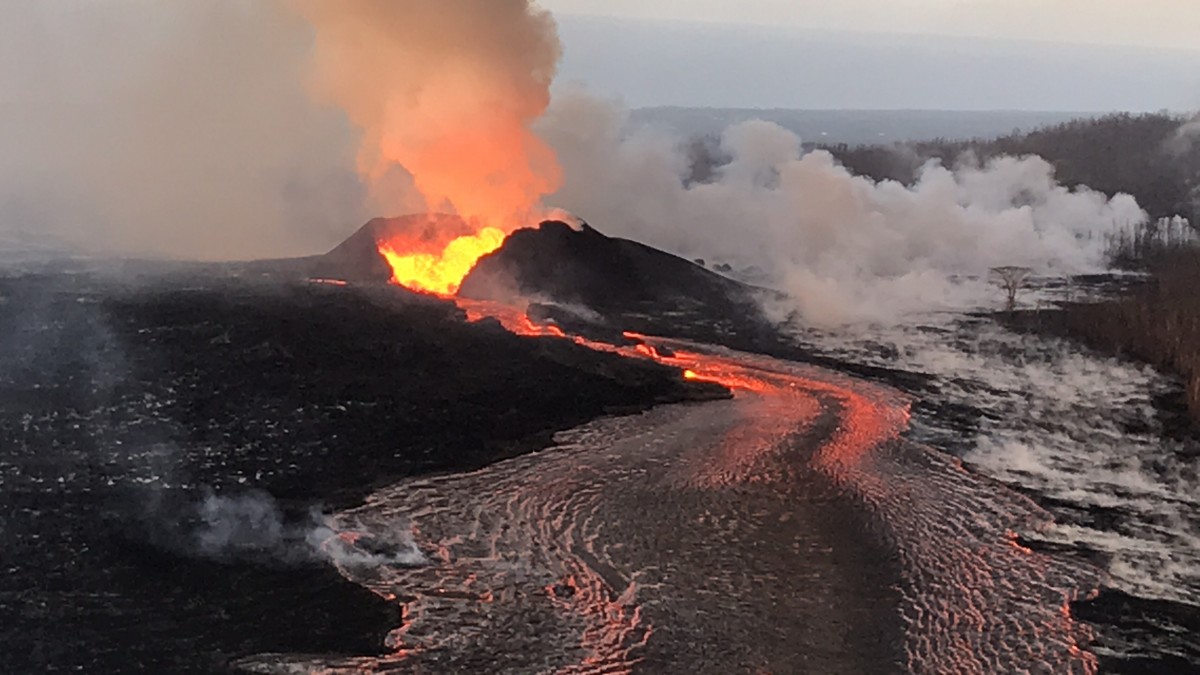
Back on the Big Island, Kilauea continues to erupt.
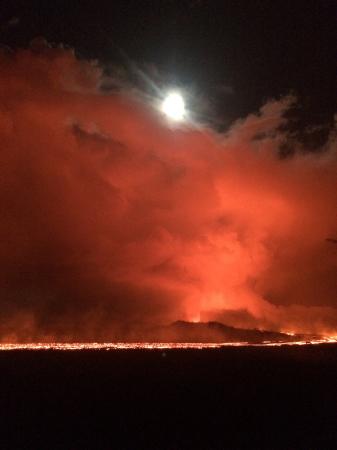
June 27 fissure 8 cone supplies lava to the ocean overflows USGS. The cone is now nearly 180 feet high.June 28 Night view of the lava channel toward fissure 8 under a nearly full moon. USGS
At the Kilauea caldera, Halemaʻumaʻu crater, home of the goddess Pele, continues to deepen and subside, the floor now 1,300 feet below what used to be the overlook area. The USGS reports that the popular parking lot next to the crater is no more, having fallen into Halemaʻumaʻu.
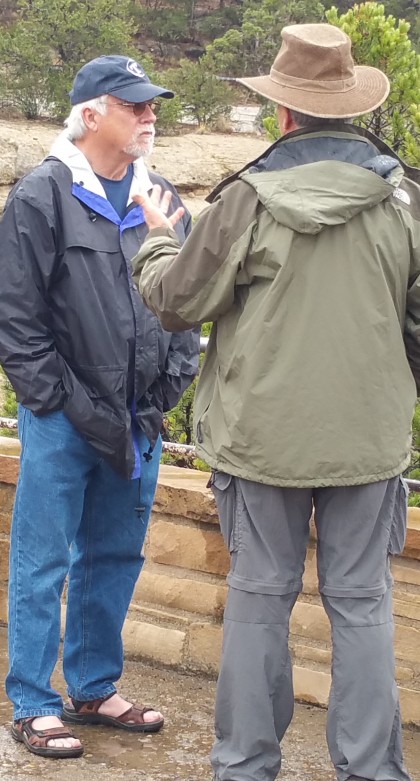
Ode, Tom, Paul overlooking the Animas River in Durango
All the Woollies are back in their places with bright shiny faces. Mark and Tom in the Twin Cities, Paul in Robbintson, Maine.
Kate had her first board meeting last night. She dressed up in her serious adult clothes, put on a coat of many colors and went to Evergreen. I stayed home. Felt good after the long drive.
It’s 50 again this morning, cool, but clear. Yesterday the rain continued in the evening. A bit of nostalgia on the weather website, a tornado watch! Felt like the Midwest. Don’t recall having had one while we’ve lived here. Lots of red flag days, flash flood warnings, winter storm warnings, but no tornado watches. A few severe thunderstorm warnings, usually announcing the possibility of killer hail. Colorado has significant hail damage, among the highest in the nation. Climate in the montane region of the Rockies.
With the Durango trip over I’m finished with traveling until early August when I’ll head back to the Twin Cities for Groveland U.U.’s 25th anniversary celebration. Look forward to reconnecting with both Woolly friends and fellow docents from the MIA, seeing the MIA and the Walker, a jucy lucy at Matt’s.
Tan clumps are stump detritus
We go into Denver less and less, our out of the house time spent either in the mountains themselves or in Evergreen, mostly at Beth Evergreen. Not an intentional thing, though the heat during the summers is a barrier for us, just that our life is now in the mountains and the city seems more and more foreign each time we go. Of course, we lived in Andover for twenty years, well outside Minneapolis, but we got into the Cities with greater frequency there. I had the MIA and the Sierra Club, the Woollies that drew me in; Kate had friends.
The stump grinder did a great job. Feels like we’re beginning to move in, a process attenuated by the medical and familial upsets that came bang, bang, bang after we moved. Jon’s bench is a good step in that direction, placing the fans, adding the light in the living room. Plenty more to do. We spent a lot of money early on installing the generator, a new boiler, solar panels, the new bathroom downstairs, sealing and staining the garage, new kitchen. Decor has waited. I’m close to having the garage organized again, may do some more work on that today.
Back from the lands of the ancients. Back from the still growing 416 fire, now 30% contained. Back from an immersion in my old life so complete that I would occasionally say here, referring to the Twin Cities or Minnesota. The web of context and thick memories with Tom, Mark and Paul is old and deep.
We ate breakfast (thanks, Mark) in Durango at the Doubletree where we stayed. Packed up and left in the rain. It rained or sprinkled the whole time we were in Durango and that same pattern continued all the way back to Conifer. This meant my three amigos got to see the mountains with clouds hanging over them, the forests with mists boiling up in and through them, the grasses green, and small, temporary creeks flowing as the rain sought lower ground through rocky elevated terrain. It was a picturesque drive made mythic.
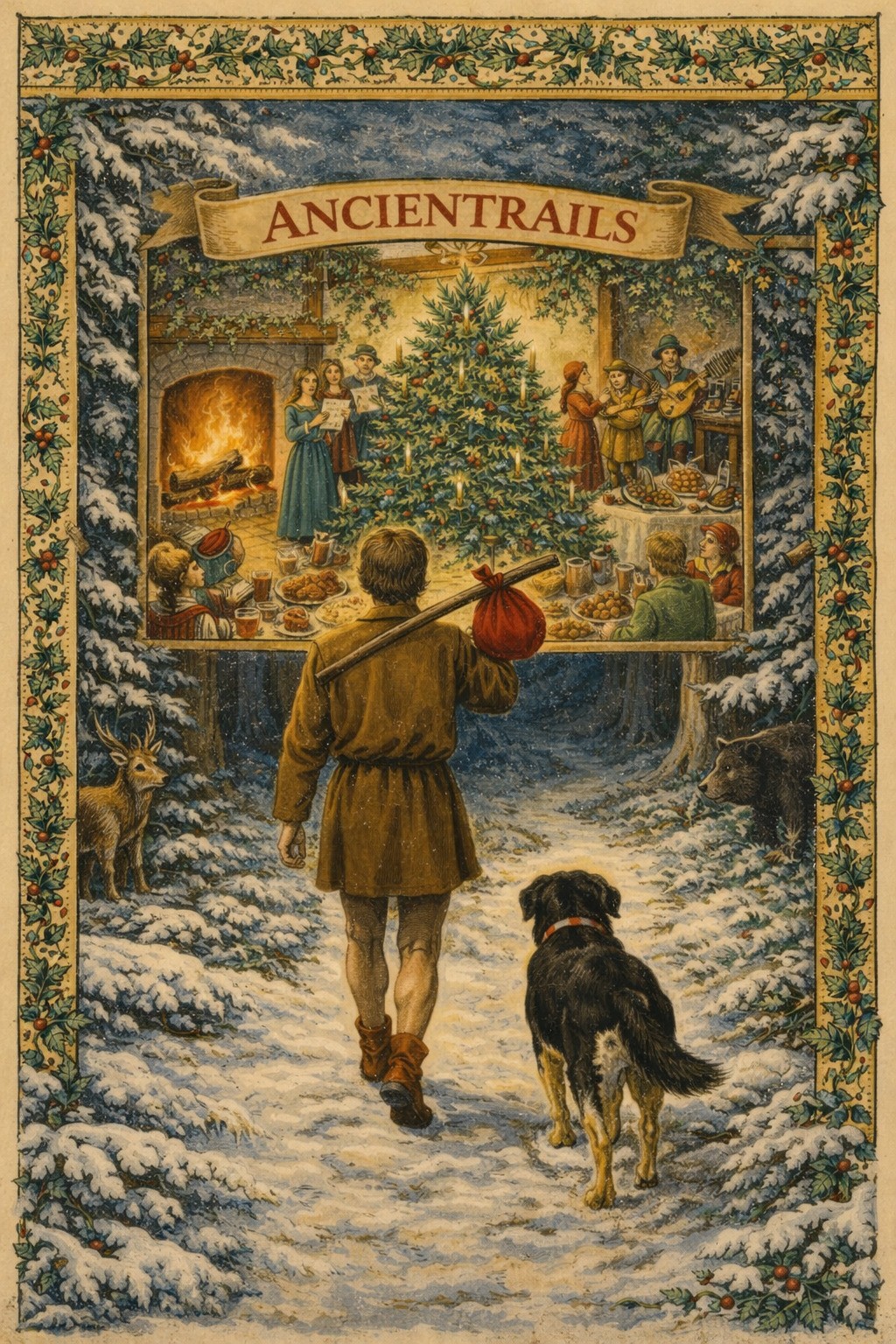
New memories. Climbing the ladders out of Cliff Palace. Talking with Doug Crispin about Mesa Verde. Tom as the Great Helmsman. Mark with his notebook open, sketching as we drove. “Riding loosens me up, makes it better.” Paul’s Common Ground County Fair t-shirt. (see poster) Wandering through the Durango RR museum with its odd, large and varied collection: the blonde black bear, the bi-plane, the solar car, a private train car, memorabilia from the capture of Saddam Hussein and a thousand miniature soldiers, among other things. Visiting the Telluride Bud Company with Mark, his first visit to a legal pot shop.
The rain, a constant for the last couple of days, has to have helped our fire situation, too. A good thing.
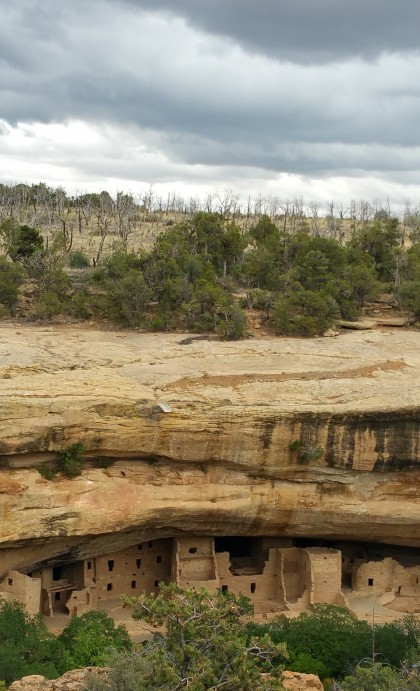
We drove yesterday where others walked long ago. The drive from the visitor center at Mesa Verde to the Cliff Palace where we went on an hour long tour took a long while, maybe 30 minutes up an incline. The land at Mesa Verde slopes up at an angle with fingers of land separated by eroded valleys. At the end of these wide fingers the land slopes down again, gently. As a result, according to an exhibit at the Spruce Tree dwelling museum, Mesa Verde is not a mesa at all, but a cuesta. Mesa’s have sharp cliffs while cuesta’s slope, as they do here, toward the lower ground.
Paul and Mark descending
The route down to Cliff Palace (I’ll post pictures when I get back home) was the same one the cliff dwellers used, narrow steps cut into sandstone, augmented a bit by the occasional iron railing. There was, too, a ten foot ladder on the way down and two ten foot ladders on the way out which also followed a cliff dweller path. It would have been a fun place to grow up as a kid, scrambling up and down over rock and ladders, a more or less level surface above the home site where games could be played.
As at many sites where rock was a primary building material, the skill level was high with walls that were plumb, right angles, and a mortar that both bound the rock together and allowed water to seep through without loosening.
Cliff Palace
Mark asked an interesting question about wall coverings. These rocky appearing structures would have had several coats of plaster on them and would have been painted. That means they would have looked much different than they do now.
A ranger at the visitor center compared Mesa Verde to Giza and other World Heritage sites. When Tom asked him what was good about working there, “We get visitors from all over the world.” Another Ranger I talked to, Doug Crispin, had an obvious reverence for this Park. He was a first generation immigrant and said, “This is an American story. I’m honored to be here to share it.” He and I mused over a thousand years from now, “Will anyone be coming to look at the ruins of Durango? Probably not. But Mesa Verde will still be here.”
Right outside my hotel room is a small balcony with two chairs, a small table and a view of the Animas River. Had I been in this room on April 7th of 2015 the Animas would have been a sickly, mustard yellow thanks to the toxic spill from the Gold King Mine upstream from here. It’s clear now, with people kayaking, long boarding, even fishing, but it took a long time. Here’s a hardly reassuring couple of paragraphs from the Durango Herald, April of this year:
Spruce Tree House
“San Juan Basin Public Health said water samples taken throughout the Animas River indicate there’s no risk to human or environmental health from normal use of the waterway.
However, the health department suggests people who come in contact with the river to wash with soap, keep a close watch on children who are more susceptible to unintentionally swallowing river water and treat water before consumption.”
Meanwhile, the 416 fire, from the same newspaper, an hour ago: “The 416 Fire hasn’t exhaled its last column of smoke yet, but steady rainfall Saturday did help tame the 16-day-old wildfire and allow firefighters to increase containment lines around the 34,161-acre blaze.”
I slept last night with the patio door open, screen closed. I could hear the Animas, the river of souls, running. When I woke up this morning, it was raining. My ear was eager for the sound, found it soothing, familiar in a humid East, Midwestern way.
Being with Tom, Paul, and Mark has reminded us all of the depth our long time relationships has nurtured. We move together through the day easily, listening to each other, making decisions, continuing lines of thought, sparking new ones. One of Paul’s hopes is that this trip might encourage us to use a meeting app like Zoom to get together even while far apart physically. I’d like that and hope we can make it work, too.
Kate says the stump grinder got a lot done in 2 hours. I’m excited to see it. An outdoor room. Later we’ll have him back to do the front, leaving widely spaced trees with no stumps.
We’re out here in the land dominated, for the moment, by the 416 fire. I smell no smoke, see no smoke, but the fire’s presence a few miles north of here is evident in conversation, google searches, and the need to plan around it. It’s grown now to over 32,000 acres with 18% containment.
Yesterday was a red flag day, today is 90% chance of rain. Sounds good, right? Water puts out fire. Well. Water also courses down fire hardened soil, soil made, as inciweb calls it, hydrophobic. Result? Flash flood warnings, especially for Hermosa Creek and Tripp Gulch. Flash floods are one of the sequelae of these big fires that last long after the fire is out.
Our plan today is to head over to Mesa Verde, see what we can see, then, this afternoon or so, find the Durango RR museum. Google says Mesa Verde is about 40 minutes to the west. Not much further north is the Canyon of the Ancients where the mysterious Anasazi culture had its home base. We’re in land settled long ago by descendants of those adventurous souls who crossed the Bering Land Bridge. A sense of humility is in order out here.
The drive from Conifer to Durango is a lesson in geology, following Hwy 285 through the long Platte River Canyon up to Kenosha Pass, then the sudden appearance of the broad, flat plain, South Park. South Park and its fellows, Middle Park and North Park are Colorado’s high plains, South Park at an average altitude of 9,000 feet. Turning south at the road to Buena Vista (where Kate had her quilt retreat in February) we drove along more high plains, and, as the mountains impinged more and more on the road, found a long stretch of beetle-killed pines.
This is poor country with makeshift shelters made from hay bales and shipping containers, old pickups parked forever, and a general feeling of hard lives. Until Pagosa (or, in the Ute, as Paul found, Stinky) Springs. Pagosa Springs (stinky from the sulfur) is a fairly large town as is Durango. Surprisingly so given the land that precedes them from the north.
The creeks here are full, running fast. The mountains steep and tree covered. Yet I’m sitting in a Doubletree Hotel room with all the appointments you would expect. Colorado is a land of heights and valleys, rocky rivers and streams, elk and mule deer, black bears and mountain lions, sprinkled with pockets of population, often upscale.
There is a conversation, now over thirty years old, that continued on the way here. We know each other, have memories and friends in common. What are you reading? What is the nature of time? How do whirlpools form? Wives and kids. Dogs. Hopes. Fears. Creation of tidal tables. What have you been up to?
Well, gotta get a shower, then breakfast. Traveling to do.
Yesterday two worlds came into contact, even if only briefly. The first was Kate and mine’s current world, the world of the Rocky Mountains and Reconstructionist Judaism, Evergreen and Shadow Mountain. The other was our old world, the world of the Land of Lakes and the Woolly Mammoths, Andover and the Twin Cities.
First, Ode showed up at mussar. Then, Tom and Paul. The middot of the week is grace and reading Rami Shapiro’s book, The Art of Loving Kindness, carried us into a discussion about shabbat as a “counter-cultural rebellion” which encourages living one day a week as if work and worry are not the point of life. Has always made sense to me, BTW, long before Beth Evergreen, but I’ve never acted on it, never observed a sabbath day.
Anyhow the context of the conversation made me realize what a grace-full moment it was for me when Tom, Paul and Mark showed up here in Colorado. It was, in one sense, perhaps even the best sense, ordinary. I knew they would find the conversation fascinating, because it was a conversation we’d been having for over thirty years. How do you live? What about life is important? How can we move ourselves into a more meaningful, graceful, gratitude filled existence?
So that moment at the synagogue smooshed together two venn diagrams, Minnesota and Colorado. And it felt really good. They met Rabbi Jamie. Debra referred to the four of us as the quadruplets, older white haired white guys of similar size and habitus and life.
Then the party moved over to Shadow Mountain. My slow cooker Irish stew was, well, partly there. The lamb was tender, but the potatoes were not. Neither Kate nor I, though she is much more able at it than me, are big on hosting events at our house. Too busy at one point, now a bit less able. But these were friends who would forgive an underdone potato for the conversation around the table. And the occasional poking of Rigel’s head under their arms.
Kate went to bed, then got up, came out and said, “You have the best friends.” Indeed, I do.
This morning at 8:30 we’ll take off in the giant SUV that Tom has rented. First stop, the Crow Hill Cafe, then The Happy Camper. Maybe the Sasquatch Outpost? Certainly Kenosha Pass, South Park, Fairplay. On down through South Park. Maybe we’ll look at the Rocky Mountain Land Library, maybe we’ll stop in Pagosa Springs for a soak in the hot springs. Not sure. Doesn’t matter.
We’re headed to Durango in the southwest corner of the state. The 416 fire, north of Durango, as of yesterday:
“While residents in two areas were allowed to return to their homes Thursday, the 416 Fire grew to 32,076 acres with no update on containment.
The fire, burning just 13 miles north of Durango, is still being worked by over 1,000 firefighters who are battling this thing from the air and the ground. Burn out efforts, that is, efforts to burn up the fire’s potential fuel, continued throughout the day.” 9News, Denver.
Mario is already in town, taking wildfire pictures with his usual acumen, traveling over mountain passes. Tom and Paul fly in today and we’ll have a slow cooker Irish stew up here on Shadow Mountain, all of us. These are friends of well over thirty years, men with whom I shared twice monthly meetings over that time, plus annual retreats. That bond was the toughest thing to leave behind when Kate and I moved out here.
This was a men’s group in the old style, one supported by, though not directly part of, the Men’s Movement. Robert Bly, the well known poet who lives in Minneapolis, was a key figure in that movement and a friend of several Woollies. He and the early Men’s Movement folks rooted the movement in Jungian psychology, considering archetypes in particular. Our group, the Woolly Mammoths-“We’re not extinct yet.”-, went in that direction, too, discussing fathers and mothers, dreams, career, love, pilgrimage and many other topics with vulnerability prized rather than shamed.
left to right, back row first: Jim, Bill, Paul, Tom, Me, Mark, Warren
I’ve been gone three years now and I felt the loss keenly in the first couple of years. These were my confidants, my friends, an external ballast that helped steady the little barque that is my life. Due to illness and divorce (Jon’s) our first years here have focused on recovery and left little money or time or stamina for travel. There were visits here, which I appreciated very much.
Now Paul, Tom, and Mark will be here for a trip to Durango, current site of the 416 fire, and jumping off spot for seeing such sights as Mesa Verde and the Four Corners in addition to the Durango/Silverton RR, closed due to the fire.
I feel so happy that these guys are coming out here, that we’ll have time together, to talk, to go deeper in the way only long time friends can do. Seeing more of Colorado, all of which will be new to me after Fairplay or so, is also exciting. Looking forward to a memorable few days.
Good friend Mario (his traveling name) coming today. I’ll pick him up at DIA and take him to Boulder where he’s going to stay for a few days before Tom and Paul arrive on Thursday. Then we’re off to visit the 416 fire, see how it’s doing 13 miles north of Durango. Well, not really, but we do have reservations in Durango and the 416, still only 10% contained as of yesterday, is a monster, a megafire to use Boulder journalist Michael Kodas’s phrase. We’ve had to rearrange our itinerary already with the Durango/Silverton RR shut down due to the 416.
Sharpening doubt has become an excellent practice. The 416 is a good example. When we plan, even as little as a month or so in advance, mother earth can shrug, say, well, it was a good idea. Or, pollen season. We take breathing as automatic until we can’t. My last couple of weeks of misery reminds me that breathing, that every few seconds miracle of exchanging used co2 for o2, the outside coming in and the inside going out, has its limits. And, of course, that is a reminder of its ultimate limit, cessation. We live as if. We live as if our plans are solid, our breathing will continue; but, in fact there are doubts about both, contingencies, real ones.
How does this make for an excellent practice? Doesn’t it really just increase anxiety? You might think so, but no, at least not for me. What it does for me is highlight the value, the necessity, of faith. How so? Faith is a choice to live in the face of doubt, faith is an act of courage that says, in spite of doubt, or because of doubt, I choose to get up in the morning. I choose life. Trivial? Hardly. Just ask Kate Spade, Anthony Bourdain, Robin Williams. Faith, not faith in a supernatural guarantor, but faith that for this moment the contingencies of life will not extinguish me, not overcome me, is a necessary virtue, in many ways, the sine qua non of virtues.
Living the unconscious, unexamined life, paying the bills, mowing the lawn, taking your meds, watching TV or movies, setting aside the reality, the truth that tomorrow is never certain, that even this moment could be fraught may seem easier, but in fact it’s a state of denial. What’s the problem with that? Two things at least. The first is that when one of those contingencies forces you against the wall, presses on you, it will come as a surprise, a betrayal, a monster. The second, and the one I’m working on with sharpening doubt, is it dulls vital living.
I want to know, to remember, to live in spite of the real dangers, not imaginary ones. Breathing can, will stop. That birthday party may not happen. This might be the day that a megafire rushes up the Brook Forest valley and consumes our home. Could be that as a result of the Korean summit meeting, instead of peace, nuclear missiles will fly. Could be that a guy like Trump will get elected as president.
I want to know that my choice to come up here this morning to write is an act of small courage, an act of faith that my breathing will not stop, not right now, that I will not fall down the stairs and break my neck, that what I write has some importance in spite of little evidence. Think, for example, of Stephen Hawking. The contingencies of life, the abyss, opened its maw for him early. Instead of cowering before it, he did not allow those contingencies to define him, instead he chose to live as if what he could do in spite of those contingencies, in spite of the moment to moment dangers to his existence, was important. True faith. The courage to become who you are in the face of dangers, toils and troubles. That’s faith.
Not sure I’m expressing this well. Let’s try this. The opposite of faith is not doubt, it’s denial. Denial truncates life, makes its secondary aspects appear primary. The job. The car. The apartment. School. This is where a religious metaphor is useful. We can make idols of our career, our marriage, our children, our home, even our fears. That is, we can make them, in H. Richard Niebhur’s term, our centers of value. We do that when they are the focii around which we make our decisions, guide our lives. They become, in every functional sense, our gods, determining our choices.
But life will not be fooled. That job will end. A marriage can falter. The children can move away, disappear. Our home can burn down or be lost to the mortgage brokers. What happens to your life when it has its own personal Ragnarok? Can you survive the death of the gods? The answer is yes only if you have known all along that they are what is secondary, that they are not gods at all, demi-gods at best, maybe dryads or nymphs, maybe not divine at all.
What is divine, what is sacred is this strange mystery, this life. And it is fragile. Yet it is in its fragility, the precariousness of it, that the juice, the vibrancy lies. We can choose to become who we are as if that fragility does not matter, cannot force us into denial, cannot make us put our faith in temporary things, and, they’re all temporary. The true idolatry is to take the temporary as if it has permanence. The job defines me. This marriage will last. Our home is safe. No. The only permanence lies in choosing in this moment to live in spite of. To live as if the temporariness, the impermanence that defines life will not manifest right now, while knowing all along that impermanence is the truth, that it will have its way with our life, now or later.




 Back from the lands of the ancients. Back from the still growing 416 fire, now 30% contained. Back from an immersion in my old life so complete that I would occasionally say here, referring to the Twin Cities or Minnesota. The web of context and thick memories with Tom, Mark and Paul is old and deep.
 New memories. Climbing the ladders out of Cliff Palace. Talking with Doug Crispin about Mesa Verde. Tom as the Great Helmsman. Mark with his notebook open, sketching as we drove. “Riding loosens me up, makes it better.” Paul’s Common Ground County Fair t-shirt. (see poster) Wandering through the Durango RR museum with its odd, large and varied collection: the blonde black bear, the bi-plane, the solar car, a private train car, memorabilia from the capture of Saddam Hussein and a thousand miniature soldiers, among other things. Visiting the Telluride Bud Company with Mark, his first visit to a legal pot shop.


 I slept last night with the patio door open, screen closed. I could hear the Animas, the river of souls, running. When I woke up this morning, it was raining. My ear was eager for the sound, found it soothing, familiar in a humid East, Midwestern way.
 Mario is already in town, taking wildfire pictures with his usual acumen, traveling over mountain passes. Tom and Paul fly in today and we’ll have a slow cooker Irish stew up here on Shadow Mountain, all of us. These are friends of well over thirty years, men with whom I shared twice monthly meetings over that time, plus annual retreats. That bond was the toughest thing to leave behind when Kate and I moved out here.

 How does this make for an excellent practice? Doesn’t it really just increase anxiety? You might think so, but no, at least not for me. What it does for me is highlight the value, the necessity, of faith. How so? Faith is a choice to live in the face of doubt, faith is an act of courage that says, in spite of doubt, or because of doubt, I choose to get up in the morning. I choose life. Trivial? Hardly. Just ask Kate Spade, Anthony Bourdain, Robin Williams. Faith, not faith in a supernatural guarantor, but faith that for this moment the contingencies of life will not extinguish me, not overcome me, is a necessary virtue, in many ways, the sine qua non of virtues.
 I want to know that my choice to come up here this morning to write is an act of small courage, an act of faith that my breathing will not stop, not right now, that I will not fall down the stairs and break my neck, that what I write has some importance in spite of little evidence. Think, for example, of Stephen Hawking. The contingencies of life, the abyss, opened its maw for him early. Instead of cowering before it, he did not allow those contingencies to define him, instead he chose to live as if what he could do in spite of those contingencies, in spite of the moment to moment dangers to his existence, was important. True faith. The courage to become who you are in the face of dangers, toils and troubles. That’s faith.
 But life will not be fooled. That job will end. A marriage can falter. The children can move away, disappear. Our home can burn down or be lost to the mortgage brokers. What happens to your life when it has its own personal Ragnarok? Can you survive the death of the gods? The answer is yes only if you have known all along that they are what is secondary, that they are not gods at all, demi-gods at best, maybe dryads or nymphs, maybe not divine at all.