Beltane Mountain Moon

Beltane Mountain Moon
Beltane Mountain Moon
Kim Stanley Robinson: Red, Blue, Green Mars meet the proposal.
Beltane Mountain Moon

Volcanoes of the Big Island
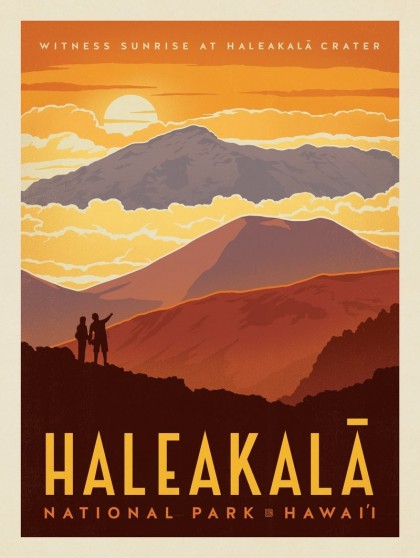 In the month of the Mountain Moon Kilauea has reminded me that my interest in mountains precedes the Rockies. My first mountain driving experience was Haleakala on Maui. I learned there that you don’t have to brake going up, take your foot off the accelerator and the mountain takes care of you.
Haleakala means house of the sun and on one of our trips to Maui I did the tourist thing of seeing the sunrise on Haleakala. As we rode in the small van around 4 a.m., the skies were cloudy, rushing across the island, allowing the full moon to become visible, then blocking it out. Even though we were on Maui, a tropical paradise, the early morning temperatures on Haleakala’s summit, 10,023 feet, were cold and windy. Black Mountain, visible from my window here in the loft, is 10,731 feet.
 Hawai’i put vulcanology on my oh this fascinates me list. On a visit to the big island, Hawai’i, we drove the Highway east out of Kona, traversing first Hualalai, which sits just above Kona, then Mauna Loa, the long volcano, and finally, climbing up the eastern flank of Mauna Loa we went past Kilauea. We did not go in that day, driving on to Hilo town. On our way back, later that evening, we drove along the southern flank of Mauna Loa again, the air scented by gardenias and jasmine.
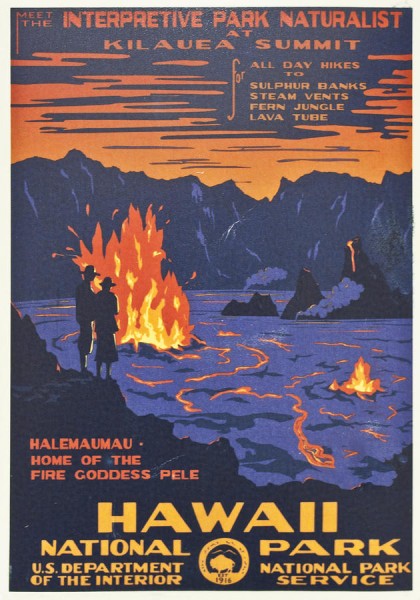
In 1999 we visited the Big Island again, this time staying in Volcanoes National Park at Volcano House. We were there for two weeks. Learning the language of volcanoes was easy there: fumaroles, vents, calderas, pahoehoe, ropy undulating lava, and aa, fragmented sharp blocky lava, lava tubes, magma, magma chambers, and the home of Pele, Halemaʻumaʻu Crater. (see poster above)
Hiking a long path around the summit, walking on lava flows where the Pu’u O’o vent added to the land mass of the Big Island, exploring inside now drained lava tubs with ferns growing from the ceilings and reading about volcanoes gave me both an experiential and intellectual immersion. I’ve followed Kilauea off and on since then and the news coming out of the Big Island has me riveted.
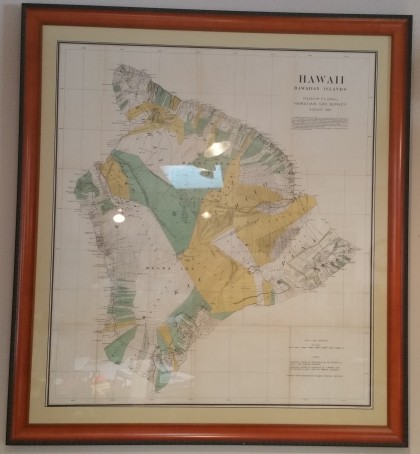 Maps. Kate bought me this wonderful vintage map of the Big Island. It now hangs in a prominent position here in the loft, reminding me of many adventures including our stay at Volcano House. Kilauea is in the yellow portion of the map that extends south to the Pacific and butts up against the large swath of green in the middle. The new eruptions are in the eastern, white segment that extends to the north from the point where Kilauea meets the Pacific. This is Kilauea’s eastern rift zone*. People building there knew about the rift zone, but hoped it wouldn’t affect them, much like we hope our location in the Wildlife Urban Interface, WUI, won’t result in our home burning down. Mother Nature gives no passes for human hopes however. She decides when and where things happen, according to her own laws.
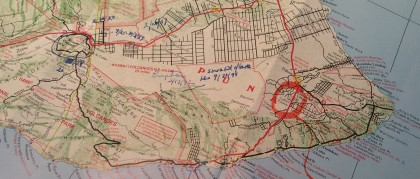 Over years of travel I have purchased maps and annotated them. I did this especially in Hawai’i where we visited often while Kate practiced. It is a popular location for continuing medical education. Each time we visited I would mark where we had gone, the date, sometimes a brief note though the longer explanations were in my notebooks. We spent time on Maui, Hawai’i, and Kaua’i, enjoying all of them in turn. Each has their particular charms.
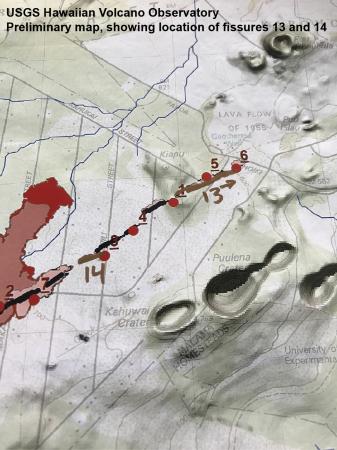
The section of my Big Island map above shows the eastern rift zone area with our 1999 visit marked by the black circle in the upper left and the current eruptions in the Leilani estates circled in orange. The Lo’ihi seamount, the latest island of the Hawai’ian archipelago forming beneath the sea, is just south of the shoreline shown here. It’s the volcano that is most directly over the hotspot** which has formed the whole archipelago.
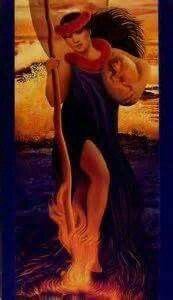 In 1999 I stood on the rim of Halemaʻumaʻu Crater. Next to me were empty bottles of gin and rum, sprays of flowers, especially red ginger and bird of paradise, a lei of gardenias. These were left by native Hawai’ians who came here to worship Pele, the goddess of fire, of volcanoes, of creativity. This is, according to Hawai’ian theology, Pele’s current home though I imagine she will be moving in the next few thousand years to Lo’ihi.
Rudolf Otto, the German religious philosopher who wrote about the nature of the holy, said it combines two elements: awe and the mysterium tremendum et fascinans***. Gazing down over the rim, looking 150 to 200 feet to the crater’s floor, awe came bubbling up at me. In 1999 Pele’s home had no active, visible lava, but just knowing that the magma existed below a thin crust of cooled lava was enough. There is a large lava lake in the crater now.
Otto could have written these words to describe my feeling: “overpoweringness, majesty, might, sense of one’s own nothingness in contrast to its power.”
Wordsworth, too, in the World Is Too Much With Us:
“I’d rather be
A Pagan suckled in a creed outworn;
So might I, standing on this pleasant lea,
Have glimpses that would make me less forlorn;
Have sight of Proteus rising from the sea;
Or hear old Triton blow his wreathèd horn.”
The lava on Kilauea is about 2,200 degrees Fahrenheit. Various magma chambers up to six miles below the surface feed the lava flows into Halemaʻumaʻu Crater, formerly fed (up until this last week) Pu’u O’o and now feed the fissures breaking through the eastern rift zone 21 miles from the Kilauea caldera. Here is the raw power of our wild universe visible in its most primal form, kin to the winds of a hurricane, the awful speed of a tornado, the waters of a tsunami, flooding rivers, avalanches, wildfire, orogeny. Nothing subtle at all in these forces; we ignore them at risk to ourselves and those we love.
I need no book, no prayer, no revelation of another. Here is the great wild, the generative power of the tao laid out for all to see. Stand in a sanctuary and feel no more divinity than in their presence. Visit St. Peter’s or the Temple Mount or the Wailing Wall or Angkor or the Great Medicine Wheel and know no more of the sacred, the holy than when the heat of the lava brushes your delicate skin. Pele’s touch.
*Rift zones are areas where the volcano is rifting or splitting apart. The rock in a rift zone has many cracks and is relatively weak, and thus it is easiest for magma to make its way to the surface through these rift zones.
**Hot spots are places within the mantle where rocks melt to generate magma. The presence of a hot spot is inferred by anomalous volcanism (i.e. not at a plate boundary), such as the Hawaiian volcanoes within the Pacific Plate. The Hawaiian hot spot has been active at least 70 million years, producing a volcanic chain that extends 3,750 miles (6,000 km) across the northwest Pacific Ocean. Hot spots also develop beneath continents. The Yellowstone hot spot has been active at least 15 million years, producing a chain of calderas and volcanic features along the Snake River Plain that extends 400 miles (650 km) westward from northwest Wyoming to the Idaho-Oregon border.
*** Rudolf Otto and the numinous
“Mysterium tremendum et fascinans” (fearful and fascinating mystery):
Spring Mountain Moon

Yes, it arrived. The bad Samsung got hauled away ignominiously with nary a tear of loss or grief. The new Kitchenaid now glares from its Cylon lens, hunting for dirty dishes, pots and pans that need a wash. This morning I walked past it and a single word glowed on the small screen visible from the front: CLEAN. Oh, joy. Oh, bring on the robotic revolution.
 Buddy Bill Schmidt shared a paper sent to him by a friend from JPL, Jet Propulsion Laboratories. It’s title is: Science and Enabling Technologies for Exploration of the Interstellar Medium. Exploring among the stars. I mean, wow. Still an avid reader of science fiction, I thanked Bill and noted in my reply that we live in a time when science fiction and science fact often intersect. One of the delightful realities of living through this particular era.
Since we have a deep freezer drawer filled with ground beef from our quarter we bought last fall, I picked up an important cookbook, The Essentials of Cooking Ground Beef. In it, to both Kate and mine’s delight, is a recipe for the famous Matt’s jucy lucy’s. This recipe is for sliders and last night I divided a pound of hamburger into eight parts, balled them up, dented the ball with my thumb and stuck white cheddar inside. Hmmm. Tasty. Served with frozen Arby’s curly fries, dill pickle slices and haricourt vert. OK, that last dish didn’t really fit, but I always like to have a vegetable and it was available.

As the photo at the top shows, we did get another round of snow yesterday. Maybe four inches. All of it welcome. Precipitation, especially now, aids to some extent in fire protection and recharges the ground water. When your daily water comes from the ground water, having moisture to replace what’s been used is important. Water is safety as well as life here. Without it we become vulnerable to lightning strikes, visiting campers and the odd animal trying to navigate high voltage power lines.

Kabbalah tonight. More about time. Qabbalah is another way to explore the interstellar medium, a matrix of space/time with its deep roots in what I’ve learned the mountain and rivers poets of ancient China called absence. Absence is at the heart of Ch’an Buddhism, that peculiar blend of Taoism and Buddhism that emigrated to Japan to become Zen. Absence is the place of the Tao, the generative force that gives rise to the ten thousand things in all their uniqueness and detail. Learning to penetrate the gauze of sensation and feel your way into the absence behind it leads to enlightenment. In fact, both Ch’an and its child, Zen, believe in instant enlightenment; once you learn this truth in your core, you know what needs knowing. Absence makes the heart grow wiser.
Oh. I did get my cleaning, reorganizing finished. Spiffed up and ready for a return to both writing and sumi-e.
Imbolc New Life Moon
 Had a strong sense yesterday of the tao. Often elusive for me, yesterday had a distinct flavor, a wind blowing through the events of the day and I rode with it.
Gabe’s sick, a croupy respiratory bug. Now, Jon has to deal with this as a single parent. A sick kid and two working parents is hard, but a sick kid and two divorced working parents is harder.
Into Aurora yesterday at eight a.m. to pick Gabe up and bring him up here. It was daylight saving time, the next day, and I felt loggy, off, a mild buzzing in my head and stomach not quite settled. There’s only one route to Aurora from here, Hwy 285 which becomes Hampden Road in Denver. Hampden runs through southern Denver, four lane at points, six lanes at others, lots of businesses, especially past Interstate 25 headed east.
I’d waited until eight to leave to avoid rush hour. The tao of the day laughed. At about Swedish hospital traffic seemed to slow, slow, slow, then crawl. And, occasionally, stop. Three lanes of traffic clotted. And, the clot lasted. Usually, from Swedish Hospital to Colorado Avenue is about a three minute drive. Thirty minutes. A lot of it with plenty of time to read the warning label about the semi-fluid lubricant in tire bearings on the semi sitting next to me.
 It was jaggedy, edgy tao, putting up barriers, then releasing. Gabe had his own struggle with this tao. I was forty minutes late picking him up.
We drove back to the mountains in silence. My hearing aid battery died in Lakewood, about thirty minutes from home. Even with the hearing aid, the noisiness of the Rav4 makes hearing Gabe’s soft voice from the back seat impossible for me.
Once home Kate had to leave for a mani-pedi, so I remained in the house in case Gabe needed anything. He came with a cooler containing ginger ale and cheese.
I felt jangly, stomach still off. Reading the Third Plate kept my mind distracted, a positive barrier to temporary discomfort. This book has a lot to teach. Of the many key learnings so far, one that keeps coming back like a ruminant’s cud was a short encounter between Dan Barber, the author, and Wes Jackson, a hero of mine who runs the Land Institute in Kansas.

Dan had visited an organic farmer in upstate New York who “listened to the language of the soil,” reading soil health from the weeds that grew in his fields. This particular formulation, language of the soil, grabbed me because I had come to the same metaphor over my years of gardening in Andover. The soil speaks, tells you what it needs. You just have to see what you’re looking at. This farmer’s attention to that language resulted in an organic farm, growing mostly heirloom varieties of corn, wheat and other grains, intermixed with soil healing crops like spelt and clover.
After Dan told Wes about this farmer, he nodded. “Yes, Dan. He sounds like a great guy, but it won’t last.” Someone else, he went on, will buy the farm and all of the careful reading of the soil’s language will disappear. The chemical/industrial farming ethos will return. When Wes recognized Dan’s disappointment, he said to him, “What can I say? We live in a fallen world.”
 This anecdote has stuck with me, I think, because of the sale of our land in Andover. We did so much, worked hard at creating soils that would grow healthy, vibrant plants, but then we moved on.
It was the tao of Monday, a slow pulsing tao that put up obstacles, then took them down. It placed Gabe’s illness alongside a huge accident with ambulances and fire trucks, wreckers, clean up crews and three lanes of traffic forced down to one lane. It put Wes Jackson’s sigh alongside my sensitive stomach, alongside Kate’s beautiful nails, calming her and getting her ready for surgery next week. Rigel once again pushing her nose into us, pacing. An obstacle. Back on the metronidazole.
Riding with this tao I let the obstacles and their resolutions wash over me, not as frustrations (mostly), but as the way of this Monday. When the day was over, I was glad, especially glad to have been sensitive to the tao.
Imbolc New Life Moon

“The noun simcha is mentioned in the Bible 94 times and is derived from the verb samach, which appears 154 times in the text. It is rooted in the Akkadian word shamahu meaning sprout or flourish.” Simcha, The Dayton Jewish Observer
A thing of beauty is a joy forever. So says Keats in his Endymion. Kate and I are leading the mussar class on Thursday, focused on joy and sadness. What else is a joy forever?
Most of the material I’ve read about joy distinguishes it from pleasure with a time distinction. A bite of food, a kiss, a winning hand, a new toy brings pleasure in the moment, but the pleasure dissipates quickly. Joy, to paraphrase Keats, is a thing of beauty forever. Joy, in other words, is lasting.
Rabbi Jamie says true joy can be recalled and experienced again whenever we want. Not fully sure about that, but a finger on the scale in favor of a lasting experience seems right to me.

Kate has come up with an exercise that will get us started on considering joy in our own lives. She designed a sheet with three columns: single-digit, adolescence, adult. We will write as many instances of joy as we can recall from each of these life phases. My hope is that in telling our stories of joy that we can experience them again and help others experience them with us.
How can we increase joy in our lives? Can we? (A)…rabbinic teaching concerning simcha points to the inner self as the source of contentment and joy. “Aizehu ashir? Hasameach bechelko, Who is rich? He that rejoices in his own portion (Avot 4:1).” ibid
So at least part of joy is perspective. What makes our life rich? Joyful? Knowing what is enough. What is enough? No less than we need, no more than we require. This seems to link joy to gratitude. If we have enough, we are grateful for what we have. Our life gains in simplicity since we don’t end up on the constantly promoted hedonic treadmill.
With simplicity, then, we know deep satisfaction. Not only do we have enough, but we do not waste our energy and our worry on getting more. Ah.
 Last week at mussar we had a fascinating conversation on the essential dourness of both Jewish and northern European cultures stimulated by the Norwegian concern that they had won too many medals in the winter Olympics. In both cases happiness, and by correlation, joy, are suspect. Why are you so happy? What makes you think that will last?
In the Jewish instance this trait seems to correlate with the multiple times in Jewish history, starting with slavery in Egypt, that a golden age or at least a comfortable existence had been destroyed by pogroms, the expulsion from Spain, the holocaust. Are you happy now? Just wait.
In the northern European instance it seems to have more to do with seriousness. “For the soul is dead that slumbers, And things are not what they seem. Life is real! Life is earnest! And the grave is not its goal; “Dust thou art, to dust returnest,” Was not spoken of the soul.” Psalm of Life, Henry Wadsworth Longfellow

Both cultures, in other words, find joy and delight and glee and exultation, ecstasy and exhilaration suspicious at best and distracting at worst. Distracting from what? From the possibility of life’s stability being snatched away in an instance. From the need to keep the shoulder to the grindstone, quite literally. From the guardedness that protects us from disappointment, suffering, pain. Joy may make us vulnerable.
So it’s no wonder that joy is a middot, a character trait that needs cultivation. The soil for it is rocky, like that in our backyard here on Shadow Mountain, at least in these two cultures.

How to do that? I chose to scan my life looking for joyful moments. My hope is that I can begin to identify in the now, embrace them, live in them. Looking at my list (it’s posted here.) I can see some common threads. Intimacy: seeing Orion at night, dogs nuzzling, the mountain night sky full of stars, hugging Kate, hearing from Tom, Bill, Mark, seeing them. Challenging myself: learning Latin, using my sumi-e brushes, grinding ink, having a new idea, reading a new book, writing ancientrails. Letting the world in: driving over Kenosha pass and seeing South Park laid out ahead, the golden aspen among the lodgepoles on Black Mountain, paying close attention to the natural world. Being in community: working with Marilyn and Tara and Anshel, setting up for adult education events at Beth Evergreen, having an idea, sharing it, seeing something happen. Travel: hearing the howler monkeys on the road to Angkor, leaving for a trip, rolling retreats (roadtrips), the earthen smells when getting off the plane on Maui, Kauai, Hawai’i. Inner moments: the moment of mystical connection with the universe in 1967, meditation, remembering the two year old me who learned to walk after polio, mindful cooking.
One track for increasing the joy in my life then would be to seek intimate moments, identify new ways to challenge myself, stay alert and let the world in, continue at Beth Evergreen, travel, allow time to cultivate the inner life.
“On the bright side, simcha is a word laden with exhilaration and festive activities. Simcha expresses not only the joy of an event, but it is also the noun which means a happy event.
A holiday is a simcha, a family gathering is a simcha, a wedding is a simcha, the birth of a child is a simcha and a Bar or Bat Mitvah is a simcha.
The host of an event is a baal simcha and the sound of joy resonating from the event is kol simcha.
Simchat yetzirah, a joy of creativity, is a way to describe the exhilaration one feels while being engaged in a creative process…
(A)…rabbinic teaching concerning simcha points to the inner self as the source of contentment and joy. “Aizehu ashir? Hasameach bechelko, Who is rich? He that rejoices in his own portion (Avot 4:1).” ibid
Imbolc Imbolc Moon


Through the Platte Canyon, over Kenosha Pass, onto the highplains of South Park, past Fairplay, into the Collegiate Range and finally to the Liar’s Lodge in Buena Vista on the Arkansas River, not far from Leadville. Picked up Kate and Valerie, two Bernina’s, lots of cloth, a suitcase, cutting boards and other accessories of the sewing life. Also petted Sadie, the dog who greets all who come to Liar’s Lodge, then reversed course through a light snow that made the drive out of Buena Vista picturesque.
About ten miles out of Buena Vista, on a hill, with no traffic in either direction, a man in a black SUV pulled onto the highway into my lane and I had to swerve to miss him. Sent my heart rate up. This is steep, curvy country with so many possible sources of accidents, but this one? Would have been stupid, stupid, stupid. Other than that the drive was uneventful.
Here are a few photographs. I stopped along the way, taking time to look, to see. So much more to explore here in Colorado. And all this is within an hour and a half of home.


Imbolc Imbolc Moon
 Off to Buena Vista in about an hour. To the Liar’s Lodge. Kate will be there until Monday noon, sewing. A quilting retreat. I’m taking her out and picking her up.
Once we get past Fairplay, about 45 minutes or so west of here on Hwy. 285 and the county seat of Park County, we’ll be in new territory for us. I’m excited to see more of South Park, the large high prairie that begins at the Kenosha Pass. Total trip is around 1 hour and 45 minutes according to Google.
Imbolc Imbolc Moon

Brief continuation of the post below. Thinking about destinations and journeys some more. A thought triggered by a BF Skinner example of creativity, “A chicken is an egg’s way of making more eggs.” Perhaps destinations are our way of creating journeys. Perhaps destinations exist to insure that we travel, get out of our comfort zones and investigate ourselves on the road.
I don’t know whether it’s still au courant in physical anthropology but there was a theory that travel in the African bush was responsible for our increase in brain size as a species. When we crossed large open spaces while hunting and gathering, we were vulnerable, a predatory species without the usual predatory equipment of fangs, claws, rippling muscles.
The theory was that to stay alive we had to be very good at noticing movement, noticing danger and that that increased work for the brain. The humans or pre-humans who were best at that task survived and presumably selected for large brains. As a result, some have speculated that our brain works best when we’re in motion.
Just thinking out loud here.
Imbolc Imbolc Moon
Wanted to mention two internal conversations. Both have occurred while in transit through the mountains.
 The first, perhaps the simpler, has been about how to describe our environment in the most economical way possible. I know, I didn’t say it was deep, just persistent. I’ve come to these nouns: sky, evergreens, slope, rock, streams. Yes, it leaves out houses and wildlife, roads and cars. But. The context for life up here can be described using those five words.
The second has been about destinations and journeys. Whenever I leave home, on foot (rare) or in the Rav4, I have a destination in mind. I’m leaving Black Mountain Drive and going to Beth Evergreen or to Jon’s house or to King Sooper or to Dazzle. Something is attractive enough or is needed enough to make me get up, go outside, start the car and go.
Because of these motivations, whatever they are, the journey tends to focus itself on the destination. Not surprising, eh? What do I need to get at the store? Did I remember everything? My wallet. Coffee. Keys. Phone. The destination can infect the entire journey, put us in blinders so that we’re like horses headed to the barn for hay.
Yet. The journey can occupy more time than we spend at our destination. But we view it as incidental and the arrival at the destination the real act. This is not about whether the destination is more important than the journey, the two require each other, rather it’s about intention and attention.
 If the present is all we ever have, and it is, then the journeys we take, no matter how mundane, are also the present at the time we are on them. There is no future. We only imagine it. There is no past, it is a memory. There is only this moment, keys clacking, letters and words appearing on the screen, a car going by, Black Mountain and blue sky out the window.
So. What? What I’m trying to do is appreciate the journey for what it is, not as wasted time between this destination and that one, but as an experience sui generis. Our whole life is a journey between emergence and disappearance, how sad it would be if we missed our life along the way.