Category Archives: Travel

Lucky We Live Hawai’i

Spring                             Mountain Spring Moon

Several years ago Kate and I took advantage of an after conference package in Hawai’i. The conference itself was on Maui, Kaanapali Beach, but the package allowed a three day extension at the Mauna Kea Resort on the Big Island, Hawai’i.

The Mauna Kea is unusual for several reasons. First, its location was a gift to Laurance Rockefeller for taking the risk, in 1965, of starting the resort business on the Big Island. He chose a site with a beautiful crescent beach of white sand. Second, Rockefeller had it designed by famous modernist architects from Chicago, Skidmore, Owings and Merrill.

Rockefeller went on an art collecting trip along the Pacific Rim and brought back works he instructed the architects to use as the center pieces of their overall design. The result is a mixture of Hawai’ian island romance with clean simple lines and materials used honestly. It is a beautiful place, one of my favorites.

Interestingly, very close to the Mauna Kea is a heiau, a Hawai’ian temple built by the powerful King Kamehameha, and named Pu`ukohola. Pu’ukohola is dedicated to the war god Ku. It is a site where human sacrifices were made and was built when Kamehameha wanted to unify the islands under one monarch.

Just a bit on down the road is a small restaurant where Kate and I ate a modest lunch. I had a local favorite, spam fried rice, which was delicious. We talked with our waiter who said, about living in Hawai’i, “Lucky we live Hawai’i.” I heard it other times, but that afternoon, after breakfast overlooking the white sand beach, a late morning visit to the temple of Ku, the war god, and a tasty basic lunch it seemed very true.

When I hear the islands call, and I do from time to time, what always comes to mind is “Lucky we live Hawai’i.”
 

Getting There

Spring                                             Mountain Spring Moon

To get to the seder we left Conifer at about 3:30 and drove into Denver, ignoring I-70 traffic, “that I-70 mess” as our mortgage banker called, we stayed on Hwy 285 to Monaco and drove up through the city from south to north. This has the additional advantage–to my sensibilities–of seeing the city as it changes from southern suburbs to its northern most neighborhoods, passing on the way through an area with streets named Harvard, Yale, Bates, Vassar, then Wesley and Iliff. This last is also the name of a Methodist seminary located on the campus of Denver University.

Going further north Monaco bisects the Cherry Hill neighborhood, a 1% enclave. Further on housing changes from low rise apartment complexes and condominiums to ranch style, one story smaller homes, but with big yards. Then Monaco becomes a four-lane boulevard with a park-like central strip and brick homes, some resembling small castles, others futuristic. Here the flowers bloom. Finally, we get to Martin Luther King, which extends to the eastern edge of Denver through the Stapleton new urbanism development. But we’ll turn on Pontiac, well before that.

On Pontiac we enter a predominantly African-American neighborhood, a couple of blocks west of Quebec, formerly a boundary street for the old Stapleton Airport and along which hotels were built to accommodate air travelers. Behind the hotels grew up a community filled with one story homes with little square feet and often desperate looking lawns, sometimes littered. It includes, too, the same homes with neatly groomed topiary, lush grass and, on Jon and Jen’s block, some older two-story homes, residue of an era before the airport was built, probably of an era before Denver reached this far toward Kansas and Nebraska.

Jon and Jen’s home was, according to house lore, originally a residence for a local farmer. Could be. They’ve done a lot of rehabilitation, adding on a new kitchen and dining area, plus a bedroom for themselves above. Jon’s done the bulk of the finishing work including tiling and plumbing two bathrooms. Outside Jon has several garden beds, fruit trees, a grape arbor, a tree house and a work shed where he produces hand-built skis.


Tourists

Spring                                   Mountain Spring Moon

IMAG1001Gabe and I had an adventure yesterday. We went to the Agro Mine Tour, ate lunch at Beau Jo’s Pizza in Idaho Springs and finished off the day with a soporific soak at the Indian Hot Springs, also in Idaho Springs.

The mine tour itself is a cheesy, tourist-trappy thing with a clunky video, corny presentations and a self-guided tour after that. Still, the Double Eagle Mine, Gage is at its face (end) in this photo is remarkable in that it was dug by hand, by two men over the course of one year. About three hundred feet long, maybe five and a half feet tall and about 4 feet or so in width, it’s a monument to persistence, if nothing else.

The rest of the tour focuses not on a mine, but on the Agro mill, which in its prime, produced $100,000,000 worth of gold when gold was at $18-35 an ounce. It was fed by the Agro tunnel, a 4.5 mile tunnel dug through solid rock to remove waste water from various mines and to create a small railroad to deliver ore buckets to the Agro mill.

The Agro mill closed in 1943 when, on the last blast of the day, four unlucky miners IMAG1000dynamited a wall holding back water filling up an abandoned silver mine. The resulting flood geysered water from the tunnel for 9 hours. In addition to killing the miners the flood weakened walls and caused cave-ins along the tunnels length making the railroad tracks no longer usable.

The mill itself went down in stairstep like levels since most of the work proceeded through the aid of gravity. The Agro tunnel fed ore in from the top of the mill and the processing went in stages toward the bottom. A structure made of wood it looked like an unsafe place to have worked.

Idaho Springs is about 30 minutes outside of Denver to the west and well into the mountains. The Colorado Mineral Belt, which begins in the San Juan Mountains in the far southern part of the state, makes an arc up through Leadville and finds its terminus just a bit further north from Idaho Springs. Along this arc lie most of the mines in Colorado, many of them producing, like the mines the Agro Mill serviced gold, silver, copper, lead and zinc. Some have molybdenum and other metals. There’s a big, working molybdenum mine outside of Leadville.

Idaho Springs is a tourist town, primarily, located on either side of a long main street paralleling I-70. It has some residential housing, but not much. Service stations, inexpensive motels, restaurants, curio shops, a knife shop, a hardware store which sells gold panning supplies, that sort of thing.

And the Indian Hot Springs. The facilities, both the main building and the adjoining motel, saw their better days many years ago. The springs, though, deliver. Gabe and I swam in a large pool of water, 100 degrees +. There are, too, hot springs caves, a men’s and a women’s cave where clothing is optional.  Kids under 16 are not allowed in the caves.

After all that, it was back to Denver and a quick exit so Grandpop could beat the rush hour traffic on the way home.


Why I Still Don’t Own Any Nihau Jewelry

Imbolc                                                                                               Settling Moon II

From this day a while ago:

Why I Still Don’t Own Any Nihau Jewelry

WRITTEN BY: CHARLES – FEB• 17•08
Clouds with sun.  Kauai weather has more fluctuation than Maui’s.  I like it.  Rain, sun and volcanic soil are a potent combination for plant growth.  The evidence is everywhere.

Kate and I noticed an egret in a profuse plant.  He stood on a branch, launched his sinuous neck down, into the foliage, as if he were hunting in a pond.  He came up with a white wriggly something caught in between two orange halves of his beak.

I had ahi sashimi last night, the third or fourth time I’ve had this treat.  The Garden Salad had jicama and grapefruit with peanuts. Tasty.  And plenty.  Yet, we went ahead and ordered pad thai, which we did not need.  It came wrapped in a flattened, cooked egg.  Most of it came home to our in-room refrigerator.

The Big Save market in Port Allen was interesting.  Grocery stores always reveal the culture as clearly as any other institution.  Here you could find Korean and Japanese foodstuffs, plenty of fresh produce, lots of beach paraphernalia and an interesting collection of fresh fruits:  papaya, ron baton lychee nuts and apple bananas.

I had forgotten how curvy the road up to Waimea Canyon is.  Fun to drive.  The view coming back down lays out the Pacific for miles and the small communities that about it.

We passed the Waimea Plantation Cottages on our way yesterday.  We stayed there in 1998.  The cottages are old plantation homes made by sugar cane workers and have a unique single board construction.  Kate said she’d go back there if they added air conditioning.

At the Waimea General Store I admired the Nihau jewelry.  Lei’s, necklaces and earrings made from tiny, tiny shells and matched for color.  I remembered wanting some of this, but I forgot why I hadn’t bought any the last time we were here.  A nice lei, the lady told me, was 19.95.  I thought, great. I’ll buy that one, then.  She turned it over and the price was $1,995.00!  Oh, yeah, now I remember.

We’re headed for a day exploring in a different direction from yesterday.
Edit Posted in Travel , , Kauai | No Comments »

Liminal consciousness

Fall                                                                               Falling Leaves Moon

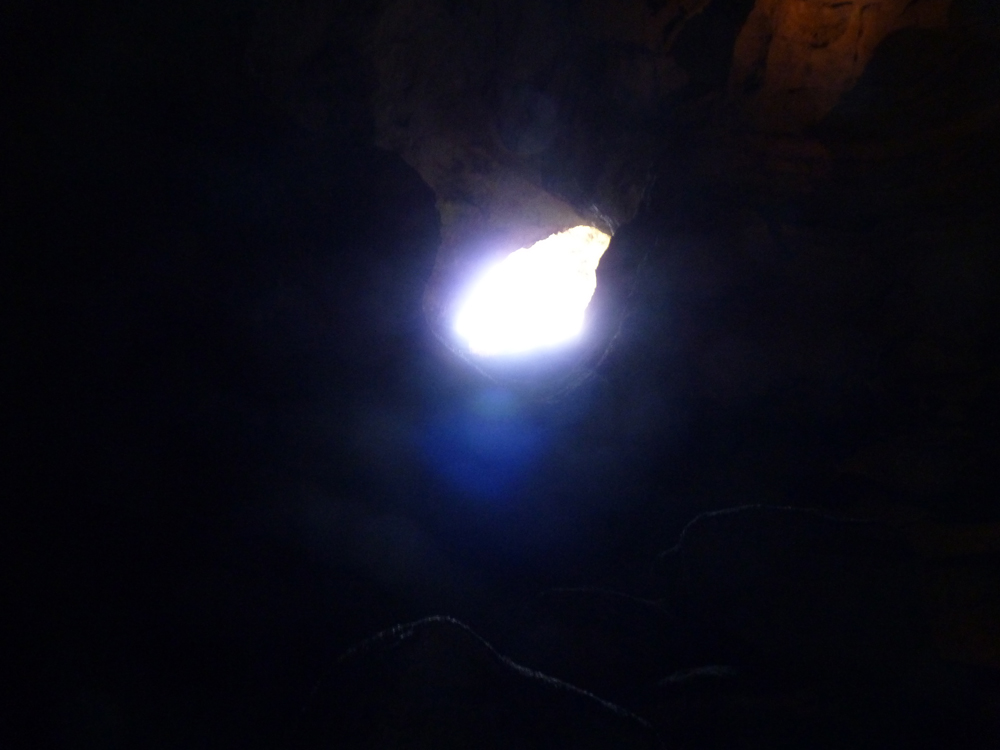
Carlsbad Entrance from the twilight zone. Beyond this point there is no natural light.

Stood tonight, arms on our mantel place, a fire crackling below me, wondering. What will I lean against this time next year? Will I hear wind coming down the mountain, the bugling of elks, the cough of a mountain lion? There might be frost on the plants outside and a chilly night ahead.

This is not I wish I would still be here kind of wondering, nor is it I wish I knew where we’ll be next year. It’s just curiosity, a sort of advance scouting. If all goes well, by this time next year-in the Great Wheel season of Mabon, a bit more than a week after the fall equinox-we should have been in our new place for over half a year. Strange to consider that.

Liminal consciousness. It arises when we know a transition is upon us, a time when we are no longer where we were, nor are we where we’re going. The weeks before a marriage. The summer after graduating from high school. Pregnancy. Interviewing for a new job. Getting ready to move to another place. In the broadest and most ultimate sense of course life is a liminal moment between birth and death. Liminal consciousness arises when we wake up to our condition.

Tonight, on our fire place mantel, I woke up again to the physical sense of moving and of

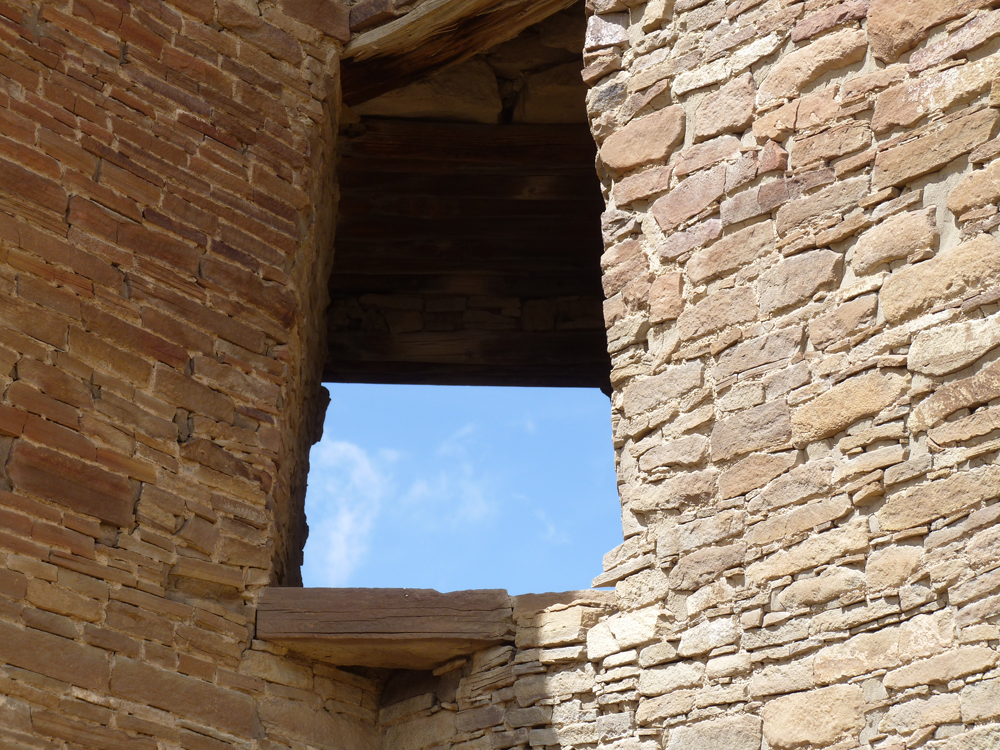
Angled window close up Chaco Canyon
Angled window close up
Chaco Canyon

having been moved. That awareness gripped me and I lived in it fully, not for long, not in a wistful way, but I was in it. Now that moment is in the past and I’m in Minnesota, with moving tasks and daily life here capturing and holding my attention. As is appropriate.

But stay aware for those moments of liminal consciousness. When they come, they have learnings for you.


Vive la difference!

Lughnasa                                                                  College Moon

How different we are from Europe. Scotland has a population of 5.3 million, Ireland about 4.6 million, England 53 million. California alone has 38.3 million people. Texas 26.5. New York, 19.6 with New York City 8.3 million. Of course, we’re all tiny compared to the behemoths of India and China, but I’m interested right now in Scotland’s vote, underway right now, for its own independence as a nation.

It’s as if Minnesota were a dependency of Caltex and wanted to break away, put up its own borders and start issuing passports. My point here, heightened by our upcoming move to Colorado, is that we move between states often equivalent in size to many of the storied nations of Europe: Netherlands-16M, Greece 10.6M, Sweden 9.5M, Denmark-5.6M. Iceland-324,000.

Think of the history of Greece. Greece! The wine-dark sea. Homer. Zeus. the 300. Or, the Netherlands, home of Spinoza, holding back the sea, pot-friendly, deeply anti-semitic. Or, Denmark, Hans Christian Andersen, Copenhagen. Places redolent with backstory, filled with the architecture and the palmprints of genius.

Minnesota and Colorado sit next to each other on the population chart: Minnesota at 5.4M and Colorado at 5.2M. We could be moving from Denmark 5.6M to Norway 5M.

Imagine crossing borders, having to register as a resident alien or the equivalent, learn a different language, be aware of a different deep history. And in that imaginary case only moving 375 miles. While we will go 966 miles, almost 3 times as far to arrive in another “nation”, where the natives speak our language, share our currency and most of our habits and customs. We are a big country and our relative unity is a wonder. It might even be a miracle, albeit a very human one and no less miraculous for that. Too, we’ll have remained roughly within the center of the nation, with hundred of miles to go to an ocean from either place.

We’re so young to be so strong. And yet the world looks to us, perhaps less so now, but still…é

Scottish Independence? Yes.

Lughnasa                                                                               College Moon

The global market in television programs, which has increased its reach now that aggregators have entered the market, offers insights into other cultures. I’ve found a clue about the English/Celtic divide in one of them.

Kate and I have converted our television viewing to Netflix, Hulu and Amazon Prime as I’ve mentioned before. A knock on effect (as the Brits would say) has been an increase in watching BBC shows: Waking the Dead, Life on Mars, Ashes to Ashes, Line of Duty and others whose names I can’t recall. We’re currently watching MI-5, a long running show that features Britain’s internal security service, a combination of the CIA & the FBI.

It’s interesting as drama. They have us on edge at least once during most shows. It’s equally interesting as a reveal of stereotypical British views, especially of other countries. The Americans are loud or devious or arrogant, or, often, all three. The French. Well, they’re French and can be dismissed pretty much.

The Celts have representation on the show mainly through the IRA which MI-5 portrays as ruthless, blood-thirsty and callous. Which mirrors exactly the Irish attitude toward the English, their long time occupiers. The Welsh show up occasionally and the Scots appear mostly through the Glaswegian accent which I’ve learned to recognize.

The other night Harry Pearce, head of MI-5, made a remark about the Celts. I’m paraphrasing: Oh, you know there’s no such thing as a Celtic race. Doesn’t exist. This is an ethnocentric point of view, one which posits English culture as the norm (not really a big surprise in that attitude) and uses it to dismiss the cultural roots of the Celts.

Culture does not equal race, never has. Race, in fact, is a nonsense phrase in terms of the homo sapiens gene pool. Yes, people discriminate on their folk understanding of race as discernible by skin color, but genetically? The differences that do exist (and they are minor) have no correlation to racist typologies.

One clear marker of culture has always been language. Find a different language from your own and you’ve usually found a different culture. All the Celtic lands have some form of the Celtic language as their historical tongue: Welsh, Irish Gaelic and Scots Gaelic chief among them though there are variations on the Isle of Mann, Brittany (Briton) and Galicia (a Celtic province in Spain’s far northwest). Probably Cornwall, too, but I’m not sure about that.

Then, there is the matter of history. The Picts (Scots), Welsh, Irish, Manx and Cornish were the indigenous people of the British Isles. Yes, they were immigrants likely, too, sometime after the culture that built Stonehenge and before the Roman and Anglo/Saxon invasions, but the various tribes of the Celtae were in place long before the Anglo/Saxons, the direct ancestors of the English.

The English have a subdue, occupy and rule mentality that did not begin in the days of the British Empire writ global. No, it began, like most good empires do, close to home. The Scots held off the British (and the Romans, Hadrian’s Wall) the longest, succumbing only after a Scottish king, James Stuart, inherited the British throne, but Scotland has a long, long history of self-rule, the longest of all the Celtic lands.

Harry Pearce of the television show MI-5 had it partly right, there is no Celtic race (no black race or yellow race or white race or brown race either), but the bald attempt to dismiss the Celtic reality, its long and distinctive history and culture, is not, again as the British say, on.

A Death in Brazil

Lughnasa                                                                   College Moon

7th and 16th in GDP. 5th and 4th in population. 5th and 15th in geographic size. What are Brazil and Indonesia? I know little about either one. Trying to plug that gap at least a little I just finished a remarkable book called, A Death in Brazil, by Peter Robb.

(farofa fried cassava (manioc) flour)

It’s a strange book structurally and in terms of genre, impressionistic in its use of anecdotes sprinkled through research on Brazilian colonization, slavery, key literary figures and recent political ethos (through 2003).  It is a Conradian evoking of the steamy foreign with strange, slightly distant figures acting and reacting in ways both understandable and despicable, and repetitive.

Yet, it is also a travel book, apparently recounting the author’s journey’s in Brazil, particularly in the northeastern coastal city of Recife. These passages go into detail about native Brazilian foods like farofa and moqueca de camarão (left).

Robb’s through line is about the first democratically elected president of Brazil, Fernando Collor and his money man, PC Farias. He recounts Collor rise to power in the small, poor state of Alagoas and PC’s role as his money man. Lula, the union organizer and presidential hopeful for the Worker’s Union Party, is the contrast to Collor, a man of the people rather than a man of the monied elite.

The book weaves in the work of Machado de Assis, Gilberto Freyre, and Euclides da Cunha, using these literary figures as lenses for viewing Brazilian society. It’s a clever deployment of literature because it illuminates the socio-political landscape of Brazil while focusing on Brazilian literary classics.

When finished, I had at least an outline of Brazilian history from the time of Portuguese colonization through 2003, an introduction to the slave trade and its unusually cruel instance in Brazil (the largest total number of slaves ever in the Western hemisphere and Brazil did not end slavery until 1888.), the political dynamic between the huge rural regions and the populous cities like Rio and Sao Paulo and an update of Brazilian political processes in the first decade of the new millennium.

Well worth reading.

Anybody know a similar book about Indonesia?


Border Towns

Lughnasa                                                Lughnasa Moon

My brother Mark is the most widely traveled of the three Ellis siblings. So when he makes a statement like this one, “I like border towns and the mixed energy of two nations that swirl around them.” it makes me realize I’ve not got a lot of experience with border towns. Detroit and Windsor. That’s about it.

(bill for an event in the State Farm Arena, Hidalgo, Texas)

Mark’s in Hidalgo, Texas right now as a medical tourist, getting dental work done in Reynosa, Mexico, just across the border. He walks to the border from his motel, pays one U.S. dollar to cross on a pedestrian bridge and bang he’s transnational traveler.

His comment about border towns makes me want to visit a few, just to see what he means. I know he has experience of border towns between Thailand and Cambodia, gained because every three months or so he had to do a visa run while living in Bangkok. Others, I don’t know.

The anthropologist in me says, aha, diffusion. And yes, it would be strongest where two cultures meet, but where they are supported by different political and cultural norms, that is, across national borders. U.S. culture could effect Reynosa and Mexican culture effect Hidalgo, safe within their own cultural envelopes.

(Pinatas in Reynosa, Mexico)

A Busy Time

Summer                                                                   Most Heat Moon

Ah. A week of guests, Jon and Ruth. 4 days with Kate gone, then 3 more days with a guest. Kate home.

Result? Weariness. A dullness and a minor sense of dispiritedness. An interesting word, this last. The spirit has gone, at least to some extent. The air has gone out of the tire, deflated. The body sags a bit, wanting to settle into a position of rest. There is to each breath the hint of a sigh.

Granting this description a full paragraph makes it sound more than I’m experiencing. It is a minor, will go away feeling. But, it is real. There is, too, a mild exhaustion. Recovery is not quite as quick as it used to be. That’s a third phase reality, too.

And, yes, it was all worth it. Jon and Ruth being here saw the deck get done, our move’s primary purpose strengthened, some important time with Ruth by herself. The time alone meant Kate was riding ahead, hand blocking out the sun, learning the mountains. Mary’s visit reaffirmed family ties, brought knowledge about mom and dad I did not have. So, yes I’m glad all of it happened and will be equally glad to have life take on its new norm as we continue to live in the move.

Today, though. A rest day.