Category Archives: Our Land and Home

Going Paleo

Lughnasa                                                                       New (Harvest) Moon

While snipping wild grapes off the vines that have overwhelmed a front rank of amur maples along 153rd, I was in pure paleolithic mode.  Hunter/gatherer.  No hunter, though the squirrels may drive me to it, but gatherer.  Yes.  These vines grow here.  They grew here before we came and produced well for several years along the six foot section of chain link; though now that has receded, for reasons I cannot discern.

The climbers on the amur maples had a bountiful yield this year.  It made me think our property would have been a stop on a seasonal swing looking out for grapes, blueberries, maybe raspberries, too.  We have wild raspberries,  but they’re less inviting to harvest and our cultivated ones are bigger and sweeter.  But these grapes are here because they like the location, have found it congenial.  Their plan for continuing the species includes many, many fruiting bodies in certain locations and this year our front was one of them

With a harvesting basket and small pair of grape shears I worked my way across about 15 feet of width and up to about 6 feet, snipping many clusters hanging within inches of the ground.  The September sun, no longer fierce at 9:30 am, beat down enough to warm me, a breeze whisked away the sweat.  Going paleo all the way, cave man.

Midwest Grimoires

Lughnasa                                                                  Honey Moon

Finished spraying.  As the crops come in, the amount of spray needed diminishes.  Today I really only needed the reproductive spray because the remaining vegetables are mostly in that category:  tomatoes, ground cherries, egg plants, cucumbers, peppers, carrots. Granted there are a few beets, some chard and the leeks yet to harvest but they seem substantial already.  They also benefit from the showtime, nutrient drenches and the enthuse that I will spray on Saturday morning.

Kate roasted the broccoli and froze it.  She’s also making pickles today, cucumber and onion.  She’s in back to the land, earth mother mode and has been for several weeks.  She consults her canning, pickling, drying, freezing books like grimoires from calico clad wise women of the rural Midwest.  And does likewise, tweaking the recipes when she wants.

A Co-op

Lughnasa                                                       Honey Moon

On a few occasions yesterday bees who had not left the supers buzzed about the kitchen as the extractor whirred and Kate ran the capping knife over the frames.  Each time I encouraged these bees to exit through an opened door and in all but five cases they found the way out.  In those others we caught them in plastic containers and freed them.  Two died, one caught in the door and one I don’t know why.  These bees are our partners in Artemis Hives and deserve respect and kind treatment.  Even if they don’t always show me the same.

It’s a repeated observation, but it’s unusual enough that I’ll make it again.  Kate and I share this property with a whole host of other animals who make their home here.  Chipmunks are the most visible mammals, but we also have gophers, rabbits, opossum, raccoons, squirrels, woodchucks, mice, voles and I have seen at least one marten though I realize he was far from his range.  I mentioned the other day snapping turtles transiting our woods, but we have other amphibians like frogs of least two kinds and toads.  Snakes, salamanders, and skinks live here too.  Many birds are at least here occasionally:  great-horned owls, crows, pileated woodpeckers, red-headed woodpeckers, chickadees, cardinals, blue jays, rose-breasted nuthatches and wild turkeys.  Deer and coyote come through our land from time to time, though it’s been awhile since I’ve seen deer.

This list doesn’t include other very important organisms in the top six inches of the soil and the other plants, from perennial flowers to vegetables.  Our woods has many oak, ash (so far), elm, ironwood, cedar, black locust, poplar and, of course, buckthorn.

It is so easy to imagine that we own the land, but it just isn’t true.  We have a temporary use permit, a years long pass to erect a human dwelling on already inhabited premises.  This permit comes from other humans who might want to do the same; it’s a rule of exclusion, keeping other humans away, but it has no effect on these other tenants.  They come and go as they will, choosing their homes in the ages honored way of finding a good nest site, an excellent burrow, a place to raise young under the shelter of a shed.

All we humans can do is enhance or destroy those options.  We don’t create them, maintain them or put them up for rent.  They are the last and true commons, that portion of the earth still used as it was long ago before the scourge of private property.  We only imagine we own it.


Prairie on my Mind

Lughnasa                                                              Honey Moon

I have an itch that I’ve waited now some twenty years to scratch and it may be about to happen.  When we moved in, I wanted to nix the lawn and sow prairie grass instead.  Now Kate is open to replacing most of our lawn with prairie grass and perhaps some new tree plantings as well.  I say open because she’s agreed to think about it.

We already have two large swatches of prairie on either side of our lawn, our compromise as we did the initial landscaping.  This notion came to me again while I walked in the eastern side of prairie grass and realized how at home and comfortable it felt: insects buzzing around, wildflowers blooming, a few trees popping up, milkweed ready to burst its pods.


The Honey Moon

8/11/2013  Lughnasa                                                    Honey Moon

BTW:  I don’t change moon names mid-month but when I realized this was the honey extraction moon I decided to go ahead.  Honey Moon is too good to pass up.

Finished moving limbs in the prairie grass area this morning.  In matters related to trees I have experience.  I learned long ago that if you line up the limbs in the same direction and pull them all together so that their branching parts follow the cut ends, moving them is easy.  If you don’t do it that way, you’re in for a frustrating time.  Of course, chipping them is the usual practice, but I like building up brush piles for critters and I’ve done that as the default option for years.  Not to say I haven’t chipped.  I have, but only when the amount was considerable.  Wasn’t the case this morning.

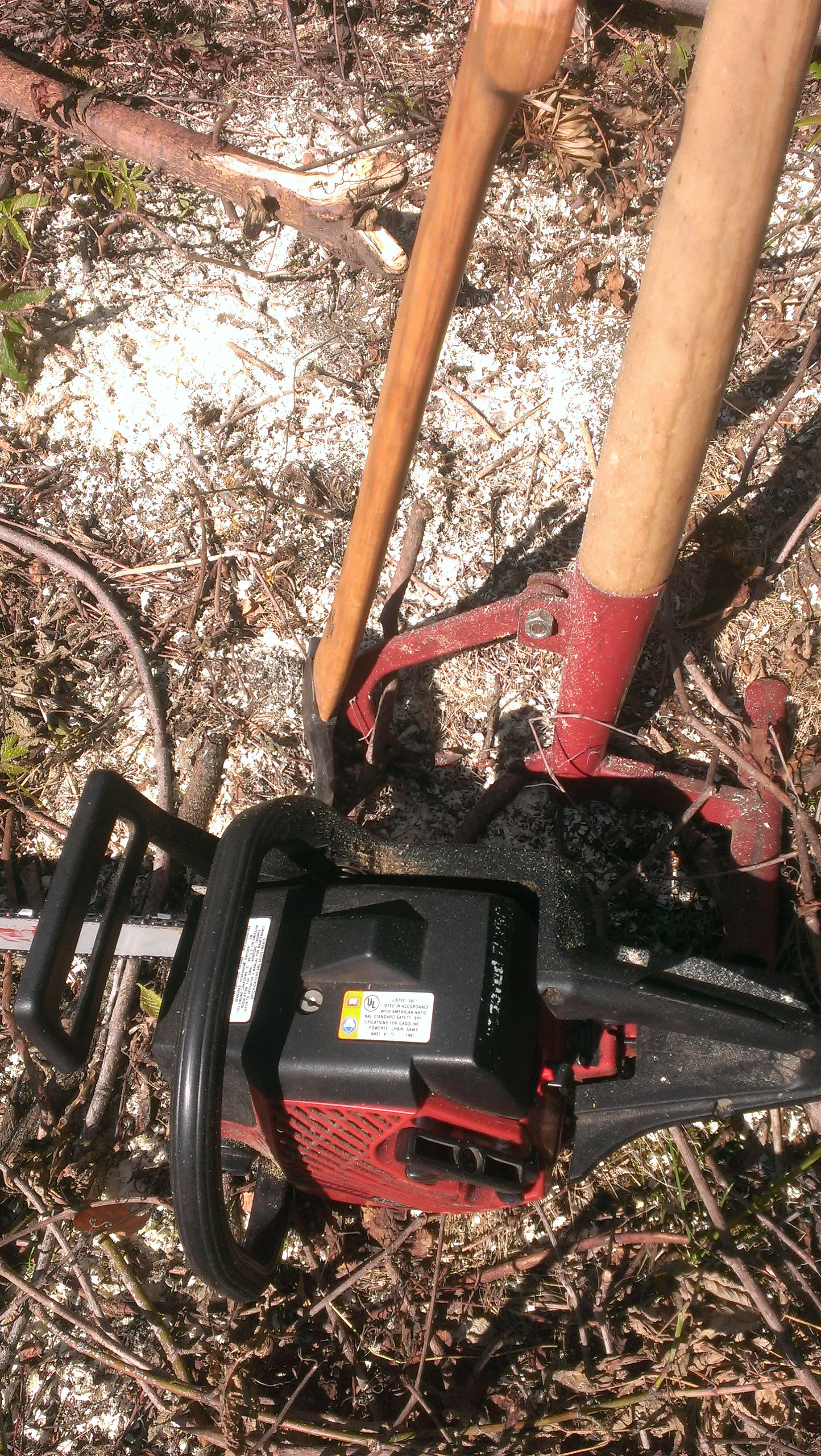
This project involved cutting down several ash trees and saplings that I had let grow up in the prairie grass area.  They had begun to shade the orchard and it was time for them to IMAG0746come down.  Past time, really.  I cut the trees down with the felling axe and limbed them with the limbing axe, but I used the chain saw to cut the trunks into logs.  The big pruners, 2 foot plus handles, allowed me to take out the amur maple saplings, too.  That area is now back to its original purpose, prairie grass and wild flowers.

Still plan to loaf today.  Sort of.  In my loafing I’m reading Madame Bovary and I finished the Communist Manifesto yesterday.  They’re both for my Modern/Post-Modern MOOC.  The guy who’s teaching it, Michael Roth, is the president of Wesleyan University and a scholar of French thought.  That makes the bias French thought, the touchstone he keeps coming back to in his examples and the source of several of the readings.  Though I took French in high school, I’ve not kept up with it and matters French have not figured significantly in my education, having a more English/German bias myself.  Gives this course a different feel for me and I like it.  But.  It’s not convincing me so far.

It’s not you

8/10/2013  Lughnasa                                                 State Fair Moon

Chainsaw man appeared today, cutting whole ash trees into firewood size chunks and moving limbs long distances.  When this gets back on Ancientrails, I’ll show you the Back IMAG0739to the Future safety goggles I bought.  German.

So.  In order.  My physician got sanctioned by the state medical board for over prescribing pain killers.  So, I then went to my next physician who, after a couple of years or so left to become medical director of an hmo.  Found Charlie Petersen, who was my physician for many years until he and his wife moved to Steamboat Springs, Colorado to live the horse and skiing life.  He recommended Tom Davis whom I’ve now seen for some years.  From whom I just got a letter saying he’s retiring.  Is it me?  They all say it’s me, not you, but I’m beginning to wonder.  Except for that first guy.


Living the Dream

Lughnasa                                                                       New (State Fair) Moon

Life seems to run from one irony to another, offering a wry twist often when you least expect it.  This irony is not one of those.  It’s been building for about 19 years, but it has begun to peak.  The irony is this.  The U.S. like the rest of the world, continues to urbanize with central cities beginning to outstrip ‘burbs.  “In 2011, for the first time in nearly a hundred years, the rate of urban population growth outpaced suburban growth, reversing a trend that held steady for every decade since the invention of the automobile.”*

What’s the irony here?  Now I find myself willing to defend the suburban or, in my case, exurban experience.  Why is that ironic?  Because I spent 24 years living in Minneapolis and St. Paul deeply involved in all manner of urban politics, working as an urban minister and eventually in charge of urban ministry for the Presbytery of the Twin Cities Area.  Though raised in a small town, I made the transition to solidly urban guy.  It was my profession, the city.

Cities burst with energy, offer sophisticated amusements, diverse places to live, a variety of foods to eat and the sort of jostling with others that sparks creativity.  They also make obvious the divisions in our society that a drive from the Northside of Minneapolis to Kenwood, directly south of it, epitomizes.  Even that last creates a juicy political scene with lots of different actors.  Fun.

And I love it.  Note the present tense.  I love it.  I enjoy being in the city and I love the kind of people who make cities their home.

Even so.  I now live in an exurb of the Twin Cities.  Only a couple of miles north of our home there are cornfields.  Surrounding our development is a huge truck farm with tractors and warehouses and rows and rows of carefully planted vegetables.  This is where the metro proper ends.  The MUSA line, the Metropolitan Urban Services Area, runs less than a mile south of our home. (see map)

Over the years Kate and I have made a life here that would not have been possible in the city.  We have a woods, several garden beds for flowers and vegetables, an orchard and a fire pit.  Our house has about 3800 square feet with the finished basement and we could never afford that much space in the city.  This combination of a large, relatively inexpensive home and land enough to create our own footprint has given us a rich and full life.

We have the suburban dream, that is, country living close enough to the city to access museums, orchestras, restaurants and political activity.  In my first days here I felt isolated and unhappy, far away from the things that had made me who I was.  As time passed though, I began to find a new person emerging based on what we had here.
It is, in some important respects, a narrower life.  Kate and I spend most of our time either outside or inside our home, but on our property.  In this sense the community oriented life of the city does not have a domestic equivalent here, at least for us.

Here there is silence.  Here we can focus on our creative activities:  horticulture, writing, sewing/quilting.  Here our life concentrates at our home.  This is similar to the farm life of millions of Americans prior to WWII.  Yes, it has its privations, but it also has unique benefits.

It remains to be seen how third phase life can be lived here, especially the waning years of that time.  We may find the distances too great for us, the isolation dangerous.  I hope not because I have learned to love this exurban spot as much I love the city.


*Time Magazine article, The End of the Suburbs

Garden Diary: August 5, 2013

Lughnasa                                                             New (State Fair) Moon

Nutrient drench today:  Inferno.  The weekly spraying of brixblaster and qualify.  The twice monthly spraying of Showtime.  Inferno is a liquid fertilizer.   Brixblaster encourages the plant to put its energy into reproductive growth such as flowers, fruits, vegetables like tomatoes, tomatillos, eggplant, cucumber, carrots, peppers.  Qualify encourages vegetative growth:  broccoli, cabbage, beets, chard, leeks, herbs.  Showtime, an oil based product, helps plants repel foraging insects.

A busy early morning in the garden. The results so far have been solid, so I’ll keep it up and add the orchard this fall.  I need to check the bees and put on the food safe miticide hopgard but working with bees when the sky is overcast is advised against.  Without the sun bees don’t travel as much so they’re at home.  More easy to rile them.  Wednesday will be plenty of time

There are still limbs to move, two trunks to cut into firewood and four large branches to cut into kindling.  That bee area still has to get cleared.  The tasks don’t end as long as the growing season is underway.

Dancing in the Garden

Lughnasa                                                         Moon of the First Harvests

We’ve settled into a rhythm that will continue until the last substantial harvest.  I go out in the mornings and harvest.  Kate then pickles, cans or freezes.  I helped with the garlic drying, but otherwise she’s done all the work.  We’ve had to clear the detritus out of the food storage room, gathered there over the winter and spring, because now trips down there for empty canning jars or to deliver full ones have become frequent.

Kate said she needed a calico dress and a gingham (Gangham?) apron.   I suggested a bonnet.  This work for her, right now, is primary in her life and she reports getting energy from doing it.  She must because she stands long hours in the kitchen.  Of course, she’s one tuckered out gal at the end, but the pantry has more stores and she feels good.

This whole garden is a dance with each of us playing different roles over the course of the season.  I have overall responsibility for the gardens and their health.  I do most, but not all, of the planting, all of the international ag labs supplementing and survey the various beds for plant health over the course of the growing season.  If there’s corrective action to be taken, that’s my job.  I bag the apples and take care of the fruit trees, also harvesting. (but not pruning.)

Kate weeds and that is one huge job.  One I don’t like.  She says it brings her satisfaction. I can’t get no satisfaction there so I’m glad she can.  At harvest time Kate takes the lead and chooses what kind of recipes to use and what methods of preservation to employ.  Near the end, when the leeks come in, I’ll make pot pies for freezing.  We both do fall clean-up and I plant bulbs.  Then the garden takes its long late fall and winter nap.

Putting Food By

Lughnasa                                                        Moon of the First Harvests

Finished turning much of our garlic crop and all of three boxes of farmer’s market garlic into thin shavings, put them in the dryer and turned it on.  We discovered last year that a very effective way to keep garlic is to dry it, thin.  The crop this year itself was thin necessitating purchase of some to get up to a quantity that we think will sustain us through the winter.  We like garlic.

Picked carrots, tomatillos and the first roma tomatoes.  Kate’s made pico de gallo and corn relish today and will make pickled carrots and daikon radish tomorrow.  This is the time when summer’s profligacy gets pickled or canned or dried or frozen since the plant world has little care for the distribution of its fruits beyond the spreading of seed.  Humans have had to overcome the plants long established plans for propagation in order to benefit optimally from the growing season.  It came in fits and starts, I’m sure, this storing of calories and nutrition, but the basics are the same now as they have been for a very long time.

When doing this work, blowing snow, howling winds and fire in the fireplace are ever present, the time when this work will make sense.  Right now it just leaves a pain in my already sore left shoulder.  That will pass.