Category Archives: Commentary on Religion

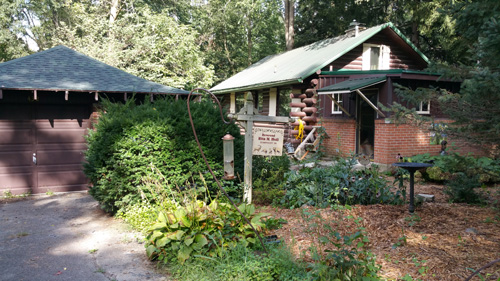
Shadow Mountain Monastery

Samhain                                                                      Thanksgiving Moon

Noticing as I cut down the trees, move the limbed branches and get ready to cut trunks into fireplace size logs that my body looks forward to the work. A riff on the Benedectine ora et labora. My prayer (ora) is writing, reading, translating. It’s easy for me to get stuck at the computer, in a book and neglect the rest of my body.

Workouts aren’t the same since they are artificial, moving my body for the sake of moving my body. That’s different than doing physically challenging work. With the work there’s the exercise of the body, yes, but it meshes with the satisfaction of accomplishment.

There’s a couple to three months of lumberjack work left, maybe more when you add in stacking the logs for curing. That’s good. With the winter there’s also the occasional snow blowing time, shoveling off the deck. Good to be outside.

Might consider trail maintenance when spring comes. Similar work.

Anco Impari

Samhain                                                                       Thanksgiving Moon

(Anco impari, Learning Still.) Goya’s small print with this title might be my third phase image.

Let me give you two very recent examples. In the first, granddaughter Ruth got a signal honor as one of ten students from her elementary school, named after Colorado astronaut, Jack Swigert, who got to meet the surviving Apollo 13 astronauts. The learning was this: Ruth wore a skirt. At 9 Ruth has her own fashion sense. It’s distinctive and one that includes neither skirts nor dresses.

Second, last night we took grandson Gabe to a Polar Express live event at the Colorado Railroad Museum. I had advocated this as grandchild time because Ruth, on a recent overnight up here, had watched the movie. But, Ruth’s astronaut event was the same night, so Gabe went without her.

He was not entranced with the Polar Express idea. He kept saying, “We don’t celebrate that.” That is, Christmas. He is a Hanukkah guy after all. Gabe had a book along, Goosebumps by R.L. Stine, and kept reading it during the evening. His diffidence and general orneriness irritated me. The whole night.

Later, out of the immediate context of the event, I had to admit to myself that I admired his willingness, in the way he could muster at 7, to stand up for his sub-culture, Judaism. We went to the event based on Ruth’s interest and I expected him to share it. Instead, he felt assaulted by things his family doesn’t emphasize. So, shame on me.

Then, this morning, as I worked up here, I heard clumping steps on the stairs. There was Gabe, smiling, rested and wanting to see Grandpop. Every day brings a new chance to relearn humility.


Kuku Tihar

Samhain                                                                               New Thanksgiving Moon

Again, highlighted by a friend, Paul Strickland. Kuku Tihar*. Kuku Tihar occurs during the celebration, in Nepal, of Diwali. (see below) This year Kuku Tihar, the second day of Diwali, falls on November 12th. Tomorrow. How will you celebrate your dog/dogs?

I was struck by the dignity of the dogs in the pictures I found of Kuku Tihar. The respect seems to carry its own profound message and bring out the seriousness of the dog.


*Dogs are especially important to Nepal’s Hindu practitioners. During day two of Tihar, Kukur Tihar, the role of dogs in human life and throughout history is celebrated. In theRigveda, one of Hinduism’s most ancient texts, Samara — the mother of dogs — assists Indra, the ruler of heaven, in retrieving stolen cattle. Hindu tradition holds that a dog is the guardian and messenger of Yama, the lord and judge of the dead. A dog is also said to guard the gates of the afterlife.

At the close of the Mahabharata, the king of righteousness, Yudhishthira, refuses to enter heaven without his devoted dog. The dog is revealed to represent the concept of dharma, the path of righteousness. During Tihar, each day is devoted to a honoring a different concept or entity: crows, dogs, cows, oxen, and fraternal relationships, respectively. On the second day, Kukur Tihar, all dogs are recognized, honored, and worshiped.   dogster.com

Pope Meets Kim Davis. So What?

Mabon                                                                  Elk Rut Moon

So. The pope met with Kim Davis. And certain parties are saying it means he’s lost all the good will he garnered while here earlier. Do I like that he’s giving aid and moral cover to what I consider a bankrupt moral position? No. Does that negate his calls for action on climate change, caring for the poor, the prisoner? No.

Politics is not this or that, black or white. Politics demands, to use a phrase coined by G. Bush I, coalitions of the willing.  So, we disagree with the pope on same-sex marriage. So what? To engage in litmus test politics is to swing ourselves into the so-called values voters camp. That is, a politics in which a single issue can signal up or down support of a person or a policy.

I’m personally delighted with the pope’s underscoring of climate change urgency. Climate change is one thing, gay rights another. Unless you haven’t followed Roman Catholic doctrine, he’s following the orthodox line when he supports those who stand against gay rights and gay marriage. We don’t need him or the Catholic church on gay rights. Having him and the larger Catholic church pushing for change on the climate front? Good news. We can use the help.


Having a Moment

Lughnasa                                                            Labor Day Moon

I’m having a moment. It’s immediate stimulus has been reading How Forests Think, by Eduardo Kohn. Kohn is an anthropologist who has done significant field work in el Oriente, the east of Ecuador where the Andes go down into the tropical rain forests of the Amazon drainage. But this book is something else. Though it draws on his field work with the Runa, its focus is the nature of anthropology as a discipline and, more broadly, how humans fit into the larger world of plants and animals.

Thomas Berry’s little book, The Great Work, influenced a change in my political work from economic justice to environmental politics. Berry said that the great work for our time is creating a sustainable human presence on the earth. In 2008 I began working on the political committee of the Sierra Club with an intent to do my part in an arena I know well. I continued at the Sierra Club until January of 2014 until I resigned, mostly to avoid winter driving into the Twin Cities.

Since then, I’ve been struggling with how I can contribute to the great work. Our garden and the bees were effective, furthering the idea of becoming native to this place. The move to Colorado though has xed them out.

Kohn’s book has helped me see a different contribution I can make. Political work is mostly tactical, dealing in change in the here and now or the near future. In the instance of climate change, tactical work is critical for not only the near future but for the distant future as well. I’ve kept my head down and feet moving forward on the tactical front for a long, long time.

There are though other elements to creating a sustainable human presence on the earth. A key one is imagining what that human presence might be like. Not imagining a world of Teslas and Volts, renewable energy, local farming, water conservation, reduced carbon emissions, though all those are important tactical steps toward that presence; but, reimagining what it means to be human in a sustainable relationship with the earth.

Kohn is reimagining what being human is. His reimagining is a brilliant attempt to reframe who thinks, how they think and how all sentience fits together. He’s not the only one attempting to do this. The movement is loosely called post-humanist, removing humans from the center of the conceptual universe.  A posthuman world would be analogous to the solar system after Galileo and Copernicus removed the earth from the center. Humans, like the earth, would still exist, but their location within the larger order will have shifted significantly.

This fits in so well with my reimagining faith project. It also fits with some economic reimagining I’ve been reading about focused on eudaimonia, human flourishing. It also reminds me of a moment I’ve recounted before, the Iroquois medicine man, a man in a 700 year lineage of medicine men, speaking at the end of a conference on liberation theology. The time was 1974. He prayed over the planting of a small pine tree, a symbol of peace among the tribes of the Iroquois confederacy because those tribes put their weapons in a hole, then planted a pine tree over them.

His prayer was first to the winged ones, then the four-leggeds and those who swim and those who go on water and land, the prayer went on asking for the health and well-being of every living thing. Except the two-leggeds. I noticed this and went up to him after the ceremony and asked him why he hadn’t mention the two-leggeds. “Because,” he said, “we two-leggeds are so fragile. Our lives depend on the health of all the others, so we pray for them. If the rest are healthy, then we will be, too.”

Reimagine faith in a manner consistent with that vision. Reimagine faith in a post-humanist world. Reimagine faith from within and among rather than without and above. This is work I can do. Work my library is already fitted to do. Work I’ve felt in my gut since an evening on Lake Huron, long ago, when the sun set so magnificently that I felt pulled into the world around me, became part of it for a moment. Work that moment I’ve mentioned before when I felt aligned with everything in the universe, that mystical moment, has prepared me for. Yes, work I can do. Here on Shadow Mountain.


The Lure of Yesterday

Summer                                                                   Recovery Moon

NYT had a video and an article, 36 hours in Siem Reap. This type of article is a regular feature and one that gives a wonderful, quick entré to a particular locale. My visit in 2004 is now 11 years ago and the Siem Reap of this video has many upscale tourist options that didn’t exist when I was there. The Siem Reap of 2004 was a sleepy village though studded with many smaller hotels and one big one, the Hotel D’Angkor. Hostels were as evident as tourist hotels. But the building boom had already begun and the Siem Reap of 2015 had its roots in 2004.

As such articles do, it featured a wide array of things to do from shadow puppetry performed in front of a fire and screen to dining in upscale restaurants, tours on tuk-tuks and shops featuring Cambodian village crafts. I suppose the article does its job as a teaser, a what if I were there, even briefly fantasy, but it glossed over, very lightly, the primary reason Siem Reap has become an international destination. Quite a feat, really, in a country ravaged by years of the Khmer Rouge and corrupt politicians.

Angkor. Angkor is a site containing over 70 temples, each built by a different ruler of the Khmer, and extending over many square miles. It is much more than Angkor wat, the supposedly eponymous temple. In reality Angkor wat just means Angkor temple. That direct translation does not differentiate the best preserved and fascinating temple closest to Siem Reap from all the others. Ta Prohm. Bayon. Banteay Serai. And many, many others.

Angkor is a built space that has carried the Hindu culture of the  Khmer deva-rajas, god-kings, who ruled between 802 a.d. and 1351 a.d., into our time and will carry it far into the future. The intricate bas reliefs, the monumental four-faced sculptures with the classical Bayon smile, the elephants carved in stone, the florid decor of Banteay Serai require time and reading to appreciate. Ta Prohm, an often photographed temple, has been left as the forest has reclaimed it, with kapok trees growing through doorways and over roof tops.

Outside many of the temples small bands of Cambodian musicians play traditional music. My first reaction was oh how wonderful, authentic music played among the temples of this ancient culture. Then I began to look closely at the band. Most were missing a foot or an arm or a leg or carried other scars from the many landmines that continue to plague the Cambodian people.


One of my most memorable travel evenings was spent on the outer stone wall of Bayon, watching the living temple across the way as monks clad in saffron and maroon hit gongs, lit incense Bayon and prayed along with passers by who came to worship. The sun set and the shadows changed the expressions of the four-faced sculptures said to be the likeness of Jayavarman VII, the last deva-raja, who converted to Buddhism. The monkeys howled, insects chirped and the deep bass of the temple gong reverberated. Incense scented the air.

JFest

Beltane                                                            Closing Moon


Kate and I went to Boulder J Fest yesterday. It was on Pearl Street Mall, a three block long pedestrian mall that is the heart of downtown Boulder. We had a great time, wandering among booths that featured Jewish crafts people, Kosher food, humanist Judaism, Judaism Your Way and B’Nai Brith among many others.

We ate lunch in an excellent Italian trattoria with outdoor seating that gave us a comfortable front row seats to the performance tent. We first heard Lost Tribe, a klezmer band with extraordinary range doing everything from Bob Dylan to reggae klezmer. After they finished an acapella Orthodox group Six13 took over the stage.

Here’s a video of one of their number on youtube:

The Blood of the Lamb

Spring                                                   Mountain Spring Moon

There are historic occasions that are of major cultural significance, then there are occasions of historic significance on a smaller scale. Last night Jen  hosted her first seder. It felt good to drive over to their home (see above for the route) for a holiday, especially passover. One of the characteristics of Judaism that has long appealed to me is its emphasis on worship and holidays centered in the home.

Many of the most memorable holidays like Hannukah and Sukkoth are observed in the home. And, in fact, passover, a key holiday for Jewish identity along with Rosh Hoshanah Purim and Yom Kippur, is largely a home based celebration. I’ve been to several over the years, but none of them were as sweet as this one.

A Rabbinic Haggadah guides those gathered through this old, old ritual. Traditional estimates place the Exodus, the story at the heart of pesach, or passover, in 1300 B.C.E. Perhaps three thousand years old pesach links each Jewish family and their seder guests to a time of liberation from bondage, making freedom from slavery an essential part of Jewish identity.

To join family in a celebration with this much history makes my heart glad. Though the metaphysics of Judaism do not appeal to me, the long march, the ancientrail of Jewish identity held constant throughout millennia by these very same observances does. And I felt privileged to be there.


Éirinn go Brách

Imbolc                            Black Mountain Moon

N.B. The “snakes” that Patrick ran out of Ireland were the Druids, priests of the Auld Celtic faith, so I’m celebrating Celtic heritage today, not Patrick. Though he did have the good sense, when returning to Rome after his missionary work in Ireland, to take several Irish Wolfhounds with him.

We’re getting ready for our second party in two months. That’s approximately two more than we hosted all last year. Today our neighbors Eduardo and Holly, Ann Beck (real estate agent) and Jon, Jen, Ruth and Gabe will eat corned beef, cabbage and other fixings with us.

This is a holiday I have celebrated at Frank (the Mic) Broderick’s for many years. It’s a Woolly traditional meal and the one tomorrow night will be the first one I’ve missed in a long time. Having a Celtic meal of our own might be the start of a new, Colorado tradition for us.

Just got done mopping the floor, after vacuuming. I can do this now with minimal huffing and puffing though there’s still a ways to go on being fully acclimatized. Kate’s got corned beef in the slow cooker, cabbage and potatoes ready to boil and a mango popover for dessert. I made an Irish soda bread yesterday that looks pretty good.

In a nod to the digital age I just retrieved my Pandora password from my password program on this computer. That way, I can go downstairs, enter it on our TV! (Roku) and provide some holiday appropriate music.

69 degrees here in Conifer, a sunny bright day for St. Patrick’s. Strange. And, when I just checked, I’m very surprised to see that in Andover it will be 71 today. Stranger yet.