Category Archives: Commentary on Religion

Midwest Lughnasa Festival

Lughnasa                                                                      College Moon

We’re off to the fair today. The last hurrah as residents of Minnesota. I’ve gone many times over the years, probably a bit more than half of the years I’ve lived here, say 25. As I’ve gotten older, stamina has become a modest issue, but a bigger one is sameness. Even with the amazing number of new food products and the changing line-up in the 4-H buildings and the animal barns there is a regularity, a predictability. On-a-stick! Blue ribbon! Necessary kitchen gadget!

Of course, that very predictability is one of the fair’s charms, too. It will always have that slightly wacky, down-home feel. The Midway will have lights; machinery hill will have tractors and the GOP/DFL booths will have politicians racing their engines for an upcoming election. And, there will be cheese curds.

For a guy trying to figure out how to connect Americans with the land, with what I think of as a kami-faith for this land is our land, the state fair is a huge ritual moment. Too often an opportunity lost to take our head out of the work-a-day cubicle world and go outside, to look down, to see the amazing, miraculous things happening in the soil and among the plants. And cows. pigs. llamas. rabbits. horses. In that sense it’s the ur-moment in the year for effecting change.


Harder Choices

Lughnasa                                                                    New (College) Moon

Listening to outlaw country as I pack boxes full of books on Romanticism, American religious empiricism and Hindu thought. It’s harder in here, in the study where I’ve concentrated the books that have captured part of a long term idea. Wondering, for example, where the threads of the Classics, the Renaissance, the Enlightenment, Romanticism and Modernism come together. Are there clues there about tomorrow, about critiquing today? About laying bare the bones of this time?

How does religion play against this whole backdrop? Does it have a future, a non-dogmatic, non-institutional future or is it an anachronism with unusual vitality?

Or, on another tangent, how does the environmental movement and its thinkers weave into the Reimagining Faith work I’ve been doing for awhile. Does Jung matter in this or any of these threads? Maybe you can see how having books at my fingertips, books not obtainable outside university libraries, is important to me.

Again, you could rightly ask why I bother. Don’t know. This is just stuff that interests me and has interested me for a long time.

Memory Train Passing

Lughnasa                                                                     Lughnasa Moon

The garden study packing, nearly done, came to a halt due to a need for some more packing supplies that won’t arrive until Wednesday. But it’s close to empty. By packing up the garden bookshelf tomorrow, I’ll be able to finish that whole area when the new plastic file holders come.

That means Wednesday the biggest push of the project will get underway. The culling and packing of the study itself. In some ways it may go quicker than the garden study, but there are many more books involved. There will not be though, in here, the picture I found today of my two and half-year old self trying to crawl while my mother and a post-polio rehab specialist looked on. My neck is on the floor, curved up at angle.  I’m looking up at the photographer. Brought a pang of empathy for that little guy, long dissolved into the man, but still present.

Nor will there be the hot picture of Kate taken beside the Siah Armajani bridge between Loring Park and the Walker Sculpture Garden. Or the polariods of Mary and Dad, of our house on E. Monroe Street and the one on Canal. Each of these stopped me and I had to wait for the memory train to pass before I could cross the intersection and get back to work.

Also, I packed in a red tape box, sell, my copies of three volumes of St. John of the Cross. To anyone else they would be have been old books, fat paperbacks that cost $1.65. To me though they were the touching gift of a fellow philosophy student at Wabash College, a senior, who saw something in me and wanted to share his passion. Yet now 40 years removed, even that connection no longer made me want them.

They were not the only decisions like that. Books, for me, often entrain memories in just the same way a photograph or a travel souvenir does. That makes these choices hard sometimes and feelings slow the process down. Taking a year makes a lot of sense.


Family Themes and Existential Aloneness

Lughnasa                                                                Lughnasa Moon

Two widely divergent thoughts today. The first about family. Families have themes, melodies that play themselves out in different keys and different arrangements, using the instruments available.

Take mine for instance. Both mom and dad had a desire to travel, to see the world. Mom realized hers, making it to Italy and northern Africa as a WAC during WWII. Dad had a dream, a boat, some time in the Gulf of Mexico, then a book about it. Yet he never left the U.S. with the exception of Canada until very late in life when he flew to Singapore to visit my sister. He did, however, take short trips to odd places in Indiana, making do with what was available.

So, travel is a theme. I’m the less traveled of my siblings, only visiting foreign countries, never staying anywhere longer than a week. Mary has traveled a lot, spending years in Southeast Asia working, visiting Tibet, India, Indonesia, Europe, the Emirates. Mark has lived the travel theme most adventurously. He’s been across Russia on the Trans-Siberian railway, picked olives in a kibbutz in Israel, taught in Thailand, Cambodia and Saudi Arabia. We’re a gradation of the wanderer archetype, the one who visits but doesn’t stay.

Then, there’s the fascination with writing and language. Dad was a journalism major and well thought of at Oklahoma State University, a school with a respected journalism department. He wrote professionally, as a reporter and an editor, most of his life.

Mary and Mark advanced this theme by teaching English as a second language (ESL). I’ve advanced this theme through novels, short stories, sermons, essays, this blog. In this instance we’re a spectrum of the Hermes archetype, the one who takes messages and delivers them.

Mom was a teacher. Many of my cousins are teachers, on both sides of the family. Mark has taught ESL as an instructor while Mary has advanced from that role to that of University professor, teaching teachers of ESL for the nation of Singapore. I’ve never taught formally, but many of my roles have involved teaching of one kind or another. Here, we’re a spectrum of the elder archetype, when the elder is one who passes on the tradition.

There are other themes, some more subtle, but these three: wanderer, Hermes and elder seem most predominant. We did not engage these archetypes; these archetypes engaged us, shaped us, set us on our paths.

The second thought is about being alone in our interior. Reading an article in the New York Times today about Hinduism, a comment made me stop, think. The interior life is one path to liberation, the interviewee said, but at bottom the life of devotion and meditation is decidedly anti-individual. What? Yes, he said, at bottom we find in ourselves a deep oneness with all creation, with the brahma. So, at our most interior we are also at our most connected.

So this bounced around for a while. Then, a thought occurred to me. How does he know?  We can say for certain that we know each person’s interior life is unique and private. We can say this much based on our own experience and the mediation of other’s interior experience through interaction. Since those interactions are not identical, hardly identical, we can infer with confidence that the interior life of those we know is different from ours and different from others. It is also self-reported as different by those we know.

It’s an attractive idea, the idea of a substrata of oneness to be found at the end of our meditation, an idea known in the west through Carl Jung’s notion of the collective unconscious. But I don’t see how it can possibly be proven and without proof the notion of a layer of oneness underneath it all seems far fetched to me; as does, too, a layer of oneness that transcends our individual state.


Nocturne

Lughnasa                                                          Lughnasa Moon

There is the decreasing light, the gradual slide into darkness now over a month underway, heading toward a culmination in December. There are nocturnes. There are evening prayers and compline. There is sleep, rest from the day. There is darkness now, a world which would be, without electricity, lit only by fire and the light from celestial furnaces burning bright.

(Evelyn de Morgan (1855-1919) – The Sleeping Earth and Wakening Moon)

This time comes each day, in its repetitive way soothing, not unlike the liturgy of the hours. Call this the liturgy of light and dark. In composing these nocturnes the night becomes a moment for reflection, meditation, consideration. These sorts of routines can simple our lives, give us dependable pillars that can see us through the storms on which we ride.

My wish for you tonight is the peace of sleep, the refreshment and joy of awakening to a new day tomorrow. Earth speed.

Live the Questions

Lughnasa                                                                   Lughnasa Moon

I must have had this insight at another point, or been taught it or read it somewhere, but I don’t recall any inkling of it from any source. That is, the study of religion is important not for the answers religions give, but for the questions they ask.

Buddhism, in its emphasis on enlightenment and liberation from the ensarement of the senses is asking questions I’m not asking. It sees, in other words, human dilemmas, yes, but not the ones that are important for me. This is not surprising since Buddhism arose as a response to the harsh laws of karma that bound early followers of the various Hindu faiths-Shaivite, Visnhuite, followers of Kali and Ganesh-to the priesthood and temple. Karma, in spite of its cultural adoption into English, means little to me. I do not feel bound to the karmic wheel, so I have no need of release from it.

Judaism, Christianity and Islam, on the other hand, and the various pagan faiths of the Western tradition have shaped questions in response to the urgent questions felt by those of us influenced by Greek and Roman thought. What does it mean to be alone, as an individual entity? What does death mean, since it is not followed by reincarnation? What is justice in a culture ruled by tyrants or oligarchs? What is the nature of human community in light of all of these?

This is not to say, of course, that Eastern traditions don’t ask questions relevant to us. They do. Guilt can be understood as a form of karma. Why are we guilty and what can we do about it? Is forgiveness possible? Does it cleanse the soul or unburden our conscience? Are those the same things?

Taoism, for me, asks the profoundest questions of all the religious traditions with which I’m familiar. Is it better to take action against a sea of troubles and by opposing end them, or does it make more sense to learn how to live with the energy of tides, adjusting our actions to their ebbing and flowing? Is life better served by intention or attention? Do we need to know the nature of reality or just how to accommodate ourselves to it?

And underneath the questions of both Western and Eastern traditions are the fundamental questions: does life have meaning? are there actions that are required of us? who or what can we trust? with our lives?

All of these questions are important not because some guru, imam or monk said so, but because they are the questions that occur to the conscious animal, the reflective species. And they arise because we know certain things: we are alive. we will not be. we are bunkered within bodies, walled off by flesh and inner life from all others, yet desirous of living with them.

The answers to these questions are so various and so different that a thinking person cannot credit anyone as the truth. So, it is not the answers that are finally important, but the questions themselves. Are the answers important? Sure. They can point us toward a glimmer on the horizon. They can flash in our personal heavens as bright aurora, illuminating for a time our night sky. But in the end, unless capitulation is your thing (and it is for very, very many) you will be left wondering about the answers. But never the questions.

And it is the questions that bind us together. It is the questions that define the ancientrail of pilgrimage through this chance occurrence we share, life.

Again, I’ll quote Jim Morrison of the Doors. Into this world we’re thrown…riders on the storm.


Nocturne

Lughnasa                                                          Lughnasa Moon

from the Episcopal service for Compline:

Psalm 91

3    He shall deliver you from the snare of the hunter *
and from the deadly pestilence.

4    He shall cover you with his pinions,
and you shall find refuge under his wings; *
his faithfulness shall be a shield and buckler.

5    You shall not be afraid of any terror by night, *
nor of the arrow that flies by day;

6    Of the plague that stalks in the darkness, *
nor of the sickness that lays waste at mid-day.

There was a time, during the mid-1980’s, when I shared an office with an Episcopal priest. During those years, we often said the daily prayers out of the Book of Common Prayer. It was soothing. Its repetition brought a sort of order to the day, or, in the case of Compline, to the coming night.

(Hieronymus_Wierix_-_Acedia)

Religions take key moments of the past and preserve them, some might say in amber, others would say in a living tradition. The emphasis in the religious life, no matter how it might claim otherwise, is to repeat the message over and over again. Taoist and Buddhist, Jew and Muslim, Hindu and Parsi all return to certain truths learned by the great men or revealed by the great gods, all in times that have long ago faded out.

The Compline service for instance promises surcease from the sorrows of life: night terrors, the sickness that lays waste at mid-day (acedia*), the arrow that flies in the day, the snares of the hunter and the deadly pestilence, by quoting the 91st Psalm. And by using it night after night.

The surcease depends on faith, of course, faith in the God who covers you with pinions (the feathers on the outer edge of the wing) and the wings, whose faithfulness to you is a shield and buckler.

There is a comfort here for me as I read this Psalm. It is a message about the universe coded for me, that is, it is a religious message within the Western tradition and even more, in the Judaeo-Christian tradition, the tradition that shaped our civilization and much of our values.

This faith is no longer my faith. There is, however, in its quick outline of anxiety and its profoundest sources, a knowledge of the existential dilemma we all face. In this I see my daily struggle acknowledged by the Psalmist, a Jew of ancient times. His answers may not be my answers, but his sensitivity to the human condition, my condition, makes him my brother. His search for a solution to acedia, to the night terrors, to the snares of the hunter makes my quest for answers to these very questions one with his.

I’m glad he has an answer. It is not the answer that is the key to the comfort in these words, but in their recognition of the question, or rather, questions, that confront us all. That’s what I find so useful about religion, its willingness to define, to name the psychic and spiritual ills that plague us all. Even the answers, though I may not share them, can point to paths I might take. (more on this one later.)


*Acedia (also accidie or accedie, from Latin acedĭa, and this from Greek ἀκηδία, negligence) describes a state of listlessness or torpor, of not caring or not being concerned with one’s position or condition in the world. It can lead to a state of being unable to perform one’s duties in life. Its spiritual overtones make it related to but arguably distinct from depression.[1]

The Song of the Earth, Herself

Summer                                                            New (Lughnasa) Moon

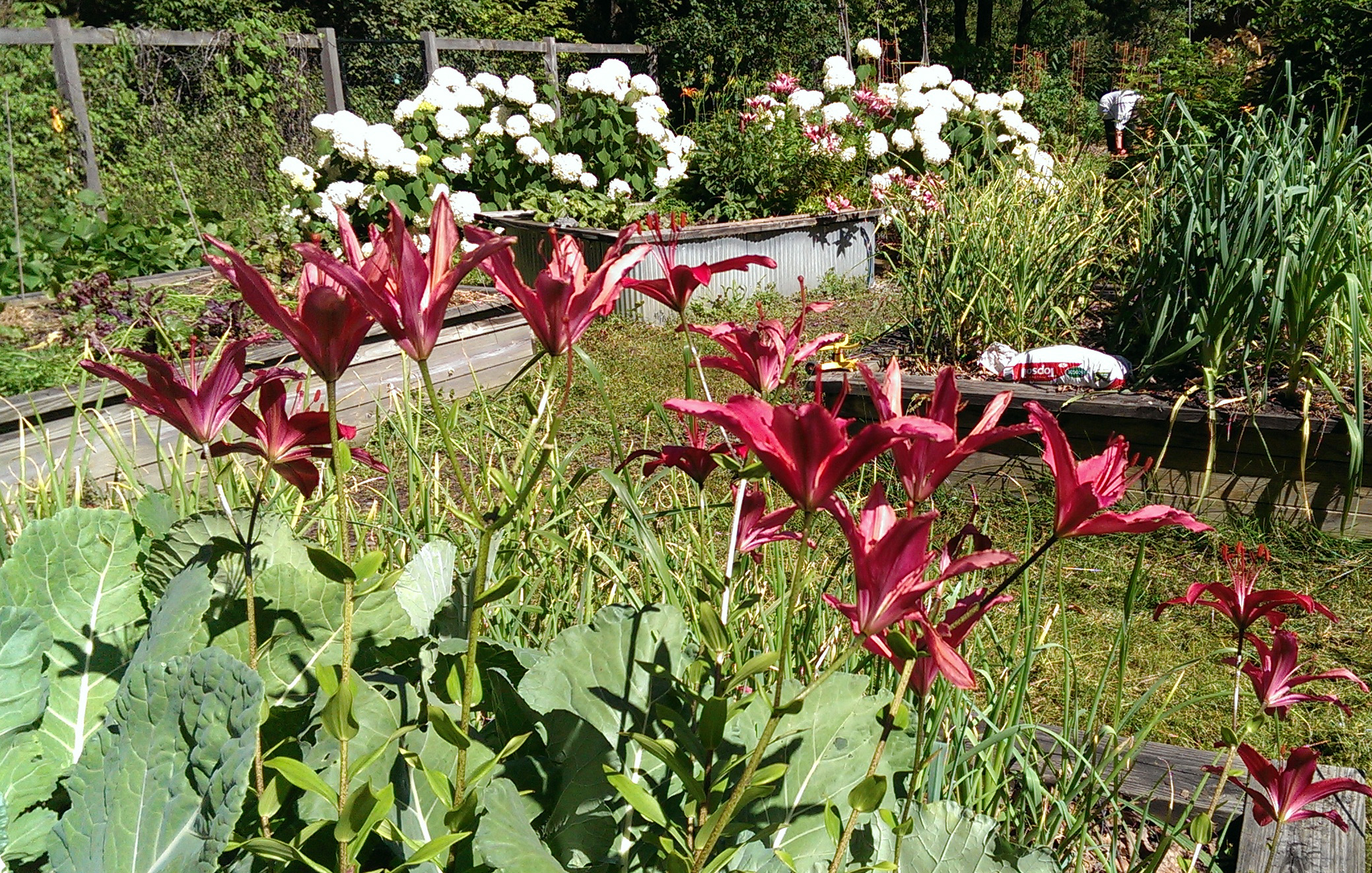
croppedZOE_0022At first, as I dug my way into a new faith, it was about a symphony: the early crocus, snowdrops, grape hyacinths followed by tulips, then iris and hosta and bleeding hearts, giving way in July to a the bold notes of the asiatic lilies until the daylilies and clematis, both bushy and climbing, the liguria and the snakeroot began to dominate followed by the soft crescendo of asters and chrysanthemums. This literal rising and falling, in palates of color always framed by many shades of green, played out in my mind, a curious analog to the mental images inspired by listening to Mozart or Haydn or Pachibel.

Then, with Kate’s guidance vegetables came to have more and more importance. They too come in their own season, following their own melodic lines, as do the fruits and the nuts. Even, I would later learn, so did honey and the concerto of the honey bee.

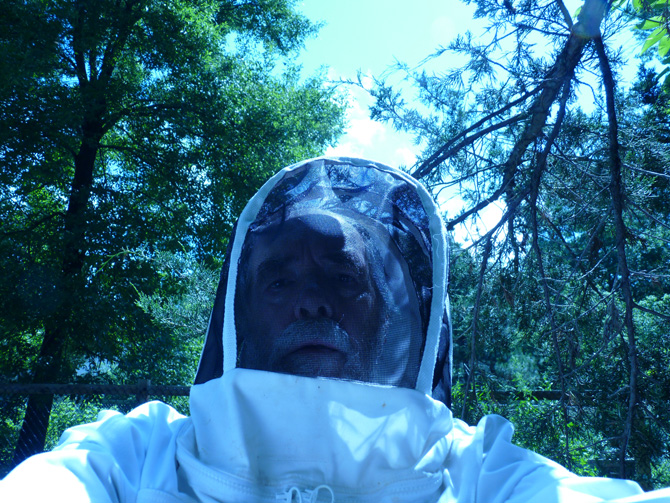
Amending the soil with compost and peat moss and decayed leaves and hay, finding the 06 27 10_beekeeperastronautheirloom seeds for the vegetables we grow and the beautiful varieties of perennials like the iris and the lily, made the whole a process laced with memory and filled with change.

It is no surprise that the Great Wheel, the ancient calendar of a people whose blood runs in my veins, came into this earthy process as a celebration, as a sacred abstraction of a very real lived experience. This was not systematic theology. This was neither dogma nor holy book. No, this was and is the song of the earth herself, composed in her own medium, the plants whom her body supplies with nutrients and her body which receives their dead bodies to replenish herself.

So this is a material spirituality, a spirituality that lives in the praxis between human awareness and the earth’s ordinary wonders, a paradoxical sacredness created by the essential, the necessary bond between the human body and the plant body and the earth’s body. It may be, probably is, that paradox exists here only when seen against the various gnosticisms of the world’s many religions. In fact, a faith rethought and reimagined without religion entering into the mix needs no spirituality other than that mysterious, miraculous link that binds the entire web of life into one interdependent whole.

Aurora

Summer                                                               Most Heat Moon

Well. The dogs have encouraged me to see another dawn. No, this is not some heroic clawback from the edge of terminal illness attained by the promise of canine companionship, rather it’s occasioned by canine demand for outside and food. So, here I am posting an Aurora just after a Nocturne. This might not be unusual for many, but for me, it’s downright odd.

The front page of the three papers I read consistently all feature the Malaysian Airlines disaster. The New York Times follows it with a long story about preparation by Israel for a ground assault on the Gaza Strip. Grim news from a part of the world that has been and continues to be a flashpoint for international conflicts.

Crimea, a major part of the Ukrainian/Russian violence, has featured in many wars and as part of the Great Game, the struggle between Great Britain and Russia for control in Central Asia. The Middle East, not far away, and its oil resources has become more prominent of late, particularly since the partition of Israel and Palestine. No one covers themselves with glory in any of these disputes and the politics are intractable, the product of ancient grudges coupled with the very modern demand for oil.

The ancient grudges often have their roots in this region’s other primary export, monotheistic religions. Though there were many polytheistic faiths in cultures there-from Babylonia to Assyria to Persepolis-it was with the Abrahamic covenant and the Egyptian diaspora of his descendants that monotheism began its ascendancy. In sequence came Christianity, then Islam both variants of that original turn toward one god.

The bitter soup concocted from petroleum and theological certainty, endemic to all three faiths, has bloodied nations and peoples over the whole globe. Where will it end? Oddly enough climate change might bring a peace of sorts in both central Asia and the Middle East. As the world backs away from its dependence on carbon based fuels, the relative importance of the oil rich regions and their conduits to markets (much of Central Asia, with pipelines headed toward China and toward the West) will decline.

Could be.

Theogony

Summer                                                             Most Heat Moon

“Rage — Goddess, sing the rage of Peleus’ son Achilles,
murderous, doomed, that cost the Achaeans countless losses,
hurling down to the House of Death so many sturdy souls,
great fighters’ souls, but made their bodies carrion,
feasts for the dogs and birds,
and the will of Zeus was moving toward its end.”      Iliad opening lines, Fagles translation 1990

Let’s see. What I was trying to say in the post below was this: political life and our opinions, our proclivities do not have to be all one thing or another. We confuse ourselves and others if we pretend it is ever other.

We make a similar error with individuals (and with ourselves). We define people based on what we see of them, usually just a small slice, and that is true of even our closest friends. We imagine that the clues, the defining moments we know of, adhere in a package that makes some sort of sense.

No. People are not one thing or another. They are as Walt Whitman observed of himself, “multitudes.” To say it philosophically we are one, we are many. I’m not identifying a psychological pathology here, rather stating that even the most rule bound of us violate our own rules and sense of duty, probably daily. The least rule bound among us may stagger through life from one interest to another, one opinion or another, one activity to another. And all this is usual, normal.

Coherence is a naive tool for understanding. We have our reasons, yes, we do, but our reasons often contradict each other. We know this when we are honest with ourselves. And our emotions. Well, they come unbidden, sometimes riding us like storms, other times calming us in periods of upheaval. Notice, too, that we try to guide ourselves both by reason and by emotion, when in fact these two faculties are not two, but one, or if not exactly one, then inextricably woven together, woven so closely that we cannot without great effort separate one from the other.

It is no wonder, when we consider these complexities that there is the saying, African I believe, that when a person dies, so does a universe. What I take from all this is to be easy with myself, forgiving, since the universe that I am does contain multitudes and at times this version of the universe holds sway, at other times this one.

It may be, probably is, that such an observation reveals the origin of the gods. There are those within us, anger for example and its more intense cousin, rage, that can take control of us, organize our lives in ways surprising to ourselves and to others. (see the opening lines of the Iliad above.) Or, grief. Or, love. Or, fear. Or, vengeance. Or, delight. Or, abandon. Or, control. Or, poetry. Or, thought. To go against Hillman I would say not that we meet our gods in our pathologies, but in our inner selves.

(Banquet of the Gods, Frans Floris)

In Voudoun the practitioners talk of being ridden by the god, an enraptured state brought on by intoxication and dance and openness. I say we are ridden by gods and goddesses all the time. To our great joy and our great sorrow.

To paraphrase Whitman, “I contain within me many gods, I am a pantheon.”