Category Archives: Commentary on Religion

These Strange Times

Lugnasa                                                   Hiroshima Moon

Pope’s butler accused of theft.  Wait.  The pope has a butler?  Shootings yesterday at Texas A&M.  The Sikh Temple in Wisconsin last week.  Aurora the 20th of July.  Can anyone else hear a tear in the moral fabric of the universe?

Not to mention that yesterday the stock market was down because of news from Asia.  Asia?  What happened to the euro?  It’s true that bad news always happens and good news is not, usually, news at all.  Still.

Let’s throw in the news from  Europe’s Cryosat that the polar ice has begun to retreat

(at) a loss of 900 cubic kilometers of ice in the last year. That’s 50 percent more than computer models predicted would melt.

A lack of ice is good news for shipping, and oil and gas exploration, but dark ocean water warms the air above more than reflective ice, a “positive feedback” that accelerates warming. Research suggests the Arctic is warming 2-4 times faster than the rest of the Northern Hemisphere. So what? This warming is nudging the jet stream north, to the tune of 1 mile a year, 18 feet/day.   (paul douglas weatherblog)

Predictions of the end times have a 100% failure rating (so far), so I’m not going there, but bizarre times?  Yes.

Of all of these, the news I understand least are the three shootings.  Like the man here who killed his three daughters, there may be a psychological explanation.  Certainly there is a psychological explanation.  Has to be.  But explanation does not serve.  Tracing the inner path to these crimes leaves us with the crime in the end.

I’d like to know, if anybody does know, the incidence of these or similar crimes in other cultures.  Are we truly aberrant or is it a statistical phenomenon, a law of large numbers reality?

Of all these, the news that worries me the most comes from the cryosat satellite.  This summer was miserable for us and horrific for much of the country.  In this case I understand the cause.  I drive one.  So do you.  I use electricity.  So do you.  We have treated global warming as a topic for next year.  For the next generation.  Guess what?

It is next year.  And we’re the next generation.
The Growing Season Begins to Wind Down

Summer                                                             Hiroshima Moon

On Wednesday we move from the growing season emphasis of early summer to the harvest emphasis of late summer.  The Celtic calendar marks that change on August 1st which begins the season of Lughnasa, a first fruits time.  Yes, harvesting has happened before this, but now the inflection is on crops for sale, trade or preservation.

[ in precipitation in during the growing season (after Meehan et al. 2004 and Bowen et al. 2005)]

If any of you saw the opening ceremony of the Olympics, the first, agrarian phase of Great Britain before the industrial revolution is the time the Celtic calendar marks.  It is not a calendar for an industrialized or a technological society though it has an important place in both.  Industrialization and technology both move us away from direct experience of the
natural world and especially from the source of our food.  The Celtic calendar gets its seasons from the botanical and meteorological rhythms, not the work day or the academic year or the never asleep world of the internet.

Those other rhythms, the Taylorized day or the instantaneous cyber world, lead us away from natural rhythms into a cultural space dominated by rationality, science and human control.  In the Celtic calendar the natural world rules, just as it does yet today, though we hide ourselves from it with thermostats, electric lights and high speed broadband.

This is not an either/or situation; there is a dialectic between the world of human artifice and the world which brings the thunder and the lightning and the rain, which grows the food, which gives us night and day.  Yet.  So many of us, in our air conditioned, wired, well-lit by electricity homes, obscure or forget or ignore that our food grows in the soil, the flesh of mother earth.  That it depends on water either from rain or from irrigation, this dependent of rain and replenishment of hidden aquifers.  That the sun which gives food the energy we need does so without human intervention or assistance.

All of our civilization has as its foundation, its literal without which nothing support, the vegetative world.  And we do not control it.  We can help it, nurture it, bless it, curse it, but we cannot make plants grow.  We can only provide or protect the conditions under which they do so.  In our amnesia about this simple, stark fact we pave over farmland, alter the chemical conditions under which plants grow, change their genetic patterns trying to extend our control, but all this begs the question.  How did the vegetative world get along without us?

The answer?  Just fine.  This is not a rant, this is a reflection of our current reality.  It is the hope of ancientrails that it can serve as one reminder.  One reminder of the essential, unique and healing power of the world beyond our control.

Changes

Beltane                                                                       Beltane Moon

Received a second invitation to a going away party for two friends moving to Maine.  They’re part of the Woolly change, the moves and deaths, the losses that accrue as we head past 65.  They seem pretty energized by this move to a home in Robbinston, a spot near the Atlantic and New Brunswick.  And why not?

Change can give us a fresh perspective, a place to begin again or to continue, but in a different direction.

Over the last several years I’ve chosen to embrace change as a deepening process, crossing thresholds into the unknown in areas with which I have substantial familiarity:  literature, arts, gardening, politics, family, religion.

In literature, for example, I moved into a different kind of book, a fantasy epic instead of the one off novels I’ve written up till now.  This change exhilarated me, made me stretch, thinking about the long arc rather than the shorter one handled in one volume.

The Latin learning and translating I’m doing is in service of deepening, too.  Deepening my knowledge of Greek myth and Roman culture.  I have, also, now peaked behind the veil of translation, learned something about the kinds of choices translators have to make.

In the arts I’ve chosen to focus most of my learning in Asian arts, probing deeper into Chinese history and the role of context for the art we have at the MIA.  This part year didn’t see as any Asian tours as in the past, but I’ve continued studying, reading Chinese literature and learning more history.

My grasp of photography has increased considerably, too, as has my understanding of contemporary art.  Going deeper.

As Kate and I have gotten wiser about our garden and how we actually use it, we’ve gone deeper into vegetable and fruit growing and preserving.  The bees increased our appreciation for the engagement of insects in the plant world.  And for honey, too.

In religion I’ve stepped away from any organized groups or lines of thought, trying now to penetrate how changes underway across the world might demand a new way of faith.  This one’s proving difficult.  But, that’s where the juice is, right?

Finally, I’m learning, still, how to be a grandparent with my two instructors, Gabe and Ruth.  Also, I’m learning the role of parent in children’s mid-life, where demands of work and family consume them.  Again, a deepening and a change.

Emerson said long ago that we do not need to travel to Italy to see beauty.  Beauty is where we see it, not only, perhaps not even primarily, where others see it.


True North

Beltane                                                     Beltane Moon

Went outside a moment to look at the stars.  A clear, calm night.  Darkness may blanket the earth, but in the heavens the lights are on.

Right now ursa major hangs upside down, pouring its contents over polaris and down to earth.  As I continue to wonder and ponder reimagining faith, I’ve looked into a Buddhist sect that worshiped the north star.  Hokusai, the early 19th genius of the ukiyo-e print, followed this belief, which originated in China.

The north star does not move; aligned with earth’s axis it sits over the north pole and is the center point of this time lapse photo. (above)  Since it did not move, and since the other stars seemed to rotate around it, especially ursa major, some Chinese believed it was the center of the universe and transmitted its messages through ursa major.

We nod toward the same sentiment when we talk about our true north, our pole star.  Gazing up at polaris, seeing the stars pointed at it, knowing the revolution ursa major is always in the process of making, I could imagine the north star as the center, the hub of meaning.

One of the virtues of a pagan perspective lies in its simple access to wonder.  Stare at the north star, imagine its constancy, see its relation to, say, vishnu, to your need for a still, calm place at the focus of your soul and embrace it as the message the universe has offered, high up in the darkness, a light that holds its place.

See the Heads?

Spring                                                            Beltane Moon

Coming north on Highway 10 (or east, I can never figure it out and I’ve lived up here 18 years) just before the big Lowe’s store, it’s no longer unusual to see cars parked along the side of the road, drivers clomping out through the high grass, camera with a big telephoto lens in hand.  They’re headed toward a dead tree with a big clump of sticks in a high fork.

Kate told me she saw heads there a month or so ago.  I began to look, too, and finally saw a bald eagle circling the nest, coming in for a landing, presumably with food for the young’uns.  I’ve seen a head or two though I’ve never been able to suss out whether they were chicks or adults.

We hunger for peeks into the wild world, a personal glimpse of the life and times of creatures that live among us, but we rarely see.  Over the last 18 years Kate and I have a great horned owl hooting at night in our woods.  I’ve seen him/her once, it’s giant wingspan remarkable, yet hardly ever observed.

We have opossum, raccoon, woodchuck, rabbit, deer, coyote, skinks, snakes, frogs, pileated woodpeckers, bald eagles, great blue herons, egrets, too.  These last three we see from time to time, usually in flight, though the egrets are often there, serpentine necks ready to dip suddenly into the water.  The rest, almost never.

Around Christmas tree three or four years ago, back when I still fed the birds, a opossum took to visiting the bird feeder around midnight.  I happened on him one night and checked back frequently after that.  His small pink paws looked almost like human hands and I delighted in watching him do his opossum thing.  Why?  Because it was a glimpse of a neighbor, a close neighbor, one who shared the very land I claim to own, but whom I rarely–up till then, never–saw.

This takes me back to the discussion of mystery I had here a few weeks back.  We do not need to imagine a world beyond the one to which we have ready access; there is a large, unimaginably large world shrouded in mystery that lives near us, with us, within us.  Take the billions of one-celled entities that share our bodies, help us live our lives in return for some benefit derived from the eco-system that is our body.  A mystery, certainly.

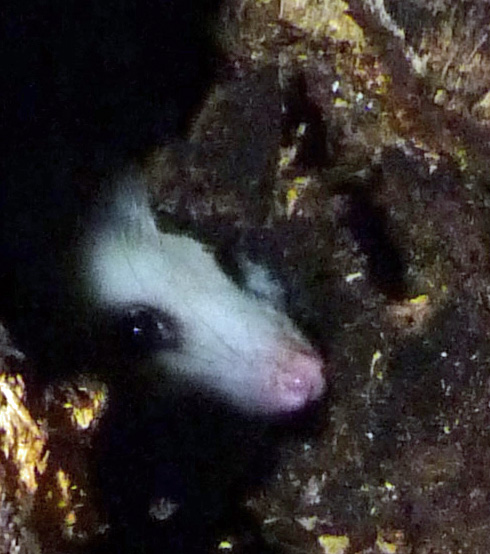
Or the baby opossum I found huddled up far inside a dead tree, doing what all prey does when confronted by snarling predators–Vega and Rigel–hiding in an inaccessible location. If Vega and Rigel hadn’t been obsessively interested in this tree, I’d never have known the opossum was there.

The morels that visited us once 18 years ago, never to return.  Or, at least never to be found.  A mystery.  This is a revelation to us, the way for us to an original relation with the universe.  And, it’s in our backyard.


Narratives With Depth and Power

Spring                                                           Bee Hiving Moon

Here is why I think the ironically evangelical atheists have it wrong.

Today is Good Friday (though I’m not clear how it ever got that name), the day Christians commemorate the crucifixion of Jesus, the carpenter from Nazareth.  It’s also, this year, the first night of pesach, the night Jews celebrate the angel of death passing over the first born of Jewish households enslaved in Egypt.

No matter the metaphysics you claim, no matter the beliefs you hold, no matter the faith you embrace these are powerful, heart deep and deeper stories.  They are narratives you can build a life upon.  And millions, hundreds of millions have.

Take a working class man, a man who earns his living with his hands, let’s say a Toyota mechanic.  Imagine him struck dumb one night with the power of love.  So struck that he leaves the garage behind and goes forth into the countryside and into the cities claiming that before anything else we have to love one another.

Imagine, further, that he gets a following, a few at first, maybe 12, then a few more, Continue reading Narratives With Depth and Power

Religion Collapse Disorder

Spring                                                           Bee Hiving Moon

Had a chance to speak to Groveland UU this morning, a regular event each year for me for over 20 years now.  Some years more, some years less, always congenial.

The Reimagining Faith piece (see Current Work at the top of this page) resonated in a way a bit different than I had intended.  The conversation was not so much about reimagining faith as it was about the falling away of religious life and what that might mean.  That’s where the discussion led.

The Reimagining Faith project needs to deliver a fuller account of what I call religion collapse disorder.  Better documentation of this accelerating trend in the US and more on its implications for individual and group spirituality will be important.  I had sort of skipped over that and gone directly to the challenge facing deinstitutionalized Americans.

Between now and the Summer Solstice I’m going to start investigating possible Asian resources.  I’ll look especially at Taoism, Shinto, and the ukiyo-e artist Hokusai who belonged to a Buddhist sect that worshiped the north star.

There is also more work to be done on tactics, or methods, of constructing a new faith and I think the constructive theology exercise lined out below will be fun and a good step in this direction.

Realized, with a bit of surprise, that I’ve spent a lot of my life putting myself in front of people:  preaching, organizing, acting, touring, writing.  Never thought of it all like that before and it made me wonder what drives it.  Don’t know.

What Is Your Core Religious Conviction?

Spring                                                              Bee Hiving Moon

Challenge to a seminary class in constructive theology.  Sounds fun.  Think I’ll do it.  Not right now because I have to go give my presentation on Reimagining Faith.

“In 3500 words or less, please answer the following questions: What is your core religio-moral conviction, and how does it inform or give shape to your understanding of the theological norms of your society? What is your organizing theological framework? What do you mean when you speak of God? Please include an account of God’s power, creative act, presence and providence, and the question of evil. Or, if you are non-theistic, how do you take account of the beginning of life, the creative power that sustains us all, the web of relations, and the question of suffering? Who and where are human beings in the scheme of things: in relation to the holy, to other humans, to other creatures, to the earth? How do you see the human predicament and the notion of sin? Finally, how shall we dwell together?”

Reimagining Faith: The Chauvet Cave Art

Spring                                                            Bee Hiving Moon

32,000 years ago.  In Europe.  When the Alps had glaciers 9,000 feet thick, in a valley in what is now France, in a cave concealed by an ancient rock slide, these astonishing works remain, a galleries of ancient art, a museum with no light, no movable images and nothing between us and the artists who worked here but time.  These are the oldest works of art.  Period.  And their lines flow from one place to the next, moving with the grace of an angel in flight, creating forms with ease, with economy of line.

Werner Herzog makes strange and wonderful films.  He finds human narratives in fascinating places.  That the French allowed him to film Chauvet testifies to his reputation and he only enhances it with this work.

He interviewed a man, I didn’t get his name or profession, who said to understand the photograph below there are two attributes of life then that could help make sense of it.  The first he said is fluidity.  That is, trees talk, rocks talk, entities are not fixed, they are fluid, one can change into the other, so a woman can become a river, a tree can become a man.  The second is permeability, the forms are not fixed, a woman might have the head of a bull, or a horse the head and upper body of a human.

He suggests, and it certainly makes sense to me, that this drawing from Chauvet Cave illustrates exactly that first example of permeability.  It doesn’t take much to get to Picasso’s Minotaurs or the Labyrinth in Knossos.  Or, Ovid’s Metamorphoses.

Imagine living in a world where life, sentience, spirit embedded itself in everything.  More, image a place where the boundaries of your form and your life were not firm, where the boundary between this place and the Other World seemed always thin.  More, imagine lions with the head and forearms of a cave bear.  Or, a woman turned into a tree by a stream.  A hunter turned into a stag and eaten by his own dogs.

This is a world where neither faith nor belief are necessary because the world is as it is.  Magical.  Changeable.  Wonderful.  Horrifying.  Unpredictable.  Just imagine.


Shun Yen and Falun Gong, once more

Imbolc                                    Woodpecker Moon

One more thing about Shun Yen (see below).  Their pitch is that they produce performances that draw on and therefore promote 5,000 years of Chinese culture.  Maybe.  They have dances based on various Chinese myths and legends, like Monkey’s Journey to the West, and on ethnic Chinese communities, but there are also contemporary dance pieces and, scattered throughout something very, very odd.

The contemporary pieces feature a common theme.  Black clad police thugs with red hammer and sickle insignia on their shirts.  They beat senseless the gentle, meditating citizens who hold up a sign that says Falun Dafa is Good.  Yes, Chinese police have beaten Falun Dafa or Falun Gong members and persecuted them.  That’s not at issue here, but, again, I paid $90 a ticket to see several dance numbers that were propaganda against the Chinese government.

There was no balance here, no context, no alerting the audience to the fact that this was their intention.

These vignettes, I think there were four, were not the oddest part of the evening however. Four times during the performance the dancers would remain off stage and a Steinway, a big black concert Steinway, and either a tuxedoed male singer or a formal gown clad female singer, all Chinese, would sing short verses, maybe they were songs, that declared some piece of Falun Dafa dogma.   Continue reading Shun Yen and Falun Gong, once more