Category Archives: Great Wheel

Self-Care for Future Corpses

Samhain                                                                         Thanksgiving Moon

Eat right, exercise, die anyway. I loved this refrigerator magnet and I love this short article by Sallie Tisdale. Especially for us third phasers. No fear, as the bumper stickers say.

Sallie Jiko Tisdale @ Tricycle.com

Sallie Jiko Tisdale is a Tricycle contributing editor and a lay teacher at Dharma Rain Zen Center in Portland, Oregon. She has authored several books and many essays.

Kuku Tihar

Samhain                                                                               New Thanksgiving Moon

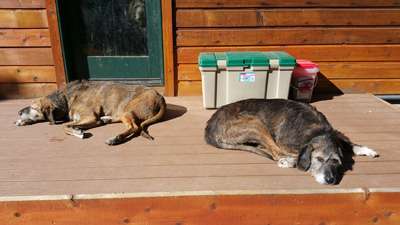
Again, highlighted by a friend, Paul Strickland. Kuku Tihar*. Kuku Tihar occurs during the celebration, in Nepal, of Diwali. (see below) This year Kuku Tihar, the second day of Diwali, falls on November 12th. Tomorrow. How will you celebrate your dog/dogs?

I was struck by the dignity of the dogs in the pictures I found of Kuku Tihar. The respect seems to carry its own profound message and bring out the seriousness of the dog.


*Dogs are especially important to Nepal’s Hindu practitioners. During day two of Tihar, Kukur Tihar, the role of dogs in human life and throughout history is celebrated. In theRigveda, one of Hinduism’s most ancient texts, Samara — the mother of dogs — assists Indra, the ruler of heaven, in retrieving stolen cattle. Hindu tradition holds that a dog is the guardian and messenger of Yama, the lord and judge of the dead. A dog is also said to guard the gates of the afterlife.

At the close of the Mahabharata, the king of righteousness, Yudhishthira, refuses to enter heaven without his devoted dog. The dog is revealed to represent the concept of dharma, the path of righteousness. During Tihar, each day is devoted to a honoring a different concept or entity: crows, dogs, cows, oxen, and fraternal relationships, respectively. On the second day, Kukur Tihar, all dogs are recognized, honored, and worshiped.   dogster.com

This and That

Samhain                                                                                 Moon of the First Snow

We’re about to head into a cooler streak, some snow in the forecast. Still a warm November so far according to weather 5280.

P.T. exercises kept the pain away. Good deal. Means I can do more work outside today.

(We’re in holiseason now and Thanksgiving colors the days. We’re doing it here this year, our first big holiday do in Colorado.)

Logging. It can be dangerous and nothing more dangerous than a hung up tree. I’ve had three already and I may have been lucky in how I dealt with them. Trees weigh a lot and releasing tension on them can result in fatal injury. Just watched some youtube videos that were very helpful. Nice to see folks actually felling hung up trees.

I’m getting closer and closer on the loft, all the books are now on shelves and I even have some space left over. Once the snow flies I’ll start rearranging the books since I shelved them in broad categories, but with no particular order in the categories. That’s fun.

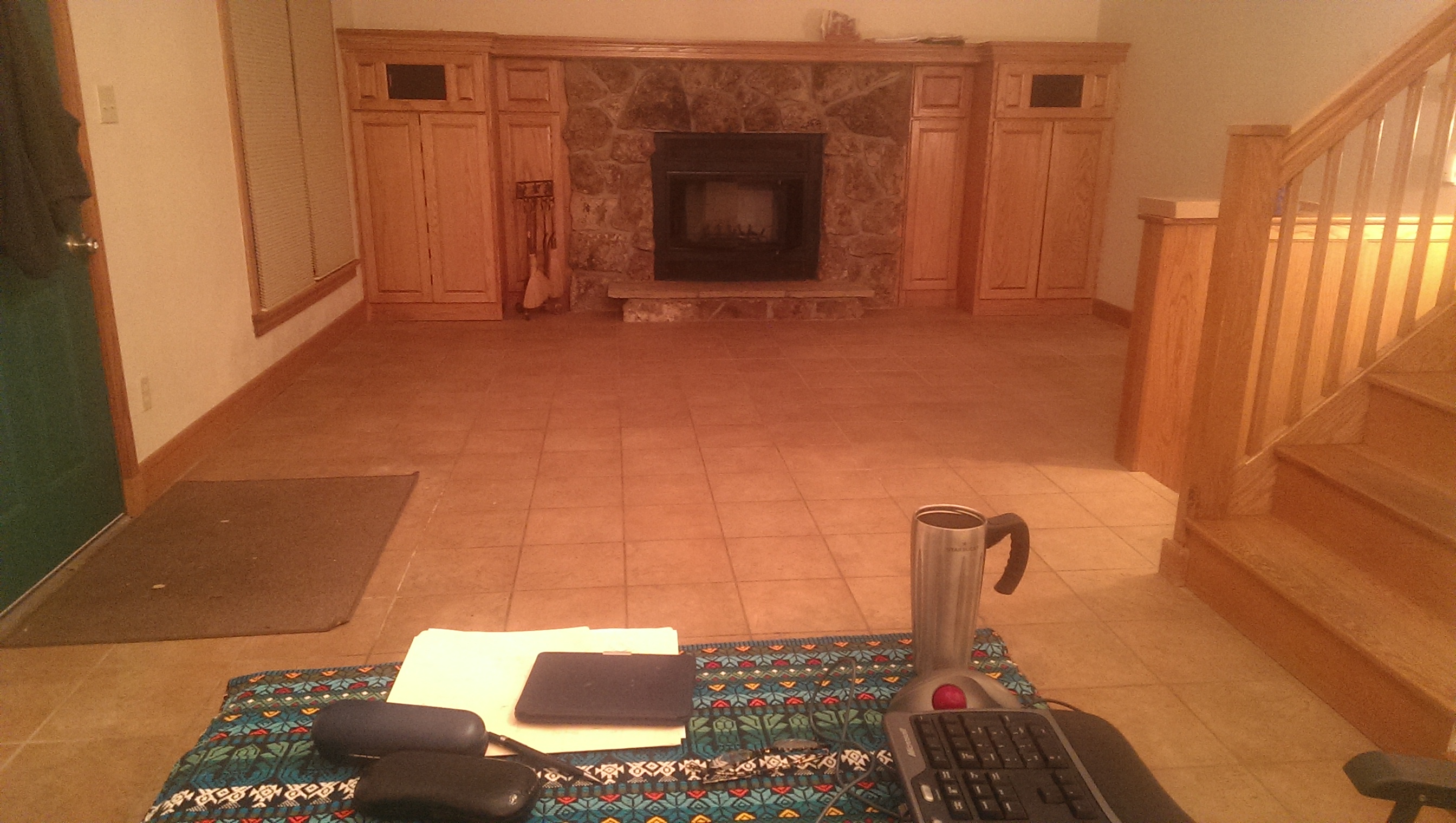
Today Melanie will do my floor and carpet. Before she comes I’m going to shelve office supplies and get things off of the floor, mostly prints and paintings, so she can work unimpeded. Getting the floor mopped and shined will make the place feel even better.

Happy New Year!

Samhain                                                                   Moon of the First Snow

The Celts began the New Year at the end of the harvest season celebrated on October 31st. In the old Celtic calendar there were only two seasons: summer and winter and today marked summer’s end or Samhain, the end of the growing season. So for the ancient Celts the year began in the fallow season, the season of senescence and death.

As I’ve watched the run up to Halloween this year, I’ve been struck by its emphasis on horror, scares and fear. As a direct, but altered version of Samhain, Halloween emphasizes certain aspects of the original holiday, for example the thinning of the veil between this world and the Otherworld, the land of faery and the dead.

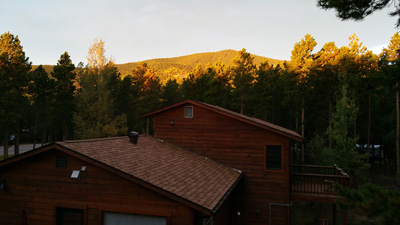
This year Kate and I celebrate the thinning of the veil between Minnesota and Colorado. Exactly a year ago today we closed on Black Mountain Drive. That closing brought Minnesota and Colorado so close to each other they could touch. For us.

Three mule deer bucks were in the back that morning, eating grass. I approached them slowly and they let me get very close, watching me with round brown eyes, attentive but not nervous. They were the spirit of Shadow Mountain welcoming us home, a trinity of mountain dwellers.

Black Mountain Drive is a Great Wheel home. We closed on October 31st, Samhain, and moved in on December 20th, the Winter Solstice, the day that Samhain ends. The holiday of the longest night, Winter’s Solstice, is my favorite holiday of the year, so to close on Samhain, the New Year, and to move in on my favorite  holiday gives our home a special frisson. It occupies a space not only on the physical Shadow Mountain but on spirit Shadow Mountain, too.

IMAG0773Our home participates not only in the massive rockness of the mountain, but in the essence of the Rocky Mountains, their wild majesty, their sudden emergence from the Great Plains, their uncivilized character. These mountains are home to elk, mule deer, fox, bear, squirrels, pika, mountain lions, human beings, dogs, cats, lodgepole and ponderosa pines, Colorado blue spruce, fast running streams, waterfalls, quiet ponds and small lakes.

It is a Samhain home and a Solstice home, forever for us, infused with the old energies of these two seasons. Our years within it begin on the Celtic new year and grow deep with the long night, the two poles of our start here.

So this year we celebrate both home and holiday. Blessed be.

Neither the First nor the Last

Mabon                                                                               Elk Rut Moon


The bloody supermoon. Saw it last night over Conifer Mountain with Kate. We stood at the end of the driveway, she in tie-dyed t-shirt and a small Hawaiian quilt for a skirt and me trying to make sure I didn’t fall in the ditch. It was, after all, dark. It reminded me of a frigid Minnesota night, a January of long ago, with the Woolly Mammoths at Villa Maria in Frontenac. We went outside to see the lunar eclipse. The air temperature was well below zero, maybe 15 0r 20, and we stood, in the dark, marveling.

When I checked Facebook this morning, I saw many cell-phone shots of the super, bloody moon. They all proved that cell-phones are not a good choice for photographing lunar anything. Too far away. They also proved the old lover’s promise, we’ll be looking at the same moon.

As any reader of this blog can attest, I start with the same two things every post: the Celtic season on the Great Wheel and the current moon. The spiral nature of time is caught by the different seasons of the Celtic year, seasons which recur, and the always changing, yet always the same phases of the moon. This focus helps me stay in context with the natural world, in it and of it.

It also reminds me of a crucial fact. This life will end in death, but death is not the end. It is, like the recurring Celtic seasons and the phases of the moon, a moment in the spiral passage of the human species from yesterday to tomorrow. I am neither the first nor the last, but rather part of a widening gyre that is the cumulative experience of what it means to be human. I contribute my part, then make way for others, just as the blood moon departs to make way for countless more phases.


A Mountain Autumnal Equinox 2015

Mabon                                                                     Elk Rut Moon

We are deep into a short and subtle season, the mountain fall. Today’s equinox, the autumnal, is not so relevant here on Shadow Mountain as the second harvest holiday. It finds no fields of corn, wheat, beans ready for reaping.

This does not mean Mabon, the pagan season between Lughnasa and Samhain, the other two harvest holidays, is not distinctive. Hardly. The early signal, as it is everywhere in temperate latitudes, is the changing of the sun’s angle as it descends from its northern zenith toward its southern nadir reached on the winter solstice. At some point in August, usually mid-August, the change in the sun’s position becomes noticeable and kicks up in memory high school football, back to school, leaves changing color, temperatures cooling. This is a nuanced moment, easily missed if life is too busy.

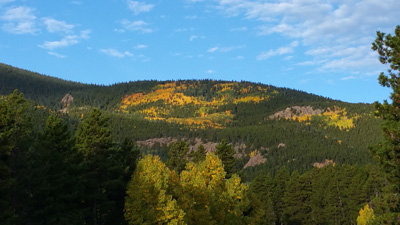
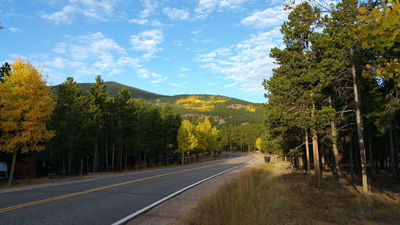
By Labor Day the new season accelerates with the temperatures actually cooler, back to school ads in the Sunday paper and, here in the mountains, the first brief flashes of gold. But the colors never broaden their palette. The fall signal is gold amongst the green. Right here on Conifer, Black and Shadow Mountains, the mountains we see everyday, the aspen groves are small and convert only patches of mountainside, but the effect is startling. What have been all summer ziggurats of green, uniform up and down, now are decorated like Christmas trees, one of those flocked trees with only gold ornaments.

The meadows tucked into canyons and valleys are a beautiful straw color, topped sometimes with a reddish furze. The season of desiccation, ignored by the dominant lodgepole pines, happens, though its reach is not nearly total, as it mostly is in the deciduous forest lands of the midwest.

The animals. Here the equivalent of the blazing colors of maples and oaks is the elk rut. Architectural wonders, the horns of mature bull elks, wander the mountains perched atop their owners, looking for does. Combat is an ancient, ancient sport here. And, like the medieval tournaments, it is for the hand of the lady. If they had them, the does would probably hand out colorful handkerchiefs and scarves for the bulls to carry into battle.

The mule deer shed their velvet in October, so during the elk rut, most of it, they still carry the moist, blood-rich covering that feeds antler growth.

Black bears are in the midst of a caloric imperative, their large bodies demanding upwards of 20,000 calories a day to insure they survive hibernation. That means constant searching for food and any disruption in their usual fall supplies of berries and nuts and honey finds them trolling residential areas in the Front Range or down into the Denver metro area. So another sign of fall are the reports of bear home and vehicle invasions.

Breathless anticipation of snow also begins to dominate the news. A couple of inches in Rocky Mountain National Park last week got several photographs on Open Snow, a forecast website devoted solely to snow and, in particular, snow where it can be skied.

Winter does not loom as the incipient oppressor as it does in Minnesota. It’s foreseen with anticipation, like the holidays. Winter is a fourth outdoor season here. An often repeated quote, an advertising slogan probably, is this: There’s no such thing as bad weather, only bad gear.

So fall in the mountains is not the climactic end to a long growing season. No filled silos or grain elevators. Instead it is the time between the heat and flourishing of summer and the cold, snowy time occupied by hibernation on the one hand and bombing down the mountains on the other.
Our First Fall in the Mountains

Lughnasa                                                                Labor Day Moon

Yesterday, driving on 285 west through the Platte Canyon toward Kenosha Pass, I could feel summer beginning to transition toward fall. The sky was a bit gray, the air brisk, a definite browning in the grasses and small shrubs along the North Fork of the South Platte. The sweet melancholy of autumn passed through me with a quiet shudder. This will be our first fall in Colorado.

These moments of awareness as seasons change carry with them the autumns of yesterday. The smell of leaves burning on the streets in my childhood Alexandria. The homecoming parade. The brilliant blaze that catches fire in Minnesota as oaks, maples, elms, ash, ironwood turn from their productive summer chlorophyll green to the color of the leaf itself. People heading north after Labor Day to close up their cabins. Kicking piles of leaves raked up in the yard. Jumping into them.

What will fall be like in the mountains? I know it will have splashes of gold as the aspens change. There will be brown, the desiccation of grasses and shrubs. But the view from my loft window to the west, which contains lodgepole pines on our property and the massif of Black Mountain in the distance, also covered with lodgepole, will still be green. I imagine the green might become duller, but I don’t know for sure. The angle of the sun will change, has changed already, but the basic green and blue, the sky above Black Mountain, will remain.

The temperatures, especially the nights, will cool down. The mule deer and elk rut are important to fall here, as is the hunger of black bears feeding themselves toward hibernation. A young mule deer buck was in Eduardo and Holly’s yard yesterday, velvet still on his antlers. We’ve seen no does for some time and wonder where they are. Perhaps waiting out the violence of the rut in secluded mountain meadows? They are, after all, its object.

Summer is always a paradox in the temperate zone. It brings warmth and growth, a loose freedom to wander outside with no coat. In that way it opens up the space around us, gives us more room. But the heat can become oppressive, driving people back indoors toward air conditioning. Humidity goes up; weather hazards like tornadoes, torrential rains, thunderstorms, derechoes increase. Here in the mountains, most years, the threat of wildfire spikes. As for me, I am usually happy to see summer slip away.


Lughnasa                                                                 Labor Day Moon


Been trying to feel the mountain. Beneath our house Shadow Mountain extends at least 8,800 feet to sea level and just where a mountain begins and ends after sea level is a mystery to me. That’s a mile and 2/3rds of rock. A lot of rock.

14 years ago I came out to Colorado and camped above Georgetown in the National Forest. Right next to me was a sugarloaf mountain. As darkness fell, the mountain disappeared into the gloom. All that massiveness just disappeared. But I could feel it looming over me. Since then I’ve wondered what the mountain equivalent is to the Shedd Aquarium’s freshwater exhibition tag: The essence of a stream is to flow. What is the essence of a mountain?

Mass seems to be the answer. It is the distinctive feature that draws our eyes when we come in on Interstate 76 from the plains of Nebraska. Suddenly, the plains stop. The essence of the plains is flatness? No more flatness, verticality created by mass intervenes with sight lines. The volume of rock pressed upwards by colliding tectonic plates changes the topography.

So these last couple of mornings, before I got out of bed, I’ve been trying to feel the mass of Shadow Mountain. Trying to extend my Self into the mountain, to feel the mountain as it lies there. Not so successful so far. It occurred to me this morning that this is the opposite of conquering the mountain, of summiting, of climbing. This is diving, deepening, merging. Part of the difficulty is the claustrophobic feeling of having the mountain all round me even in my imagination.

This is not all. I noticed the other day in the east, just above the lodgepoles on our property, Orion. In Minnesota I was a late riser so I don’t know where Orion was at 5 am in August, but his presence here surprised me. I have, until now, counted Orion as a winter companion, first becoming visible in November. He may have risen much earlier even in Minnesota, but I missed him. Orion is a special friend, a constellation with which I’ve had a long relationship and one I view as a companion in the night.

Then, there are the bucks. Mule deer bucks. On Sunday as we drove to Evergreen there were four mule deer bucks with still velveted antlers quietly munching grass along the side of the road. They looked at us; we looked at them. The velvet has a prospective nature, auguring the rut when not yet released. On this morning they were friends, not competitors for breeding rights. And they were in harmony.

Then, yesterday, Kate said, “Look at that!” I turned and over my left shoulder looked down into the grassy valley that extends between Shadow Mountain and Conifer Mountain. In the field of mown alfalfa stood a huge bull elk. His rack was enormous and already cleared of its velvet. It arced out away from his head on both sides, tines extending its reach even further. This was a bull of legend. Seeing him took us into the wild, the world that goes on alongside us here on Shadow Mountain, the lives of our fellow inhabitants of this mountain.

All of this, the essence of the mountain, Orion rising, velveted mule deer, the bull elk, hiking on the Upper Maxwell Falls trail, all of this accelerates becoming native to this place. The Rockies. Our home.

Having a Moment

Lughnasa                                                            Labor Day Moon

I’m having a moment. It’s immediate stimulus has been reading How Forests Think, by Eduardo Kohn. Kohn is an anthropologist who has done significant field work in el Oriente, the east of Ecuador where the Andes go down into the tropical rain forests of the Amazon drainage. But this book is something else. Though it draws on his field work with the Runa, its focus is the nature of anthropology as a discipline and, more broadly, how humans fit into the larger world of plants and animals.

Thomas Berry’s little book, The Great Work, influenced a change in my political work from economic justice to environmental politics. Berry said that the great work for our time is creating a sustainable human presence on the earth. In 2008 I began working on the political committee of the Sierra Club with an intent to do my part in an arena I know well. I continued at the Sierra Club until January of 2014 until I resigned, mostly to avoid winter driving into the Twin Cities.

Since then, I’ve been struggling with how I can contribute to the great work. Our garden and the bees were effective, furthering the idea of becoming native to this place. The move to Colorado though has xed them out.

Kohn’s book has helped me see a different contribution I can make. Political work is mostly tactical, dealing in change in the here and now or the near future. In the instance of climate change, tactical work is critical for not only the near future but for the distant future as well. I’ve kept my head down and feet moving forward on the tactical front for a long, long time.

There are though other elements to creating a sustainable human presence on the earth. A key one is imagining what that human presence might be like. Not imagining a world of Teslas and Volts, renewable energy, local farming, water conservation, reduced carbon emissions, though all those are important tactical steps toward that presence; but, reimagining what it means to be human in a sustainable relationship with the earth.

Kohn is reimagining what being human is. His reimagining is a brilliant attempt to reframe who thinks, how they think and how all sentience fits together. He’s not the only one attempting to do this. The movement is loosely called post-humanist, removing humans from the center of the conceptual universe.  A posthuman world would be analogous to the solar system after Galileo and Copernicus removed the earth from the center. Humans, like the earth, would still exist, but their location within the larger order will have shifted significantly.

This fits in so well with my reimagining faith project. It also fits with some economic reimagining I’ve been reading about focused on eudaimonia, human flourishing. It also reminds me of a moment I’ve recounted before, the Iroquois medicine man, a man in a 700 year lineage of medicine men, speaking at the end of a conference on liberation theology. The time was 1974. He prayed over the planting of a small pine tree, a symbol of peace among the tribes of the Iroquois confederacy because those tribes put their weapons in a hole, then planted a pine tree over them.

His prayer was first to the winged ones, then the four-leggeds and those who swim and those who go on water and land, the prayer went on asking for the health and well-being of every living thing. Except the two-leggeds. I noticed this and went up to him after the ceremony and asked him why he hadn’t mention the two-leggeds. “Because,” he said, “we two-leggeds are so fragile. Our lives depend on the health of all the others, so we pray for them. If the rest are healthy, then we will be, too.”

Reimagine faith in a manner consistent with that vision. Reimagine faith in a post-humanist world. Reimagine faith from within and among rather than without and above. This is work I can do. Work my library is already fitted to do. Work I’ve felt in my gut since an evening on Lake Huron, long ago, when the sun set so magnificently that I felt pulled into the world around me, became part of it for a moment. Work that moment I’ve mentioned before when I felt aligned with everything in the universe, that mystical moment, has prepared me for. Yes, work I can do. Here on Shadow Mountain.