Category Archives: Great Wheel

Tonight I Was the Stranger

A quick note.  Did phone calling for the Sierra Club tonight.  This represents both a signal of my commitment and a raging contradiction for me.  A phone call from a stranger, pitching something in which I have marginal to no interest or may find abhorrent irritates the hell out of me.  Tonight I was the stranger.

Some calls I made to other Sierra Club members who might volunteer to call swing voters.  The rest of the calls were persuasion calls to swing voters in a Minnesota House of Representatives district in the general area of Shoreview.  Most of these folks didn’t want to talk.  I’m not good at making nice with people who’d rather be left alone, since I’m such a person myself and respect the inclination.

Oh well, only one more night of calls.  The last phoning I’ll do will be on election day, get out the vote calls.  Those will be easy, straightforward.

I did say these calls were a signal of my commitment.  I felt a need to push myself out of my comfort zone.  These calls do it.   My relationship with mother earth makes it clear to me that irritating some people in order to create a more favorable climate for eco-friendly legislation is worth it.

Kate says she’s feeling sick.  She gets exposed to everything new.  Sometimes the new stuff slips by her otherwise amped up immune system.

Senescence

60  bar rises 30.07  2mph N  dew-point 59  sunrise 7:06  set 7:00  Autumn

Waning Crescent of the Harvest Moon  rise 5:12  set 6:05

Today and tomorrow will be full gardening days.  There are bulbs to plant: daffodils, hyacinths, snow drops, many tulips and garlic.  Sprinkler heads need coaxing.  Mulch sits over at the Anoka County Landfill.  Some of it has to come here in the trailer.

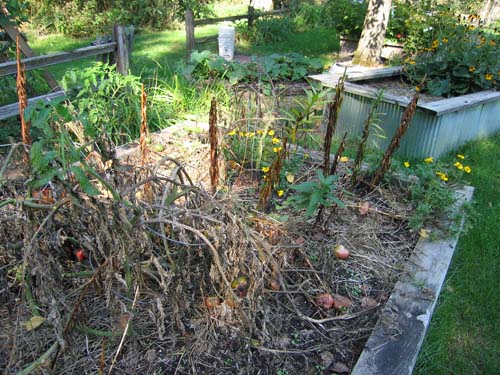
orchard-installation-day-3decay.jpg

While documenting the orchard installation, I also took some shots of the vegetable garden in late September.  This photograph has our heirloom Cherokee Purple tomatoes in their senescence.  The asiatic lilies with the tall tan stems of wilted leaves look much the same in terms of their life cycle, but in fact are different.

As annuals, the Cherokee Purples put all their effort into fruit, then the plant dies.  As a result, we have had a bumper crop of tomatoes, all raised from four seeds planted in April of this year under the lights of the hydroponic system.  Continue reading Senescence

Chop Wood, Carry Fencing

After years in urban ministry, economic development, affordable housing and responsbility for urban congregations spread throughout the metro area I thought I knew Minneapolis.

Not so.  When I drove over to ecological gardens, Paula’s home at 4105 Washburn Avenue I discovered north Minneapolis, the one that includes Shingle Creek, the Humboldt Greenway, Victory Memorial Drive.  This is a quiet leafy chunk of the city that seems somehow separate, another urban entity, neither suburb nor city. 

Delightful.  I love to drive around in the city, on city streets, to places I’ve never been.  That chance came to me today and I had a great time.

Back home in time for the nap, but no sleep.  A family I know has a terrible weight on them right now and I couldn’t get it off my mind.  What can I do.  What will they do. 

So I got up and moved old wire fencing Continue reading Chop Wood, Carry Fencing

Allison’s Corn Images From Mexico

Charlie,

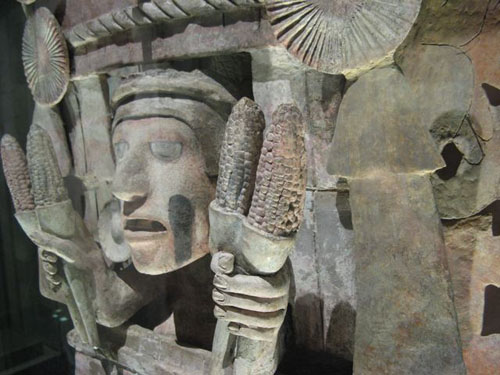
    cornallison3400.jpg

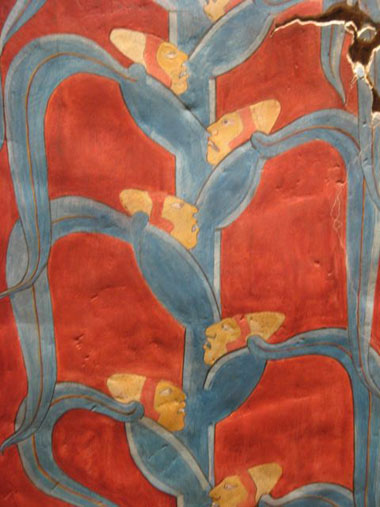
Here are three photos I took last year in La Ciudad de Mexico.

One is a portion of a mural by who-else but Diego Rivera.

The other two are from that great Museo de Anthropologica.  I was intrigued by the corn plant that was sprouting men’s heads.  And you will have to agree that the sculpture is pretty powerful.

Allison Thiel

                                   cornallison1380.jpg

                                   cornallison2380.jpg

Athletic Pinnacles, All On A Friday Night

69  bar steady  29.96  0mph NE  dew-point 64  sunrise 6:17  sunset 8:17  Lughnasa

Full Corn Moon

The Japanese have tea parties.  They sit on special decks built for one purpose.  Their artists have perfected its illustration.  The moon.  Moon viewing.  We have the same moon, but our utilitarian perceptual field notes the brightness.  Or, the sentimental connections of blue moons or harvest moons or over the moon, but we do not honor the moon sui generis.  If you have time the next night or two, take a moment, maybe more.  Look at this silvered neighbor, our closest ally, a chunk of earth separated now from home by 250,000 miles.  Full moons and crescent moons spark the fire in my heart, wonder.

I watched three Olympic events tonight and each one in its way affected me.  The Romanian woman, Constantina Tomescu-Dita, ran away from the field at the ten mile mark.  She ran away, ran away, ran away home in an inspiring individual effort.  At 38 she was the second oldest contestant in the field.  I got caught up in her bravery, her grit and finally her perseverance.  When she ran into the bird’s nest stadium, I cheered along with everyone else.

Michael Phelp’s 8th gold medal.  It was no gimme with a strong Australian team and a scrappy Japanese team right on the heels of the US, but Jason Lezk swam another anchor lap with great energy.  He’s 32.  Do you see a theme here?  Dana Torres, US silver medalist in the 50 metre dash (swim), is 41.  Phelp’s is in his prime and has done something no other Olympic athlete has ever done.  8 gold medals.  In one Olympic.  Some say it may never be done again.  Maybe not.  Maybe so.  What ever happens, nothing will ever detract from the disciplined, humble swimmer from Maryland.

Ussain Bolt ran a 9.69 100 metre dash.  He did it with ease and elegance.  He, on the other hand, is 21.  This was his first Olympics. He was so far ahead of the field that he thumped his chest and opened his arms palm up to the crowd–while he headed toward the finish line, speeding up.

3 riveting athletic feats.  Makes you proud to be a human being.

Corn Mother

82  bar falls 30.06 2mph N dew-point 65  sunrise 6:16  sunset8:17 Lughnasa

Full Corn Moon

This comes from wise woman Susan Weed and her website.

Her presentation of Lammas (Lughnasa) and especially her explanation of the link to the Eleusinian mysteries gives me chills.  Why?  Because I have corn growing in the garden right now.  Lughnasa is in essence a celebration, as I said in my post on the Great Wheel page, of the neolithic revolution, a celebration then, of wise women, since most archaeologists agree that women began the practice of horticulture.  It is also, and this is what gives me chills, a celebration of the corn that grows now here in Andover in 2008.  As the neo-pagans say, Blessed be.

                     punksilk2.jpg

Lammas, or “Loaf Mass,” is the Feast of the First Harvest, the Feast of Bread. This Holy Day honors the women who created agriculture and bred the crops we cultivate, especially the grains, or corn. In the British Isles, celebrants make corn dollies from the last of the newly-harvested wheat. The corn dolly holds the energy of the grain Goddess and, when placed above the door or the mantle, will bring good luck to the household all year.

When we think of corn, we think of succulent cobs of crisp, sweet, buttery yellow or white kernels: immature Zea mays, Indian corn. You know, corn. As in sweet corn, popcorn, blue corn, decorative corn, corn bread and corn chowder. Corn!

But, did you ever wonder why it’s corn? “Korn” is an old Greek word for “grain.” Wheat and oats, barley and even rice, are korn. This usage is preserved in the song “John Barleycorn must die.” When Europeans crossed the Atlantic and were introduced to the beautiful grain the Native Americans grew, they, of course, called it “corn.” And nowadays we think of corn as only that, but corn is Kore (pronounced “core-a”), the Great Mother of us all.

Her name, in its many forms — Ker, Car, Q’re, Kher, Kirn, Kern, Ceres, Core, Kore, Kaur, Kauri, Kali — is the oldest of all Goddess names. From it we derive the English words corn, kernel, carnal, core, and cardiac. “Kern” is Ancient Greek for “sacred womb-vase in which grain is reborn.”

The Goddess of Grain is the mother of civilization, of cultivation, of endless fertility and fecundity. To the Romans she was Ceres, whose name becomes “cereal.” To the Greeks, she was Kore, the daughter, and Demeter (de/dea/goddess, meter/mater/mother) as well. To the peoples of the Americas, she is Corn Mother, she-who-gave-herself-that-the-People-may-live. She is one of the three sister crops: corn, beans and squash. In the British Isles she was celebrated almost to the present day as “Cerealia, the source of all food.”

Honoring grain as the staff of our life dates at least as far back as Ancient Greece. Nearly four thousand years ago, the Eleusinian mysteries, which were regarded as ancient mysteries even then, centered on the sacred corn and the story of Demeter and her daughter Kore or Persephone. Initiates, after many days of ceremony, were at last shown the great mystery: an ear of Korn. Korn dies and is reborn, traditionally after being buried for three days. Corn and grain are magic. The one becomes many. That which dies is reborn.

The Earth, a Sacred Place

79  bar falls 29.96  0mph NE  dew-point 56  sunrise 6:10 sunset 8:25  Lughnasa

Waxing Gibbous Corn Moon

I got this off the Permaculture listserv.

“(I find this is a good reminder to recite every morning.)
Diadra

A Prayer for Gaia by Rose Mary O’Malley

As I breathe in your air, eat your fruits and drink your water, let me be sustained and nourished so that I may serve.

As I use your resources for clothes, shelter and warmth, let me be strengthened so that I may give back more than I have taken.

As I drink in the beauty of your oceans, flowers, blue sky and stars, let me be so filled with beauty that I will bring only love and joy to your inhabitants.

As I am nourished, taught and loved by your inhabitants, let me so filled with love and knowledge that I joyfully work to assure a fair distribution of your treasures.”

It is an example what I believe to be true, that is, many many people consider the earth a sacred place and have the intention of reverence and worship toward her.  The whole neo-pagan movement with its mix and match invocation of Europe’s ancient pantheons and perhaps some Egyptian influence does not reflect the rootedness of this sentiment in American soil. (That is, the American manifestation of it.  I believe this is a global phenomenon.) It is also not the case that the Native American reverence for the earth is other than a salutary reminder since their experience is so different from that of us boat people.

We need a way of following the seasons that respects our American experience of this vast and wonderful land.  We need a way of honoring mother earth that borrows, yes, from other cultures, but does not presume to make their ways our ways.  We need, as Emerson said, a religion of revelation to us, not the history of theirs.   And that revelation comes from two sources:  our experience of the outer world–this land, its peoples and our experience of other peoples and other lands; and, our experience of our inner world and its own universe, added to our resonance with the outer world.

This is the pagan lovesong that I hear in the hearts of so many people, one that needs articulation and expansion.  This is like Brian Swimme’s work, too.

This faith, this reverence and worship of the earth, as in Ms. O’Malley’s prayer, is an ur-faith, or a proto-faith, a faith that comes prior to others,  a faith whose acceptance does not contradict the Mulism or the Buddhist, the Taoist or the Christian, but complements, supplements them.  For some, like me, it is an adequate faith, enough to sustain me on my journey and as I contemplate the life after this one, or others, it is not enough, but one that needs some salvation instrument or some philosophical cleanser.  That’s all right.

Remember The Sabbath Day And Keep It Holy

76  bar steady 29.97  0mph NEE dew-point 58  sunrise 6:10 sunset 8:25  Lughnasa

Waxing Gibbous Corn Moon    moonrise 1633 moonset 0040

Strange how I have to relearn, sometimes again and again, simple home truths.  A day of rest is good for the soul.  The Jews knew it.  The traditional Christian community knew it.  It may be a Western contribution to humanity.  I’ll have to check, but I don’t think the Asian communities have a similar notion.  Yes, they have festivals and holidays, that’s for sure shared, but the notion of a weekly day of rest?  I don’t know.  Those of you who read from Southeast Asia, what do you know?

Anyhow, I woke up today recharged and ready to go.  This in spite of my lingering doubts yesterday.  Remember the Sabbath Day and keep it holy.  Quite a while back I got interested in the idea of sacred time, my commitment to the Celtic calendar is an example.  I also observe a week long retreat at the end of each year thanks to the Mayan concept that the last five days of the year are best left alone in terms of work.

I took from the Spanish cultures, especially Colombia and Mexico, the siesta.  A nap a day continues to be a cornerstone of how I live daily.

The religious communities with whom I shared a vocation for a time convinced me of the value of regular retreats.  The retreats and the Sabbath day have been honored more in the breach than the observance, but I believe that is about to change.  Our body needs sleep, perchance to dream, and, it turns out, our mind does, too.  Recent research shows that the mind sifts, weighs, analyzes and interprets the days events while we sleep.  I suspect the same thing occurs when we take a regular caesura from the usual rhythms of our week and our year.

Please note I’m not talking about vacations here.  Those exist for a different reason, I believe.  Vacations allow us to vacate the norm and experience another world.  They are more for fun and for education seen as fun.

The holy rhythms of which I write here are different.  They focus on the spirit, the care and maintenance of our soul.  Our doubts about such a metaphysically evanescent idea may have contributed to our immersion in and the stickiness for us of the material, outer world.

Well, time to put this regathered energy to work.  See you on the flipside.

An Existential Chill

66  bar steady 30.06  1mph NE dew-point 48  sunrise 6:09 sunset 8:27  Lughnasa

First Quarter of the Corn Moon    moonrise 1533  moonset 2334

We will never be an advanced civilization as long as rain showers can delay the launching of a space rocket.  George Carlin, RIP

The drum tower in Beijing.  Anyone who’s gone on the one week quickie tour of Beijing and environs has at least had a chance to climb it.  As early as the Han dynasty (206bce to 220ace), these towers used drums and bells to mark dawn and dusk. Kate and I climbed the drum tower when we visited Beijing in 1999. (I think it was 1999.)  I recall it as a dusty place with open areas used for storage, like an old barn.  Three stories high it had a commanding view of a market and one of the old style Beijing neighborhoods.  We were there at the end of December and the drum tower was cold in the way only bare, featureless spaces can be cold.  A sort of existential chill.  Maybe Kate didn’t go up, I do not remember now.

The death of Todd Bachmann, CEO of the premier garden center corporation in the Twin Cities, shocked me.  Many of our plants started their life at Bachmann’s.  Long ago in another life I was in a year long class with a Bachmann who had chosen the Lutheran ministry.  Then, too, there is the somehow stronger link with the site itself.

So often when events happen abroad, they happen in a place that is at best abstract:  Darfur, say, or Baghdad, Ossetia, even Jerusalem.  Once you have been there, walked those streets, seen the heaped up spices and vegetables in the market near the drum tower, then what happened is no longer abstract or far-away because the context is available to your own sensorium.  My feet recall the climb in the cold December weather.  My eyes recall the sights of the market and the small shops.

A strange sense of lassitude has come over me today.  On Sunday I do not work out, so there is a feeling of expansiveness, but also relaxation, a similarity to the sabbath.  The weather is perfect, moderate, sunny, low dew-point.  A great day to work outside, but digging out the firepit seems to have used up that motor for right now.  Even so, I’ll probably pick up the spade and spading fork and begin removing day lilies to new locations.

This is a task that has a window, a window created by the ideal time to transplant iris, August.  In this way my time must conform to the garden.  It is a happy bondage, though, and one to which I willingly submit.

How I Work

76  bar falls 30.01  0mph SW dew-point 58  sunrise 6:06 sunset 8:30  Lughnasa

First Quarter of the Corn Moon  moonrise 1326  moonset 2226

“More Americans are likely to suffer kidney stones in the coming years as a result of global warming, according to researchers at the University of Texas.”  Agence France-Presse, July 2008

N.B. All these quotes about global warming come from this website:  The Warmlist.  Here’s the webmasters explanation:

“This site is devoted to the monitoring of the misleading numbers that rain down on us via the media. Whether they are generated by Single Issue Fanatics (SIFs), politicians, bureaucrats, quasi-scientists (junk, pseudo- or just bad), such numbers swamp the media, generating unnecessary alarm and panic. They are seized upon by media, hungry for eye-catching stories. There is a growing band of people whose livelihoods depend on creating and maintaining panic. There are also some who are trying to keep numbers away from your notice and others who hope that you will not  make comparisons. Their stock in trade is the gratuitous lie. The aim here is to nail just a few of them.”

So, don’t say I didn’t fess up.  The Star-Tribune turned me onto this site.

Shifted focus. Gonna work on that firepit.  I decided Kate can help me transplant day lilies when she gets home and I’ll still have time to transplant the iris.  I get on a task and sometimes don’t lift my headup to check whether it makes sense.  Heresy Moves West is an example.

The research alone would take a good bit of time, I knew that.  That meant I could not hope to research and write it in the week prior to September 14th.  Knowing that I began to develop this knot in my to do lobe.  It began to insist, get it done.  Get it done now.  Right now.  This even though the date was 8 weeks away at the time.  Anyhow, I finally opened up and let the lobe have its way.

Once begun, research and writing, at least for me, need to be one fluid motion, the research followed by the writing.  In my case this is because as I research various ways of slicing and dicing the information comes to me throughout. At night before I go to sleep the data often floats up and demands consideration.   Sometimes I make note of these patterns, sometimes not.  Often I don’t because I want the order and interpretation fungible to the last possible moment.

Why?  In between the research and the writing there is a creative time in which the data and the various arrangements of it begin to pull other information, other paradigms out of my memory.  This process can change the data’s relevance.  Let me give you an example.

At first I imagined a straight chronological presentation.  The Unitarians began at such and such a place at such and such a time.  The westward expansion of the US began in this time period.  It rolled out according to these stages, in this place at this time and another place at another time until the whole shebang ended up encountering Minnesota. This came to me first because historical movement often seems cleanest presented in chronological order.

Soon though, as the pieces began to swirl, it became clear to me that the historical progression would have to start earlier, then even earlier.  I wrote about this a while back, my need for context.  When I realized there were big ideas at play here, the order of things changed again.  Then it was a history of ideas approach that made more sense, capturing the development of the peculiar notion of religious freedom in the US.  As that became clear, a second important dynamic rose to the top, the rolling dialectic between orthodoxy and heterodoxy.

To highlight the ancient character of this dynamic I decided to find its beginnings in the Abrahamic tradition with Abram’s call away from polytheism to allegiance to YHWH.

Both of these decisions meant that the data in the presentation would have to show how the westward movement of heresy (the rolling dialectic of orthodoxy and heterodoxy in Unitarian history) advanced thanks to the first amendment and how it continued the long arc of dogma challenged by new thought.  This lead to the realization that the westward expansion of heresy intensified in the  atmosphere of freedom and pioneer energy found on the frontier.  So, when we end up in Minnesota, the presentations show how religious freedom and the rolling dialectic not only manifest themselves here, but in fact gain strength and intensity.

Finally, that lead to a desire to push the dialectic one step further, beyond the bland everything’s in bounds soup of current day Unitarian-Universalism to the articulation of a new heterodoxy, one opposed to the dogma of one size fits all faith-lite.  This piece is the unwritten one at this point.