Beltane Cancer Moon

Today is the Indy 500. The 103rd. A long time. I’ve written here before about this race. Growing up in Indiana there are two sporting events that create a life-long spot in the heart, the Indy 500 and basketball, especially high school basketball. At the beginning of May the Indianapolis Star would start running articles about the racers, the crews, their preparations. The build up would peak pre-race on qualification day.
On race day those who didn’t get tickets would gather around their radios to listen. If you chose to go to the race, you already knew about the horrific traffic jams ahead of your trip to Speedway.
Speedway is a western suburb of Indianapolis which, according to Mapquest: “The town of Speedway was developed as a city of the future. Meant to be a testing ground much like the famed race track which is its namesake, Speedway was designed to be a city that was hospitable to the car. In a time when Indianapolis streets were often narrow orange brick thoroughfares… the town had homes with garages for cars.”

On the F1 circuit, the winner stands on a podium with the second and third place drivers, opens a bottle of champagne and sprays his fellow drivers and the crowd gathered around. It’s a media event. At the end of the 500 the winning driver is alone in pit row, like a thoroughbred at the end of the Kentucky Derby, which runs not far away in Louisville, Kentucky. Also like the Derby the 500 winner gets a floral sash.

The 500 is a race with agricultural roots, a car race held about as far south from Detroit as it is north of the Derby. A blend. Nothing shows that more than the winner posing with the huge Borg-Warner Trophy and chugging down, not champagne, but a quart of milk. From a glass bottle.
In 1965, the same month I graduated from high school only sixty miles from the speedway, Jim Clark and his Lotus changed the look and feel of the race forever. Jack Brabham brought the rear-engine European designs from F1 to Indy in 1961. 5 years later Jim Clark won in his Lotus-Ford. After that rear engine cars dominated the race. And still do.
 No scan. AARP Secure Horizons denied payment. When I asked how much it would be as a self pay. Pet scan, $2,600, axium dose somewhere between $1,000 and $3,000. Nope. And, I made the decision for the same reason AARP probably did. The scan’s accuracy is around 60% and that goes down the lower the PSA. My PSA is well above the reemergence marker of .2 at 1.3, but it’s still pretty low for imaging studies.
 On this side of the wall, where you and I are, is the money used to pay everybody in medicine. If you are a one percenter, there’s a special gate you can walk through anytime you need it. You can access all of the excellent care that is available. If you’re the rest of us, no money passes through the wall unless several corporate, bureaucratic entities and individual people within them, say yes. Those entities include private, for-profit health insurance companies, medicare, medicaid, non-profit health insurance, banks, credit card companies.
 Such a shift would eliminate all of the corporate gate-keepers who have an interest in profit for their company. Perhaps they could all go work for the TSA and use their previous employment experience to annoy the hell out of travelers.
 We hit month 7 since Kate’s bleed yesterday. (To quote the Grateful Dead.) Procedures and imaging. Trips to the emergency room. Trips to doctors. The gradual shift in roles at home. Things have gotten clearer, some solutions have appeared, but nothing certain right now.
 Synagogue shootings. Mosque shootings. Church shootings. I’ve not read of any Hindu temple shootings, but if they’ve not happened, it seems inevitable. A Southern Baptist clergy said, “…no one should be gunned down in worship.”
  I’ve been using the Instant Pot. Made a wonderful chuck roast, shredded easily, tasted great. On Saturday I made rice. Turns out three cups of dry rice makes a lot of cooked rice. It cooked for 1 minute. Sort of. There’s a learning curve for guys like me. First, the instant pot, a pressure cooker with bells and a literal whistle, has to heat up to the temperature required to produce the right pressure. That can take a while, maybe 5-10 minutes. Then, it cooks for 1 minute in the instance of rice. Fast, right? Well, yes. But, with foods like rice that have liquid and plump up after cooking, you do what the instant pot cook books call natural release. In essence that means you wait until the pressure cooker depressurizes on its own. 10 minutes. So, to cook 1 minute takes around 20 minutes in real time. Has some resonance with DST.
 Our first major snowstorm of the season is upon us. We’ve gotten 4 or 5 inches already and it’s only been snowing since midnight. May get 8-10 inches. Black Mountain has disappeared behind a gray-blue curtain, the lodgepoles look like flocked Christmas trees, and our solar panels have a 4 inch white blanket between themselves and the sun. No appointments today, no meetings. We can take this storm in as it comes, not see it as a barrier. We’ll get plowed today, I’m sure, so no worries there either. Let it snow.
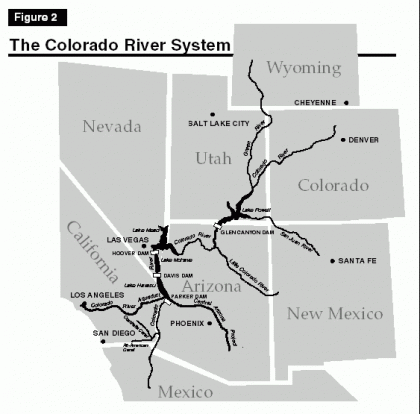
 There are two other effects that are critical to life both here in the Colorado Rockies and in the southwestern U.S. A good snow season reduces the threat of wildfire in the spring and summer until the monsoons come. That effects Kate and me and our neighbors directly. It feels much better going into summer having had plenty of moisture for the trees and the soil. A good snow season also recharges our aquifers, makes sure we’ll have water throughout the next year. This is an immediate, right here result of good snow.
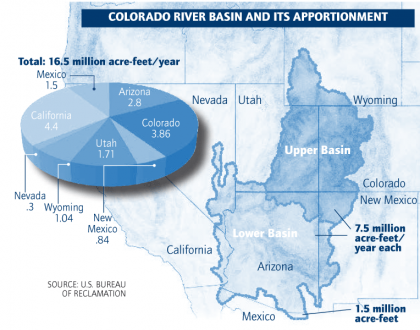 “Total population in the Colorado River Basin (CRB) increased from 4.56 to 9.44 million people from 1985 to 2010. Most of those people were in the lower CRB, with 86 percent of the total in 1985, and 90 percent of the total in 2010.”** The snowpack numbers, created by our annual snowfall, are critical not only here, because the Front Range and the Denver Metro rely on the Colorado River, but throughout the seven state CRB. These figures, almost invisible to the population of the humid east, are never far from the minds of government officials at the state, county, and municipal level here in the arid west, or the population as a whole.
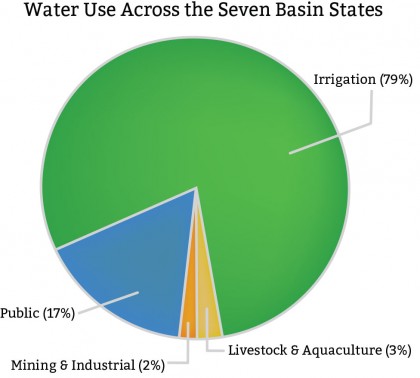 Finally, here is the problem that bedevils all those effected by The Law of the River, a web of compacts, federal laws, court decisions and decrees, contracts, and regulatory guidelines.* As this graph clearly shows irrigation is the largest claim on the CRB’s water by an order of magnitude. Add to that the allocation for livestock and aquaculture and 82% of the allocation goes to agriculture of one kind or another. We need food, those who grow our food need water. With public uses only 17% of the pie even the most draconian water policies in cities and areas like the Front Range will not move the needle much in total water use. Add to this the problem of the gap, droughts, and rapidly increasing populations, five of the fastest growing states in the nation are part of the CRB, then you can begin to imagine the tense negotiations required to maintain the status quo, let alone plan sensibly for the future.
 The stent moon is a crescent, 12% illumination, hanging over Eduardo and Holly’s. It’s been everything I hoped. Next, a month focused on getting Kate’s weight up. What would you name the moon for that month? I’ll take ideas until Friday.
 I woke up. The air is cool. My body’s ok. Kate’s beside me with no nausea or cramping. Kepler’s wagging his tail, ready to go upstairs for breakfast. The power came back on yesterday after a long outage. The generator works. I didn’t even know it was on. The long road to DIA offered good conversation with our second son. He’s going back to Minnesota to spend time with a friend who’s depressed. That gives me joy. Ruth up here painting and giving me tips. Joy. Pure. Gertie’s kisses. Murdoch’s bouncy, smiley presence. Snow. Cold. The black clear night sky with stars and a crescent moon. A car that works. SeoAh’s cooking. Kate’s joy at her relief. Gifts, joys, and gratitude. Everywhere I look.
 Are there challenges? Oh, yes. But our human tendency to scan the horizon for threats, be alert for danger often blinds us to everyday wonders. Life is not all about illness, or finances, or legal trouble, or separation from loved ones. Yes, these matters crop up in our lives just like the occasional predatory lion or tiger came upon our ancestors in the veldt or in the forests of India and, yes, we need to see them, understand them, respond. We do not, however, have to build our lives around them.
 2019. The Blade Runner year. Dystopian time? Match. Authoritarian regime? Match. Police killing those marginalized to society? Match. The cinematography of our era may look different-though Hong Kong, Shanghai, Dubai-but the underlying premise of a dark future catching up with all of us was prescient, if not exactly surprising.
 Dystopian futures, even ours from the perspective of 1982, have this seeming anomaly: Life goes on. Most folks make some accommodation, some compromise, and go on with their daily routines. Short of mass suicide, what other option is there? It is those very accommodations and compromises that are fertile soil for the demagogue and the populist. See Trump, Erdogan, Germany’s alt-right, Hungary’s Viktor Orban, Brazil’s Michel Temer. Movies have to convey dystopian troubles cinematically, so we think if the visuals don’t correlate with ours that the movie doesn’t apply. Wrong. It’s the core cultural themes that are important.

 I’ve begun to assimilate into Jewish culture. Different from becoming a Jew, just like Jewish assimilation into American culture is different from no longer being a Jew, my identity is largely intact, but I find myself much more aware of living life through a Jewish lens. Their holidays are now mine. Their community, mine. Their marginal reality, also mine, though this last requires a full choice on my part, not just acquiescence. That is, I choose to stand with my new culture against all elements domestic and foreign and not to retire into privilege when things get hairy.
 Been thinking about actions to fight climate change. The inversion of the Great Work championed by his Satanic Majesty, the orange tumor on our democracy, threatens human genocide. Intentional mass murder of potentially billions. Hitler and his crowd? Pikers.
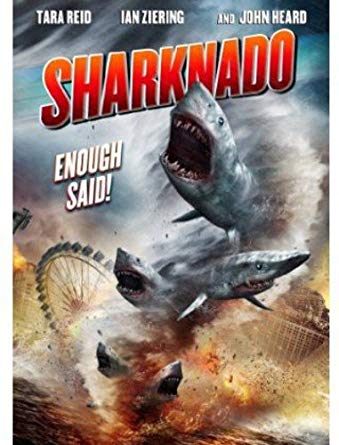 Chum is in the water. It may be Sharknado for he who shall not be named’s presidency. Part of Michael Cohen’s testimony indicates that individual-1, i.e. 45, the orange tumor on our democracy, ordered hush payments to two women with whom he had affairs, Stormy Daniels and Karen McDougal.