Category Archives: US History

Summer’s Gateway

Beltane                                                                  Closing Moon

Beltane marks the start of the growing season and the Celtic summer on May 1st. Meteorological summer doesn’t start until June 1. The summer solstice isn’t until June 20th/21st. Even so, we have just passed through our cultural gate to the summer season: Memorial Day and the Indy 500.

Yesterday bike riders began to show up in greater numbers, a fact that encouraged a lot of barking here on Shadow Mountain. There goes another one. Woof. And another one. Woof. The doggy equivalent of OMG.

Decoration Day, as it was called when I was a kid, was also the end of the school year. 12 years in the Alexandria, Indiana school system left me deeply imprinted with its meaning. First, we had the last day of school. The student’s equivalent of OMG. Then, we had the Decoration Day parade which ended at the cemeteries on Highway 9. After that, bliss.

Each year since, even today, the day after Memorial Day feels different. Lighter. My heart fills up with possible small adventures: hikes, road trips, movies, long evenings outside with friends. Too, U.S. history becomes more important to me, so I often pick up a Civil War book or something about slavery. This year I imagine they will be about the West.

So, let’s go play!


Living Large

Spring                                                   Mountain Spring Moon
Over the last couple of days an e-mail exchange between two friends used, twice, the phrase living large. As sometimes happens, this time I looked at it and said, huh? What does that mean? So I looked it up in the urban dictionary and another online slang dictionary. Here’s what they had:

able to pay for and enjoying a very expensive style of living.  Vacations in the hot spots, a huge apartment in the city, cars, servants – that’s my idea of living large!

phr. Doing okay. (The response to How ya living?) I’m living large. How you doing?

Living with an extravagant or self-indulgent lifestyle.

In a cascade came another phrase: How then, shall we live? then, Peter Singer’s new book: Doing the Most Good. Then, what? And, living well is the best revenge.

I’ve always been struck by the power of unspoken, perhaps even unknown motivators, things that might have entered our psychic world unnoticed, sort of sliding in under our usual filters. My suspicion is that living large is such an unspoken, often unknown motivator.

The idea of being able to spread out in your world, to recline at your ease where and when you want underlies many an entrepreneur’s aspirations. It drives many during the long years of getting professional degrees, especially in the law and medicine. Those kids shooting hoops on inner-city asphalt, the rapper with the gold medallion around the neck, even the drug dealers and pimps, all want to live large. And, you might say, why not?

Yes, there’s the American dream. And, now the Chinese dream. In both cases you might say the dream is to live large in relation to poverty, to the uncertain rungs on society’s socioeconomic ladders. In that original dream the goal is a stable life, one with a home, enough food, savings, health care, education for the kids. And, yes, for many, maybe most of humanity, over most of history that goal would have been unattainable. In that sense these modest dreams represent living large.

But these kind of dreams have a way of metastasizing, like body builders on steroids, like an unchecked cancer. Instead of being a dream they become a nightmare of needs turned into desires and desires turned into lust. In this, its more usual sense, I think living large represents the corrupting influence of late-stage capitalism, where to gain more becomes its own rationale. Living large is not an aim, it’s a manifesto of unchecked wants that will, somehow, be satisfied.

Living small. Now there’s an aim.

Tourists

Spring                                   Mountain Spring Moon

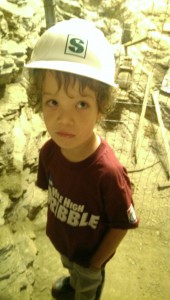
IMAG1001Gabe and I had an adventure yesterday. We went to the Agro Mine Tour, ate lunch at Beau Jo’s Pizza in Idaho Springs and finished off the day with a soporific soak at the Indian Hot Springs, also in Idaho Springs.

The mine tour itself is a cheesy, tourist-trappy thing with a clunky video, corny presentations and a self-guided tour after that. Still, the Double Eagle Mine, Gage is at its face (end) in this photo is remarkable in that it was dug by hand, by two men over the course of one year. About three hundred feet long, maybe five and a half feet tall and about 4 feet or so in width, it’s a monument to persistence, if nothing else.

The rest of the tour focuses not on a mine, but on the Agro mill, which in its prime, produced $100,000,000 worth of gold when gold was at $18-35 an ounce. It was fed by the Agro tunnel, a 4.5 mile tunnel dug through solid rock to remove waste water from various mines and to create a small railroad to deliver ore buckets to the Agro mill.

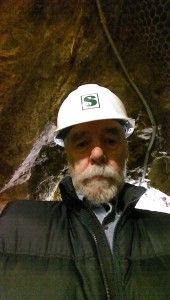
The Agro mill closed in 1943 when, on the last blast of the day, four unlucky miners IMAG1000dynamited a wall holding back water filling up an abandoned silver mine. The resulting flood geysered water from the tunnel for 9 hours. In addition to killing the miners the flood weakened walls and caused cave-ins along the tunnels length making the railroad tracks no longer usable.
The mill itself went down in stairstep like levels since most of the work proceeded through the aid of gravity. The Agro tunnel fed ore in from the top of the mill and the processing went in stages toward the bottom. A structure made of wood it looked like an unsafe place to have worked.

Idaho Springs is about 30 minutes outside of Denver to the west and well into the mountains. The Colorado Mineral Belt, which begins in the San Juan Mountains in the far southern part of the state, makes an arc up through Leadville and finds its terminus just a bit further north from Idaho Springs. Along this arc lie most of the mines in Colorado, many of them producing, like the mines the Agro Mill serviced gold, silver, copper, lead and zinc. Some have molybdenum and other metals. There’s a big, working molybdenum mine outside of Leadville.

Idaho Springs is a tourist town, primarily, located on either side of a long main street paralleling I-70. It has some residential housing, but not much. Service stations, inexpensive motels, restaurants, curio shops, a knife shop, a hardware store which sells gold panning supplies, that sort of thing.

And the Indian Hot Springs. The facilities, both the main building and the adjoining motel, saw their better days many years ago. The springs, though, deliver. Gabe and I swam in a large pool of water, 100 degrees +. There are, too, hot springs caves, a men’s and a women’s cave where clothing is optional.  Kids under 16 are not allowed in the caves.

After all that, it was back to Denver and a quick exit so Grandpop could beat the rush hour traffic on the way home.


Becoming Native to This Place. More.

Imbolc                                         Black Mountain Drive

Four Native Plant Master classes educate new learners in Colorado’s fauna: one for the high plains, one for the foothills and one for the montane eco-system where we live. The fourth, plant sketching, will support the nature journal I’m starting this week.  The Friends of the Colorado Geology Museum offers lectures and field trips that focus on Colorado’s physical features. Geology Underfoot, an excellent geology primer on the Front Range, suggests 20 self-guided field trips to see instances of particular developments over geological time. Wild Food Girl presents opportunities to hunt food in the Rockies.

How to saturate myself with the Old West, the mining and ranching histories here, that’s a challenge that lies ahead though History Colorado provides opportunities.

It’s an exciting time, full of information. Lots to do.


It’s All Real Stuff

Imbolc                              Black Mountain Moon

Prep days. Yesterday reorienting my workouts, today moving back into Ovid with the Latin. Prep is important but I find I want to hurry through it, press on, get to the real stuff. But, it’s all real stuff, isn’t it?

When doing the Latin, for example, I want to work fast, translate easily, get it. But, most often I have to work slowly, translate with difficulty, struggle to understand.

In the MOOC I’m taking from McGill University the current section is on physical literacy. An amazing insight for me. Literacy in the alphabetic, language based world, yes. Numeracy in the numbers based, mathematical world, yes. But physical literacy? That is, learning basic moves and physical actions that can later be strung together to play a sport, keep one fit, teach us how to fall, no. The idea never occurred to me.

It apparently surfaced in the 1930’s in America whereas numeracy only emerged as an idea in the 1960’s. It’s not surprising, I guess, since the move from the farm to the town and city was weighted against the old, physical ways that had existed since hunting and gathering gave way to the neolithic revolution.

Perhaps, come to think of it, becoming native to this place is a component of physical literacy, a tactile spirituality. As we move less and less, we interact with the natural less affectively, less often, less well. Perhaps play is a big component of becoming native to this place, wandering aimlessly in the woods or by a pond, in the mountains, on lakes.

Anyhow, I’m excited about this idea, a human trilogy necessary for a satisfying life: literacy, numeracy and physicality.

Peek-A-Boo

Imbolc                             Black Mountain Moon

Reading in the New York Review of Books about FBI surveillance of the anti-war movement. There was paranoia about the Feds all the time, with new folks coming under suspicion. The times were rich with focus, focus that made sense and focus that did not. The two were sometimes hard to separate.

Anyhow, the article reminded me of the funniest instance of FBI surveillance in which I personally participated. Back in ’72 or ’73 a bunch of us conceived the idea of a human chain around the Federal Building in St. Paul. There may have been a court case then, I don’t recall, but we showed up bright and early, joined hands and made a circle around the building. OK, almost the whole building. We didn’t have enough to close off the loading docks.

Anyhow, the Kellog Square apartments were under construction across the street from the Federal Building. They were mostly complete, several stories of apartments with glass windows facing the street. All of the apartments, up, I don’t know 20 floors, were empty. No curtains on the windows. No furniture. No renters yet.

Except. About six stories up, one unit had curtains. And, peeking between the curtains were cameras. The lenses were visible to the naked eye. Once we noticed them we waved, of course.

Very subtle of the FBI to hide behind curtains. In the only apartment that had them.

Oh, those were the days.

Who?

Imbolc                                                                      Settling Moon II

As the dominant ethos of Minnesota lies in its wild lands to the north, the Boundary Waters Wilderness and Voyageurs National Park emblematic of it, so the dominant ethos of Colorado lies in its wrinkled skin, mountains thrusting up from north to south and from the Front Range to the west. Where Minnesota’s map is essentially flat, marked with depressions filled with either water or wetlands or peat bogs, Colorado’s map is tortured, angular chunks of rock shoved up this way and that, lonely roads tailing off into gulches and canyons and valleys.

These two states share a common theme, wild nature at their core. You may live in these states and never trek in the mountains or visit the lake country; it is possible, but if that is you, then you shun the basic wealth of the land which you call home. In these two states, as in several other western states like Idaho, Washington, Montana, Oregon the political borders that mark them out matter much less than the physical features that define them.

In these places the heart can listen to the world as it once was and could be again. This is a priceless and necessary gift. It may be found in its purest form in the areas designated as wilderness, but these lands participate in wild nature in their totality. Those of us lucky enough to live within them have a privilege known only by occasional journeys to city dwellers. With that privilege comes, as with all privilege, responsibility.

These places which speak so eloquently, so forcefully when seen are silent out of view. On the streets of Manhattan, inside the beltway of Washington, in the glitter of Las Vegas and the sprawl of Los Angeles these places shimmer only in photographs, movie and television representation, books and their power is not in them.

Who will speak for the mountains? Who will speak for the North Woods and its waters? Who will speak for the trees?

A Hole in the Heart

Imbolc                                                                           Settling Moon II

Mike just finished loading up all the boxes we’ve emptied so far, a pile three feet high plus three large boxes filled with collapsed book boxes. They’re headed off right now to Mountain Waste. He also carried my 50 inch plasma up the stairs. Carried it. I couldn’t even lift it. This guy is strong.

He typifies a core problem with our republic. Mike makes his living doing a variety of things that require physical strength and manual skills: fence building, hauling out appliances, and general hauling. Plus odd jobs. It’s hard to earn enough to live that way. But there are many people who love physical labor and find the idea of working inside abhorrent.

When asked how things were going, Mike told me. His 14 year old daughter has problems, not unusual, but difficult. He also had a stress test, which found an abnormality. An angiogram confirmed the abnormality but showed he didn’t need a stent. He’s had to change his whole diet. Tough to do, as most of us know.

Here’s the problem though. What does a guy who prefers physical labor do if unable to continue? A hard reorientation in mid-life if it becomes necessary. Also, hearts are expensive organs to manage.

We really have few places in our new, brave world for guys like Mike. Logarithmically reinforce that if you’re a black or Latino male or disabled. This hole in our economy may enlarge to become a hole in our collective heart since it will not go away.


_________ the terrorists have won.

Samain                                                                                Moving Moon

If you, ______, the terrorists have won. Stop shopping. Stop flying. Stop going out at night. Stop eating Cheerios. You remember this dark comedic line delivered as a straight line by our highest governmental officials.

While clearing a cache of newspapers out from underneath our stairs, a collection hidden I imagine in attics and basements across the land, several headlines blared out. Taliban Keeps World Waiting On Turn Over of Bin Laden. Dateline September 19th, 2001. The Day The World Changed. An Economist cover from that same week.

The impulse that had me storing these and learning about Islam for well over a year has long since waned in strength. These artifacts no longer have the heat they did when I laid them one on the other over a decade ago.

As I took them out to the trash though, an idea did strike me. What if we said this? If you mount a global military campaign killing thousands of civilians, engage in pre-emptive warfare, torture any believed at all complicit, sweep up information on the entire US population and many foreign countries, and ravage the political culture at home, then, oh yes, then, the terrorists have won.


Strange Fruit

Samain                                                                           Moving Moon

Ferguson. A situation where any decision would have been met with anger and disappointment. I don’t pretend to know the facts well enough to evaluate the grand jury’s decision. It is clear however that the black community, after a recent string of publicized police related deaths, will question the conclusions.

Look at this from the perspective of Ferguson’s black community. An unarmed teen-ager is shot down in the street by a white police officer. The government and most of the police force is white. There have been high visibility instances this year of other police related killings of black people. Too, this sort of violence, violence sanctioned by those in power is not a new thing, not at all.

Considering the inherent violence in the enslavement, sale and servitude of Africans early in our history, a violence only ended by a great spasm of violence, and even then not truly ended but substituted for by Jim Crow laws, the Klan and structural racism, it is important to understand that the situation looks very different from within the black community. The assumption there is not on behalf of the police, or the benevolence of the government, rather it is fed by what Billie Holliday called Strange fruit. And understandably so from my vantage point.