Category Archives: Latin

The Wall

Samhain                                                              New (Thanksgiving) Moon

Hit a mental wall yesterday.  Could. Not. Do. One more MOOC or Latin related thing. Brain was not interested.  In the AM  we completed the last of the garden chores for the season and I went downstairs to work on Ovid.  Nope.  Then turned on ModPo and, for the first time since both MOOCs started I did not complete a week’s work on time.  So this week I have to finish week 9 and do all of Week 10.

Doable because I no longer have Modern and Post Modern, but I don’t like to be behind.  I’ll catch up today or tomorrow.  At the same the new Latin learning style Greg recommended is, again, doable, but it takes more time.  For now.  The combination of the ending of Modern/Post Modern, the assessments due in ModPo, the home work Kate and I did to get ready for the Samhain bonfire and the bonfire itself, coupled with the changed Latin working style short circuited me.  Or threw an internal G.F.I.

Then, there is, too, the G.D. time switch.  I’m a naked, blanket, no prisoners opponent of messing with time.  Leave it on standard time and damn the consequences.

As I write this, I realize I’m not much further along today.  Need some more rest.  On the other hand, feeling tired means I’ve been active and that’s how I want to be.

There is, though, one more flaw in this ointment.  I started my low fiber diet yesterday, clear liquids starting at 11:45 pm tonight.  Then that fun couple of hours with a Powerade Miralax punch.  Those of you over 50 almost certainly know this routine.

As I read the rules for this procedure, it reminded me of ascetics who would undergo elaborate rites of purification before entering the temple to commune with their gods.  In this case the god will appear in white armed with a long, skinny camera.  He, not me, will be going deep inside myself, gaining self-knowledge for me and recording it with a camera. It’s better than meditation! Gastroenterologist be with me now and in the time of my procedure.  So help me Galen.


Pushing past a plateau

Samhain                                                                  Samhain Moon

Latin.  Better today.  Greg pushing me to do sight reading at a higher level of proficiency. He wants me to read the Latin, without aids, and translate it for him during our sessions. This will entail, he says, going over each sentence or verse at least four times until it becomes embedded.  He believes this will push me off my current plateau.

(old roman)

I’m excited about this.  It will make my translation pop, he says.  At some point.  There is, though, the inevitable regression in terms of time, since this will make each sentence take longer. How much longer I can’t tell yet because I haven’t practiced it.  It does mean I’m headed in the right direction.


Fall                                                                  Samhain Moon

more Lucretius

1. You who have born Aeneas, pleasure of man and god,

2. Bountiful Venus, gliding smoothly underneath the mark of heaven,

3. How thou dost enliven the ship-bearing sea and the fruitful earth

4. Everything since transformed into a living being

5  Is conceived through thou  and (we?) behold the light of life rising.

6. The winds take flight with thou, goddess, with thou, with thou the clouds of heaven (flee)

7.  And come suitably for you, for thou the skillful earth

8.  Causes to spring forth delightful flowers, the calm sea smiles upon thou

9.  And quieted heaven shines (forth) diffuse light.

(Titian’s Venus)


The Nature of Things

Fall                                                                        Samhain Moon

My first venture into Lucretius, De Rerum Natura:

Book I:

1. You who have born Aeneas, pleasure of man and god,
2. Bountiful Venus, gliding smoothly underneath the mark of heaven,
3. How thou dost enliven the ship-bearing sea and the fruitful earth
4. Everything since transformed into a living being is conceived through thou.

Keeping On

Fall                                                                       Samhain Moon

After a lackluster come back to Latin on the 17th of October, my confidence wavered. Kept at it though and today I finished my 60th verse since then.  That was my goal for the two week period.  Unless I’m way off, I’ve found my trireme legs again.  Far from easy, but very far, too, from being opaque, as Latin was to me for the first 63 years of my life.

In fact, with the time I’ve got left over this next three days I’m going to start on Lucrectius’ De Rerum Natura.  Some variety is helpful Greg says but Vergil and Caesar didn’t work for me.  Couldn’t hold my interest.  Lucretius will.

Started the last third of ModPo today with the Language poets.  I’ve only read one piece so far, Albany, by Ron Perleman.  It’s a 100 line autobiography in what he calls new sentences, each sentence personal and political.  And, not in sequence.

It sounds strange but I found reading it a pleasure.  A gestalt forms from the scraps of

More later on these contemporary poets working in an unusual way with poetry, memory, and story-telling.

Changes Are Coming

Fall                                                                     Samhain Moon

With Modern/Post Modern in its last week and Modpo with only three weeks to go, I feel like the end of the quarter or semester is in sight.  Since it will roughly co-ordinate with Samhain, this means a distinct change in my daily life.  The garden is almost put to bed and will be by the end of this week as well.  The bees, too, will get their cardboard outer sleeve, the moisture absorbing top board and corks in the lower two entrances, plus the entrance reducer.

This year part of that outdoor energy will get focused in the garage which can use a major cleaning, rearranging.  It’s gotten cluttered and we could use it for more if we eliminate a few things like the five stall dog crate and feeding platform.

Writing Loki’s Children and keeping up with the Latin will occupy the bulk of the time.  I’ll huddle downstairs with the green gas stove burning, my Zojirushi kicking out tea temperature water and visions of old Rome and Ragnarok.

Two Good Movies

Fall                                                                      Samhain Moon

The wood got split.  The Latin trounced me.  Two essays on pragmatism, one by Richard IMAG1083Rorty and one by Cornel West, put philosophy into the day and the next to last essay in ModPo just went into cyber space.  It’s below, if you’re interested*.  The assignment was a few posts back.

Saw two good movies tonight, too.  Once Were Warriors is a difficult movie to watch since it shows domestic violence in as raw a way as I’ve seen.  About Maori’s living in contemporary New Zealand Warriors has a long tragic arc which only lifts near the end and then to recognize the role of tradition in a tribal people.  Most of it is grim and much of the grimness comes from self-loathing generated by rootlessness, abandonment of the past for a present with no cultural handles.  It’s definitely worth seeing.  The funeral of Grace had me in tears.

Then a longer, unusual Hollywood movie, the Place Beyond the Pines.  This Ryan Gosling/Bradley Cooper movies has a surprise narrative arc as a major character dies halfway through the movie.  This is a movie about consequences, too, like Warriors, but here the past is not so cultural, it’s personal and it skips a generation before it comes to ahead.  I liked the longer plot line, an unusual choice in a mainstream Hollywood movie.  An actual adult movie.  Also worth seeing.

*All That’s Left Is Letters

The title “Why I Am Not A Painter” answers the existential why of the poem’s second line before the poem itself ever starts. O’Hara is not a painter because he writes poetry. For example, here’s one titled “Why I Am Not A Painter.” The poem is his work as the painting hung in the gallery is Goldberg’s. Thus, O’Hara is a poet and Goldberg a painter.

He thinks he would rather be a painter, but he says, “I am not. Well,” This is, I guess, a soft end-stop, a sort of pause here and think construction which suggests a wry answer to the question. He is not well, at least not well enough to be a painter.

The two long stanzas provide an alternative narrative to the usual description of the creative process and in so doing give an insider’s look into the difference between painters and poets.

“Mike Goldberg is starting a painting”, this line in the continuous present, puts us with Goldberg and O’Hara until in the third to last line the painting is finished. What has happened? O’Hara dropped in, had a drink, noticed the painting had the word SARDINES in it. He leaves, comes back, leaves, comes back. Then he returns and it’s finished.

O’Hara asks, “Where’s SARDINES?” In what I read as a plaintive or mock plaintive note, he notes, “All that’s left is just letters,” “It was too much,” the painter says.

In the alternative narrative of a painter painting, we get no description of the painting itself save for the word SARDINE and then its absence in the final work. Even one word was too much.

So, having shown us a painter at work, O’Hara says, “But me?” The poet. What does he do? Well, ironically, he thinks of a color: orange. He writes a line, then a whole page of words, not lines. Like SARDINE this is at the beginning of the creative process. As with Goldberg, O’Hara lets days go by, then he says, “It is even in prose, I am a real poet.” I don’t understand this line except perhaps as irony meaning something like, I’m a real poet so even prose is poetry.

The twist comes at the end and like a magician there is a big reveal. When he names his twelve poems, he calls them ORANGES in spite of having not mentioned orange in any of them.  When he sees Goldberg’s painting in a gallery, it is named SARDINES.

Painter and poet are alike in what they leave out, but different in that with Goldberg “all that’s left is just letters.” O’Hara, on the other hand, has words. That’s the key difference between the two, when their work is done, O’Hara has words and the painter only letters.


Splitting Wood

Fall                                                               Samhain Moon

Each day has its lessons.  Today the Latin was harder than yesterday or the day before and I had to spend time in the grammar book reminding myself about supines and gerundives. On top of that I still couldn’t wrestle a sentence out of the two verses that troubled me.

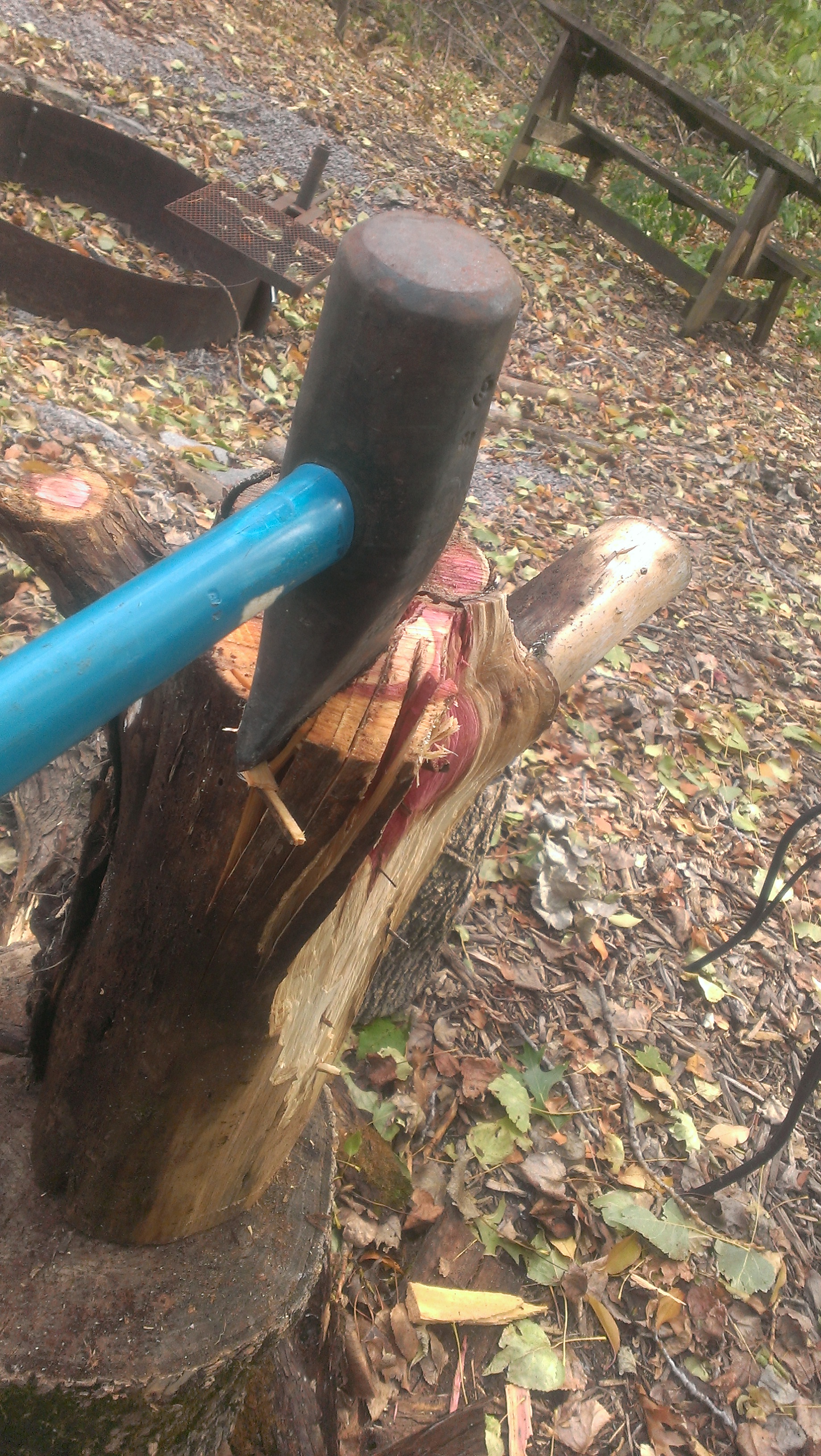
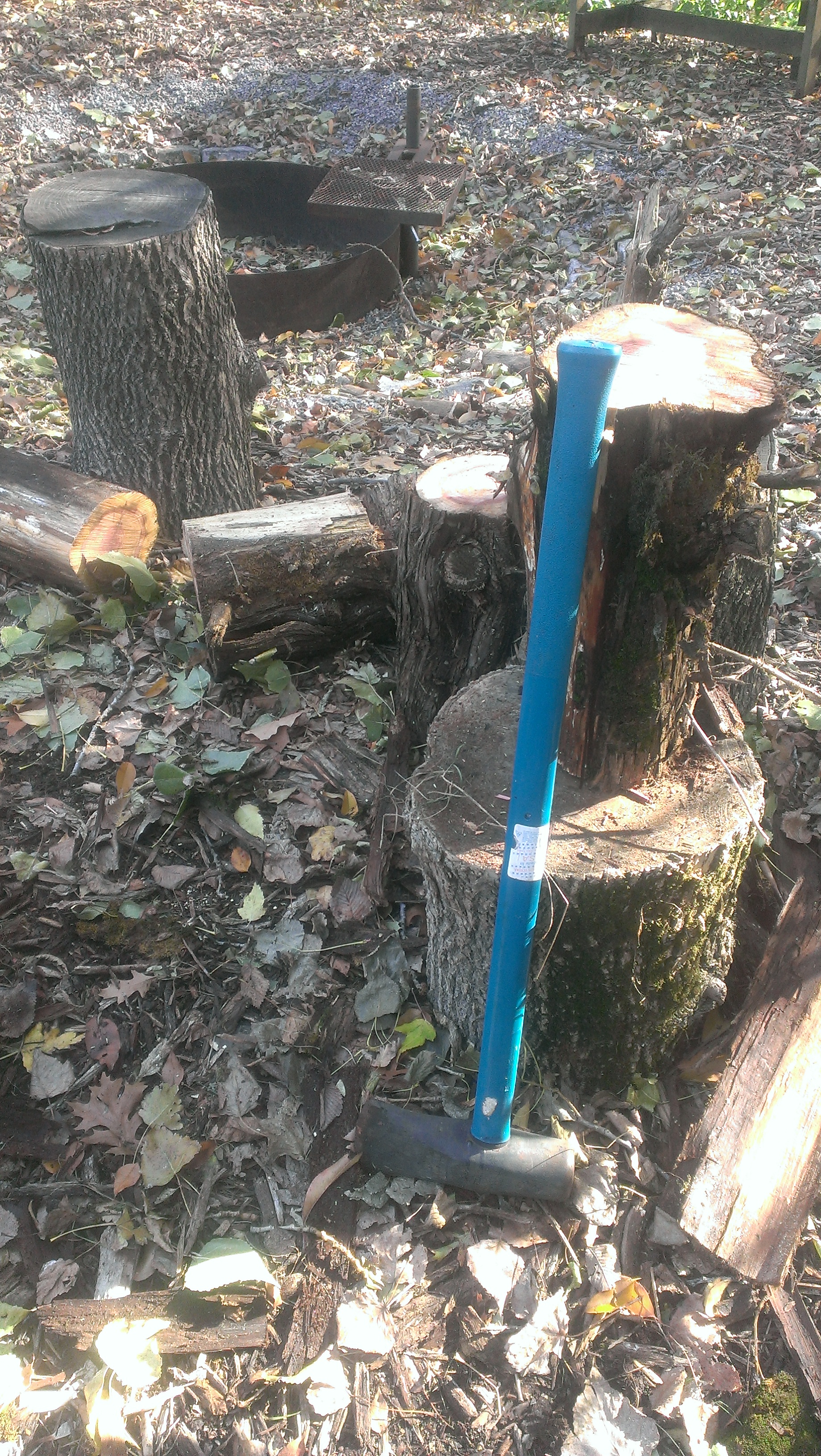
When I’d run my brain as far as I could down the old Latin way, it was a good time to go IMAG1084outside and split wood for the Samhain bonfire.  Boy, it had been awhile since I split wood.

The splitting maul combines a dull axe and a sledge hammer. When you’re splitting wood you want to force the fibers apart, not cut them, as a sharpened felling or limbing ax will do.  That results in ax blades sunk deep into the log.

Besides, as often happens, the splitting maul wedges itself in the wood, allowing for a secondary maneuver which involves lifting maul and with it the log into the air, then bringing both down on whatever solid surface you’re working with, in this case a chunk of the elm formerly in the vegetable garden.  The more slender handle of a felling ax is not designed for the force generated by this action.  The splitting maul, however, has a plastic handle that absorbs the blow and keeps right on working.

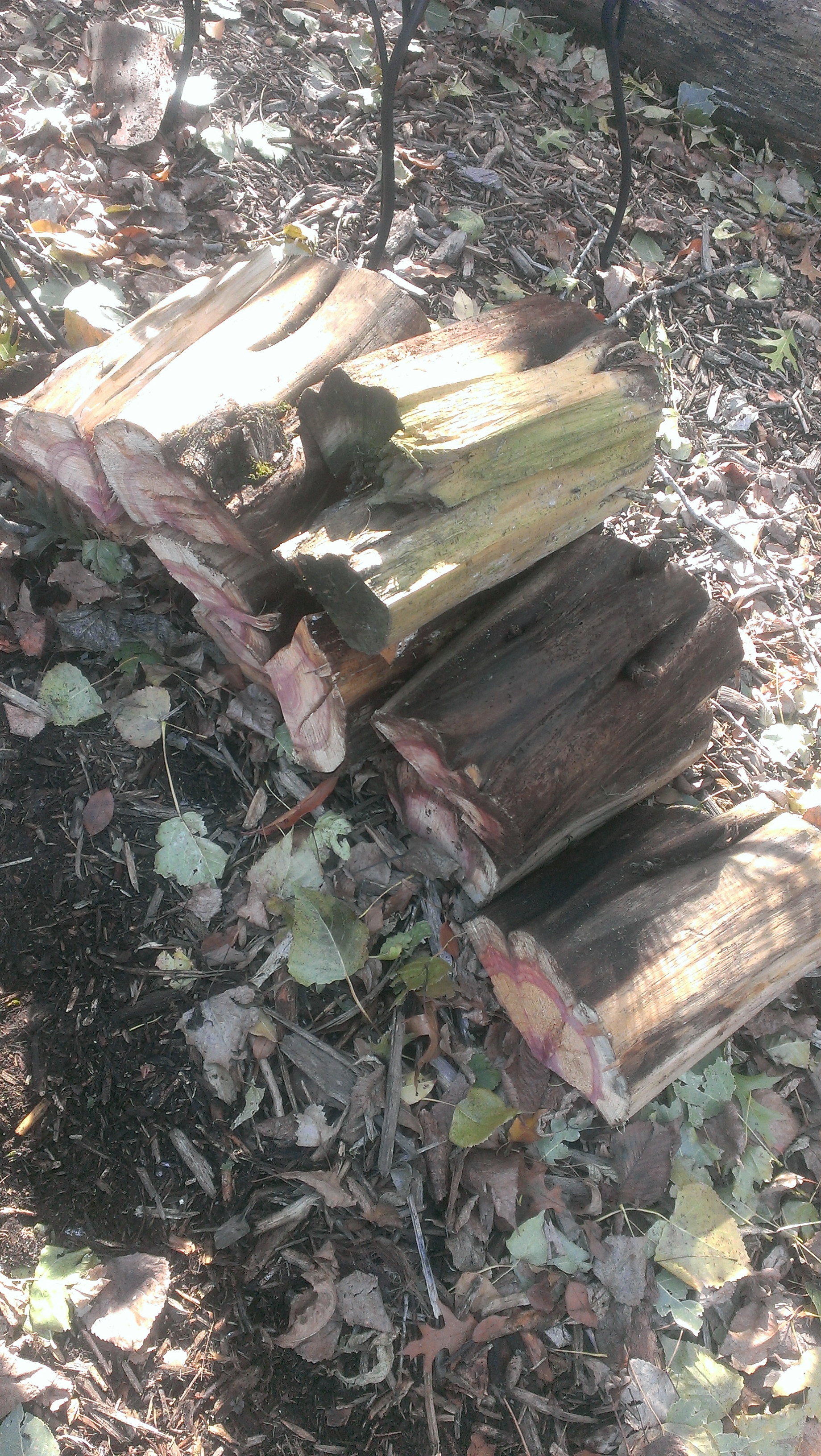
Here’s the completed work, which consists of two cedar trees blown over by a windstorm aIMAG1081 couple of years ago.  They used to be beyond our deck, between us and the vegetable garden.  I still miss them.  Well, this is actually about half of it, but you get the point of what splitting accomplishes.  It creates a surface that more easily catches fire; and, if it were an issue, which it isn’t, makes them easier to put in a fireplace or stove.

Anyhow, after lifting the maul and the occasional log in the air and slamming them back down on the elm, I was glad I do regular resistance work.

Still At It

Fall                                                                         Samhain Moon

I’ve picked up the pace in translating.  Not a lot.   But I have.  My intention is to time myself from now on, figure out how I can increase my speed.  That will be important, as I said before, if I’m to translate the whole Metamorphoses.  (Ovid)

You might ask, why?  A few years ago I decided to read classics for a whole year.  I read the Koran, Faust, Dante’s Divine Comedy, Homer’s Iliad and Odyssey and the Metamorphoses among others.  As I did this, I also read commentaries and essays on these works to give myself a broader and deeper perspective.  When I got to the material on the Metamorphoses, I realized it stood at a critical juncture between ancient Greek religion (and, I imagine now, the Egyptian influence on the Greek) and Western civilization in the common era.

During the Renaissance it was Ovid’s work that moved Greek mythology into the mainstream of Western intellectual life.  The older sources were either unavailable at the time, as yet undiscovered, or simply missing.  That’s why the versions of the mythological corpus you know are most often Ovid’s version.

(Banquet of the Gods-Frans Floris)

If I could imprint Ovid’s stories into my brain, then I would have a vast resource, one with deep resonance in the entire Western literary tradition.  How to do that?  I had always wanted to learn a language but had told myself I couldn’t.  How about learning Latin, then translating the Metamorphoses? It could vanquish a self doubt, allow a peek behind the curtain of translation and help me absorb these wonderful stories.  All in the same project.

It’s not been, nor is it now, easy.  It is hard part of the time, difficult the rest.  But I’ve learned to enjoy that.  There are new insights often and results that I know are mine.  I’m learning the stories and advancing towards the skill level I need to go the distance.  This is the fourth year of learning and translating.  Many more to go.

BTW:  There is, somewhere in this, the novel I want to write.  A big one, a fantasy, because that’s how I think when it comes to fiction, but one deep in this material.  What it will be like, I don’t know, but I keep looking for fleeting images as I work.  Perhaps behind the story of the golden age?  Philemon and Baucus?  Medea?  Pentheus?  Perhaps in Ovid himself?  First century C.E. Rome?  All of these?  I don’t know.  But it’s the Moby Dick I’ve set sail to find.

Around and Around and Around We Go

Fall                                                                       Samhain Moon

Interesting convergence.  In Ovid today I translated some verses about the silver age in which Jupiter created four seasons from summer, brief spring, winter and autumn.  After finishing this work, I went out and joined Kate, already at work in the garden.  Small pellets of snow fell.

(The Close of the Silver Age by Lucas Cranach the Elder, c. 1527-35)

We went into the orchard.  Kate pulled back the landscape cloth around the remaining trees while I broadcast the fertilizer, sprayed with biotill and then worked them both into the top three inches of soil.  While she replaced the landscape cloth, I shoveled soil, mostly sand, back into two large holes dug by our energetic girls, Vega and Rigel.

At one moment I looked up at a tall Norway pine and felt a kinship with Ovid and those farmers in long ago Latium.  We had similar things to do at similar times of year.

The word annum popped up from today’s translating.  You know, I imagine, that it translates as year, but you might not know that its primary meanings are: a circuitcircular courseperiodical return.  In one sense this is obvious of course, but that term we use frequently could orient us not to linear time, as we tend to use it, but to cyclical time.

When I say, I am 66 years old, we tend to think, oh.  Born 66 years from this date.  But that’s not what it really means.  It really means I have experienced a full year 66 times.  The year itself, if we’re true to its Latin roots, is not a one after the other marker of chronos, but a complete set, 4 seasons here in the temperate latitudes, finished and done with each winter, begun anew each spring.  Or whenever you want to break beginning and ending.

We then start over again.  Another year as we often say.  Yes, just so.  Another year.  This time in the next year I’ll be fertilizing the orchard.  As I have this year.  So that moment of apocalypse when the earth becomes changed and brand new?  Spring.  When the earth becomes desolate and barren?  Late fall.  Happened before, will happen again.  Amen.