Category Archives: Memories

Destination Twin Cities

Beltane                                                                               Solstice Moon


Butch Thompson is an elegant guy who can really get down.  “Two Minnesota artists — celebrated choreographer Sarah LaRose-Holland and jazz pianist Butch Thompson — have collaborated to present “Destination Twin Cities,” an impressionistic, time-traveling exploration of neighborhoods, landmarks, people and places that define urban life in Minnesota. Who were we, and who are we today?”

Butch played piano and one very soulful clarinet piece and Sarah LaRose-Holland’s dance troupe, Kinetic Evolutions, gave movement to a nostalgic look back at many Twin Cities’ notable places from the Lexington Restaurant to the Hennepin Avenue Strip.  The latter roughly located where Block E is now.  It was a place full of dives that provided steady work for many Minnesota jazz musicians.

Slides of Twin Cities past:  the Wabasha Caves, street cars, winter scenes in neighborhoods, the Stone Arch Bridge, the West Bank accompanied the music and dance projected on the brick wall of the former Guthrie Lab space, 700 N. 1st Street.

Butch’s music was sad, cheery, bouncy, wistful and cool.  The choreography had some fine moments, especially two two person sets, one ironic and intentionally so I imagine, paired a fine African-American dancer, Kasono Mawanza, with a superb Chinese dancer, Jenny Sung, moving through an evening at the haunt of the white power elite, the Lexington while the second featured a mother and daughter walking on Selby Avenue.  The daughter was 5 years old, maybe 6 and kept right up with the adult who could have been her real mother.  The Lexington piece was elegant and smooth, all careful sinuousity while the Selby Avenue work had improvisation and the kind of charm only a young performer can bring to the stage.


Archaeology of the Heart

Beltane                                                                         Solstice Moon

While watching a NOVA program on dogs, a reference was made to archaeology.  I studied archaeology and the broader discipline of anthropology seriously in college.  Seriously enough that I applied for doctoral work in theoretical anthropology.  Why I didn’t follow that up is a story for another time, but archaeology resonates for me and the mention of it in this context triggered a memory only recently interpreted.

Over the course of my life when confronted with the odd plumbing job or carpentry task, you know, the men things, I would fob them off with the stock phrase, “Oh, I learned everything my Dad knew about these things.  Nothing.”  And, as far I know, that’s a true statement in both instances.  I’m still not able in those areas though I admit I’ve never tried too hard to learn.

Kate and I work outside together a lot, though she works in one area and I work in another.  I found myself having a rising sense of impatience, irritation about her work.  Those who know me well would recognize this mood in me.  I’m not proud of it, but it does surface from time to time.  This time I knew my mood simply had no basis in reality.

Kate works hard.  She works well.  And she was doing both of those, as I know she always does, so this mood was about me, not her.  Suddenly buckets of water sloshing in the wee hours of the morning came to mind.  Uh, oh.  When we moved to our home at 419 N. Canal, it was the first, and last, home my father and mother owned.  We moved there in 1959 and my dad had his stroke there in the  1990’s and died after having moved to a nursing home from there.

In my years there, from 1959 to 1965, I don’t recall a service person ever coming to our house to repair anything.  Likewise, I don’t recall anything ever getting repaired.  Must of have happened, but I don’t recall it.  The only such incident I do recall was a recurring one in which our basement, which housed our furnace and little else, would flood.  When that happened, Dad would get me up and together we would bail out the basement, one bucket at a time.

Roused from sleep, cold and wet, these were not my favorite memories.  I do remember that as we worked, Dad would become silent, sullen.  In fact, I remember him being irritated and impatient with my willingness to do this chore.  Aha.  My memory of teamwork seems to be tied to those nights and I seem to have selected my father’s attitudes to carry on, carrying his water into my own life.  As sons often do.

Rethinking this time also made me realize a second thing.  Why didn’t Dad try to solve the problem rather than resort to such a makeshift solution every time?  I don’t know the answer.  It might have been money.  It might have been pride.  It might have been that these matters simply didn’t show up as problems to solve, but rather came up as problems to ameliorate.  Whatever the reason, I learned to be incurious about solving problems around the house.  Doesn’t matter.  Maybe it’ll go away or fix itself.

Now, I have owned homes since 1969, 7 altogether, one in Appleton, Wisconsin, one in Minneapolis, one outside Nevis, Minnesota, 3 in St. Paul and 1 here in Andover.  Over that time I’ve learned some very minor skills in home repair and one big one.  The big one?  Hire somebody.  Works most of the time.  As far as I can tell, solving day to day problems in the house is one of the few things I’m incurious about.  Fortunately Kate is better than I am and together we can call anybody.

The archaeology of our own thoughts and feelings is the most rudimentary and personal dig we will ever engage.  And that, I’m plenty curious about.


Memories

Beltane                                                                     New (Solstice) Moon

Over the last couple of weeks I’ve had interactions with folks from Alexandria, Indiana resulting from a reader posting a blog entry, a 50’s boyhood, to an Alexandria Facebook site.  It’s been interesting.  The most interesting interaction has come from an old classmate who found my memories romanticized.  You can see her comment under Who.

(1st)

I wrote her and in doing so discovered that she was a girl (then) who had done very well in our class, but didn’t (apparently) get the recognition she felt she deserved.  I had to reflect that could have been true.  Sexism (though not named) was alive and well back then and I’m sure it effected teacher’s perceptions and other students opinions.  It may have helped me to some awards and recognition.  Impossible to parse out now at this remove, but I’d never thought of it until she wrote.

Having said that I want to add that happy memories are not necessarily romanticized.  That’s a word used by an outside observer.  As resident in those memories, they were happy.  Being a kid among kids is a great way to spend time when you’re young.  Sure, we had our hassles, too.  Our arguments and fights.  I remember one incident where a next door neighbor pulled my pants down in front of my friends.  This was the nuclear option at the time.  I thought life was over and I could never face anybody again. Until the next day of course.

(3rd)

Once my life moved away from Monroe Street it began to take on a more serious, turning toward adult tone.  We had a house on Canal Street, one  we owned, rather than rented.  In junior high I remember a fight with Rodney Frost, a bad one by the standards of the day. (low)  Rodney died several years ago and my first memory when I saw his obituary was of that 6th grade fight near the junior high school.

Girls remained a mystery for me well into college, so I had the normal ration of pre-teen and teen angst over dating, sex and self worth.  Those were not happy memories.  My father and I began to part ways emotionally during junior high, a fact I credited only much later to a growing unease he had with my intellectual maturing.  When this distance had reached its maximum, around my senior year of high school, my mother had a stroke and died seven days later.

(4th)

Those months and the years following them were more than unhappy times.  They were a constant struggle for self-worth capsized often by grief and the estrangement I had with my remaining parent.  This was just the way it was.  Do I wish it could have been different?  Of course.  Do I know it won’t be.  Yes, I do.

That period and its attendant miseries are now in my past, but they are in my past and they show up whenever I visit that period or that place, Alexandria.

(third phase)

Magnetic or Sticky?

Beltane                                                                     Early Growth Moon

Sister Mary discovered an interesting analysis by the Pew Trust which measured states as magnetic and sticky.  Essentially magnetic meant the capacity, demonstrated by census data, to attract newcomers while sticky measured the capacity or lack of it to retain those born in the state.  States received rankings on both measures and then were grouped into categories such as high magnet/low sticky, low magnet/low sticky and so on.

Minnesota and Indiana are in the same group, along with surprisingly, California.  That is, neither state attracts all that many new folks, but those born there tend to stay.

I’m not sure why folks remain in Indiana, except for inertia, but I’m sure folks stay in Minnesota because it offers a distinctive culture, one rooted in an outdoor life-style coupled with progressive politics and a highly developed arts and performing arts scene in the Twin Cities.  All this set in a spot tucked up next to Canada with the boreal forest extending almost to the northern exurb of the Twin Cities where Kate and I live, a forest filled with lakes and wilderness bounded on its eastern edge by the largest fresh water lake in the world, Lake Superior.  (Lake Baikal has more depth and therefore more water, but its surface area is somewhat smaller than the shallower Superior.)

Having said that I moved here by accident when I came for seminary in 1970 and remained by choice.   Minnesota is a low magnet state for several reasons, the chief one being climate.  We have, or had, severe winters coupled with short but intense summers.  Another factor working against Minnesota is its location.  It’s not on the way to anywhere in the US.  You have to come here on purpose, either for school or outdoor recreation or a work related move.  The Upper Midwest, of which Minnesota is a part with Wisconsin and Michigan all share that sense of isolation from the more southerly tiers of states.  And you’ll notice they are in the same column.

Indiana does not attract folks, especially now, I imagine, due to poor job prospects.  The closing of industrial manufacturing facilities put Indiana solidly in the rust belt.  It does not have the natural amenities of the hills and mountains of Tennessee, Kentucky, Arkansas, nor does it have any other particularly noteworthy natural features.  It does have a strong blue collar culture focused on basketball, cars, racing and the remnants of unionism which might help explain why folks stay.

The whole article on the Pew website is worth reading.  They do very interesting work on several topics.


Thrown In

Beltane                                                                      Early Growth Moon

Nostalgia.  Ran across the word today and it made think about Alexandria and about the Simone Weil quote:  “To be rooted is perhaps the most important and least recognized need of the human soul.”

It also made me think about a cousin who, though successfully (to my eye) transplanted to California many years ago, still longs for her Blue River home, her 30 acres or so of bottom land and the life of a Midwestern tiny town.   Then of course there is the interesting case of the ex-patriot, that very word calling up a certain estranged relation between the one identified by it and their homeland.

All explained by the need to be rooted.  I reread that post and felt it wandered a bit, got off point, thought about fixing it and decided to leave it as it was.  This is a topic that has a lot of resonance for me, a bite not explained by any nostalgia I have, little.  It is perhaps explained best by the existential stance I take toward the world, yes there’s a place for me here, but it’s by choice and not by chance.  Even so.

Heidegger has this wonderful expression, thrownness, which is the time, the culture, the geography into which you are born.  Or, thrown.  And thrownness has everything to do with roots since roots are about place, especially that first place you call home.

Duncan, Oklahoma, a small town, the Mistletoe Capitol of the World, near Texas was the first place I was thrown, but it didn’t take because my parents moved not long after my birth back to Indiana, specifically to Alexandria, where my dad found work at the local newspaper, the Alexandria Times-Tribune.  This was the place the universe threw me into.

(Alexandria is in the upper right on this map.)

Quite a specific time, too, as all times are.  This was post-war America, the victorious military spit out most of its members including my mom and dad.  They settled down to populate the land.  America had become a world power in the war years, so to those of us born post-war it seemed as if it had always been so.

Alexandria was a bedroom community then, a place where workers at the three shifts run by General Motors at Delco Remy and Guide Lamp could earn a middle-class income and only drive the nine miles to Anderson, Indiana on bloody Highway 9.  It was in many ways the epitome of the American dream where a family could own a house, a car or two, have enough money left over for a boat and a vacation.  Food on the table with regularity.  Good medical care.

They came from the hills of Arkansas, Tennessee, Kentucky especially and settled in this small town with two dime stores, two grocery stores, a woman’s clothing store, a men’s clothing store, a daily newspaper, a newsstand and shoe repair, a furniture store, two drugstores, a bakery, two theaters, two banks, several churches, a couple of drive-ins, a bowling alley and a national class roller rink.  There was, too, a Carnegie library, two or three elementary schools, a junior high and a high school.  The Nickle Plate ran through town and Highway’s 28 and 9 intersected toward the north.

Physically it was flat with a small creek, the dejectedly named Pipe Creek, running on the eastern side and through the southern end of town.  Surrounded by the checkerboard pattern of mile square road systems laid down in the 19th century, Alexandria sat in the middle of fertile farmland and had a thriving farm community, too.  It was mixed in that way, farm and industry.

Most folks in those early post-war years just wanted time to settle down, sink into a peaceful life.  And they did.  Still, my friends whose parents came from the hills in the south often talked about going home.  This was a diaspora for them, a move away from home dictated by better economics, but not by a better place.  Their yearning was palpable, a distinctive feature of my childhood.

Indiana in those days and Alexandria was representative of this was union country.  The United Auto Workers, representing all those folks commuting to Anderson, won victory after victory against the power of GM, Ford and Chrysler.  They won better wages, better medical care, better pensions, better vacations.  In return Alexandria’s UAW workers turned out alternators and silvered head lamps for Chevrolets, Oldsmobiles, Pontiacs.

It was, because of the strong union, a Democratic place, a liberal voting place that put Democrats in congress with great regularity.  My dad, a newpaperman, was a Franklin Delano Roosevelt liberal which meant he supported social security and other new deal benefits, but was rabidly opposed to communism.  Mom was a stay at home mom, though she had an associate teaching degree and did sometimes substitute teach at the elementary level.

There was, too, basketball.  And the Indy 500.  The Indiana state fair.  These three were cultural institutions that defined us, creating conversation and speculation all year.

I may not be nostalgic for that time or that place, but that does not mean I don’t appreciate it, respect its place in my past and the lessons it taught me.  Over time, I’ve lived here in Minnesota for 43 years now, far longer than the 21 I lived in Indiana, Minnesota has become my home, a place I threw myself into and my roots are in 10,000 lakes, the boreal forest, the cultural life of the Twin Cities, friends, family and memories here.  But for all that this is not where I was raised, it is not where my high school classmates live and it is not the place where the nights and days of childhood have physical referents.


Alexandria

Beltane                                                                         Early Growth Moon

A shout out to the Alexandria, Indiana readers who’ve written in over the last week.  Good to hear from you.  I left Alexandria in the fall of 1965 and, except for two summers and a brief period in 1968, never lived there again.  My memories, therefore, now fall into the realm of yesteryear.  From 1965, the year I graduated from high school, to now is 48 years, almost to the 50 mark.  I look forward to that one because it will be another high school reunion and I’ll be back again.

(Alexandria Carnegie Library)

Summers back then meant the opening of the pool at Beulah park, days spent hanging out, sometimes at the bakery, sometimes at the Kid Kanteen, going to dances at the armory,  heading over to Frisch’s to see what was happening.

In my crowd there were also weekly poker games with Wilbur Gross, Larry Cummings, Zane Ward, Richard Lawson and some others whom I don’t recall right now.  Since I carried the Times-Tribune, a daily at the time, for 8 or 9 years, that meant every evening around 3:30 or 4:00 pm, I would come to pick up my papers in the little shack attached to the Times-Tribune building, then at the base of what, John Street, I believe, headed toward Highway 9.  That meant time before we picked up the papers and we all played black jack.  Five nights a week for many years.  Alexandria gave me a firm grounding in card games, instilling a card sense that has stood me well.

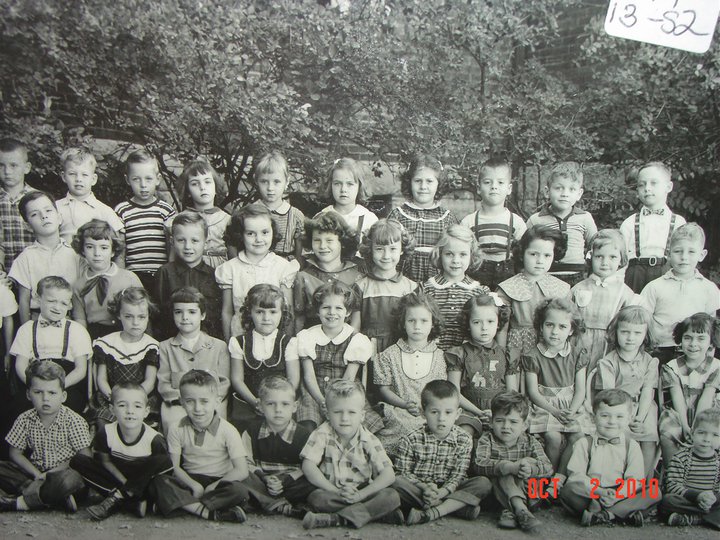
(1st grade at Harrison Elementary–Hwy 9 across from the cemetery.  That’s me second from the left in the first row between Steve Kildow and Ronnie Huffman.)

Lots of memories, most of them good, though not all, because not all times are good, even those seen through the gauze of past time.  Maybe we’ll investigate some of those another time.

A 50’s Boyhood

Beltane                                                                        Early Growth Moon

As summer tries to take root, bringing heat to this winterspringsummerfall season we’ve
been having, Memorial Day arrives.  In my school days Memorial Day meant school was over until Labor Day.  The grandkids in Colorado go into June and start up again mid-August.

I recall those long summer breaks perhaps better than the school years they punctuated, especially at the elementary ages, grades 1-5.  They were hours upon end of baseball, bike riding, playing kick the can, hanging out at the field, a special place that could become a fort, a trench, a hideout, a bunker, an overnight camping spot.  This was kid world, immersed in the boiling mass of kids my age or so that lived on Monroe Street between 1952 and 1958-9.

To a young boy in Indiana this was the 50’s, the Atomic Age now lionized in Mad Men and  shops filled with retro furniture, plastic chairs with metal legs, formica tables, aluminum tumblrs, boomerang shaped end tables, blond furniture, poodle skirts and fancy aprons for high-heel clad cooks.

This was not our 50’s.  Our 50’s had sandlots, trips to the forbidden pit, the subtle ranking inevitable among groups of children, the magical evenings as dusk fell, bats swooped and we each found a hiding place behind an arbor vitae, an enclosed porch, a dark shadow beside a garage, waiting for the tag that would make us out or finding a chance for momentary glory when we could streak out, run like the wind and kick the tin can clattery clat clanging down the street.

Yes, we had homes and parents and bedrooms and breakfast but those were way stations, filling stations and kiddie hotels, holding us only until we could go out.  “I’m going out,” was a phrase common on our lips.

We knew the limits to our wandering which meant we could have, from time to time, the  experience of venturing beyond them, back to the old gravel pit now filled with water where instant drowning awaited–we imagined our sad funerals and weeping parents, or off into a far neighborhood, perhaps as far as downtown if we had pop bottles we had collected from the trash.

That all lay before us as Memorial Day came, with the legionnaire color squad straining and sweating in those uniforms that fit so well back in their service days, the band playing patriotic music and a few floats with a queen or two doing the wave.  Dogs barked.  Clouds rode high in the blue sky and war was in the past, something to remember.


Indy 500

Beltane                                                                             Early Growth Moon

Cord cutters.  That’s Kate and me.  We signed off Comcast cable a year plus ago and haven’t missed it.  We do have Netflix, Hulu and Amazon Premier which keep movies and certain TV shows available, but at times we want to watch them, not according to schedules and with none of the hardware of Tivo.

Except for today.  The Indy 500.  Sometimes I watch it; sometimes I don’t.  Today Kate suggested we go to a sports bar since we couldn’t get it here.  We did that.  And it was fun.  We watched about 80 laps at Tanner’s, had breakfast/lunch and headed back around 12:00, 12:15.

I came downstairs and discovered that I could follow the remaining laps  with four screens on my computer, each one with the on-screen camera feed of a key driver.  I finished watching Ed Carpenter (Naptown boy, 21, finished 10th after winning the pole), Helio Castroneves (3 time winner who finished in the top five), Hunter-Reay (who lead most of the last laps, but lost out in a heart breaker, losing the lead between two yellow flags, the last one up through the end of the race) and Marco Andretti (of the storied Andretti clan, who, after 90 plus starts have won only once).

It was a compelling way to watch the race with the standings running across the top like ticker tape.  That’s what I did with the last three hours.  Now for a nap.

The Numinous

Beltane                                                                         Early Growth Moon

One of the problems with the Self model I proposed yesterday is that it is sticky.  When the ego has its way, which it wants to do all the time, feelings and thoughts gum up the mental works, a problem that zen and other meditative disciplines can correct, or, at least, diminish.  Example.  Waking up at 4:50 am this morning, then running through the evening at Tom’s 35th anniversary gig.  Nothing in particular, just this thought then that thought, which might lead to an emotion which can careen off in another direction.

This not unusual for me, neither is it usual.  It happens.  Rather than eliminate the self to control the ego I choose to say, it happens.  And not worry the matter beyond that.  Then I can move on, albeit with less sleep than I might desire, but I can always–and always do–take a nap.

At 10:30 I see John Desteian, my analyst (Jungian), of long standing and we will discuss the numinous.  At least that’s the question for the day:  what is the essence of the numinous?  I’ve had some time to reflect on that since John and I last met.

Rudolf Otto invented the term numinous in his book, The Idea of the Holy.  In this book he wanted to get at the non-rational aspects of religion, the holy and the sacred being the usual terminology for it.  He felt these words had a lot of baggage and had gotten confused in the up take of rationalists who wrote theology, did historical criticism of biblical texts and generally tried to shoehorn the  whole of the religious experience into the reason paradigm forcefully advanced by Enlightenment thinkers and the newly regnant science.  Otto wrote in 1909.

The numinous is his word for the dimension of the holy and the sacred not touchable by reason, yet crucially important to their lived reality.  Jung, born in 1903, came to Otto’s work with a deep respect for the small r religious life and adopted the numinous as critical to his understanding of psychology.

Thus, the question, what is the essence of the numinous?  As I see it right now, the numinous is an affective response to an experience of the other, an example of which would be the ego experiencing the Self.  The ego, as the command and control center of the psyche, believes it has full authority for advancement of its priorities, but not so.  The ego works best and accomplishes the most when subservient to the overall needs of the Self.

That is, the ego wants to arrange matters to optimize the survival and flourishing of what it perceives to be me, the sense of I that has the most developmental history, and also the sense of I most invaded by cultural or personal expectations that may not advance the interest of the Self, but may try (too often successfully) to bend the Self toward the goal of career, ambition, money, fame, power.  This bending or truncating of the Self in service of needs defined by externals–the culture or persons influential in the individual’s history–leads to deep unhappiness, a sense (and the reality) of betraying one’s Self.

The power of the numinous comes in its ability to challenge the mundane priorities of the ego.  Note, the ego’s priorities are not bad or wrong.  To the contrary, they are in line with the need to survive and, within limits, to thrive.  Those limits are, interestingly, the places where the needs of the Self conflict with received expectations, either cultural or from your personal history.  In other words, the unexamined ego will take me down the path of whatever expectation hollers loudest.

When the numinous, the whole Self, (or God, or Brahma, or shunyata) intervenes, it enlists the ego’s powers of organization, protection and survival and marshals them in a more holistic direction, that is, fulfillment of dreams and hopes that connect the individual to the collective, not in the sense of overpowering it or coming to dominate it, but in a manner that synchronizes the gifts of the individual with the needs of the many.

This change of direction can be terrifying, can seem like abandonment of everything mom and dad taught, of those very things the culture says are most desirable, and such a direction threatens the individual with isolation and failure.  The most familiar direction seems safest and an experience of the numinous challenges it.


Cities

Beltane                                                                       Early Growth Moon

Writing the post below reminded me of a topic I pursued in some depth for many years, cities.  Cities fascinated me from the moment I visited Chicago, Washington and NYC as a teenager.  Small town central Indiana, even the Indianapolis of the late 50’s and early 60’s, had none of the energy, the danger, the possibility.

(Cedar-Riverside People’s Center, formerly Riverside Presbyterian Church.  I had an office there in the late 70’s and early 80’s.)

When I moved to New Brighton in 1970, on my very first day at Seminary, also my very first day in Minnesota, we visited the Guthrie, the Walker and the MIA.  Not too much later I discovered a program, I don’t recall its name, that allowed students to buy theater tickets and orchestra tickets for ridiculously low prices.  That put me in the seats at the Guthrie, its design in the old spot based on the Stratford, Ontario festival theater, a theater in the round(ish) with a thrust stage, a theater I had visited many times.

At some point not long after that I got a job as a weekend staff person for Community Involvement Programs (CIP), a facility for training recently released and high functioning developmentally disabled adults.  The concept involved apartment based training, teaching folks how to live independently.  The next stop after C.I.P. was your own apartment.

I lived in the facility, located in Mauna Loa apartment building, just to the east of what was then Abbott Hospital in the Stevens Square Neighborhood.  After that move I lived in either Minneapolis or St. Paul until 1994, our relocation year from Highland Park, St. Paul to Andover. (There was a brief and unhappy hiatus at the Peaceable Kingdom, my first wife and mine’s 80 acre farm in Hubbard County, and a bit of time in Centerville, the rest all in the cities.)

Over those years, starting with the organizing of the Stevens Square Community Organization and its subsequent redesign and redevelopment, which featured a very public fight with General Mills over their purchase and rehabbing Stevens Square apartments, my life became inextricable from the life of urban neighborhoods.  That engagement stuck until I left the Presbyterian ministry in 1991.  It even lasted a year beyond that when I took on teaching a small group of students in urban ministry internships.

Someday, I’m going to write about those years.  They were fun and a lot of good got done.  Plus I learned a lot of things about cities.