Category Archives: Memories

Labor Day

Lugnasa                                                                 Garlic Planting Moon

The current awareness of the 1% and the 99% is due to the Occupy movement last year.  It is a useful division to recall on Labor Day.  Why?  Labor Day is a holiday that reaches out to the 99% of us that do not have inherited wealth, do not have elevators in our garages or fixed wing sail boats at our (non-existent) waterside property.

It puts a day on the calendar when we remember the value of labor unions, those democratically controlled voices of the 99% in organized industries and businesses.  Why are labor unions important?  In a contest of power between the 1% and the 99% who normally wins?  Yes.  If you don’t have money, you have to have people to have power.

(“Every cook should learn to govern – Lenin”)

Now, power is not necessary as long as you want other people to set your wage structures, to decide if you deserve health care insurance, to have the opportunity to fire you based on their whim.  If, however, you want a voice on these matters that directly effect you and your family then you need an organization that answers to you, not to the bosses.

Back in the 1950’s and 1960’s my hometown supplied workers to General Motors factories in nearby Anderson, Indiana.  Thanks to the UAW families headed by persons who did not graduate from high school had incomes sufficient to own homes, boats and take vacations.  They had health insurance adequate to remove health care from their list of worries.  They had grievance committees and union representatives who would stand with you in case of a dispute with a foreman.

Those days are gone, have been gone for a long while, but I remember them well because I grew up in those times.  The Mcjobs that many of the same people have to settle for provide minimal wages, few benefits and no protections.  We have seen the hollowing out of the middle class and especially the working class jobs, jobs where college was not a requirement.  Where hard work and honesty could result in a decent life.  Those jobs have become vanishingly few.

Who, General Motors, will buy your cars?  Who, Best Buy, will shop in your stores?  Who, Kitchen Aid, will buy your appliances?  Who will buy homes?  It is a sad and ironic truth that as capitalism pushes harder and harder for more productivity per worker, gains achieved often through robots and computer aided manufacturing processes, it loses the customers who drive America’s consumer economy.

If you’re an anti-union person, and many are, ask yourself whether you want a voice at work or not.  If you don’t, maintain your position.

Good Enough

Lugnasa                                                                    Hiroshima Moon

When Kate and I visited our money in July, our financial planner, R.J. Devick, made an interesting observation.  Responding to the deluge of financial information–there are so many sources newsletters, private websites, newspapers, books, information services for financial professionals–he decided to have just four sources on which he relied, to the exclusion of the others.  I don’t recall the specific four, but they were high quality one private, one newspaper, one financial analysis group and something else.

He said he realized he could spend all his time reading and come away more confused.  Probably so.  There is, of course, a need, and I’m sure he does this, to check the continuing reliability of your sources, but overall this was an early information management strategy. Pare down your resources, make sure they’re high quality, then rely on them.

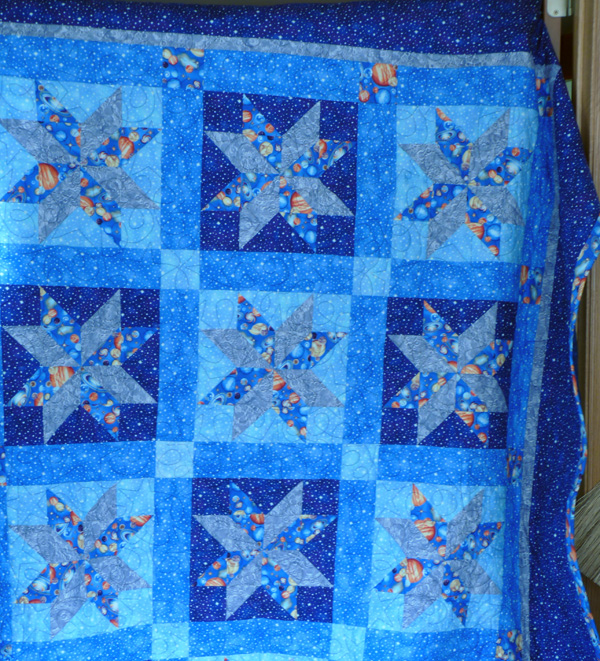
This struck me when Kate told me about seeing the quilt display at the MIA.  One of the artists dyed their own wool in slight gradations of hue in the same color, then used those variations as the design element in her quilts.  I asked Kate if she had any interest in learning to dye and she said no, quilting and piecing were what interested her.

Kate’s made a decision not unlike R.J.’s, an intentional choice to limit her range of interest in the service of getting higher and higher quality out of her work.  It’s a strategy some of the most creative folks apply, going back to the same well over and over again, though with infinite variation in treatment.

It may see obvious to you, probably does, but to me this is anathema.  And probably to my detriment.  I’ve written before about the valedictory life, the kind of life lived by valedictorians.  Once in awhile I check up on research about this topic because I was a valedictorian in the long ago faraway.  Mostly valedictorians don’t become famous experts, great writers or over achieving corporate climbers.

Why?  Because to be a valedictorian, you have to pay similar attention to all the classes that you take.  Or, at the least, in those classes that don’t come easiest, you still have exert enough effort to get an A or 4.0.  Apparently that style continues throughout life for most valedictorians.  That means we don’t achieve the kind of focus that designs the first computer, tracks down the most efficient way to manage information, builds the deep knowledge to become an artisan in cloth or paint.

Nope, we’re happily reading Scientific American, being a docent at a museum, writing a novel, translating Latin, putting in a vegetable and flower garden, doing all of these things at a reasonably high level but not high enough to stand out.  This is a hard life to accept, in one way, when achievement has been important, but it tends to not be the type of world beater achievement others expected.  On the other hand it meshes pretty well with the good enough life.  Good enough.
Home Again, Home Again

Summer                                                               Hiroshima Moon

Back home. Aurora far away, Ruth and Gabe faraway, the mountains, far away.  Here the garden is close, the bees, Kate, the dogs, the city.  Home.

Each time I go to Denver a piece of me wants to stay.  The mountains, the grandkids, a hip urban scene.  And yet all of me wants to come home.  To come here where my friends are, where our home and land is.  Where I’ve lived for the last 42 years.  Where my adult memories are.

This American dislocation creates problems for families.  My sister in Singapore.  Brother in Saudi Arabia.  Son in Denver.  Son in Georgia.  Everybody knows long distance relationships are tough.  When they’re this spread out, as many are, it makes holding the family together a bigger, and more important, challenge.

The humidity.  Home.  The mosquitoes.  Home.  The lakes. Home.  The north. Home.  Home takes all these things geography, climate, weather, friends, family, memories, politics, art and wraps them up in a complex package of which we are an integral part.  That’s how we know where home is.

It may seem pedestrian in a global age to prefer the particular and the local, but I do.  And have.  A Midwesterner raised and now an Upper Midwesterner, I’m happy here.


A Small Town

Summer                                                          Under the Lily Moon

Independence Day eve.

Memories.  American memories.  A small town, like any small town.  You might call it Small   Town, U.S.A.  Kids played outside until 9:00 pm, hide and seek and kick the can, using neighbor’s yards as hiding places.  Lightning bugs blinked off and on.  Bats swooped down after July mosquitoes.

The labor unions fought for wages, benefits and a whole town, this Small Town, went out on strike.  And won.  Workers had houses, boats, vacations.  Their kids went to college.  Health insurance came with the job.

This small town had a daily newspaper.  Each afternoon at 3:30 pm after school let out paper boys gathered in a small wooden shack attached to the back of the press room, green paper bags in hand.  The circulation manager would count copies and hand them out.  Some paper boys would stay a bit, folding the papers into tiny, compact squares with a folded down corner.  They flew 20, 30 feet with astonishing accuracy, curve ball accuracy.

One newspaper boy bought a transistor radio, clipped it to his belt, stuck the ear piece in and listened to baseball games as he walked down Monroe Street, flipping the small squares onto porches from the sidewalk.

This was a time, maybe about the year, that the Spunik satellite went up, pinging its bright metallic way across the sky.  Before that there were no human objects in space.

Kids collected pop bottles from trash cans, pulling Red Flyer wagons, loading them up.  At Cox’s grocery store a nickel a bottle, ten cents for some.  A lot of money.  Buy some marbles.  Firecrackers.  Ice cream.  Essentials for hot summer days.

Pot bellied veterans would carry the colors in this small town’s parades, their pink flesh peeking through the no longer form fitting white uniforms.  Tanks from the local armory left tracks in the hot asphalt.  An Independence Day parade.  Marching bands, baton twirlers.  A queen of something doing the wave.

Folks lined up along the street, the folks whose husbands had gone on strike.  Who received the copies of the newspaper.  Folks whose kids played outside until therr was no time left and mothers called from their doorsteps.  They stood there in the heat and watched the parade.  A big event for a small town.

Far over ahead, a ping.

Weeds of Grass

Beltane                                                       Garlic Moon

Kate and I completely weeded the second perennial tier this morning, but it took both of us to finish it.

Grass.  More grass.  When the gods created grass, they forgot all about gardeners of the future.  Grass grows everywhere, many different kinds and needs little nurture.  In many ways it is the perfect weed.  Tall, it can grow up and out from within clumps of wanted plants.  Tough, it sticks to the soil with tenacity.  Wily, its rhizomes too often remain behind when what looks the whole plant comes out.  Then, in its persistent way, it regenerates and lives to annoy the gardener another day.  So, here’s to grass, a plant wonderful in its manifold powers.

Dragonflies have hatched in abundance.  Which means the mosquitoes have, too.  The dragonfly, with its bi-wing form, has a retro sort of look.  They are beautiful.  Iridescent colors, transparent wings.  Fairy like in their quickness.  Benevolent in their choice of food.  Seeing their forms darting through the air brings the great wheel round another turn.

Today the temperature felt, again, like July, but there was a fine breeze.  A warmer day, a gentle wind and the smell of lilies-of-the-valley transported me right back to grandma and grandpa’s house in Morristown, Indiana.

OK.  On sentimentalism.  Here’s the distinction that just came to me after seeing a definition of nostalgia as a sentimental yearning for the happiness of another place or time. The sentimentality I have doesn’t include a yearning for the happiness of another place or time.  I just want to recall my past, since it is mine, not wallow in it.  Just sayin’.

Alonzo Stagg Stadium 1969

Beltane                                                                 Beltane Moon

Working on tours today.  Discovered a sculpture by Henry Moore that I inhabited once, long ago, the year 1969.  Just south of Kenwood Avenue my then wife’s brother, Bob Merritt, lived in a large flat with other undergraduates attending the University of Chicago.

Kenwood marked the dividing line between Hyde Park, the upper middle class enclave gathered around the University and the South Side.  The South Side, known for gangs and poverty and community organizers began at their building.  So much so that one evening a gang of thieves with shotguns held all the students while they robbed the apartment.  Didn’t get much.  University students?  Geez.

As a guest, I joined in a big weekend party that had plenty of drugs, sex and rock and roll.  No sex for me.  Married.  But drugs?  Oh, yes, please.  Mescaline, cut at the time with strychnine for a faster rush.  We sat around on mattresses on the floor, classic college student high decor.  At one point I leaned against a bare wire and got an electric shock.

Oh. Boy.  That lit me up inside and out.

Later on we decided to get something to eat and went for a stroll around campus, near Billings Hospital.   Alonzo Stagg stadium where Enrico Fermi first split the atom.  Used to be right there.  Fermi and others under stadium.  Playing with an energy source known only to Shiva at that time.  In a container enclosed with regular bricks, if I recall correctly.

There, on the site of Fermi’s experiment sat this sculpture by Henry Moore.  Taken by the explanation of its purpose, I crawled up inside and sat there, mind altered by the mescaline molecules, imagining the splitting of the atom, down to a very fine detail.  I inhabited the split, a part of it, riding the cascading protons and neutrons and electrons.  I forgot about the food, about the evening.  I sat there for quite a while, back in Alonzo Stagg stadium, as Fermi worked his magic.

Later on I walked back to the flat.

Mother’s Day. Not A Happy Day.

Beltane                                                                        Beltane Moon

Mother’s day.  Every year.  Since her death.  1964.  A long time to be motherless.  Almost a life time.

Her stroke changed all our lives.  We went on but not well.  I often stumbled, not picking myself up and shaking it off, not turning the pain into a gift.  Instead, I experienced it as pain.

(Morristown Post Office)

She was a small town girl. Morristown, Indiana.  800 people.  Many of them our kin.  A rural town right where Indiana breaks into full on country as you travel south, the big cities and heavy industry behind you.  Lots of corn and beans (soy beans), tractors, barns, cows, pigs, a few horses.  Still that way.

Might have been a small town girl her whole life, except for WWII.  Signal Corps.  Mom was a WAC.  She went to Rome, Naples, Capri, Algiers.  After, she married Dad.  She had an A.A. degree in teaching, elementary.

Never learned to drive.  Can you imagine?  A midwestern country girl who never learned to drive.  Didn’t stop her from an active life. In our small town, Alexandria, Indiana, there was no spot you couldn’t reach by walking.  So Mom went everywhere on foot or riding with Dad.

Warm and quick, kind, loving.  Compassionate.  You know, the mom you see on the cover of Saturday Evening Post drawn by Normal Rockwell.

Since 1964, she’s been a memory.  At times she almost seems to slip away, a murmur, a rumor from the past, like an imaginary place I used to visit as a small boy.  Then I recall the garden spider at our kitchen window.  Her taking insects in a kleenex to release outside, something I still do.  Her voice breaking as she learned her father, Charlie Keaton, my namesake and grandfather, had died.

So, mother’s day has not been a big favorite of mine, not for a long time.  Not a happy day with dinner out, flowers and a big hug.  No, “remember when?”  No, “you’re just what I hoped.”  No, “oh, you.”  Just not. Absence.

Beltane 2012

Beltane                                                          Beltane Moon

May Day.  Brings up cold war images for me.  If you’re of a certain age, you remember black and white television with Kruschev or Brezhnev in the reviewing stands as long flat bed trucks pulled even longer missiles, whole large squares of soldiers trooped after them, some tanks, armored personnel carriers, probably some air displays, too, but I don’t recall those personally.

This was the worker’s holiday to celebrate the successful revolution, the now sad story of a mad man who killed millions and used a centralized state to justify it all, and those who came after him, company men with broad shoulders, craggy faces, phenomenal eyebrows and bad tailors.

If, however, you’re of a certain ethnic heritage, or inclined to join us on certain holidays like May Day, I can conjure a different picture.  Fair maids dancing with ribbons, winding them around and around the tall May pole.  In other spots women and men jumping over bonfires to quicken their fertility.  Herds of cattle driven between two bonfires to cure them of disease.

On a mythic plane the goddess as maiden takes the young greenman for her lover, offering their fertile energy to the fields, to the animals  and to the people.  Villagers take to the fields at night for bouts of lovemaking.

A fair, running perhaps a week, finds persons contracting for field labor, trying out handfast marriages, and surplus goods being traded. This was a joyous time, the long winter lay in the past and the fields had seeds in them.  The air was warm, there was milk and meat.  A good time.

A mood much different than the other great Celtic holiday, Samain, or Summer’s End, which marks the end of the growing season, the final harvests before the fallow and the cold time began.  In that holiday the dead got gifts of food and spirits in hopes that they would at least not do harm.  Those of the fey might cross the barrier between the worlds and snatch a child or even a grown man or woman, taking them back to the sidhe.

These two, Beltane and Samain, were, in the oldest Celtic faith, the two holidays.  The beginning of summer, or the growing season, and summer’s end.

In Beltane we have all the hope of fields newly planted, cattle quickened, perhaps wives or lovers pregnant, warmth ahead.  This is the holiday of hope, of futurity, of anticipated abundance.

No missile laden trucks, no marching soldiers.  No, this was a festival for rural people celebrating the rhythm of their world, a highpoint in the year.

Just Another Miracle

Spring                                                         Bee Hiving Moon

Polio in the news.  This month’s Scientific American has coverage on the bid to eliminate polio.  That this can be a serious discussion represents a literally unbelievable leap from 1949 when I had polio to now.

(I was a March of Dimes baby.  March, 1950, I think.)

Polio before Salk and Sabin created even more generalized fear than H.I.V.  It devastated millions.  Some of us, like me, had it, recovered and moved on.  Others still wear a brace, have a withered limb, a curved spine.

I’m left with the fading memories of a forgotten terror, a time when a child’s chill could be the precursor to paralysis.  As it was in my case.

It’s strange to have been a victim of a plague most don’t even know ever happened.  Think of those high school seniors I toured last week who were born in 1994.  1949 was 45 years before they were born.  When I turned 18 in 1965 45 years before was 1920.  And 45 years back from my birth date of 1947 was 1902.  It’s as if I had the Spanish flu during the great epidemic and survived.

A miracle, really.