
Category Archives: Asia

World War?

Beltane                                                                      Emergence Moon

Over breakfast this morning we got into an interesting conversation, first about climate change, then about China.  Climate change sentiments varied around this table of guys who mostly agree with each other.

China raised the most controversy. Mark Odegard feels a war with China, a world war, is inevitable. I don’t. I feel China is not historically expansionist and very far behind us in military spending, military preparedness and military competence. Doing much harm to the U.S. would also hurt the Chinese investments in our economy. I forgot to mention this morning that since both China and the U.S. have nuclear weapons the likelihood of a full-fledged war is much less.

Mark sees the region as rent by old wounds, like the Japanese invasion and rape of Nanjing, the occupation of Tibet and, he didn’t mention, but could have the Islamist Uighur’s in the West. He also sees Japan and North Korea, especially the latter, as prone to irrational decisions and likely to precipitate a full-scale war through some hot-headed action.

Certainly history is on the side of the one who foresees military action. As a species, we are violence prone and given the anarchic nature of politics at the nation-state level that tendency has often led to military rather than diplomatic solutions. There are, too, no end of possible trigger points, the major among them being China and Japan’s insatiable appetite for oil, which must come from largely from the Middle East. That makes the South China Sea a potential flash point and China has repeatedly engaged in provocative actions there.

It is my sense though that Chinese development benefits much, much more from peace and diplomacy than it would from a war fought across the vastness of the Pacific and especially against an enemy like the U.S. which already has significant military presence in its near ocean. A war would present the U.S. with major supply chain issues, of course, but we have shown ourselves willing to overcome that distance once and I imagine we could again, certainly much faster than China could project naval and armed forces power in the other direction.

History is the judge in this debate and we may not live long enough to see the question answered definitively.
 

A Rare Dining Experience

Spring                                              Hare Moon

I may have inadvertently added to the selection of Korean dishes available in Tucson.  At Takamatsu’s, a Korean-Japanese restaurant, I went in hoping for a raw beef Korean dish that is served with sesame oil over daikon with an egg yolk in the top.   The name wouldn’t come to me and I asked the waitress, a local Tucson white girl, who shook her head.  Nope, nothing like on that menu.

So, I asked her about sashimi, since I couldn’t find it on the menu either.  Yes, she said.  Right there.  It was on a long paper menu to be filled out at the table.  I checked the 10 piece sashimi dinner and waited for her return.

Instead, the owner came out.  A Korean, I think, (might have been Japanese), he said, “You’re talking about and he used a name that didn’t sound familiar to me.  Like steak tartar, in a mound with an egg yolk on top?”  That was it. “Well,” he said, “We don’t have much of a Korean community so we took off the menu 17 years ago.”  Oh, well.  I understood.  Thanks.

He went away.  Then, he came back.  “My chef says she can make it for you.  She’s the same chef we’ve had for 18 years.  She’ll take frozen rib-eye and slice it up.”  I smiled, “That sounds great.”

After my waitress brought me the usual Korean side dishes of kimchee, bean sprouts, spinace, pickled radish and thin sliced potatoes, she filled my tea pot.

She left and came back with a beautiful mound of raw beef, an egg yolk in the top, all sprinkled with sesame oil and seeds.  But on thinly sliced apple.

It was delicious.  Best I’ve ever had.

The owner came back after I’d finished. “The chef says maybe we’ll put it back on the specials menu.”  I tipped the chef.


You Canceled It For What?

Imbolc                                                                 Valentine Moon

Sister Mary had a chance to keynote a conference on education.  She’s spoken at several conferences, but never keynoted before.  An honor.  But.

She wrote that her flight to the island of Java had been canceled and she would not be able to make it to the conference.  Why?  Volcanic eruption.  Mt. Kelud. (see right)

It grounded planes and caused tens of thousands of people to flee.  I wrote back and said that was a new one for this flatlander, located mid-continent.  Snow, yes.  Ice, yes.  Even flooding.  But volcanic eruption?  Quite the exotic reason for cancellation sitting in Minnesota.  Not so exotic in Indonesia, a very volcanically active and earthquake active region of the world.  It is, too, the fourth largest nation in the world by population.

Where is Mt. Kelud?


Ecce Homo

Imbolc                                                             Valentine Moon

Scott got reservations at David Fong’s, a long time Chinese restaurant in Bloomington. David Fong, Yin’s brother, started a chow mein takeout on the same location about 50 years ago.  This was eating in a Chinese restaurant on Chinese New Year’s, not eating a New Year meal.  The food was very good, especially since Scott came complete with recommendations from Yin as to what we would like.  Handy.

Frank, Warren, Tom, Scott and I were there.  We shared our steak kow, mongolian beef, lo mein, honey crusted walnut shrimp, pot stickers and a crumbly chicken dish whose name I can’t recall.  You put the chicken in a lettuce leaf, sort of like a taco.  All of them were tasty.

We spent a lot of time talking about grandkids.  Scott and I had a similar experience of five-year old grand-daughters who decided we were not “real” grandpop’s because we were not the biological father of their parent.  As with Ruth, this has passed in Scott’s case, too.

Tom has set up an intriguing question for our February 17th meeting:   What does it mean to be a male in our culture?  He has also asked that we bring three images of men that will start off our conversation.  I’ve got a few posted here, but as I’ve gone hunting for images it made me wonder if there is a book called the male image in art.  Lots of such books for females, many of nudes, but of men?  A quick google search in the books section shows none.  Probably are some, but that they’re not obvious says something.

Another thought that occurred to me, and it relates to third phase life for men, is this, what is our image of a man at home?  That is, beyond the guy with the fly-rod, golf club, barca-lounger, or woodshop.  And these are based on the silly, even pernicious idea of third phase life for men as the replacement of work hours with a favorite leisure activity.

With no positive image of a man at home it’s difficult to understand how to be at home when one has left traditional work life behind.

Bristling with Trailer Hitches

Winter                                                       Seed Catalog Moon

The parking lot here at the Best Western bristles with trailer hitches sticking out into the driving lanes from six wheel pickups.  The side streets have fifth wheel cattle and horse trailers lined up one after the other.  This is Stock Show time in Denver. Big belt buckles, boots and Stetson’s.

It’s also NFL title game weekend.  There are New England Patriot fans and their jerseys, Bronco fans and their orange.  Jon and Ruth took a couple of hours getting home from A-basin due to MLK holiday traffic.

Gabe’s stretched out on the bed watching a large fish and an absurd saggy breasted ballerina.  TV goes off at 9:00 pm.  Thank god.

Ruth and I will hit the Science Museum tomorrow morning and go to Steve’s Snapping Dogs for lunch.  I may miss most of the big game while I nap.

Tomorrow night we go to the Japanese restaurant, Domos.  This is a different Japanese experience, a country food menu.  Should be fun.


Back in the MIA

Winter                                                            Seed Catalog Moon

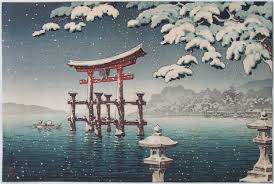
Went into the MIA today to see the Audacious Eye exhibition.  It contains representative torii-in-snow.jpgtorii-in-snow.jpgobjects from an entire collection, the Clark Collection, acquired in the last year by the MIA.  It was an uneven show with several spectacular pieces and several not-so spectacular ones. Many of the nicest pieces were screens and paintings in the Chinese tradition, a substantial influence on all of Japanese culture.

(detail_of_daruma  Tsuji Kakō, 1870–1931)

Lesson from this.  Go in the first days of a new show so a later visit, more focused, can result in greater depth.  Several of the pieces I would like to see again will, I imagine, be up in the permanent collection over the next few months.

Ran into docent friend Bill Bomash.  We had lunch and talked about the museum and his life.  He went to Knox College in Galesburg, Illinois.  His roommate came back one day and said he’d signed up for a year abroad.  Bill thought that sounded good, went to the library and looked at the bulletin board with year abroad brochures.  The Scandinavian Seminar had no prerequisite language requirement.  Aha, he said, that’s for me.

His year focused on Denmark where he discovered an affinity for the Danish language which he spoke with almost no accent.  The director of the Seminar, whom he met by chance while working in Copenhagen mistook him for a Dane, complimenting him on his English.  This proved significant later on when he applied for Ph.D. work at the University of Minnesota.  A letter of recommendation from this same man produced an offer of a teaching position in Danish.  He funded his Ph.D. work teaching Danish.  All because of that brochure on a bulletin board.

After the MIA, I went over to Verdant Tea where I met the general manager, Brandon, purchased two clay tea jars and a new teapot, one Brandon purchased in San Francisco some time ago.  Verdant Tea is a very Seward neighborhood kind of business with latter day hippies and contemporary hipsters sitting around sipping tea and discussing the issues of the day.

Found the exhibit, which was quite large, induced museum fatigue two galleries from the end, so I began to look with only cursory interest.  Still, it was good to be back with the art. Trying to figure out how to get in often enough to satisfy that itch.

Yixing Teapot

Winter                                                                      Winter Moon

My holiseason present came today.  It’s a yixing teapot from the Chinese Teashop based in Vancouver, British Columbia.  That brings my collection to three:  one for black and pu’er teas, one green and oolong teas and one for white teas.  Eventually I’ll have a yixing teapot for each of the varieties of tea, but it takes a while to get there since they’re not cheap.

My gong fu cha chops have increased over the last few weeks and sitting above me and to my right are these teas:  Master Han’s Looseleaf 2004 Shu Pu’er, spring harvest Laoshan green, Phoenix Mountain dancong oolong, Wuyi mountain big red robe, Qilan Wuyi oolong, Silver Needle.

This tea journey I’m on now is another ancientrail, a side path from an interest in Asian art and culture.  It allows me to have a bit of Asian culture right here, on a regular basis.

With gong fu cha I infuse tea leaves for times ranging from 4 seconds to the very longest 25 seconds, pouring hot water over the teapot while the tea infuses, a different temperature for each variety of tea.  This requires a teapot and my Zojirushi.  The Zojirushi holds three plus liters of water at 175 degrees.  It’s perfect for white and green teas.  The teapot gets water to the 205-208 degree temperatures best for the oolongs, blacks and pu’ers.

There’s a good deal of puttering with it, fussing and that’s all part of drinking tea.  It takes me, at least for a minute or two, into a world of long ago and far away.  When I return I have about half a cup of tea, which lasts a good while since I drink it out of my Chinese teacups, smaller and shallower and wider than the tea cups we use.

Having added it to my working day gives uniqueness to the beverages I drink and links me to a worldwide culture of tea drinkers.  It’s a hobby, I guess.

Global

Samhain                                                                 Winter Moon

-12.  81.  72.  34.  35. 14.  Andover.  Singapore.  Muhayil, Saudi Arabia.  Mihailesti, Romania. Montgomery, Alabama.  Denver, Colorado.

Mary and I talked today, she near her bedtime while I ate a quick breakfast.  7:30 am here while 9:30 pm there.  It’s a big planet.

(Thanksgiving 2013, Singapore)

Having close family members scattered around the world affords an occasional window on quirks in places far from the center of North America.  Mary reports that Thanksgiving has taken hold in Singapore, colleagues say to her, “Happy Thanksgiving!” and many Singaporeans celebrate with a big meal.  Thanksgiving has no religious roots and its secular coloring is very faint, the whole pilgrim/indian thing long ago and perhaps apocryphal anyhow. It’s emphasis on food, family and gratitude could travel well into any culture.

Halloween and Christmas are also big in Singapore with Mary reminding me of the lights by Hitachi that go up on Orchard Road, lights that I saw when I visited in early November, 2004.

There is one holiday transfer that puzzles me.  Mary says St. Patrick’s day is big, too.  And, people wear green and go to bars and drink green beer.  In this case Chinese and Indian people, maybe even a few Malays, too.  Maybe it’s seen as a spring holiday?

(St. Pat’s 2013 Singapore)

Mark is in his third week of classes in Muhayil, Saudi Arabia.  He reports that many of his students leave class early to go home and eat kabsa.  “Kabsa (Arabic: كبسة‎ kabsah) is a family of rice dishes that are served mostly in Saudi Arabia — where it is commonly regarded as a national dish. Kabsa, though, is believed to be indigenous to Yemen.”  Wiki.


A Soul in Ruins

Samhain                                                           Winter Moon

It was nine years ago the first of November that I left for Southeast Asia, visiting Mary when George Bush again won the presidency.  Mary and I went to the American Club for brunch around 8 a.m. to watch the polls close and night-time punditry begin.

Later a Singapore taxi-driver, Chinese, explained how much he disliked Bush and how much an American election, 12 time zones and 12,500 miles away, affected him.  It was, he said, a strange and not a good feeling to have so much of your future tied up with a foreign land and its peculiar decision making about leadership.

Singapore has a distinctly pro-Western bent for all its declaiming about Asian values; it is capitalist and materialist to its fingernails.  Mary and I experienced Diwali, the Hindu Festival of Lights, saw firewalking in a Hindu temple and broke the Ramadan fast in Arabtown.

Bangkok came next, a $60 introductory rate flight by Tiger Air, a cut-rate airline beginning to service Southeast Asia.  Bangkok’s ChinaTown, my home base for the two weeks I spent there had sidewalk fold-up restaurants at night, vendors during the day and always people, lots of people and cars streaming by on Yaowarat.  The neon lights gave the after dark old main street of Bangkok a garish look, but also made it enticing.  Exotic.

After some time in Bangkok, I got on a Bangkok Air flight for Siem Reap, Cambodia.  We landed next to a plane from the Republic of Vietnam.  On the flight from Bangkok bomb craters had been easy to pick out in the fields below.  Taxiing up to a spot beside that plane, in Cambodia, brought back anti-war memories from the 60’s.

The highlight of this trip was still ahead.  Angkor.  Most people identify this complex with
the name Angkor Wat although all that means is Angkor Temple and there are many, many temples.  The temple widely known as Angkor Wat is closest to the small Cambodian city of Siem Reap.  It is huge and well preserved.  I spent a full morning climbing its ritual and mythic architecture, it recapitulates a sacred landscape, and took most of my time at the object that made me travel all this way:  the churning of the sea of milk.

(This bas relief, carved intricately at all points, runs round the bottom most walls of the temple, roughly 1/4 of a mile.  The panels are maybe 12 feet high.)

This sentence from the Unesco world heritage website will give you an idea of why Angkor Wat is just a taste of what’s in the area.  “(Angkor) extends over approximately 400 square kilometres and consists of scores of temples, hydraulic structures (basins, dykes, reservoirs, canals) as well as communication routes.”

This is not a week’s journey, not even a month’s.  Three months would be a good start, especially since early morning and late afternoon are the only times you can really visit since the temperatures are so intense in midday.  I had four days.

All my photographs are on an old hard drive and I haven’t retrieved them yet, a project ahead of me. There are a lot of photos: Bantay Serai, Ta Phrom, Bayon, Preah Khan.

Morning and night for four days I explored, dodging scorpions, nodding to saffron robed monks, amazed by the kapok tree roots reclaiming these 9th through 14th century sites.

A memory that stands out came on evening the third day.  I had clambered around the temple mountain of Bayon, the temple with the four-faced stone monuments you’ve probably seen in pictures.  Incense drifted over from a contemporary Buddhist temple across the dirt road, following the smoke was music from cymbals and gongs.

Sitting on tumbled down stones near Bayon’s west entrance, a reverie overcame me and I drifted back, back, back in time to the days of the Khmer and the god-kings who built these monuments to politics and divinity.  To a time when the Khmer carved living rock from quarries far-away and floated the carved rock down river to these sites, using an elaborate system of canals.

(Bayon’s west side.)

This was when I realized a strong part of me was a soul in ruins, captured by the past, most alive while picking my way through Ephesus, Angkor, the Forum, Delphi, Delos. Through ancient texts like the Metamorphoses and the Odyssey and the Iliad.  Learning the ancient Roman language.  That realization has shaped much of my work since then.


Tea in the Mail

Samhain                                                         Thanksgiving Moon

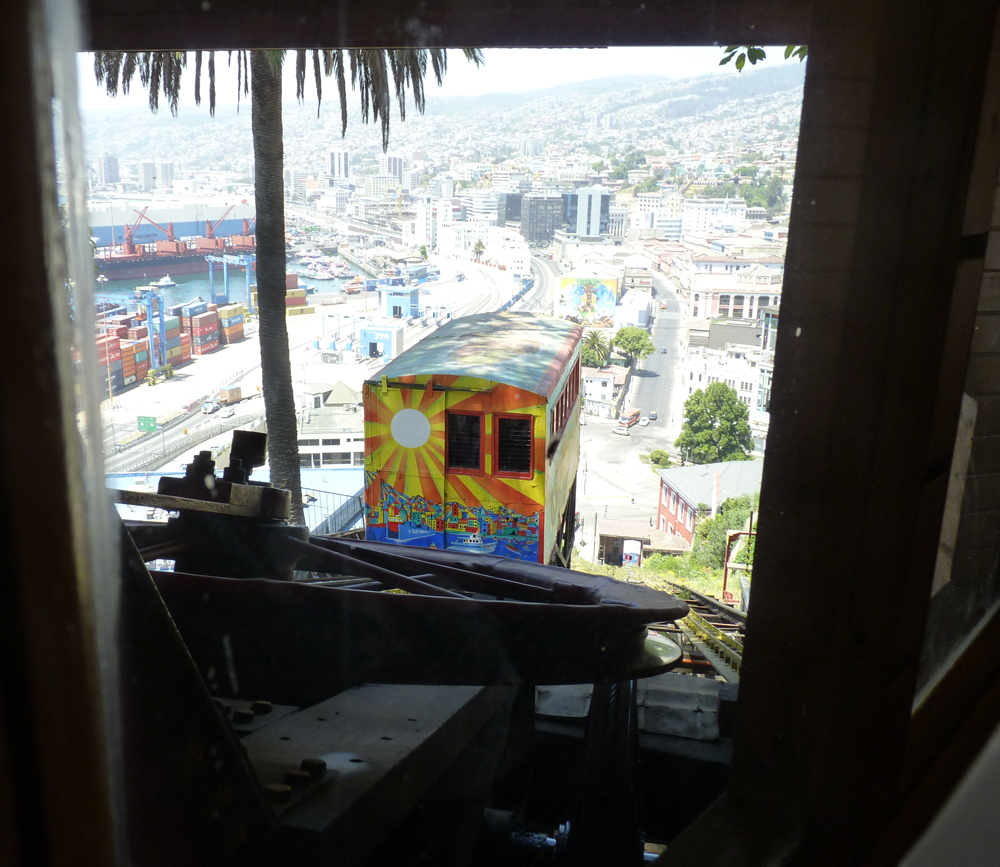
A short morning since I slept in till 8:30.  Not usual.  I usually get up between 7:00 and funincular10007:30 am after a bed-time of 11:30.  Last night I was up until 11:50.  Not sure why I needed the sleep, but I did.  So, I’m alert.  That’s good.

An hour plus working on Missing.  I described Hilgo, a harbor town in the realm of the Holly King.  I used memories of Valparaiso, Chile, (see my photo) giving Hilgo a bi-level appearance with a large wharf.

Got my first shipment of teas from Verdant Tea, a 3 oz. a month club that sends out seasonally apt teas in 1 oz. increments.  They also include brewing instructions.  Since I spend so much time at the computer, the gong fu cha method of brewing works very well.  Today I got a black, and two oolongs along with information about the farmer and their operation for each of them.  All Chinese.

The first one I’m going to try is Qilan Wuyi Oolong.  This picture is a tea farm in the Wuyi mountains, famous in Chinese landscape paintings.

Now I’m back after the nap, ready to hit the Ovid.