Category Archives: Weather +Climate

Warmer

Imbolc                                                                  Hare Moon

50 degrees yesterday.  Dripping ice created a torrent in our downspouts, as if a hard rain was falling.  This is still, I think, a gradual melt, so I’m ok with the temperatures.  Not that I can do anything about them anyhow, of course. That rain forecast for today? Not so happy about that.  Slow melt good.  Fast melt bad.

Waking up to moist air, warm (over against -15) and carrying the scent of the woods and the soil, moves me forward along with the turning of the Great Wheel. My body begins to synch itself with the change, pushing me toward the outside, a part of me unfurling with the sun’s changed angle, the increased warmth.

A lot to do this week before I leave for Tucson, so I’d better get to it.  Finish the climate change course.  Send off my query letters.  Always more Latin.  A couple of putzy tech things. Call Enterprise. Get my packing organized.  A two week plus trip on the road requires different packing than a weekend flight to Denver.

Kairos

Imbolc                                                      Hare Moon

A bit more on an old topic, inspired by thinking about Jenkinson’s remarks that appear below.

The humanities are important as just that, the human forming portion of our educational deposit.  Over the millennia, stretching back to the time of gods emerging from the deserts of the Middle East and continuing right through the poetry and literature and painting and sculpture, the movies and television and games, the sports and horticulture and domestic arts of our day, we have had to grow into our lives, into our identity as human beings. It is not easy, but it is the most important task we have and the one which the family, the schools, our societies and cultures exist to engage.

This is not an argument for the humanities over science, technology and mathematics.  Far from it.  We have needed and will continue to need the valuable insights that come from deep thinking about the atomic structure of things, the hard rock science of the earth, the softer touches of the biological inquiries and the neuroscientific and all the other forms of scientific endeavor with which we humans engage.  But consider the difference in importance between raising a boy or a girl and lifting a rocket ship to the moon.  Which matters more?

It is not in the theory of evolution or in the biological sciences or in matters astronomical that we find the answer to such a question.  Even though we often pretend it is in this insecure age the answer is not in the psychological studies.  No, the answer to a question of value, of significance, of which is more than this lies only in the realm of culture.

The most important task of our time is said simply and defined humanistically, but requires the sciences in all their potency to finish:  create a sustainable human presence on this earth.

Why is this most important?  Because if it is not accomplished, the earth, no matter our scientific prowess, will scour us from her face.  She will make the thin layer of our habitation, from maybe 6 inches below the surface of the soil, to maybe 12 miles or so above the earth-the troposphere where most weather occurs-outside the parameters necessary for our existence.  That is, as the biologists are found of saying, an extinction level event.

So we are at a moment of kairos, a greek word meaning the opportune time.  Paul Tillich a theologian of the last century saw kairotic moments as “…crises in history which create an opportunity for, and indeed demand, an existential decision by the human subject.” Wiki His clearest example from the mid-point of that bloody hundred years was World War II, but even WW II and WW I put together do not equal the crisis we face now, a kairotic moment which, as Tillich said, demands an existential decision by us all.

(damaged relief of the Greek god Kairos of 4 century. BC)

The will and the skill to make that decision, a decision for or against our children and our grandchildren’s future, lies not in the sciences, but in the humanities.  It is in our sense of who we are as a species, as a being with a history, that we will find what we need to decide.  And, contrary to many, I am now convinced that the biggest barriers confounding our ability to make a non-suicidal decision lie in the realm of governance, a thoroughly humanistic endeavor.

Strip away those disciplines that force us to consider our humanity and we will be left with the calculus of Malthus.


Quiet

Imbolc                                                                      Valentine Moon

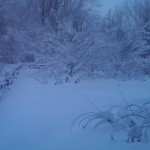
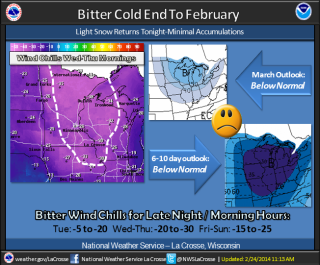
Again, I know it’s a common thread for these later night posts, but the stillness.  The quiet of a late February night with thigh-high snow in the yard and temperatures headed into the minus teens below zero again.  It is like living far further north where sometimes the winters bump into the beginning of summer and pick up again before the growing season is over.

Yes, and I know it’s crazy, but I like it.  Am I tired of the cold and the snow?  A bit.  Would I live somewhere that couldn’t deliver this kind of season?  No.  These outliers define us, show the edge of the world toward which we are closest.  And it’s not Louisiana and the Gulf of Mexico.  No, we align with the pole, the north pole. This year we even shared the polar vortex with it.

I’m hoping we hit #8 on the coldest winters since the Civil War.  Remember the winter of 2013-2014?

Winter Time Archaeology

Imbolc                                                                   Valentine Moon

Finished first draft of my query letter.  It includes a synopsis of Missing, about 1,500 IMAG0365words, and the first five pages.  Missing itself, after revision 5.5, is at 103,000 or so.  I want to get some feedback on the query letter, then start sending it out to agents.  My plan is to get it out to 10 agents before I leave for Tucson and other points south west.

(June 5th, 2013)

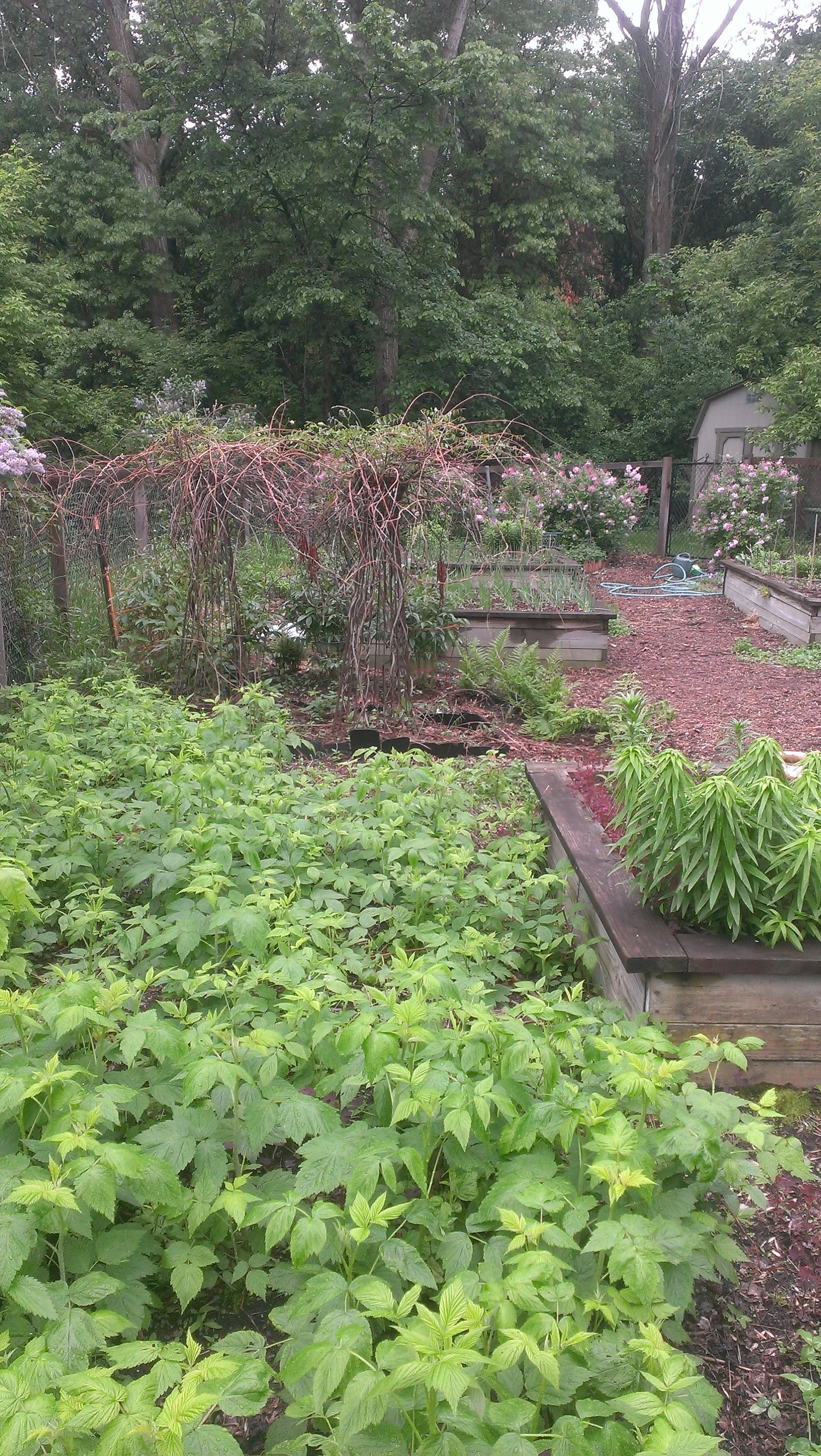
That took the morning.  Tomorrow I’m putting together our seed and plant orders, calculating the kinds of nitrogen they will need based on the bed sizes for specific vegetables and getting an order for the nitrogen off to Luke Lemmer in Plato, Minnesota.  This is in plenty of time since our vegetable beds, raised about 18 inches off the ground, are invisible now.  It would require winter time archaeology to find them.

The Vegetable Garden

This is part of why I like four distinct seasons.   Planning a garden while 3 feet of snow lie in our yard and the temperature is in the teens headed toward the teens below makes the full cycle of life an experience rather than abstraction.

(February 21, 2014)


The Storm Has Passed

Imbolc                                                                   Valentine Moon

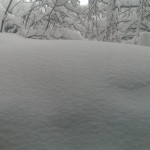
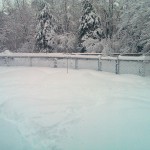
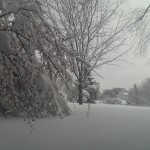
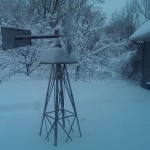
Daytime silence.  The snow is higher around our house, in our orchard and vegetable 1000IMAG0028garden than I can ever remember it.  The garden shed, the honey house, the grandkids playhouse have foot-thick contoured roofs, snow conforming to their shape.  In the orchard the currants are visible only at the tips and snow climbs the trunks of the cherry, the plum, the apple and pear trees.  The fruit tree limbs dangle heavily, weighted down by snow clinging to them.  Cedars, spruce and Norway pines all droop, heavy with captured snow.  This kind of snow can injury trees, split limbs, even kill younger or more fragile trees.

The result is a quality of quiet I associate only with late night.  A muffled experience with no mufflers, the kind of quiet where the sounds of your mind and your ear try to compensate with small murmurings, chirpings, light buzzing.  Like the house has been wrapped in cotton.

It leaves me in a pleasant torpor, a vague holiday or weekend feeling on a Friday afternoon, wanting hot chocolate and a log fire.  Some jazz, a good book.  Mostly it feels like night, as if candles would be good, too, except the windows are ablaze with albedo returned sunlight off the new snowcover.


Snow. Snow. Then, Some More Snow.

Imbolc                                                               Valentine Moon

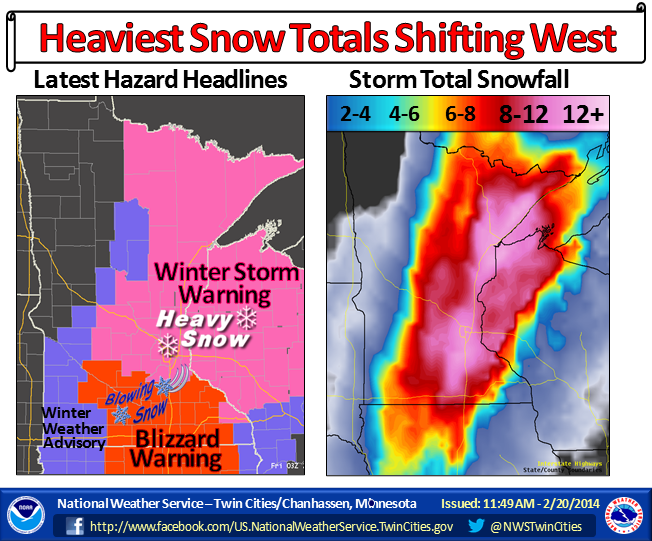
The snow has come down steadily, earlier it reminded me of the whiteout we mushed 2 20 2014 snow storm.through in the Boundary Waters all those years ago.  We may not get a lot of snow compared to some places, but when we have a winter like this one, it’s all still on the ground.  After the storm, cold again.  Not the deep bone chillers, but cold.

Right now the projection is for around 12 inches.  That’s a lot of snow.  And it’s heavy.

I know it seems improbable but there is a climate change explanation for this winter.  As the polar ice melts in the Arctic, it changes the direction and intensity of the jet stream. The sag that has polar vortexed us for much of the winter might well be a direct result.

Tomorrow morning I have a meeting at 10 am in St. Paul.  We’ll see whether that’s possible.  I’m representing the Sierra Club, Margaret Levin in particular, at the America Votes monthly gathering.  This is an interesting group focused on building a progressive America.  Me, too.

The Week Ahead

Imbolc                                                              Valentine Moon

Weather has warmed up over 40 degrees from the last few weeks and it’s still cold. That’s about where we live.  No volcanoes erupting to interfere with our lives though.

Today or tomorrow I’ll finish reviewing the edits made by Bob Klein to Missing.  Then it’s off to the agents.  I’ve probably taken more time getting to this point than a novel of this type warrants, but I’ve wanted to produce as good a book as I can.  The first two or three books sold can determine success over all (that is, being allowed to continue publishing) and I want to present clean, focused stories.


Also tomorrow I’m going to resume my P90X workouts.  I’ve taken a week + off to allow my chest to heal and it seems mostly calmed down now.  Dave Scott, the handy-man I mentioned a bit ago, has installed the new pull-up bar, the Stud Bar (Tm).  It will not pull out of the ceiling studs (aka Stud Bar) and I will not drop unceremoniously onto the concrete anymore.  This last makes me happy.

When Kate and I discussed my attendance at an Ira Progoff workshop, I initially wanted to go to an event in early May.  It was in Asheville, N.C. and the thought of contemplative work in the Blue Ridge mountains appealed to me.  But, she rightly observed, this was soon after our Colorado trip for Gabe’s birthday and at the beginning of the growing season.  Other dates and places I liked were either in the middle of the growing season or at the time of the honey harvest.  That’s how we chose the end of March.  No planting, no bees.  And I can make Denver on the way home, wishing an early birthday to granddaughter Ruth.

Another way of saying Tucson was not on the top of my list for places to go.

The polishing begins on the story of Deucalion and Pyrrha this week. Back to the beginning with careful attention to commentaries, dictionaries and other English translations.  The goal:  as well spoken a translation as I can muster plus commentary notes.

(st. jerome, patron saint of translators. and yet another great beard model)

It’s also week 7 of the Climate Change course.  This course has proved as influential for me as a weekend Kate and I spent in Iowa City with PSR, Physicians for Social Responsibility, a conference on climate change. That one propelled me into my work with the Sierra Club. Just where I’m headed now is not yet clear to me, but I’m for sure going to increase my activity level on adaptation.

Ice Cold. Superior.

Imbolc                                                                Valentine Moon

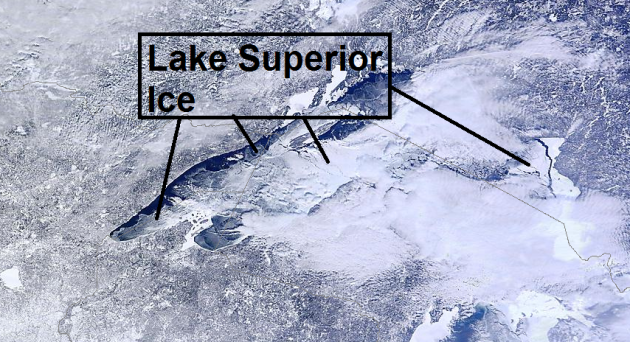
from the Updraft Blog:  “Today’s MPR News weather spy Jay Austin is a professor at the University of Minnesota-Duluth and the Large Lakes Observatory. He sends along the news this morning that Lake Superior has completely frozen over, a month ahead of schedule for years when the big lake reaches complete ice cover.

Here’s the brief but attention getting email Jay sent my way this morning.”

Superior is completely ice covered

superior-Frozen  nasa