Category Archives: Feelings

Kona

Summer                                                                  Moon of the First Harvests

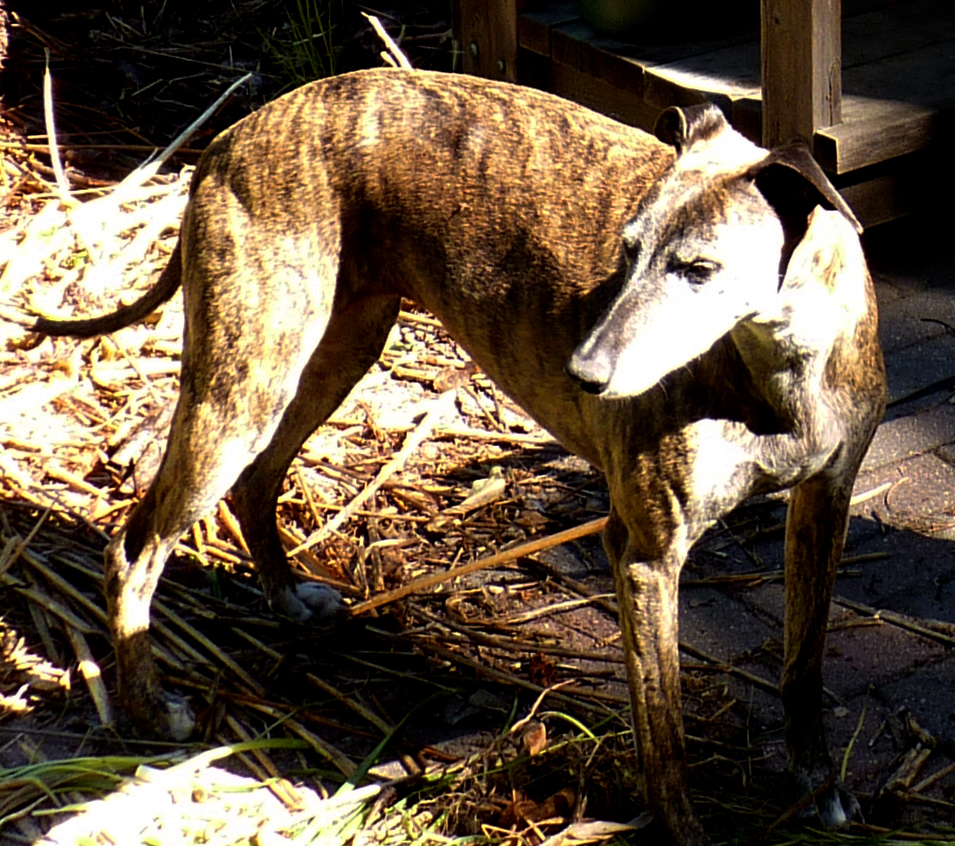
Kona died this morning.  Both Kate and I spent time with her just before she died.  She was alert and responsive to the end.  She died knowing we loved her and in the crate she knew as her safe place.

(Kona)

We cried, both of us.  Yes, in spite of an end obvious long ago, the actual loss still opens a chasm between the living dog and the dead one.  That chasm represents the never will agains.  And those made me cry.  I would never again feel her nuzzle into my hand.  Never again see her smile.  Never again see her run the trails in our woods.

Her corpse no longer retained her; it was a symbol now, not a reality.  This is a wonder to me.  When I spoke with her about a half hour before she died, she looked at me, put her nose in my palm, caressed me with her muzzle.  Kona was 100% there.  Then, she was gone.  The light left her eyes and her body no longer moved.

The wonder is this, that life has a magic about it, seen most clearly after it is lost.  That which was Kona was there, then not.  Yes, her memories live on, that’s true.  But Kona does not.  The personality, the somewhat aloof I’m living life as I intend to personality of the sighthound, has vanished.  Just like that.

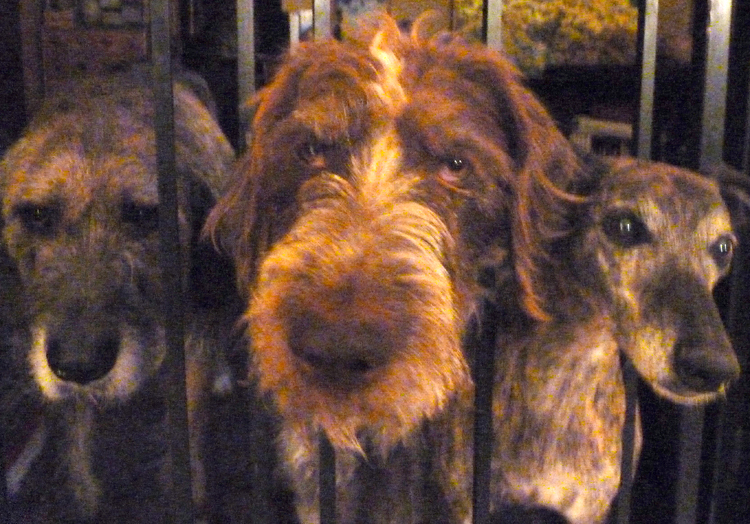
(Rigel, Gertie, Kona)

Life is a miracle, ordinary in its profusion and ordinary as long it exists, yet when it has gone, then we know.  So, each death gives us a moment to reflect on the precious gift we have.  The one carrying us forward into tomorrow.  A gift others give to us, too.  Each death is an opportunity to affirm and celebrate life and living.

Kona’s father was a whippet champion named Drum.  When we picked up Hilo and Kona from the breeder, the puppies and the parents were watching Animal Planet.  We brought them home and they began a series of escapes from the property, going under the chain link fence in pursuit of prey or delight, often both.

We held them on our laps when they were young.  Hilo would squirm, sit up, stretch, jump down.  Kona, the much larger of the two, would lie quietly, happy to be there.  

In her early days Kona was a predator.  I remember one day Kona came up on the deck, dropped something there, then ran back out into the woods.  The something was the still warm and clear eyed head of an adult rabbit.  Why she brought it to the deck I don’t know.   Over a long period Kona would kill rabbits and we would pick up the dead rabbits, put them in a plastic bag and dispose of them.  This never deterred Kona.  She just kept at it.

Hilo died three years ago of kidney failure and was never much of a hunter.  She liked to be with her people.  Kona kept to her self, finding places to sit nearby, sometimes with us, often not.  She kept her own counsel and determined what her day would be like, pretty much independent of us.

After her death this morning, I went out into the garden and sat on one of the raised beds.  Gardens heal.  Surrounded by life and life producing food, the cycle of life was concrete.  Kona fit into this cycle.   It helped me remember that at some point the light in my eyes will go out, too.  And, more.  That will be fine, it will fit into this cycle.

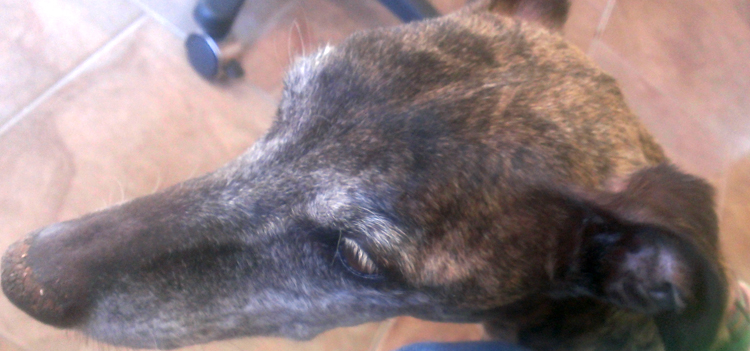
(Vega and Kona)

Kona had privileges the other dogs didn’t.  She would go with me into the garden, mainly because we could count on her not to dig holes in the garden beds.  She would also be outside on our brick patio with us because we could count on her to stay around the house.

She has been part of our lives for 12 plus years, as real and regular a part of our lives as we are to each other.  True she was a dog, but as a companion and fellow traveler on this pilgrimage she was with us, part of our pack as we were part of hers.

We travel on now with one less pilgrim immediately in our presence, yet at the same time, the whole pack with us, all 17 dogs, two parents and two sons.  Amen.


Primal

Summer                                                                 Moon of the First Harvests

Kona lives though her mobility has been greatly diminished.  She is, however, alert and responsive.  We get down with her and talk to her on a regular basis, letting her know that we love her and are with her in this part of her journey, too.  It’s the light in her eyes, the Kona-ness of her presence in those eyes, I think, that forces me not to put it out.  At least that’s a big part of it.  Another part is not breaking trust.  She has trusted me to care for her all these years.  To care for her.  Not kill her.

If you differ with me on this, I understand.  I can see how caring might reach to euthanasia, the whole control around end of life debate has many testimonies to that effect, even in humans.  Why I feel so strongly on this is not clear.

It’s strength oddly enough reminds me of one other moment in my life, the one in which I knew I needed to be a parent.  It was a strong, primal feeling, dominant.  The need became overriding, pushing other concerns into the background.  It wasn’t compulsive, at least I don’t think it was, but it was so urgent.  The best word I can use to describe it is primal, that is, it came from a part of me so deep that it bypassed subconscious and conscious thought to arrive full borne in my psyche.

The same process has surfaced in me around euthanasia.  I have no reasons, no arguments, no explanations.  For me, it is forbidden.

Just to be clear, really really clear: there are no religious or political sentiments attached in either case.  This is something from the veldt or the cave.

Being Human

Summer                                                             Moon of First Harvests

The morning after.  The Woolly feeling lingers here, a gentle mantle over the back, around the fire pit where we gathered.  A primary, perhaps the primary, purpose of the Woollies is to see and be seen.  No invisible men allowed.  We have bum knees, wonky shoulders, weak legs, poor eyes and sore backs.  These are acknowledged, not for sympathy, but for recognition that we are each the sore back, the poor eyes, the weak leg, the wonky shoulder, the bum knee.  And that we are none of us only or even mostly our ailments, more and mostly we are the ones who have spent this 25 year+ journey together, time that included wholeness, able-bodiedness and now includes physical decline.

We’re not exactly a support group.  We don’t try to fix each others problems (usually).  We do go in for empathy, but not too much because too much focuses the group on one while the whole has been and is the most important.  We’re not a group of friends, or, at least, not only a group of friends, rather we are fellow pilgrims, traveling our ancientrails in sight of each other, calling out from our journey and hearing the other call out from theirs.

Though our ancientrails intersected less in times past, as we move into third phase life they intersect more and more.  How to make this transition.  How to create a life anew when work is no longer the primary lodestar.  How to look death in the face, unafraid, even welcoming.  No, not suicidal welcoming, but unafraid of what is common, ordinary, part of the path.  We look at each others hearts, hear the pulse of each other’s blood.  This is what it means to be human.


Watching As the Lights Go Out

Summer                                                                        Solstice Moon

When we gathered last night at the Woodfire Grill, five of us Woollies talked, catching up on family, discussing current events, laughing.  Then, the talk turned serious and deep, as the fly fisherman said, “existential.”

A sister-in-law, a chiropractor, called one of us and told him she was retiring.  “Because,” she said, “I’ve been diagnosed with early Alzheimer’s.” That brought silence around this table where the youngest was 64 and the oldest 80.  As is his way, this one wondered how to be present to her, not to fix her, but to aid her in her present situation.  How might he stay present to her over time, perhaps learning enough to alert her children, who live far away when things become dire?

I pointed him to a website I recently added here, under the link’s title, Third Phase, called Watching the Lights Go Out.  Here’s this 68 year old retired physician’s description of its purpose:

“In September of 2012 I was diagnosed with Alzheimer’s disease. This blog is the story of my day-to-day life with this illness and my reflections upon it. We tend to be scared of Alzheimer’s or embarrassed by it. We see it as the end of life rather than a phase of life with all its attendant opportunities for growth, learning, and relationships. We see only the suffering and miss the joy. We experience only the disappearing cognitive abilities and ignore the beautiful things that can appear.”

One of us has an obvious anxiety about this since he has a mother with Alzheimer’s and definitely does not want to place that kind of burden on those who would be his caretakers. What will I do, he asked, if this becomes me?

We turned to the writer who cared for his mother-in-law, Ruby, who tipped over into Alzheimer’s after open-heart surgery.  He has interviewed many Alzheimer’s sufferers and said that after a couple of years of sometimes intense existential dread, there comes a peace with the disease.

“But I don’t want to not care!” said the one of us who was anxious.  “That leaves my caretakers with the burden.”

This conversation continued, all of us trying to put ourselves in the situation of watching the lights go out.  It was not pleasant, but neither was it hopeless, because we had friends around the table.

A primary inflection of this whole conversation was readying ourselves to live into this and other dark realities that loom not far down the stair case of aging.


Eudaimonia

Summer                                                                     Solstice Moon


A word about pursuing happiness.  Or meaning.  Yes, life, liberty and the pursuit of happiness.  I know.  Right there in the founding documents.  An ur-right.  One equivalent to survival and liberty.  Well, who wouldn’t be pleased to find happiness?  I doubt I would.

Now this may be because I have a northern European genetic predilection to dysthmia, could be.   And, in fact, I think that’s the case.  This is not, however, my point here.

Happiness doesn’t strike me as a desirable state, at least not for any length of time.  Why?  Because it has the flavor of arrival, of sufficiency, of finished, of done.  Happiness comes to the human life like the finish line model of retirement, once we get there that’s all we need. After that, we coast.  Play golf.  Smoke cigars.  Travel.  Watch TV.

No, I’ll go for a more Greek idea, eudaimonia.  Composed of two Greek worlds, eu (good) and daimon (spirit) Aristotle and the Stoics after him promoted it as the end of human life. As such it has often been translated as happiness or welfare, but perhaps a better phrase is human flourishing.  Or, without getting fancy, why not good spirit?  Both have an active turn, taking us toward enrichment, fullness, striving within a humane ambit.

Now there you have an internal state worth cultivating.  It’s the difference between a noun and a gerund.  Happiness vs. flourishing.  I would much rather flourish than be happy.  Much.

The Sweetest Sound

Summer                                                                        Solstice Moon

Apparently this decompression thing will take a bit longer than one day.  Slept in this morning, late start.  Worked out last night and that often means a longer sleep the next day.  I’m pushing myself now, more reps with lighter weights.  Taking a weight until I can do 20 reps twice, then moving up.  That means more work per set and a longer time with the body at a higher heart rate.  All for the good of the team.  Team Self.

There is a feeling of satisfaction, a deep joy.  Though they differ from culture to culture, there are certain basic roles that define us.  Raising children is one.  Being a grandparent is another.  These are old roles, ancientrails common to all cultures.  Who does them may change from place to place, but in our culture it is usually the core couple of a nuclear family that fulfills both roles.  Blended families bring nuances to those roles that are real, but they don’t change the roles themselves.

Cries of grandpop! in the small voice of children has to be one of the sweetest sounds the human ear can hear.  Better than Mozart or Led Zepplin or I do or here’s your diploma.  Why?  Because they come from innocence, unfiltered and largely unexamined.  They are an unconditional affirmation.  I know this because I here these words from Ruth and Gabe with whom I have no genetic link.  That’s one of the nuances from the blended family.  Yet even Ruth, who wanted to meet her Dad’s real (biological) father and therefore her real (biological) grandfather, greets me with the same lack of reserve.  I fill the role, am the role.


Bee Diary: The Ruth Entry

Summer                                                                              Solstice Moon

Took grand-daughter Ruth with me on a hive inspection today.  I showed her how to fire up the smoker, use a hive tool, check for brood and move slowly when working with the bees.  She hung in there, saying a couple of times, “Now it’s making me really afraid.” but not moving away.  Gradually her fear receded.  Now she can back me up when I need help.

There’s something profound about sharing a passion with a grandchild, as Kate has done already with Ruth and sewing.  Whether they choose to pick it up or not, the indelible memories, for both Ruth and me in this instance, speak of today and tomorrow walking the ancientrail of life together.

Because, like most current beekeepers, I have 9 frames to a 10 frame hive box, the frames are easier to manage that way, the bees often fill up the empty space with comb and honey.  I harvested a lot of this today, so we have fresh comb honey, both comb and honey made in the last week.


Archaeology of the Heart

Beltane                                                                         Solstice Moon

While watching a NOVA program on dogs, a reference was made to archaeology.  I studied archaeology and the broader discipline of anthropology seriously in college.  Seriously enough that I applied for doctoral work in theoretical anthropology.  Why I didn’t follow that up is a story for another time, but archaeology resonates for me and the mention of it in this context triggered a memory only recently interpreted.

Over the course of my life when confronted with the odd plumbing job or carpentry task, you know, the men things, I would fob them off with the stock phrase, “Oh, I learned everything my Dad knew about these things.  Nothing.”  And, as far I know, that’s a true statement in both instances.  I’m still not able in those areas though I admit I’ve never tried too hard to learn.

Kate and I work outside together a lot, though she works in one area and I work in another.  I found myself having a rising sense of impatience, irritation about her work.  Those who know me well would recognize this mood in me.  I’m not proud of it, but it does surface from time to time.  This time I knew my mood simply had no basis in reality.

Kate works hard.  She works well.  And she was doing both of those, as I know she always does, so this mood was about me, not her.  Suddenly buckets of water sloshing in the wee hours of the morning came to mind.  Uh, oh.  When we moved to our home at 419 N. Canal, it was the first, and last, home my father and mother owned.  We moved there in 1959 and my dad had his stroke there in the  1990’s and died after having moved to a nursing home from there.

In my years there, from 1959 to 1965, I don’t recall a service person ever coming to our house to repair anything.  Likewise, I don’t recall anything ever getting repaired.  Must of have happened, but I don’t recall it.  The only such incident I do recall was a recurring one in which our basement, which housed our furnace and little else, would flood.  When that happened, Dad would get me up and together we would bail out the basement, one bucket at a time.

Roused from sleep, cold and wet, these were not my favorite memories.  I do remember that as we worked, Dad would become silent, sullen.  In fact, I remember him being irritated and impatient with my willingness to do this chore.  Aha.  My memory of teamwork seems to be tied to those nights and I seem to have selected my father’s attitudes to carry on, carrying his water into my own life.  As sons often do.

Rethinking this time also made me realize a second thing.  Why didn’t Dad try to solve the problem rather than resort to such a makeshift solution every time?  I don’t know the answer.  It might have been money.  It might have been pride.  It might have been that these matters simply didn’t show up as problems to solve, but rather came up as problems to ameliorate.  Whatever the reason, I learned to be incurious about solving problems around the house.  Doesn’t matter.  Maybe it’ll go away or fix itself.

Now, I have owned homes since 1969, 7 altogether, one in Appleton, Wisconsin, one in Minneapolis, one outside Nevis, Minnesota, 3 in St. Paul and 1 here in Andover.  Over that time I’ve learned some very minor skills in home repair and one big one.  The big one?  Hire somebody.  Works most of the time.  As far as I can tell, solving day to day problems in the house is one of the few things I’m incurious about.  Fortunately Kate is better than I am and together we can call anybody.

The archaeology of our own thoughts and feelings is the most rudimentary and personal dig we will ever engage.  And that, I’m plenty curious about.


Memories

Beltane                                                                     New (Solstice) Moon

Over the last couple of weeks I’ve had interactions with folks from Alexandria, Indiana resulting from a reader posting a blog entry, a 50’s boyhood, to an Alexandria Facebook site.  It’s been interesting.  The most interesting interaction has come from an old classmate who found my memories romanticized.  You can see her comment under Who.

(1st)

I wrote her and in doing so discovered that she was a girl (then) who had done very well in our class, but didn’t (apparently) get the recognition she felt she deserved.  I had to reflect that could have been true.  Sexism (though not named) was alive and well back then and I’m sure it effected teacher’s perceptions and other students opinions.  It may have helped me to some awards and recognition.  Impossible to parse out now at this remove, but I’d never thought of it until she wrote.

Having said that I want to add that happy memories are not necessarily romanticized.  That’s a word used by an outside observer.  As resident in those memories, they were happy.  Being a kid among kids is a great way to spend time when you’re young.  Sure, we had our hassles, too.  Our arguments and fights.  I remember one incident where a next door neighbor pulled my pants down in front of my friends.  This was the nuclear option at the time.  I thought life was over and I could never face anybody again. Until the next day of course.

(3rd)

Once my life moved away from Monroe Street it began to take on a more serious, turning toward adult tone.  We had a house on Canal Street, one  we owned, rather than rented.  In junior high I remember a fight with Rodney Frost, a bad one by the standards of the day. (low)  Rodney died several years ago and my first memory when I saw his obituary was of that 6th grade fight near the junior high school.

Girls remained a mystery for me well into college, so I had the normal ration of pre-teen and teen angst over dating, sex and self worth.  Those were not happy memories.  My father and I began to part ways emotionally during junior high, a fact I credited only much later to a growing unease he had with my intellectual maturing.  When this distance had reached its maximum, around my senior year of high school, my mother had a stroke and died seven days later.

(4th)

Those months and the years following them were more than unhappy times.  They were a constant struggle for self-worth capsized often by grief and the estrangement I had with my remaining parent.  This was just the way it was.  Do I wish it could have been different?  Of course.  Do I know it won’t be.  Yes, I do.

That period and its attendant miseries are now in my past, but they are in my past and they show up whenever I visit that period or that place, Alexandria.

(third phase)

Cash Flow, Fiscal Tides

Beltane                                                               Early Growth Moon

Boy.  This money stuff doesn’t seem to get easier, even with practice.  The annoying reality of cash and its flow, in and out, never seeming to be quite enough, no matter how much is available.  A well known phenomenon at all income levels this is an area where Kate and I have grown enormously over the last 15 years, yet still have growing to do.

We have different approaches to money, no surprise there, we’re different people and most of the time the differences seem to complement each other.  Her more detailed way, my big picture way.  Her more generous nature, my more conservative one.  (when it comes to money.)  Sometimes we work at cross purposes and that requires extra conversation, extra listening, extra patience.

Money is very far from the point of life, for either of us, but its misuse can make life pretty damned miserable.  As we’ve experienced.  So we’re committed to staying on top of this, to stay in the conversation, to keep things clear and honest.  It’s good for us, but it’s not always easy.

I’m proud of both of us and how we’ve become more adult, more rational, more compassionate in this area of our life.  We never stop learning or growing.