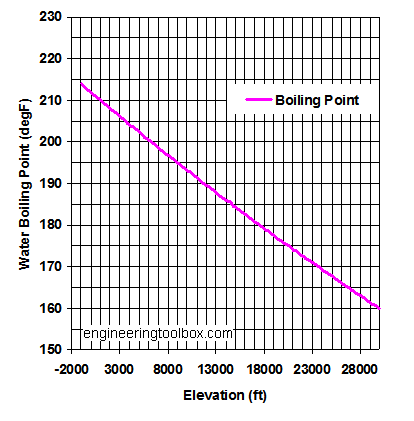
Gong fu cha requires specific temperatures for different sorts of tea. Black teas like pu’er, lapsang souchong, iron buddha require water temperatures of at least 203 degrees F. Unfortunately, these are some of my favorite teas. Unfortunately is easy to understand from this simple graph. We’re at 8,800 feet above sea level, call it 9,000 for this instance. Follow the line and you’ll see the problem.
Oolong teas require water temperatures between 194 and 206 F. I haven’t tried oolong yet, but it’s obvious that its needs are right at the cutoff point for our elevation. Water boils at around 195 F up here.
If any of my engineering oriented friends have an idea about how I can get water to the higher temperatures, barring use of a pressure cooker (too clunky), I’d love to hear it.
I’ve found the Colorado equivalent of Minnesota’s Scientific and Natural Areas (SNA’s). Here they’re called Colorado Designated Natural Areas. “Designated Natural Areas contain a wide representation of Colorado’s rare plants and animals, unique plant communities, rich fossil locations, and geological features.” I enjoyed visiting these areas in Minnesota. Sounds like they’re a little more diverse here. Road trip!
The sound of radio waves from Cassini as it crosses Saturn’s rings and the gap between them and the planet itself. Dust particle hits make most of the noise in the second clip. I found hearing these sounds an eery, literally other worldly experience. An extension of our human senses is actually out there, between Saturn and its rings. That’s what this sound said to me and said it in a way multiple photographs for some reason cannot.
The mountain streams we see regularly: Shadow Brook, Maxwell Creek, Bear Creek, Cub Creek have begun, a bit early, I think, their post-ice plummet toward sea level. In May these streams are often boiling, filled with snow melt and pushing the limits of their banks. On any given day driving past them as they speed downhill, down the mountain, they look interesting, worth watching for the tumult; but, in fact, these racing streams are much more than merely interesting.
They are the levelers of mother earth. They take the mighty and strip them down to size, pebble by pebble, rock by rock, chunks of soil by chunks of soil. A defining characteristic of a mountain is its imposing size, its thereness. Mountains dominate their landscape, putting up barriers to human passage that often forced the pioneers of nineteenth century America to go around them rather than over them. They seem, in the moment, eternal.
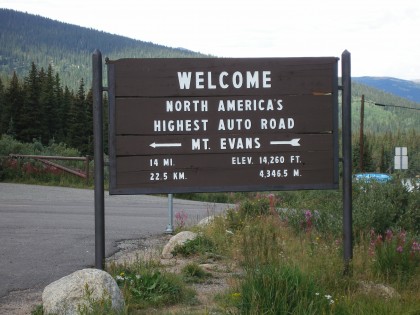
When living in or visiting a relatively young mountain range like the Rockies, no reasonable person would ever expect them to look any different than they do right now. Colorado is proud of its fourteeners, those summits exceeding 14,000 feet. Mt. Evans, for example has a summit of 14,265 feet. That’s precise. And, would you add it to a website or book or road sign if you expected it to change? No.
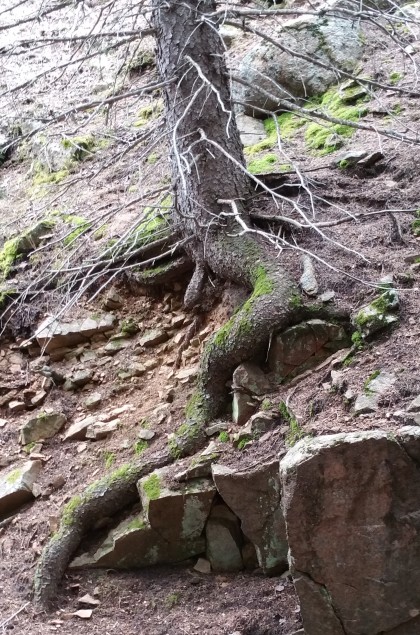
Near Bailey, 2015
But it will. One only has to drive east toward the Atlantic to see what’s in store for even Mt. Evans. Look at the Appalachians. Their mountain building episode (orogeny) happened around 480 million years ago. When it was done, the Appalachians stood as tall as the contemporary Rockies. The Rocky Mountain orogeny was a quite recent, geologically speaking, 80 million years ago. They too will wear down.
In the spring we see this process at its most obvious as mountain streams from every summit in every range of the Rocky Mountains, including here in the Front Range, obey gravity and try to find the lowest points available to them. Of course, the streams are not the only process at work. Drive on Highway 285 out of Conifer, as we do often going down or returning from Denver, and you will see large steel mesh hanging over some cliffs. In other places there are bolts driven into the side of rock faces, giving them a slightly Frankensteinian look. In other spots massive retaining walls of concrete encase an especially troublesome chunk of mountain.
These CDOT efforts are not always successful, witness the many Watch for Falling Rocks signs sprinkled throughout Colorado. Freezing and thawing splits the rock faces and they come tumbling down, creating talus or road obstructions. Just this last year, near Glenwood Springs, a large boulder broke loose from its millions of years long position and crashed down on an SUV on I-70, killing the driver. Winds, too, often reaching high double digit speeds, also wear away the rock.
These forces are slow, miniscule in appearance, but massive in their results over long periods of time. When driving by a mountain stream in full force, remember the Appalachians. They’re coming, but not soon, to a Rocky Mountain range near me.
Today I’m making chicken noodle soup and Kate’s making Vietnamese pho. We’ll serve this at a Beth Evergreen leadership dinner for Rabbi David Jaffe, author of Changing the World from the Inside Out, a Jewish Approach to Social Change. Along with our friend Marilyn Saltzman, chair of the adult education committee, who is making a vegetarian squash soup, we’ll provide the soups for a soup and salad meal. I really like this low key involvement. It feels manageable.
Although. I am hoping that Rabbi Jaffe’s time here at Beth Evergreen, tomorrow through Saturday as a visiting scholar, will spur the creation of an activist group focused on some form of response to the Trump/oligarch era. In that instance I’m willing to move into a more upfront role, though I would prefer to remain a follower.
Then, there’s the Sierra Club. I wrote here about my excitement with Organizing for Action, Conifer. That was back in January, I think. Lots of people, lots of energy. Good analysis. I thought, wow. Here’s my group. Then, I never heard from them again, my e-mails went unanswered. Weird, but true. Weird and disqualifying for a group that’s organizing political work.
So I renewed my effort to connect with the Mt. Evans’ local group of the Rocky Mountain Chapter of the Sierra Club. Colorado seems to work more through these regional clusters than as a whole. There are nine of them, covering the entire state. The Mt. Evans’ group includes our part of Jefferson County, Clear Creek County and a northern portion of Park County. It’s titular feature, Mt. Evans, is a fourteener (over fourteen thousand feet high) which has the highest paved road in North America leading to its summit. According to locals here it’s also the weathermaker for our part of Conifer.
I finally made it to a meeting a couple of weeks ago. When I came back, Kate said, “You seem energized.” I did. And, I hadn’t noticed. Something about that small group plugged me back into my reigning political passion of the last six or seven years: climate change. Oh, yeah. With OFA I’d tried to head back toward economic justice, my long standing motivation for political work, dating back to the UAW influences I picked up as a teenager in Alexandria. Guess the universe understood me better than I understood myself. Not much of a surprise there.
My mind began ticking over, running through organizing scenarios, figuring out how we could (note the we) raise the visibility of the Mt. Evans group, gain more members, influence local policy. This is my brain on politics. I might be willing to play a more upfront role here, too, though I want to explore other ways of being helpful first.
Anyhow, between these two, I’m sure I’ll get my political mojo working in some way. And that feels good. Want some soup?
The waning passover moon is behind a faint scrim of clouds giving it a moonlit halo. Each moon cycle repeats the past, yet is unique to itself. The slow orbit (relatively slow) of the moon around the earth produces the same phases each month and in that sense repeats. But the lunar month and the sidereal year do not quite match up*, as all cultures that depend on lunar months for their calendars have long known. Judaism is such a culture.
Each lunar month happens at a slightly different place in earth’s orbit due to this irregularity over the course of sidereal year. In addition, our whole solar system is not static, but moves through the universe at a speed of 12 miles per second toward the constellation Lambda Herculis.** At the same time our solar system is also spinning around the Milky Way and the Milky Way itself is speeding toward a collision with Andromeda Galaxy in 4 billion years.+
When you consider the irregularities in the lunar position occasioned by the sidereal/synodic difference and the speed of our solar system both moving on its own toward Lambda Herculis and around the Milky Way and then throw in the speed of the Milky Way itself, it becomes clear that no one phase of the moon every occurs in even remotely the same location.
Why belabor this? Becauses it underscores the irreproducibility of much seemingly regular phenomena. Now think about the long span of evolution on this moving planet, within this speeding solar system. This means that no animal or plant species has occupied the same cosmic location for even a short span of its existence. So, in this sense alone, each animal or plant species is unique. But, each animal or plant itself is also unique because it comes into existence and dies, having occupied only one small niche in the larger web of life.
Australopithecus afarensis
Within this context regard human evolution. Australopithecus, considered the first instance of the Homo genus, has been dated to 2.8 million years ago. Since that time the genus went through many speciations until, about 200,000 years ago, our own species, Homo sapiens, emerges. So, for over 200,000 years individuals of our own specific branch of evolution have been born, lived and died. Each one of them are unique within just our species.
Each of us, then, from the moment of our birth and for the very brief span of our life (in cosmic terms), travels literally millions and millions of miles, speeding around the sun, the Milky Way, toward Lambda Herculis and as part of our galaxies own rush toward Virgo and Libra. In addition each of us represents a specific instance of an evolutionary branch with its own branch on the tree of life, a branch that split off on its own some 2.8 million years ago.
This means we are each unique in many different ways in addition to the obvious ones of parentage, genetics and personal development.
Finally, the point. We are, each of us, unique and precious instances of over 2 billion years of evolution of life on Earth. We represent a moment in time, yet even our moment is not static. It finds us moving incredible distances.
A key insight of both Judaism and Christianity is the notion that we are all made in the image of God. This insight casts a bright light on both each person’s uniqueness while also revealing our oneness. This truth does not change no matter what content you put into the word God.
Think about it. Out of all the billions of years since the Big Bang, moving in all the various ways discussed above and at speeds that make Formula One look slothful in the extreme, you and I exist in this special time together. How remarkable! We are in fact made as the conscious image of this whole universe, with all its reckless momentum and we have been given the chance to know each other and through knowing each other to know the universe that gave birth to us.
Camus talked about the river of life that flows toward death, what I have called in recent posts the Gulf of All Souls. He suggested that it was our common responsibility to make this journey as pleasant and peaceful for each other as possible. As Ram Dass says, we’re all just walking each other home.
*watch this short movie to understand the difference between the sidereal month, 27.322 days, and the synodic or lunar month of 29.531 days.
+This webpage shows the difficulties in measuring the speed of objects in the universe and gives a speed for the Milky Way as it moves in the universe–an amazing 1.3 million miles per hour!



 Today I’m making chicken noodle soup and Kate’s making Vietnamese pho. We’ll serve this at a Beth Evergreen leadership dinner for
  So I renewed my effort to connect with the Mt. Evans’ local group of the Rocky Mountain Chapter of the Sierra Club. Colorado seems to work more through these regional clusters than as a whole. There are nine of them, covering the entire state. The Mt. Evans’ group includes our part of Jefferson County, Clear Creek County and a northern portion of Park County. It’s titular feature, Mt. Evans, is a fourteener (over fourteen thousand feet high) which has the highest paved road in North America leading to its summit. According to locals here it’s also the weathermaker for our part of Conifer.


 The waning passover moon is behind a faint scrim of clouds giving it a moonlit halo. Each moon cycle repeats the past, yet is unique to itself. The slow orbit (relatively slow) of the moon around the earth produces the same phases each month and in that sense repeats. But the lunar month and the sidereal year do not quite match up*, as all cultures that depend on lunar months for their calendars have long known. Judaism is such a culture.
 When you consider the irregularities in the lunar position occasioned by the sidereal/synodic difference and the speed of our solar system both moving on its own toward Lambda Herculis and around the Milky Way and then throw in the speed of the Milky Way itself, it becomes clear that no one phase of the moon every occurs in even remotely the same location.
 Finally, the point. We are, each of us, unique and precious instances of over 2 billion years of evolution of life on Earth. We represent a moment in time, yet even our moment is not static. It finds us moving incredible distances.
 Think about it. Out of all the billions of years since the Big Bang, moving in all the various ways discussed above and at speeds that make Formula One look slothful in the extreme, you and I exist in this special time together. How remarkable! We are in fact made as the conscious image of this whole universe, with all its reckless momentum and we have been given the chance to know each other and through knowing each other to know the universe that gave birth to us.