Beltane Rushing Waters Moon
Beltane Rushing Waters Moon
Beltane Rushing Waters Moon
The knee has improved. A lot. I went on my first post-surgery mountain hike yesterday morning, an hour plus at Flying J Ranch, just down the hill from us off Hwy. 73. I can’t scoot along the way I used to, moving fast and keeping my heartrate up, but that’s a function of age as much as the knee. Still, I was able to keep a steady pace even though I did stop often to take pictures.
These are unnamed streams flowing down the side of Berrian mountain, crossing the Shadow Pine trail that I hiked. I love the sound as much as the video itself.
Beltane Rushing Waters Moon
When the temperatures were in the teens below zero and winds whipped the trees, driving along a barren stretch of road meant a breakdown could kill you. That sensation is a major component of Minnesota macho, enduring the worst the north pole can throw at you. At times it was invigorating, at other times we were just glad to have survived it. It did make opening the door at home and going into a warm house a real joy.
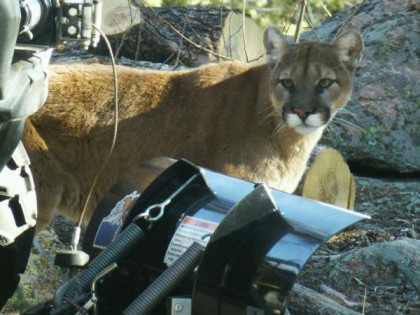 This morning I fed the dogs as I usually do, but I left them inside, no longer willing to risk a mountain lion attack. Mountain lions add frisson to life in the Front Range Rockies. It’s similar to driving in well below zero weather.
It’s also different. In the instance of weather the danger is without intention, the cold does not care whether you live or die. The mountain lion cares. To the mountain lion our dogs are food, perhaps a day’s ration of calories. So are we. Though mountain lion attacks on humans are rare, they do happen and as development presses further and further into their territory the chance of an encounter, fatal or not, increases.
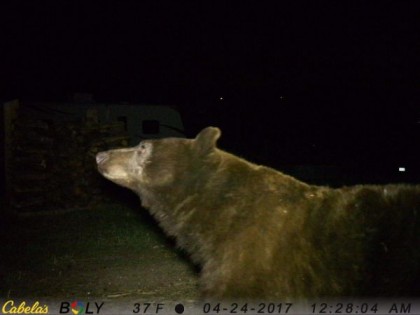
There are bears here, too. Unlike the mountain lion the bear will not hunt us, but if we interfere with a bear, say a sow and her cubs, she will hold her ground and defend her babies. Though the bear is not a predator of humans, they are a danger because an encounter can end in severe injury, even death.
 Mountain lions and bears, oh my, are not the only fauna here that can hurt you. At lower elevations there are timber rattlers. There are also black widow and brown recluse spiders, all venomous enough to cause great harm. In these hills we find not the sound of music, but the shake of a snake’s tail. Julie Andrews might not skip so blithely here.
Wild nature is neither our friend nor our enemy, whether it’s Minnesota cold or Rocky Mountain predators, Singapore heat, or California surf. We live out our short moment as reflective, aware extensions of the universe, as natural and as deadly as the mountain lion, as dangerous when surprised as the bear, as willing to defend ourselves with deadly force as the timber rattler, the black widow and the brown recluse.
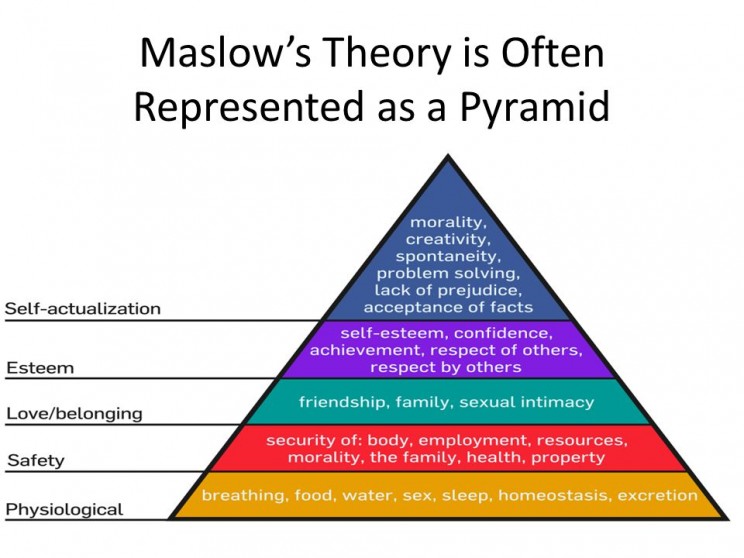
It is fragile, doomed to fail, this mystery we call life. Yet while we have it, be we bear or mountain lion, rattle snake or poisonous spider, we fight to keep it, do whatever we need to do to survive. This is the harsh reality at the bottom of Maslow’s hierarchy*, a necessary part of existence we share with all living things. It is better, it seems to me, to be aware of our shared struggle, to see ourselves as fellow creatures. Yes, we can reflect on our struggle, but that fact does not make us better than our living companions, it only makes us different from them.
*
Beltane Rushing Waters Moon
 So. Because physics. No black tea up here, at least not at a proper temperature. Thanks Tom and Bill for your help. When you relieve the pressure, the water reverts to the pressure of the air and the temp goes down as it does. Sigh.
Black Mountain is covered in cloud, hidden behind an opaque scrim of greyish white. Bishop Berkeley would suggest it’s not there at all, but I think it is. We’ll find out sometime today.
 Went into Kate’s hairstylist with her yesterday and got my ears waxed. Jackie put hot wax on my ears, then pulled it off, removing those hairs that seemed to follow receipt of my Medicare card. This is my second time. She says if we do this often enough, the follicles will not push up hair. I mean, hair on the ears is so last iteration of our species.
Kate spent the rest of the day at Bailey Patchworkers. This is a sewing group that meets at the Bailey Library. Kate joined in our first year here. Another group with some of the same members, a needleworkers group, invited her to join them. As a result, she’s had two circles of friends here for almost the duration of our time in Colorado. This is a woman who listens to lectures and does counted cross-stitch or needlepoint. She’s sew into it.
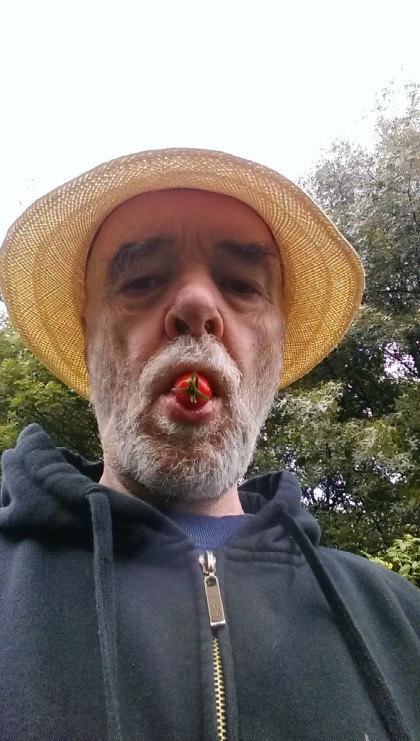 Planted a tomato plant yesterday in a five-gallon plastic bucket. When I opened the bag of garden soil (we don’t have anything a Midwesterner would recognize as soil), the smell of the earth almost made me cry. I miss working in soil, growing plants and my body told me so. A greenhouse went up higher on the priority list.
I love living at altitude, among the Rockies and all their flora and fauna. See the post below. I also loved living in Andover where horticulture, in retrospect, was so easy. It is possible to recreate that experience in miniature, inside four walls and a roof. I want to do that.
Beltane Rushing Waters Moon
File under items that would not have showed up in Andover, Minnesota:
Lost black yak with white star on head. Last seen at S Baird Rd. call Trevor.
Big ol bear strolling down the road on Corsair just past Maurader at about 6:45am. Looked right at us and walked up the neighbors driveway. Cinnamon colored.
My once a year sighting of a moose
Just spotted a mountain lion near Shadow Mountain and Warhawk on side of the road.
Beltane Rushing Waters Moon
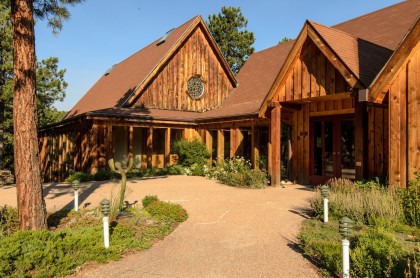 Irv Saltzman invited us to a performance by his singing group, the Renaissance Singers. It was held in a wooden Episcopal Church, St. Laurence’s, which is near our home. Directed by a Chinese national, Hannah Woo, who is finishing her Ph.D. in musicology, they were 8, four men and four women. As a group, they matched each other well. April, a soprano, had a lovely clear voice and a large range. Irv, formerly a tenor, has now transitioned into a bass/baritone role. Their performance was wonderful. At a meal afterwards we discovered April is our neighbor.
 Renaissance choral music and instrumental renaissance music has always captivated me. It’s easy to see courtiers in colorful costumes listening to this music in a palace, brown robed and cowled monks hearing it in a morning prayer service, or small groups performing at home for their own amusement. It’s also the music most often heard at Renaissance festivals. Sorta makes sense, eh?
The sanctuary had a vaulted ceiling with exposed beams and two large, clear windows that looked out to the east, toward Shadow, Evergreen and Bear mountains. It rained while we were there and the mountains were in mist, the windows covered with raindrops slowly moving from top to bottom. There were individual chairs, padded with kneelers, arranged in a three sided configuration, making the sanctuary a sort of thrust proscenium stage, an ideal arrangement for a small group of singers.
A church artist had painted the stations of the cross and they were around the sanctuary, set off by bent sheet metal frames. A copper baptistry, large, sat over a cinerarium where the congregation deposits cremation remains and memorializes the dead with small plaques.
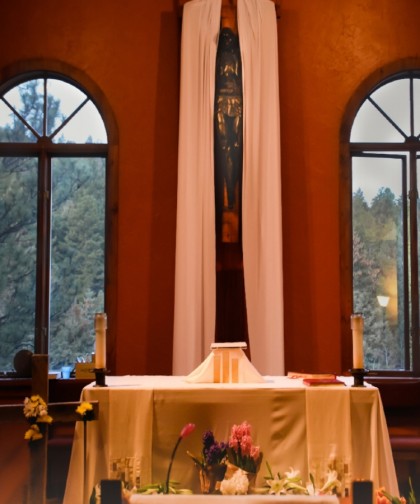 Between the two windows hung a large crucifix, a cross made of bare, light wood and a bronze Jesus hung by two nails. I had an odd sensation while listening to this music I’ve often heard in monastic settings on retreat. It carried me back into the spiritual space of an ascetic Christianity that often comforted me. This time though I came into the space as a peri-Jew, identifying more with Marilyn and Irv and Kate, with the still new to me spiritual space of Beth Evergreen, than the theological world represented by this spare, but beautiful sanctuary.
The crucifix stimulated the strongest, strangest and most unexpected feeling. I saw, instead of the Jesus of Christianity, a hung Jew, a member of the tribe. More than that, I felt the vast apparatus and historical punch created by his followers, followers of a man who shared much of the new faith world in which I now find myself. It was an odd feeling, as if this whole religion was an offshoot, a historical by-blow that somehow got way out of hand.
These feelings signaled to me how far I’d moved into the cultural world of reconstructionist Judaism. I see now with eyes and a heart shaped by the Torah and mussar and interaction with a rabbi and the congregants of Beth Evergreen.
 This was an afternoon filled with the metaphysical whiplash I’ve experienced often over the last year, a clashing of deep thought currents, spiritual longings. This process is a challenge to my more recent flat-earth humanism, a pagan faith grounded not in the next world, but in this one. Literally grounded.
What’s pushing me now is not a desire to change religious traditions, but to again look toward the unseen, the powerful forces just outside of the electromagnetic spectrum and incorporate them again into my ancientrail of faith. This makes me feel odd, as if I’m abandoning convictions hard won, but I don’t think that’s actually what’s going on. There is now an opening to press further into my paganism, to probe further into the mystery of life, of our place in the unfoldingness of the universe, to feel and know what lies beyond reason and the senses.
Beltane Rushing Waters Moon
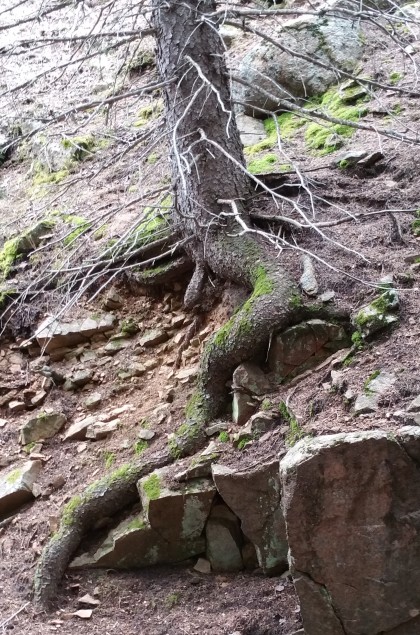
I’ve found the Colorado equivalent of Minnesota’s Scientific and Natural Areas (SNA’s). Here they’re called Colorado Designated Natural Areas. “Designated Natural Areas contain a wide representation of Colorado’s rare plants and animals, unique plant communities, rich fossil locations, and geological features.” I enjoyed visiting these areas in Minnesota. Sounds like they’re a little more diverse here. Road trip!
Beltane Rushing Waters Moon

“People forget something: in climbing, it doesn’t matter what you’re doing,” he told Outsideonline.com in 2010. “If you do a speed ascent, you’re the fastest up the Eiger’s North Face, nothing’s going to change in the world. But maybe your world is going to change. In the evening, when you’re going to bed, you know exactly what you have done. And that’s what it’s all about….If it’s your challenge, and you’re happy with it, that’s the most important thing.” Ueli Steck, quoted in the Alpinist
*Yokoyama Taikan was the pseudonym of a major figure in pre-World War II Japanese painting. He is notable for helping create the Japanese painting technique of Nihonga. His real name was Sakai Hidemaro. Wikipedia
Beltane Rushing Waters Moon
Fog this morning over Black Mountain. It comes in and out of view as the mist moves toward us. Now it’s gone altogether. There’s a thin scrim of icy snow on the solar panels. Colder last night.
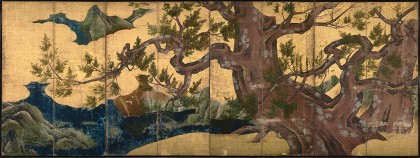
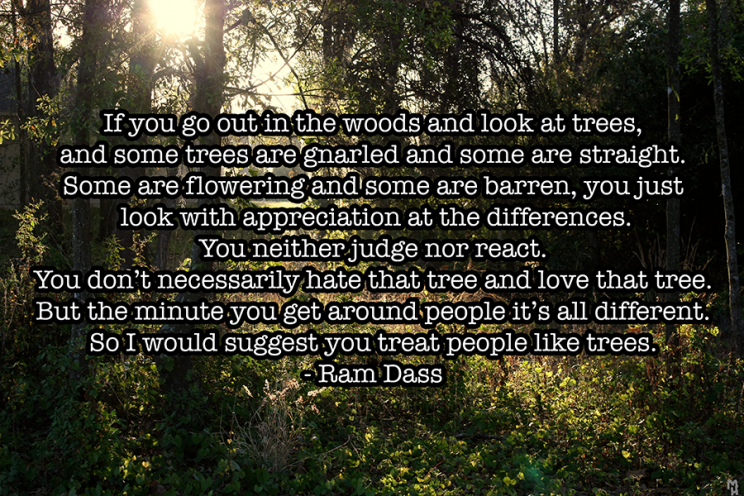
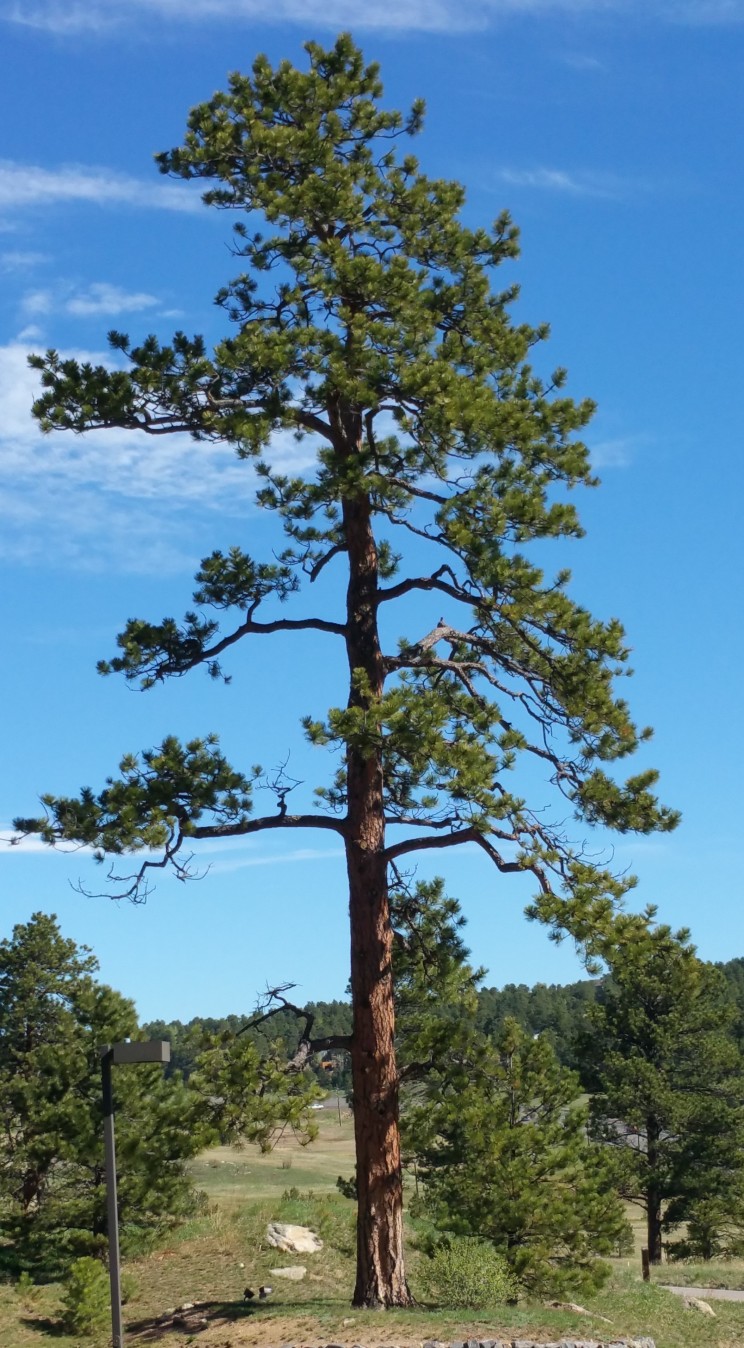
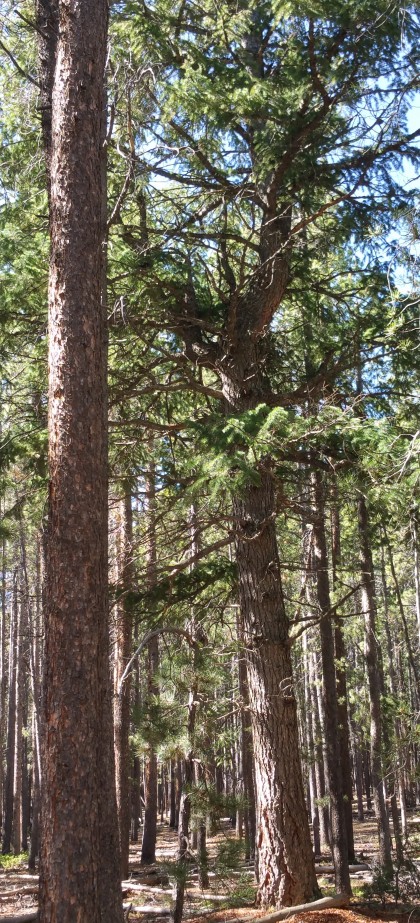
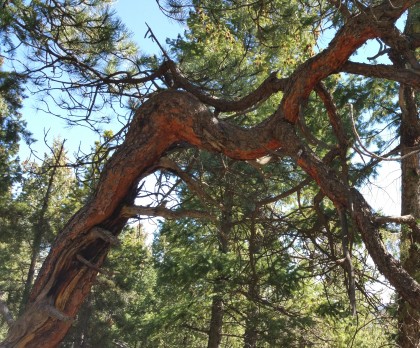
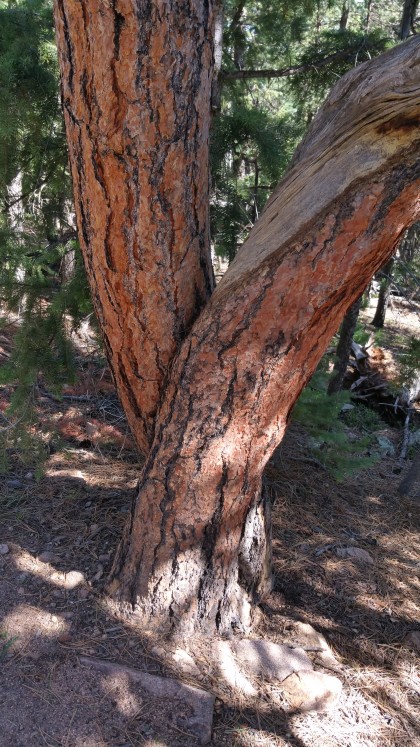
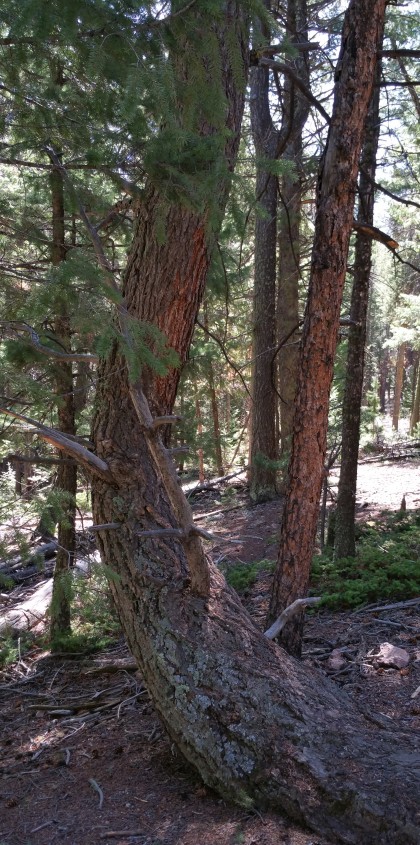
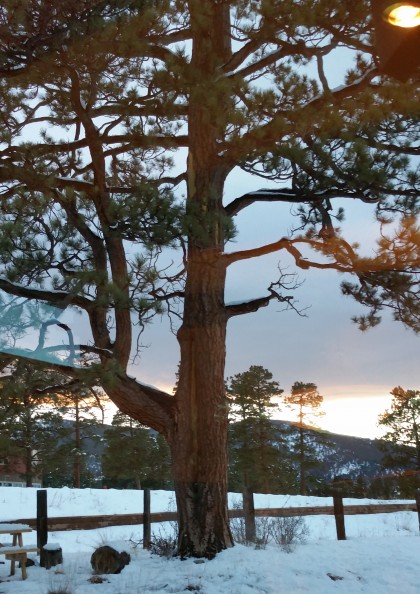
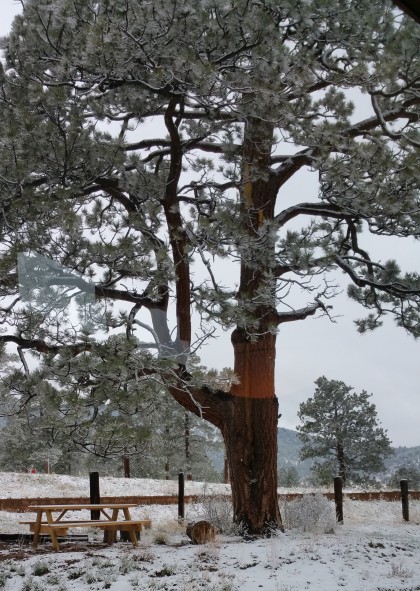
My Japanese informed aesthetic often finds resonance here in the mountains. The ponderosa pines that surround Beth Evergreen’s synagogue present heavily crenulated bark, twisted branches and a sturdy calm. From the sanctuary, looking south and east, one window pane has an especially crooked branch that reaches up like a hand. When the snow comes, it looks like a portion of a Kano school gold screen. Ravens and crows land on these branches, too, also emulating the scenery that inspired so many Japanese painters and printers.
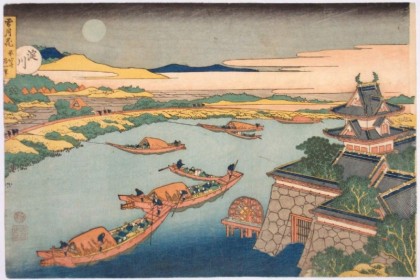
Moon watching, a Japanese pastime, has its analogue here as well. The moon rising and setting among the mountain peaks, clouds placing a thin gauze in front of it, the stars as its context, emphasize the moon’s romance. I can stand on my deck here off the loft and watch clouds cross the moon’s face. Its silvered light makes beautiful shadows of the lodgepole pine.
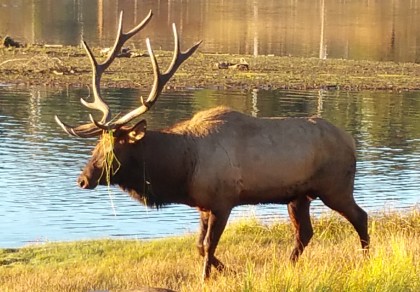
Big eared mule deer and thick, tall elk come down to Maxwell and Cub creeks, lapping up the cold fresh melted snow. Mountain lions slip noiselessly through the undergrowth, lie prone on rock cliffs waiting for them to pass nearby. Bears root up tubers. Minx, bobcats, pine martens, smaller predators, hunt for prey. Rabbits and squirrels and mice feed, look over their shoulder. The web of life is vibrant.
Ichi-go ichi-e is a Japanese phrase often associated with the tea ceremony. The tea master arranges art in the tokinama, chooses teas and sweets, decides which tea bowls and tea pots and tea utensils to use, then greets their guests as they arrive, often no more than one or two. He does this to create an ichi-go ichi-e, a once in a lifetime moment or for this moment only. It connotes the treasure of each meeting between or among people.
Each moment of the day Black Mountain offers ichi-go ichi-e to those of us who live near it, if only we stop and look. To appreciate ichi-go ichi-e though we need to pause, or as mussar teaches us, put a space between the match and the flame. If we slow down our glance, our gaze, let it come to rest, if we take a breath and consider what is right there in front of us, then we find once in a lifetime moments happening throughout our day.
These do not, as you might think, cheapen or dilute over time, rather they enhance our experience of the world. We recognize the fleeting nature of life, of this moment and that moment, of the unique and precious and irreplaceable flavor to each encounter. Nothing is old, all is new, always.
In fact, to the extent that we can gain an appreciation of ichi-go ichi-e, then we never age.
Beltane Rushing Waters Moon
 Cue the couples out in the fields doing their sympathetic magic for the fertility of the crops. Light the bonfires for leaping over and the bonfires for driving the cattle between. Gather the naked Scots outside of Edinburgh for the great fire festival. Dance in the streets because the growing season has finally come round again, the Great Wheel has turned and food will begin to appear from mother earth.
The greenman is dead, long live the greenman. Let the lady and the god Cernunnos mate again and again and again. Watch as the seeds break open and pierce the soil, spreading leaves, gathering in sunlight and drinking in rain. See the birds, gone for the season, return to sing and fly and swoop and delight us.
As winter has made us fold our arms and shiver, put on coats and boots, Beltane says, open them, embrace the sky, kick off the boots, shed the coat. Go out into the forest and walk, slowly. Listen to the streams falling down the mountainside. Feel the wind come over the continental divide, still cool from the snow covered peaks beyond it.
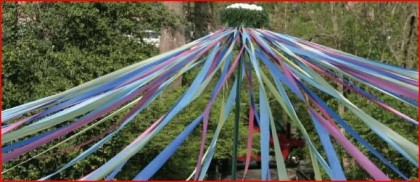 This is Beltane. Mayday. Collect women and men, girls and boys, give them streamers and ribbons, connect them to the tall pole and have everyone swirl, under and in and out and back again. Pick flowers for the table, for a basket, for your lover.
May the power in each plant, in each rock, in each deer and fox and moose and elk and badger, in every person you meet, each bit of food you eat illuminate your heart and may your heart illuminate theirs. This is a time for coming out. Hug. Kiss. Smile. Appreciate.
Show gratitude for the snows of winter, the transition of spring, and the promise of nourishment spreading among us now. We have come again to the season of plant growth. The time when animal babies slowly mature. Celebrate, celebrate, dance to the music of the earth herself and her consort the sun.