Category Archives: Humanities

OK, Woollies. I Finally Did My Assignment.

Winter                                                                 Cold Moon

For this meeting, please bring a magazine, journal, newspaper article, book, or something written, that you have read within the last month and that brought a great deal of passion, inspiration, focus, energy, or meaning for you personally.” Scott Simpson, for the Woolly meeting a week ago today

I’ve read three books recently that have stayed with me: Zero K by Don Delillo, Underground Railroad by Colson Whitehead and The Nix by Nathan Hill. These are all fiction, all by contemporary authors.

zero kZero K examines, in a minimalist world, our obsessions with death, immortality and technology while recounting a strained father-son relationship. It’s stark and strange, featuring, for example, a compound somewhere in the ‘stans. At this compound, mostly underground, is the center for a cryogenics movement funded by wealthy folk hoping to live forever, or at least until there’s a cure for whatever they have right now.

Underground RailroadUnderground Railroad imagines a real railroad, with tunnels and station masters, which carries escaped slaves. It is not so much the railroad though that commends this novel, but the story of the slaves who escape. This novel puts you inside the minds of slaves on the plantation and as they decide to flee and the ambiguous world that faces them even in relative freedom. Claustrophobic, scary, uncertain life on the run sometimes contrasted favorably with enslavement, sometimes furnished prisons and punishments that did not. I appreciated the chance to live in this world for the time it took to read this novel.

nixThe Nix uses massive online video gaming, the Chicago protests of 1968, and the life of a disappointed assistant professor of English and his estranged mother to reflect on what it means to be human.

The nix is a Norwegian legend, according to the characters in the book, which involves a horse. The horse finds children, plays with them, then invites them, by lowering his head, to climb aboard. At first, the children are delighted. They love the horse. Then, the horse begins to gallop, faster and faster. The child becomes frightened. Finally the horse wades into a lake, throw off the child and kills them. The theme of the Nix is just this: that the thing you love can kill you.

Well worth the read.

Racism. Long. Hard.

Fall                                                                               Hunter Moon

540546_405303126228787_1694483271_nRacism. Is complicated. Very complicated. And, yes, I believe all white Americans are part of its grip on our culture. I’m going to try to boil down a very thorny subject into a few words, see if I can convince you that you are part of the problem if you’re white and live in the U.S.

Power. Racism is not about prejudice, it is about power. An analogy is rape. Rape is not about sex, it’s about power. So, just as rape is about power, not sex, racism is about power not race. Race, a spurious concept in the first place, not supported by DNA evidence, is a cultural idea, not a biological one.

At the beginning of our country, as the founders drafted the much admired and revered U.S. Constitution, a beacon of liberty and freedom for all nations, there was conflict between southern slave holding states and northern states. It concerned how to count slaves for the purposes of determining a state’s population. In our system of government the number of representatives a state gets in the House of Representatives follows from the state’s population. More population=more representation.

antislavery_medallion_largeSlaves did not vote, but if counted as full persons for population purposes they would have given slave states and the whites who did vote greater representation in the U.S. House. This would have unbalanced power between the North and the South.

The three-fifth’s compromise was the result, stating, in our founding document, that slaves were only three-fifths a person for census purposes. From the start both North and South willingly manipulated the fate of the enslaved for their own purposes. Not only did the north instigate the three-fifth’s compromise, they did it to retain slavery in the U.S. Slavery was then a powerful economic engine that underwrote a large amount of the total U.S. economy.

This legal idea of a slave as a three-fifths a person contributed to the general devaluation of the enslaved. And who benefitted? Every citizen of the new country who benefitted from the slave economy. Everyone did. Thus whites in the U.S. had from this early date in our history an unearned advantage, an unearned economic advantage over persons of African descent.

build-a-tableThey also had an unearned advantage in their social status as at least higher than that of the slave, the three-fifths of a person enslaved. This unearned social status gave low income whites, often share-croppers, a psychological and social boost which had nothing to do with their personal merit. They were better, at least, than those who toiled without compensation and freedom. That unearned and undeserved lift in personal status persists in the minds and hearts of all white Americans.

The advantage in economic circumstances held by whites in the aggregate over the descendants of the enslaved has its roots in this wholly unequal economic baseline. Our wealth, as whites, depends in part on the advantage we had as a segment of the U.S. population, a segment that received the economic benefit of goods and agricultural products made cheap by the unpaid labor of the enslaved.

chomskyThe civil war, you might say, shows the inherent goodness of the north and the hostile debasement of southerners. You might say that if you don’t factor in the unearned economic and social advantages even northerners gained from the enslaved. You might say that if the wreck of reconstruction hadn’t resulted in Jim Crow laws throughout the south. You might say that if you hadn’t grown up near Elwood, Indiana which had a sign at its city limits, No Niggers In Town After Sundown. This was taken down only after the civil rights act in 1964.

You might say that if the disparity in white/black economic fortunes hadn’t persisted to this very day. You might say that if prisons were not filled disproportionately with persons of color, especially African Americans. You might say that if systematic attempts to prevent African-Americans from voting weren’t front and center in this very election-all those cries against non-existent voter fraud and for voter i.d. laws that would make it difficult for the poor to vote at all.

i-am-not-a-racist-i-am-against-every-form-of-racism-and-seggrationHow have all these terrible realities managed to remain in place? Because those with power rarely give it up willingly. We white Americans, through our avoidance of these issues, have capitulated to the structures already in place. Why? Because those structures: biased employment choices, biased voting requirements, lack of affordable housing, lack of available health care, still unequal education, are on the fringe of our lives, happening to someone else, some other African-American self. And to fix them would cost us in taxes, in our unearned advantage in employment, in our ability to control local and state and national elections.

Are these conscious decisions for most of us? No. But they do not have to be. It is our assumption that the way our culture organizes itself is just and fair that makes us all complicit. This is institutional and institutionalized racism. It is the result of either our conscious decisions or our unconscious capitulation to things as they are. We, we white Americans, are all part of this, and, in this very real and potent sense, racist.

Living Consciously

Lugnasa                                                                              Harvest Moon

Two great quotes yesterday. One from our mussar group: I never saw a U-Haul trailer behind a hearse. The second from a comment on a NYT article on the meaning of life: You say No Matter, I say Never Mind.

Mussar. It’s September, the days are cooling down and years of Septembers have me getting ready to accelerate my study. This year a focus will be mussar.

mussar-path-of-w-logo1Mussar is defined here by Rabbi Ira Stone, of the Mussar Leadership Program: “The most accurate translation of the word mussar into English is “discipline,” defined in all three ways we use the word in English. Mussar defines a discrete area of study, like the discipline of physics. It describes a practice, as in “it takes discipline to practice piano every day.” It also describes the act of correcting behavior, as in “you must discipline the child.””

In our study of the Way of the Just, begun yesterday at Congregation Beth Evergreen (CBE) and led by Rabbi Jamie Arnold, we talked about the purpose of life. Rabbi Jamie offered what he said was a traditional Jewish perspective: Experience happiness fully. Experience sadness fully. And in the times between be content. Works for me.

It feels good to have some anchors in Evergreen now. Our work with Bear Creek Design will introduce us to the contractors who do work for them. Kate’s study of Hebrew and our mutual study of mussar has begun to open up relationships at CBE for CBE. This means Evergreen is no longer a destination only for restaurants and shopping, but also for community.


Into This World We’re Thrown

Lugnasa                                                                        Superior Wolf Moon

mattisPolitical correctness. What a genius it was who invented that phrase. An oxymoron that sounds like a platitude while really functioning as a self-imposed conservative censor. Let’s be clear, there is no such as the politically correct. There are only those cultural observations and changing traditions that reflect a certain political perspective. So, in that sense, I agree with the conservatives.

(The danger in not knowing yourself and being willing to impose your perceptions. Taken to the extreme here.)

When I react negatively to a woman being called a girl, to a black man being called colored or nigger, to a lesbian or gay being called queer (although that community has embraced this epithet), it is precisely my point that the world has moved on. Find people who aren’t like your idea of normal as people nonetheless. Am I right, or correct, in this perspective. I certainly think so. Do you think so? Maybe not. If not, I’m interested in your rationale for your language.

Now, having said that, I find the University of Chicago letter to its incoming students both unobjectionable and positive. Trigger warnings, intellectual safe places and sanctioning speakers on campus are the precise opposite of what colleges and universities are about. If you go to college and don’t find yourself challenged, embarrassed, overwhelmed, exhilarated and scared, you’re not only not getting your money’s worth, you’re being actively cheated.

atlantic-baby-2No matter where you come from you arrive at the beginning of a college education with a set of biases and conceptual short cuts framed by the world into which, as Heidegger put it, you were thrown. This is neither a negative or a positive, it just is. A university education is about pulling those blinders off so you can see the whole street. This is the moment when we learn that our way is not the only way, that our understanding about religion or agriculture or class or gender or race is not shared by 100% of earth’s population. In fact, it’s shared by only a tiny percentage of the seven billion or so alive right now. Again, that’s neither negative or positive, it just is.

We also learn that the perspectives and biases of everyone alive right now are not the end of it. Over time, that is both historically and pre-historically, humanity has entertained a plethora of forms of government, religious practice, kinship patterns, artistic conventions, military custom and all other forms of human activity that can be imagined.

The only way to enter the human experience fully is to learn a reflexive humility when confronted with difference. The only way to gain that humility is to learn yourself inside and out, to know why you view the world the way you do. And the only path to self-knowledge is a gauntlet of hits to your self-complacency.

Zhzi44College is the safe space. It’s not safe in terms of no discomfort. It’s not safe in terms of reinforcement of your cherished beliefs. It’s safe in terms of its recognition that we all need to learn who and what we are within the context of the great body of human knowledge and within the vast sea of living humans. It’s safe in that it provides a place where that is the purpose of daily life.

This is, btw, the soundest argument I can make for the humanities. While science may challenge your understanding of the physical and natural world, it will not, except in rare instances, challenge your mores, your prejudices. It will also not train you in the vast number of options of how to be human, or the vast number of options of how we can be human together. No, for those learnings you need art, literature, philosophy, music, history, political history. Where do you find those? Yes, in a college space.


Indolence in Horse Country

Summer                                                               Park County Fair Moon

An indolent day yesterday. Kate, Jon and the grandkids left for Fairplay, about an hour west of here in South Park, headed to the Park County Fair. Neither Jon nor us has a vehicle that comfortably seats 5, so somebody had to stay behind. Me.

Did a little binge watching, read the Sport of Kings. This book, Sport of Kings, is a major American novel. It catches American aristocracy (that strange self-inflected club), slavery, westward expansion, effectively compares the breeding of blue-blood humans and blue-blood horses-thoroughbreds, the respective dynamics of working class, upper class and poor black families, all seen through the prism of Kentucky bluegrass horse culture. It’s one I may read twice.

Jon’s into Denver today to work on his and Jen’s house, getting it ready for sale in the red-hot Denver market. I’m following in just a bit to pick up some portion of his stuff: tools, clothes, walnut boards for the loft, machines for ski-making. This whole process has been icky so far, but I’m entertaining a hope (maybe, really, a fantasy) that this week marks a modest turning point in the acrimony.

Ladders rattle over the roof of the garage as the final masking is underway. The staining will commence on the whole very soon, perhaps today. The preparation for a good painting/staining job is painstaking, time-consuming.

Law

Summer                                                                 Park County Fair Moon

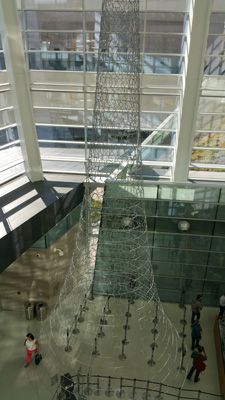
enver Court House Lobby
Denver Courthouse Lobby

All day yesterday two young men from Timberline Custom Painting power washed our two decks, the shed and the garage. They now look clean and bare, ready for the clear stain. The low humidity up here dries wood out, can crack and split it, so wood siding demands care just like a painted surface.

We got the bid back for the bathroom. Ouch. Need to get other bids, other ideas because the one we talked about with Bear Creek Design is more than it makes sense to spend. Part of the process.

The divorce and legal matters continue to roil up family life. Lawyers and courts and judges, decrees and orders. External power, again the state’s coercive authority, enters intimate areas, areas usually outside the pale of government interference. The capacity of the law to circumscribe behavior is chilling, inexorable when it comes down on you or ones you love. Yet, necessary. Common life, especially in a democracy, occurs among individuals with widely varying goals, ethical assumptions and moral positions. Conflict is inevitable and at times the conflict demands mediation, even arrest and imprisonment.

The law, made in assemblies of elected officials, too often reflects the biases and values of a majority, giving bare attention or actual suppression to those less well represented. Think sodomy laws, restrictive abortion regulations, voting measures like reading tests and i.d.’s, Native American reservations. The law is about power and like all things related to power subject to corruption.


Works of Art in an Age of Digital Reproduction

Beltane                                                                  Running Creeks Moon

Kate, May 2013
Kate, May 2013

It’s taken me a week and a half, but I’ve cleaned up Ancientrails. All images are either mine or ones from sources without copyright issues. The time it took was penance for not being attentive to this issue for over ten years. There is, too, a financial penalty, negotiated between a lawyer and myself for using a copyrighted photograph.

I feel like a raven whose stash of pretty things has been stolen. But, ravens are thieves and I was, too, though not in a possessive way. Both Richard Prince, an artist who reuses the photographs of others, and Walter Benjamin, who wrote a famous essay, “The Work of Art in the Age of Mechanical Reproduction,” have been on my mind during this time.

Once I’ve taken a break from the computer, today I’m going to do a lot of straightening up and rearranging up here in the loft, I’m going to give the whole issue of copyrights, attributions and fair use a concentrated look. Included in that will be a rereading of Benjamin and some of the follow on scholarship plus material about Richard Prince and others like him.


Music. Painting.

Imbolc                                                                     New Valentine Moon

We started our Sunday at the Clyfford Still Museum. A chamber music quartet played in Gallery 5. Their audience which carried some nifty aluminum gallery chairs to the room filled the gallery. They were appreciative, too, but, as Kate pointed out, they clapped after every movement. Not the mark of a sophisticated crowd.

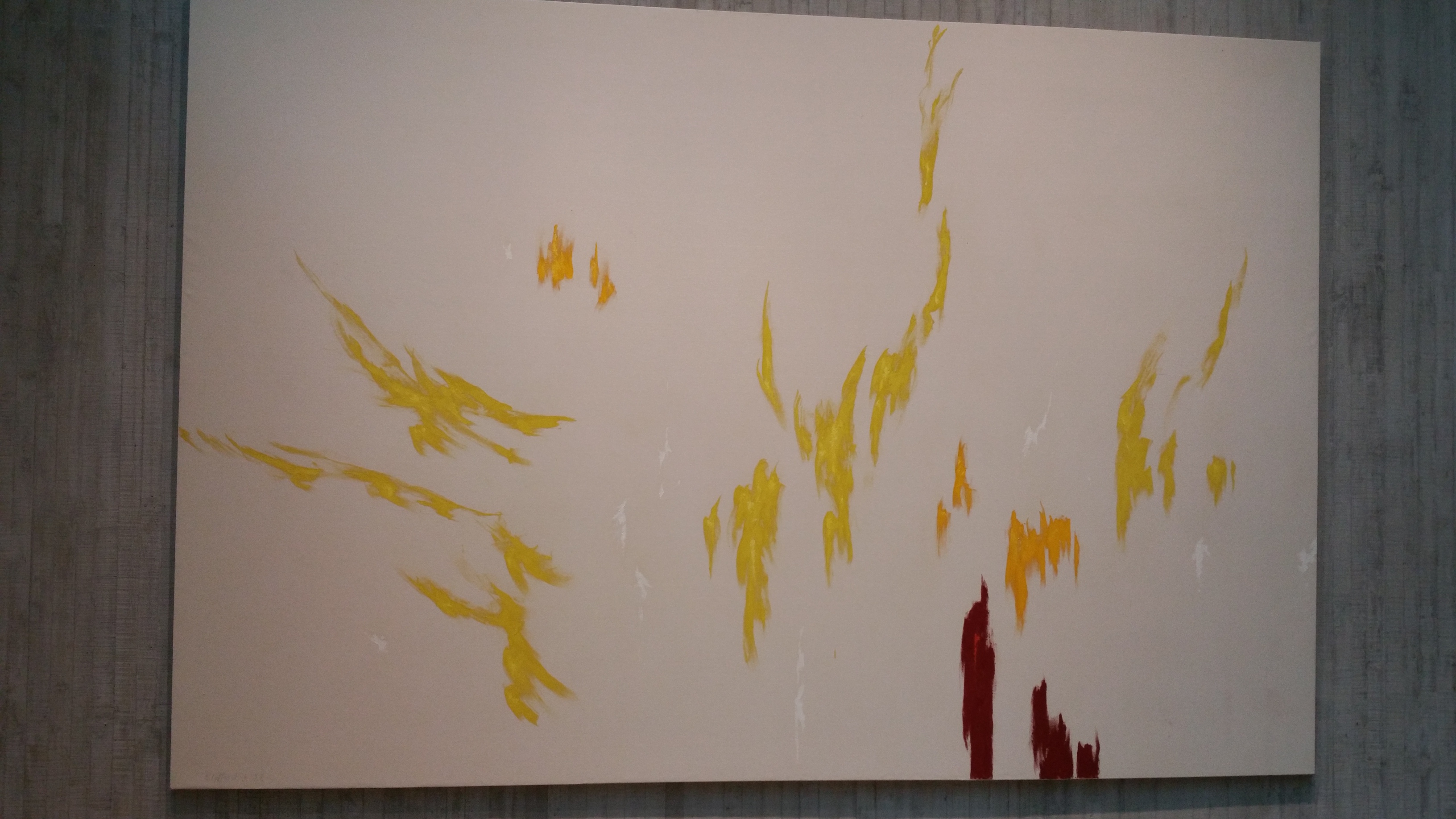
I took the opportunity to wander through this small museum, listening to the music as I tried to get a read on Clyfford Still. A few of his later works were wonderful, brave. A favorite featured a huge, mostly blank canvas, with just a few yellow marks flying up like a flame burning mysteriously, some white, splashes of orange and a few scarlet intrusions from below.

20160207_142150

I sat for a while in the gallery next to the one where the music played looking at the painting below. Somehow, I don’t even remember how now, I became a chamber music fan. For seventeen years I went to the St. Paul Chamber Orchestra, attending most concerts in their season with a subscription.

I’m not a sophisticated listener from a musical point of view. That is, I don’t really follow the construction of a piece, nor do I understand the intent a composer may have had. Not an impediment. This music reaches inside my rib cage and squeezes my heart. Often, I would sit, eyes closed, watching small sparks, sometimes large ones, dance behind my eyelids, called into existence by a note, a run, a solo performance, a particular melody.

Other times a profound sense of melancholy would overtake me, followed by jubilation. With Charles Ives’ pieces, he’s a particular favorite of mine, a small crack in the fabric of space-time could open to reveal just a glimpse of what lay beyond this moment.

I mention this because while I sat in the gallery yesterday, a question, not an original one by any means, came to me: what is the difference between music and painting? Both are art forms. Both with artists engaged intimately. Both requiring tools for the artist. Both appealing to a desire (or need, even if undiscovered) to see or hear the world in a new way, a way not possible in the everyday. Both requiring some seriousness in the listener or the viewer, some attention to the work, some willingness to be vulnerable. Both chamber music and abstract art with long histories.
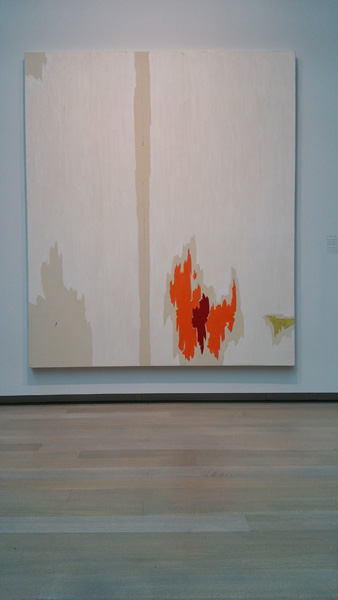
Still 600

Yet the differences were stark. The music floated through the galleries, taking up aural space everywhere, yet visible nowhere except Gallery 5 and even there only the artists and their tools could be seen: cello, violins, viola. One of the wonders of music is that we can see the musicians at work, bow in hand, reed wet, embouchure quivering yet we cannot see what they make. So music is invisible and painting very, necessarily visible.

Also, music is ephemeral. A painting, with appropriate conservation, can last centuries, even millennia. Once a note, a run from the quartet was heard, it died away and others filled in behind it, the linear drive of the music creating a certain expectation, a sense of beginning, middle and end. Still painted this canvas in 1972. With the exception of some possible changes to the linen and the paint-and I don’t know if there have been any-this work looks now like it did when he laid down his brush. So a painting is in that sense static.

That static nature of a painting is, in fact, a part of its meaning. We have confidence that we stand before what the artist intended; so a painting provides a moment, unmediated by others, when we as viewers can connect personally with the expressive power of a person often long dead, think Fra Angelico or Rembrandt or Poussin. Still died in the early 1970’s.

Music, in contrast, requires mediation, at least in chamber music. We hear, usually, not one artist, but many interpreting through their instruments the musical idea of a composer no longer able to comment on his or her intention. And we hear that interpretation, in the instance of live music, only once.

But, and here was an idea that was new to me, I might leave a concert whistling a melody or a particular portion of a composition. I might remember much of it, be able to recall the work as I go on from the concert hall. But, in the instance of abstract art, it is very difficult to recall what I’ve seen. The lack of representation of things familiar leaves my mind adrift when it comes to recall. This may, of course, be just me, but I imagine not.

So in this aspect, interestingly, the abstract painting becomes ephemeral, seen, then not recalled or recalled poorly, while a symphony or a concerto or a smaller chamber piece might remain, at least in part, accessible long after being heard.

In this case the apparent distinctive elements of stability and ephemerality are reversed, music being memorable, no longer ephemeral, and painting being unstable, as impermanent as the music I listened to yesterday in the gallery.

 

Stock Show Weather

Yule                                                                                 New (Stock Show) Moon

The Denver metro has Stock Show weather. Stock Show weather is cold as opposed to snowy, not surprising since the Stock Show runs the three weeks after the first week of the New Year.

We got 5 or 6 inches of snow overnight. The next few nights will be in the single digits or low double digits, cold by Colorado standards. Just getting cool by Minnesota’s. It rarely gets chilly here, that is well below zero, though it does happen. Still, as I told Greg, my Latin tutor, this morning, I wouldn’t care to visit Minnesota during a chilly period. Not anymore.

A couple of weeks ago Greg gave me an assignment. Match my English translation against other English translations, then figure out where and why we differ. This means I’m moving closer to the sort of translating I sought when I began this long journey. In order to proceed honestly I still have to translate the Latin first, then check others. This way I don’t engage in cheating, making my translation fit someone else’s interpretation. But, done in the proper sequence this method allows me to begin polishing my language, getting beyond a more literal translation to a more literary one.

Getting back to regular, that is daily, Latin work has been frustratingly slow. I’ve allowed holidays and illness to intrude. Understandable, not helpful. After this morning’s session though, I have a feeling I’m back at it. Greg said I did very well with the material I prepared. That means, when we sight read the Latin, I easily and accurately translated what I had put through the English translation match.

With my workouts somewhat regular now, illness and holidays again, it feels as if I’m returning to the productive rhythm I had in Minnesota. Now I need to add writing on a novel and/or the reimagining book. Working out, Latin and creative writing are the three legs to my stool, each necessary in their own way.

The art will come along, too.