Category Archives: Great Work

Clash

Lughnasa                                                            Labor Day Moon


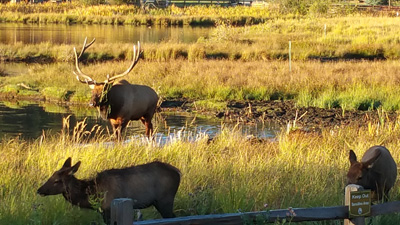
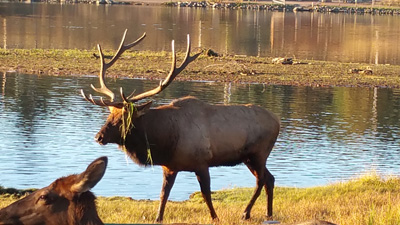
Part of the transition to fall here in the mountains is the elk rut. My dental hygienist told me about her first experience. She and her husband came home from work in late September. They heard a sound like two men clashing 2×4’s together, went to the window and saw two bull elks in the backyard, charging each other. This went on through supper, and as night fell, they both used night vision goggles that her mother had left behind after a visit. They went to bed to the sound of the elks battling for reproductive rights.

When she got up, the second elk was gone and the winner basked in the comfort of a large harem of does. Also, she said, the bugling sounds just like bugles. Looking forward to this fall.


Lughnasa                                                                 Labor Day Moon


Been trying to feel the mountain. Beneath our house Shadow Mountain extends at least 8,800 feet to sea level and just where a mountain begins and ends after sea level is a mystery to me. That’s a mile and 2/3rds of rock. A lot of rock.

14 years ago I came out to Colorado and camped above Georgetown in the National Forest. Right next to me was a sugarloaf mountain. As darkness fell, the mountain disappeared into the gloom. All that massiveness just disappeared. But I could feel it looming over me. Since then I’ve wondered what the mountain equivalent is to the Shedd Aquarium’s freshwater exhibition tag: The essence of a stream is to flow. What is the essence of a mountain?

Mass seems to be the answer. It is the distinctive feature that draws our eyes when we come in on Interstate 76 from the plains of Nebraska. Suddenly, the plains stop. The essence of the plains is flatness? No more flatness, verticality created by mass intervenes with sight lines. The volume of rock pressed upwards by colliding tectonic plates changes the topography.

So these last couple of mornings, before I got out of bed, I’ve been trying to feel the mass of Shadow Mountain. Trying to extend my Self into the mountain, to feel the mountain as it lies there. Not so successful so far. It occurred to me this morning that this is the opposite of conquering the mountain, of summiting, of climbing. This is diving, deepening, merging. Part of the difficulty is the claustrophobic feeling of having the mountain all round me even in my imagination.

This is not all. I noticed the other day in the east, just above the lodgepoles on our property, Orion. In Minnesota I was a late riser so I don’t know where Orion was at 5 am in August, but his presence here surprised me. I have, until now, counted Orion as a winter companion, first becoming visible in November. He may have risen much earlier even in Minnesota, but I missed him. Orion is a special friend, a constellation with which I’ve had a long relationship and one I view as a companion in the night.

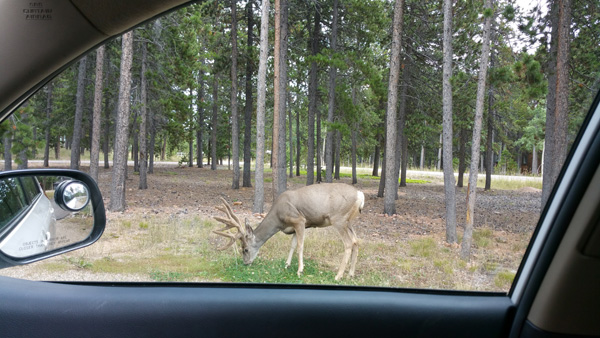
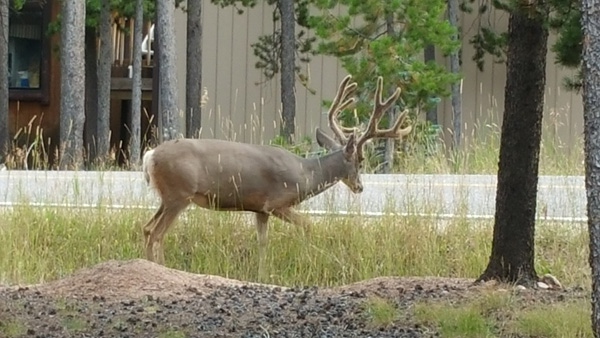
Then, there are the bucks. Mule deer bucks. On Sunday as we drove to Evergreen there were four mule deer bucks with still velveted antlers quietly munching grass along the side of the road. They looked at us; we looked at them. The velvet has a prospective nature, auguring the rut when not yet released. On this morning they were friends, not competitors for breeding rights. And they were in harmony.

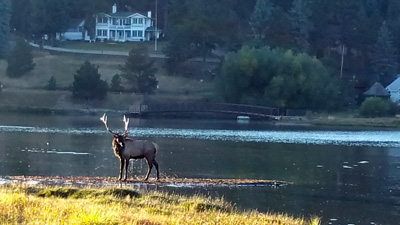
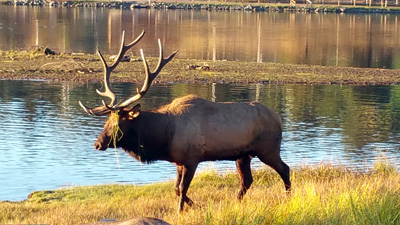
Then, yesterday, Kate said, “Look at that!” I turned and over my left shoulder looked down into the grassy valley that extends between Shadow Mountain and Conifer Mountain. In the field of mown alfalfa stood a huge bull elk. His rack was enormous and already cleared of its velvet. It arced out away from his head on both sides, tines extending its reach even further. This was a bull of legend. Seeing him took us into the wild, the world that goes on alongside us here on Shadow Mountain, the lives of our fellow inhabitants of this mountain.

All of this, the essence of the mountain, Orion rising, velveted mule deer, the bull elk, hiking on the Upper Maxwell Falls trail, all of this accelerates becoming native to this place. The Rockies. Our home.

On the Path

Lughnasa                                                               Labor Day Moon

gabeuppermaxwell300Two hours in the dentist’s chair yesterday. Cleaning, followed by a crown prep and filling two cavities. When Kate came back from the dentist on Wednesday talking about the sticky fluoride treatment she’d received, it made me realize we’ve had no fluoride in our water for over 20 years. Living with our own well.

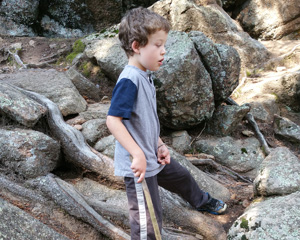
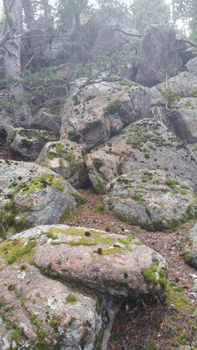
Took Gabe and Ruth to the Upper Maxwell Falls trail yesterday afternoon. We didn’t make it to the falls, instead wandering off on an alternate trail that climbed through jumbles of boulders and large, rocky cliffs. The regular trail is very popular in spite of its out of the way location. Over the summer there have been no fewer than six cars and often twenty parked at the trailhead.

We examined plants. Ruth found a snake (she wants one for a pet.), but it slithered away Upper Maxwell Falls Trail1350beneath the rocks. We climbed on the rocks and looked out. Nature provides something new, something noteworthy every foot or so. It was a slow hike. Here were lichen, familiar forms from Minnesota. There was a very late blooming Indian Paint Brush, its fiery bloom resting on the ground. The trees, some of them, were huge, trunks so big that Gabe, Ruth and I couldn’t get our arms around them holding hands.

Maxwell Creek exerted the magnetic attraction that water has for humans. We went down twice to be closer to it, the first time we crossed over to the alternative trail that we followed. The second time we crossed back to the Falls trail. Ruth talked about some camp counselors who followed a mountain stream to its source, an artesian spring, drinking from it, since “water is never fresher.”

Being in the Arapaho National Forest has its own version of mindfulness, one in which attention leaves the world of the day-to-day and focuses on an interesting rock, a blooming flower, the sound of water rushing over rocks, the view from a boulder. The eye scans for what is new or unfamiliar, being delighted constantly by a patch of cowslip, a bit of lichen on a lodgepole pine, a small squirrel playing peek-a-book around a thin aspen trunk.

Ruth and I are going back this morning, taking Kepler along in his harness.

Having a Moment

Lughnasa                                                            Labor Day Moon

I’m having a moment. It’s immediate stimulus has been reading How Forests Think, by Eduardo Kohn. Kohn is an anthropologist who has done significant field work in el Oriente, the east of Ecuador where the Andes go down into the tropical rain forests of the Amazon drainage. But this book is something else. Though it draws on his field work with the Runa, its focus is the nature of anthropology as a discipline and, more broadly, how humans fit into the larger world of plants and animals.

Thomas Berry’s little book, The Great Work, influenced a change in my political work from economic justice to environmental politics. Berry said that the great work for our time is creating a sustainable human presence on the earth. In 2008 I began working on the political committee of the Sierra Club with an intent to do my part in an arena I know well. I continued at the Sierra Club until January of 2014 until I resigned, mostly to avoid winter driving into the Twin Cities.

Since then, I’ve been struggling with how I can contribute to the great work. Our garden and the bees were effective, furthering the idea of becoming native to this place. The move to Colorado though has xed them out.

Kohn’s book has helped me see a different contribution I can make. Political work is mostly tactical, dealing in change in the here and now or the near future. In the instance of climate change, tactical work is critical for not only the near future but for the distant future as well. I’ve kept my head down and feet moving forward on the tactical front for a long, long time.

There are though other elements to creating a sustainable human presence on the earth. A key one is imagining what that human presence might be like. Not imagining a world of Teslas and Volts, renewable energy, local farming, water conservation, reduced carbon emissions, though all those are important tactical steps toward that presence; but, reimagining what it means to be human in a sustainable relationship with the earth.

Kohn is reimagining what being human is. His reimagining is a brilliant attempt to reframe who thinks, how they think and how all sentience fits together. He’s not the only one attempting to do this. The movement is loosely called post-humanist, removing humans from the center of the conceptual universe.  A posthuman world would be analogous to the solar system after Galileo and Copernicus removed the earth from the center. Humans, like the earth, would still exist, but their location within the larger order will have shifted significantly.

This fits in so well with my reimagining faith project. It also fits with some economic reimagining I’ve been reading about focused on eudaimonia, human flourishing. It also reminds me of a moment I’ve recounted before, the Iroquois medicine man, a man in a 700 year lineage of medicine men, speaking at the end of a conference on liberation theology. The time was 1974. He prayed over the planting of a small pine tree, a symbol of peace among the tribes of the Iroquois confederacy because those tribes put their weapons in a hole, then planted a pine tree over them.

His prayer was first to the winged ones, then the four-leggeds and those who swim and those who go on water and land, the prayer went on asking for the health and well-being of every living thing. Except the two-leggeds. I noticed this and went up to him after the ceremony and asked him why he hadn’t mention the two-leggeds. “Because,” he said, “we two-leggeds are so fragile. Our lives depend on the health of all the others, so we pray for them. If the rest are healthy, then we will be, too.”

Reimagine faith in a manner consistent with that vision. Reimagine faith in a post-humanist world. Reimagine faith from within and among rather than without and above. This is work I can do. Work my library is already fitted to do. Work I’ve felt in my gut since an evening on Lake Huron, long ago, when the sun set so magnificently that I felt pulled into the world around me, became part of it for a moment. Work that moment I’ve mentioned before when I felt aligned with everything in the universe, that mystical moment, has prepared me for. Yes, work I can do. Here on Shadow Mountain.


Feel the Rain On Our Face

Lughnasa                                                                    Recovery Moon

There are many ways of becoming native to this place. The one that worked for me involved a combination of following an ancient liturgical calendar based on seasonal changes in temperate latitudes: the Great Wheel and gardening. There are many other paths. Chado: the Way of Tea integrates the tea ceremony with a finely divided sensibility to Japanese seasons, some only two weeks long. Hunter/gatherers have to be native to the place where they are or they will not survive. Followers of the Tao, the way, lean into the rhythms of the natural world rather than away from them, flowing through the world as water does in a stream. Hiking and camping and canoeing. Forestry with an emphasis on forest health. Conservation biology.

Oddly though practitioners of modern agriculture are often as estranged from their place as residents of vast urban enclaves. And I recently read, in Foreign Policy magazine’s July/August edition, an intriguing explanation as to what lead current, often corporate, agriculture astray. When the population explosion gained prominence in the mid-1960’s, think Paul Ehrlich’s “The Population Bomb,” a concentrated focus on methods of improving agricultural productivity resulted. And it worked. More acres went under the plow, more chemicals went into the soil and onto crops, antibiotics filled food animals, food production became more sophisticated though not more nutritious, fast cheap restaurants bought and sold fast cheap food. There are real dangers in letting ourselves become strangers to our home world.

Becoming native to this place is analogous to being born again, revivified for the act of belonging to, being part of this planet. Second naiveté, Paul Ricoeur’s wonderful notion, can follow a state of critical distance:

“According to Ricoeur, the rational forces brought to our civilization through modernity have made it difficult to accept religion or scripture in the “first naïveté” sense. Once subjected to rational inspection, the literal meanings of religion really do not hold up…”  exploring spiritual development

Modernity has put the fruits of enlightenment reason and modern technology forward as more significant, more important than the growth of a tomato, than the beauty of a wilderness lake. It has substituted the grace of a soaring condor with the stiff, hard brilliance of an airplane. That tomato, grown soft and juicy on the plant, got replaced by a hard-skinned, pre-ripe picked fruit designed for machine harvesting and long distance transport. Distances that used to require human feet and legs, or the same of horses, now demand only that we sit and wait.

Before you resist this. This is not a screed against airplanes, cars, computers, telephones or grocery stores. It is a recognition of the rupture, the critical distance, modernity has created between our lives and the world that sustains them. Food comes from soil and plants and the animals that eat the plants. Oxygen from the plants at work. Water used to be purified by the very wetlands we fill in or drain to build subdivisions or to plant more acreage of chemically injected crops.

Life, in other words, exists in a delicate balance with the inanimate; that balance is literally billions of years old and one we cannot afford to ignore. Yet we do. And so we must make an effort to again become native to this place, this place which in its wonder gave life a chance.

Following the seasons as they change and following within those changes emergence, growth, life and death became easier for me when I overlaid on spring/summer/fall/winter the four big solar events of equinoxes and solstices, then put between those the cross-quarter holidays of my Celtic ancestors:  Samhain (summer’s end), Imbolc (in the belly), Beltane (the beginning of the growing season) and Lughnasa (the first harvest holiday). When I write the season at the top of this blog, I remember, for example, that we are now in the season of first harvests. And sure enough Kate brought home some wonderful heirloom tomatoes today.

The extensive gardens, both flower and vegetable, plus the orchard that Kate and I installed and nurtured in Andover reinforced the lessons of the Great Wheel. At Halloween, Samhain’s paler descendant, our garden would be finished, the beds covered, foods in jars in the basement, garlic hanging from rafters, onions and apples spread out. We were part of the turning wheel and the turning wheel shaped what we could and could not do. We lived then with the rhythms of the temperate latitudes, in some harmony with them.

Now we are in a new place, a more arid, less fertile place and the way of becoming native to it is still in process. But it will come.

We cannot all go back to the land. Cities dominate the living patterns for most of the world. But we must find ways, whether through community supported agriculture or urban hydroponics or organized trips to the countryside, to help us all feel the rain on our face. We all need to wonder at the slender green shoots that brave their way through the late snows of winter. Or, at the tropical lushness of equatorial jungles. Or the marvel of lives lived fully in the world ocean. Our lives and the lives of our grandchildren depend on our becoming, again, native to this place. To know our spot with a second naiveté so that we will care for, love this rocky, watery wonderful earth.


Becoming Native to This Place

Lughnasa                                                                Recovery Moon

The most ancientrail of all is becoming native to this place.

But, why must we become native to mother Earth? Aren’t we native simply because we are thrown onto the planet’s surface at birth? Yes and no. Yes, in that we are an organism designed to live in this gravity, breathe this concentration of oxygen, use plant matter and other animals as food. No, in that those of us thrown into a complex industrial/technology culture are native not to the planet itself, but to adaptations made over centuries by economies and governments. This includes the U.S., Europe, most of Asia, the Middle East and Latin America, as well as residents of urban areas on every continent.

In the U.S.A. we are native to electricity as Kate and I learned just this Monday.  Our typical life ground to a halt along with 4600 others when the power went out. We are native to a night lit not by fire, but by bulbs. We are native to warm houses in winter, cool ones in summer. Our hunting and gathering takes place at King Sooper, Safeway, Lunds, Byerlys. We are native to antibiotics, surgery, dental care.

When we climb the additional 3,600 feet in altitude from Denver to our home on Black Mountain Drive, we sit comfortably in a moving chair powered by the ancient remains of dinosaurs and forests. We are native to telephones, computers, text messages. We are native to machines and carpenters and plumbers. We are, in short, native to almost anything but this planet where we live.

You could reasonably ask whether this matters. Our future lies in the stars anyhow, doesn’t it? Maybe so. Especially if we render the earth uninhabitable for humans. Which, with climate changing drivers still dominant in our world economies, we’re working hard to accomplish.

I believe it matters. Why? The short answer is that becoming native to this planet, again, is our best hope for throttling back those climate change drivers. We can escape to the stars while having a beautiful homeworld as our base of exploration.

The longer answer has to do with the nature of our humanity. Technological and industrial estrangement from the rhythms of the natural world is almost a canard, a cliche. We expect tomatoes in winter. We expect access to any part of the planet within hours. Even the colors of our sunrises and sunsets often have chemical pollutants to thank for their vibrancy.

We need to awaken ourselves to the essential, everyday miracles: photosynthetic conversion of sunlight into food, the transpiration of that same process, oxygen, being a gas we need to survive. And this consciousness that we have. How about that. Or the intricate and interdependent web of living things. The changing of seasons in the temperate zones. Water’s strange characteristics.

In the next post I’ll suggest one way of becoming native to this place.

Stained Fingers

Summer                                                         Recovery Moon

Jon and I went to Paxton Lumber Company yesterday, checking out exotic and not-so-exotic woods for material to extend the surface of the shorter shelving units. A couple of the ones I really liked were $20 and $19 a board foot, padauk and wenge. At those prices one board, thick, was in the $300 range. After looking at ash, white pine, and douglas fir, all of which I liked but were too close to the birch veneer on the bookshelves, we settled on black walnut.

Not only will the black walnut contrast with the birch veneer, black walnut trees were common in my hometown of Alexandria, Indiana. I have fond memories of stepping on the green acrid smelling husks of walnuts as they fell from those trees. We teased out the walnuts tucked inside and took them home, fingers stained with a greenish-yellow paste that had a bitter lemony taste. A part of my childhood. Also, black walnut trees were part of the old forest which dominated the landscape of the midwest prior to westward expansion. So those boards of the midwest will rest on birch veneer, redolent of the boreal forest in Minnesota. But the bookcases they constitute reside here on Shadow Mountain among lodgepole and ponderosa pines.

We ate lunch at Park Burger in the Hilltop neighborhood of Denver, a wealthy area with tear-down lots filled now with house reminiscent of Kenwood in Minneapolis. I had a Scarpone burger with pancetta, provolone and giardiniera. It was delicious.

Jon’s skills as a woodworker were evident as we selected the particular walnut boards. We matched their color, thickness and rejected some with too deep fissures or splits. He knows the woods and their characteristics. He also knows the places where exacting cuts can be made, straight. One place has a table saw as large as a small room.

Once again the joy of returning home from Denver’s 94 degrees to Shadow Mountain’s 77 with 23% humidity. The nights have been warm of late, making sleeping more difficult and pushing those ceiling fan purchases higher up on our priority list.

The First of July

Summer                                                                  Healing Moon

Hodges Plumbing came out yesterday. They will install the gas line to the generator. Gary or Mike Hodges, I didn’t get his first name, arrived in a red truck and wearing overalls, has a gray handlebar mustache, gets up slowly after visiting the crawl space, and has a train whistle as his ringtone. I liked him.

The generator has to get over to the breaker boxes first, of course, and that’s Eric Ginter’s job. He and 3 other guys will muscle it out of the garage and over to the west side of the house. Eric will install the automatic transfer switch and hook up the generator to it. The automatic transfer switch starts the generator when power goes out in the house and shuts it off when the power returns.

While waiting for Hodges to arrive, I cut down aspen suckers and painted them with an herbicide designed to take out heavy brush and poison ivy. In the wild aspens throw out suckers in a ring around a parent tree. When the suckers grow to a certain size, they throw out more. One of the largest living organisms is an aspen stand which began from one tree*. I’m encouraging certain aspens by not cutting them down, but leaving them enough space to grow large. They are fire resistant, as Jacob Ware, deputy chief for the Elk Creek Fire Protection District, said. “Water, not pitch.”

In the evening we went again to Dazzlejazz, having been there last Friday with Tom and Roxann, this time with Jon and Jen. It was a sweet evening. We gave Jon a large gift to help pay down his student loan debt, part of the house sale proceeds. They were both surprised. They asked about my surgery and how they could support Kate. We listened to groups of teen jazz musicians, two jazz bands and a choral group. One tenor sax player really caught my attention, an edgy growly sound.

We drove into the mountains, back home, with Venus and Jupiter in conjunction and a bright full healing moon hanging in the southwestern sky.

*The Pando (Utah) grove consists of about 47,000 tree trunks, and it covers a little more than 100 acres of land. Overall, researchers believe it could weigh 13-million pounds.

Dazzle

Summer                                                           Healing Moon

Looking forward to seeing Tom and Roxann Crane tonight at Dazzlejazz. They’re in town for a few days, then Tom has some work here. We’ll see the Ken Walker sextet at this Colorado jazz institution. Good food, too.

Here’s a thought for all you eco-minded folks, Arcadia Power. The High Country News, a journal of liberal/progressive thought about the West published in Paonia, Colorado recommended them and I’ve taken some time to research their business model. They take the bill from your utility company, then buy renewable energy certificates to completely offset your usage. It raises your bill about 1.5 cents a kilowatt, but it means your energy use comes from sustainable energy products. Or, supports an equivalent amount of sustainable energy, either way you want to look at it.


For Millions of Years

Beltane                                                      Closing MoonUpper Maxwell Falls Trail350


A mile or so from our driveway is the trailhead for Upper Maxwell Falls trail. I went once in the winter and didn’t take my yak-traks with me. It was too icy to navigate the altitude gain.

Today, as the gloom began to settle in late afternoon, and as my own mood began to mimic the gray overhead, I set out for Maxwell Falls.

Upper Maxwell Falls Trail1350The trail is not long, about a mile and a third round trip, but it does climb, then decline through ponderosa forest. Piles of large boulders, weathered and jumbled together, cling to the side of Shadow Mountain above and the trail, while Maxwell Creek flows with equal parts power and grace, going white over rocks in its way, curling around them, too, in gentle embrace.

The falls themselves are modest in height, but there are several, one after another, giving more speed to the already rapid water. This is the way it’s been here for millions of years after the snow melt and when rains come. The water starts up high and finds these channels that allow it to collect and be the chisel. Later, it will grow calm after having taken a fast ride, perhaps pooling behind a beaver dam or a spillway or flowing into a lake or pond.Upper Maxwell Falls1350

It is a privilege to live so close to this magic. It dispelled the gathering gloom in my Self, allowed me entrance to the Otherworld, the place where humans are still one among many and not more important than any other.