Emissions testing is necessary before converting an out of state title so I was on my way to Ken-Caryl Aircare, a testing site with a low wait time. Denver has pretty bad air pollution, especially when there are inversions, a layer of warm air over a layer of cold. Denver metro counties have emission regulations and we’re in a western county of the metro area, Jefferson.
In what has become a regular occurrence the technician, a dread-locked African-American of about 40, told me he could do the VIN verification (also needed for title conversion), but, “I’ll charge you $20 and the Jefferson County Sheriff will do it for free.” He smiled, “Well, I won’t charge you. The company will.” Very friendly folks so far.
A nod to what’s left behind finished up the errands at Fedex, mailing the disclosure statements for the Andover house and the memory stick with Mark Odegard’s brochure to our Realtor.
Back home. All this driving through the Front Range foothills or in their periphery, the beginning of the Denver area from the West.
Woollies met tonight at the only house owned by Warren and Sheryl in Roseville. They’ve been moved in for about a month and a half. Bill, Frank, Warren, Mark, Scott, Stefan and myself met with Will Steger. Tom is in Kansas City and Charlie H. decided he was unable to be in the same space as Will. Charlie H’s loss.
Will’s story is an interesting one. He had, from a young age, a clear vision. He wanted to live in the wilderness where there was no road. And become self sufficient. He achieved that goal by buying a piece of property two lakes away from the nearest road outside Ely, Minnesota.
Continuing what he described as a vocation for teaching through many venues, he almost quit exploration until the internet allowed him to connect school children with his journeys.
He described great enthusiasm for and confidence in the young generation, folks in their twenties. “They want purpose and are willing to work with their hands. They have not shut out the older generation like we did when we were young.” Will’s 70 this year.
His foundation, the Will Steger Foundation, focuses on educating kids. The Steger Center is an ambitious plan to open a topflight center for leadership education, in a building designed by Steger during his 222 day journey across Antarctica the long way.
The building he designed is under construction, getting built by interns who work with master stonemasons, tile-workers, wood workers in a master/apprentice relationship and volunteers who come up for weekends during the growing season.
He has a clarity of personal vision that is rare and the humility to share that vision with others. An inspirational guy, working at 70 toward a dream that he knows will outlive him.
A primary text in my rethinking, reimagining my faith is Becoming Native to This Place by Wes Jackson of the Land Institute. It’s not the content of the book-though it has useful material about new ways of agriculture-but the gerund phrase it has as its title.
Becoming native. What an idea. The very notion of native is that you can’t be native unless you’re born to it. So what can this mean, becoming native? In my understanding it’s about a process, a careful listening and seeing. Casey Reams, a soil scientist, was notable for saying, “See what you’re looking at.” So often we don’t.
We will never be native to a place where we were not born, but we might enter a state of grace with the land, a “becoming native” state, an ongoing increased intimacy and sense of co-creation. When Kate and I landed here in Andover 20 years ago, I was far from what I understood then as my native turf, the streets and inner city neighborhoods of Minneapolis and St. Paul. But, as I wrote here a few days ago, I’ve actually spent most of my life in small and medium sized towns of the midwest, 47 of 67 years. So, I became native, or entered into a state of becoming native to the city.
Becoming native is not achievable from the couch or from books or from yearning. It begins when, as the New Testament says of Jesus’ disciples, you shake the dust off your sandals and finally leave the other place behind. Whatever it is. Becoming native begins when you commit, often unconsciously, to the new place.
After 19 years in Indiana, where I was raised; I lived in Wisconsin for a year, Appleton, and never felt like I landed. By the time 20 years of residency in Minneapolis/St. Paul came and went, its streets were my streets, its future my future. Becoming native happened gradually and unconsciously.
Here in Andover, where I initially felt out of place (a cliche I use deliberately here), becoming native followed a somewhat more conscious path. We decided to put landscaping work into the mortgage and added terrain features such as boulder walls, a tiered perennial garden and several plantings of trees and perennial flowers and shrubs. Initially, the gardening work was bulbs and annuals, almost exclusively in the tiered bulbs above our brick patio.
There were though, several black locust trees in a grove about 40 feet off our back deck. That area, sort of a backyard, had weeds and these trees. Black locust is a dense wood and one often used for fence posts in the 19th and early 20th century. They also have thick, wicked thorns. It was the work of a couple of years, with chain-saw and step-son, before those trees were gone and the stumps had been ground away.
After the bulbs and the annuals, the felling of the black locust grove, attended by sweat and days of heavy labor, including sessions with a rented industrial quality wood-chipper, began to reel me into this place. The soil and manual labor, outdoors work, gave me an intimacy with the grounds I’d never had anyplace else.
Add in the dogs of those years, the planting of this garden and that, the eventual creation of the raised beds, the orchard, the fire-pit and we began to become one with the land here. The bees provided a collegial work force from the insect world.
The house hosted birthday parties, holiday meals, meetings with the Woolly Mammoths, the Sierra Club and parties for Paul Wellstone’s first campaign. Over time this land became home.
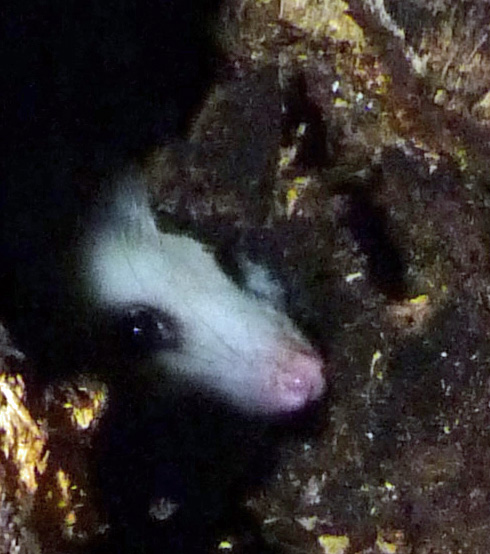
Then, becoming native to this place could truly begin. I would mark the moment of crossing the threshold late one fall night, perhaps in November when I heard a scratching outside the study window. Turning off the light in the room I moved closer to the window and looked out at a bird feeder then set up nearby. There, scratching among the fallen seeds was an adult opossum. This was the first opossum I had ever seen live outside of a zoo. He came back several nights, then disappeared, perhaps eaten, perhaps gone into hibernation.
In thinking about the possibility of hibernation I began to see this property in a new way. According to the Minnesota Extension Service and the DNR, there were likely thousands of animals: chipmunks, voles, opossums among them hibernating here in our woods. An image, a vision really, of our land with many, many lives lying below ground or in tree hollows came to me.
It was that vision that awoke me to the fact that we shared this property with so many others. It was not our property anymore than it was theirs. We were cohabitants. And not only with animals. The jack-in-pulpit, the columbine, the wild grape and wild cucumber, virginia creeper, the lilies and the iris, the tulips and the daffodils, the garlic and the asparagus, they all rested here over the winter waiting springs touch to come out into the sun.
An anthropocentric notion of ownership, amplified by deeds and by the very process we go through now, selling this property, creates an illusion of our habitation here as the only significant one. Many people would, without much thought, identify humans as the only inhabitant of the land. And it is not so.
Here there are whistle pigs, raccoons, squirrels, chipmunks, voles, the occasional wandering muskrat and rat, salamanders great and small, newts, garter snakes, toads and frogs, snapping turtles at certain seasons, pileated woodpeckers, great horned owls, crows and geese. There are millions, probably billions, of microscopic flora and fauna that keep our soil vital and nourishing for the larger plants that live within it.
This is a hectare of land, 2.5 acres. It has oak, ash, poplar, ironwood, elm, cedar, buckthorn (grrr), snowberry, river birch, maple, pine and spruce. There are many native and many domesticated plants and six domesticated animals, four dogs and two humans.
Once this umwelt settled into my conscious and unconscious awareness I knew I was becoming native to this place. I will never be as native to it as the generations of rabbits that have lived and died here. Nor will I be as native as any of the other animals or the native flora. Perhaps I have become as native here as the daffodils in our gardens and the lilies, both flowers that thrive on this land just as Kate and I have.
And now we are selling. What does that mean? Really? A certain sum of money, often transferred from one mortgage bank to another, changes hands. Legal documents get signed. Keys handed over. On some day we see our goods loaded onto a truck, we get in our Rav4 and pull out of the driveway never to return. But our cohabitants will remain, snugged into their tree cavity, their underground burrow, their nests beneath the shed. The major natural character of this place will remain largely intact. Sales are about humans, mostly, unless new “owners” abuse their trust.
We will, I think, go through a process of denativizing in which we gradually let go of the sensibilities shaped by these woods, these plants, these animals, these cohabitants. Even if we visit someday, just to see how the old place is getting on, we will return not as natives but as travelers, historical tourists.
We will, I hope, be becoming native to a new place, one with hard rock and high peaks, faraway vistas and remarkable spring snows. But it will not be easy. We will have to earn our place there, just as we have here. Frankly, it’s the part of this journey that most excites me. Yes, the grandchildren. Of course. Yes, Jon and Jen and Barb. Of course. But as to my life and its daily turn, becoming native to the Rocky Mountains is the big joy ahead of me.
Been moving at a reduced pace the last four days. Latin each day, getting further into Caesar’s Gallic Wars. Today he set out on a characteristic fast march from Rome to protect “our province”, a part of which is now Provence, from marauding Helvetians. Whom he’d set up with a betrayal by a wealthy leader of their people, Orgetorix. This is the war when Caesar, in the ever expanding effort of Rome to secure its borders, bleeds himself into world history. He speaks of himself in the third person.
Beyond the Latin, not so much else. Picked a few raspberries. Electrified the visible fence. (Kate says I should call it the invisible fence, except I didn’t bury it, I strung it on an existing fence line.)
Finished up the Southern Reach trilogy. Not sure how I felt about it. I wouldn’t recommend it, but it might have been good. In essence it presents an alien invasion that is so alien we can’t even be sure we’ve been invaded. Its central idea, that an alien might come to earth in a way so outside our experience that we would have difficulty recognizing it, seems valid to me. Anyhow. Check it out or not.
Watching the news, picking up positive threads about the environment. Bill McKibben’s 350 organization’s 400,000 person march in NYC was good news. Increasing public disapproval of the Polymet mine project is another. Coal seems to have been knocked back on its heels, at least here in Minnesota and by Obama’s actions, in the rest of the country. Little El Hierro has gone 100% renewable as did the Danish island of Samsø. Even the President’s decision to reach out to a smaller club of wealthy countries for action on carbon emissions is a positive sign, maybe the most positive of all these.
Still, as a Sierra Club staffer said when I gave her the same list, “Yeah, but doesn’t it make you nervous?” She’s right. Gaining ground would be so unfamiliar to us that we might make mistakes. But we have to take the risk that our message might finally be gaining in both public and political circles.
Feeling like I might get back to the packing side tomorrow. Clean up some clutter left behind after the SortTossPack push. Vet yet more files. Pack photographs, office supplies. There’s still more to go.
Listen to the languages calling out to you. From the lilac bushes, from the way vehicles move on the freeway, from the body movements of people in a crowd, of the clouds as they scud overhead or stop, gray and wet. Watch dogs as they wag their tales (tails, I meant, but I like this homophonic error) or smile or lean in or bark or whine. Watch their eyes move. Babies reaching, reaching. From the insects as they buzz the late season flowers, the wasps flying in and out of their nests, the birds high in the trees or walking across the road. The turtles when they walk miles to find a proper place to lay their eggs. So many tongues.
Mother earth is the original pentecostal, speaking in so many tongues. She also speaks in the movement of continental plates, the upwelling of magma, the process of evolution, the deep sea vents and their often alien seeming life forms. Or look up. Into the milky way and see the language of origins spread out before you on velvet, the most valuable jewels in all of creation. Each of these languages has a syntax, a grammar, meaning. The speakers of these languages want to reveal their purpose.
Groveland UU has asked me to speak on December 14th. Their theme for the year is social justice. They wanted me to talk about restorative justice, a topic about which I know little. Instead I suggested this:
Social Justice: Reflections Looking back at work for affordable housing, neighborhood organizing and neighborhood economic development, against corporate control of neighborhoods, organizing for jobs, for equity in philanthropy, for a sustainable human presence on the earth, for undocumented immigrants, for progressive politicians like Wellstone, Karen Clark and Peter McLaughlin, against the Vietnam War, for women’s rights, against the draft.
Looking forward at work necessary to retain and expand gains made.
When looking at it again, I realized it had the character of a summing up about my political work over the years, mostly in Minnesota. Sort of a minor leftie memoir, but not for the purpose of the memories, or not mostly for them, but mostly for teasing out the themes, the underlying rationales, the whys. What worked, what didn’t. What might work now, what might not.
This topic came to me because I realized it would be my last time at Groveland, with whom I’ve shared a two decade plus relationship and possibly my last time speaking in Minnesota, maybe ever. I don’t, at least right now, intend to find a religious community in Colorado since such institutions no longer interest me.
There is a modest bolus of energy in reviewing a body of political work that arose mostly in response to individual issues and moments of time, that never followed a straight path and that, like most serious political work, had some successes and many failures.
Where I wondered, did all this energy and effort come from? It wasn’t a good career move, yet the political path was the one I followed anyhow, pushing away more logical trajectories. There was, of course, my father’s role as a newspaper editor and his often weekly airing of his Rooseveltian liberal opinions, basically pro-social welfare and anti-communist, pro strong defense. That may have shaped my willingness to be seen publicly as a representative of unpopular points of view.
Also important was the nature of my hometown’s work force, the parents of my friends. With few exceptions, my parents being among those exceptions, my friend’s parents were either factory workers or stay-at-home moms. It was the 1950’s after all. As factory workers, a very high percentage worked for General Motors, others often in suppliers to the auto industry or other vehicle related manufacturers like Allison-Chalmers. They were members of the UAW.
These folks, the majority by far from the hills of West Virginia, Tennessee, Arkansas and other southern states, usually had not finished high school, but had jobs in General Motors, jobs that, thanks to the UAW, had health care, pensions, regular vacations, good wages and decent working conditions. As a result, Alexandria, Indiana hummed. When the auto industry went into decline and the UAW with it, Alexandria crashed into a ghost town.
A third factor was my mother’s unwavering compassion all people, no matter their condition in life or the color of their skin. Her example shaped me profoundly in that way.
The final ingredient came when the U.S. went full force into Vietnam. I started college in 1965 and would be in higher education for the duration of the war. The struggle against the war radicalized many students and I was one of them.
The Northrup King building in Northeast Minneapolis houses artists, floors and floors and floors of studios: potters, painters, metal workers, collage artists, sculptors, print makers. 5 years ago a docent group did an event there during Art-a-whirl. The room in which the event was held had remnants of the building’s original purpose. Slick concrete columns fat as oil drums flowered toward the top, supporting the weight of feed grains that would come into the top floor of the building, then get separated below through the chutes still visible in the large open area.
While the band played, memories of another time, in the late 1970’s swirled around. Back then Northrup King was still an independent seed company, selling seed to farmers. But in the mid-1970’s a specter stalked the seed industry. Large pharmaceutical companies had become aware of the great concentration of power available for those who controlled patents on seeds, on their genetic makeup. A huge buyup of seed companies was underway.
A group attempted to stop the buyout of Northrup King by Switzerland’s Sandoz corporation, but failed. Northrup King, or NK, became a subsidiary of the pharmaceutical company and was later sold to Sygenta, an agrochemical and seed company.
You may recall a post here on July 12th of this year that contained this quote: “Today, humans rely on fewer than 150 plants for nourishment, and just three cereal crops—wheat, rice, and corn—make up more than two-thirds of the world’s calories; along with barley, they own three-quarters of the global grain market.” Wired This could be the strategy statement for that buyup, which went unchallenged.
The result has been the concentration and subsequent manipulation of genetic material for many of those 150 plants and an even tighter focus on the big three: wheat, corn and rice. An article in today’s Star-Tribune mentions just one small outcome of this process, but one with big consequences for those of us who raise bees, the use of neonicotinoids. This pesticide-slathered on the seed before it is sold to the farmer for planting-has a role in colony collapse syndrome which has led to hive losses as high as 20% even for professional bee-keepers. It weakens the bee or kills them outright, geometrically increasing the effects of habitat loss (often created by the same agrochemical folks through “round-up ready” crops), mites, bee strains unprepared for the hygienic requirements these changes produce.
More than trouble for bees is exposed in the article Bees on the Brink. Here is the true problem (which is not to trivialize the problems for bees, but to see its place in a much larger and more insidious problem):
“Though they represent just 2 percent of Minnesota’s population, farmers control half its land. And their embrace of the monocultures and pesticides that form the basis of modern industrial agriculture has been implicated in the decline of bees and pollinators.
But as long as farmers sit at the receiving end of an agri-chemical pipeline that fuels the nation’s rural economy, not much is likely to change…“
The centralized control of seed genetics, with its beginnings in the mid-1970’s, has now become the apex of a command and control apparatus that dictates how over 1/2 of Minnesota’s land is used. And that’s just Minnesota. That control is hardly benign. Witness the Minnesota river and its agricultural runoff polluted waters.
The payoff, the ransom for which these lands are held in thrall by big pharma and big agrochem, of course, is higher yields. This however only reinforces a decades long collusion between agriculture scientists at land grant universities like Purdue, University of Minnesota Ag campus and Iowa State. Long before big pharma got involved crops have been manipulated not for better nutrition but for higher yields and crops that are easily harvested, shipped and processed.
The result? A farm sector which pollutes our waters, uses huge amounts of petroleum products in fertilizers and fuels, kills our bees, diminishes genetic diversity and worst of all produces food with less nutritional value. This is criminal and should stop. Now.
Rain so hard it sounded like hail has scoured the air, washing the dust out and dropping the temperature. The tornado watch expires in half an hour though we’ll have more thunderstorms later tonight. Weather is local; climate is global. Climate change in this case has given us days with more moisture in the air, driving up the chance of stronger storms and more concentrated rain fall.
(Curry The Line Storm)
Robert Jay Lifton, a grand old man of American letters, known for his psychological and psychiatric work on war and nuclear weapons, has written an interesting article in the NYT, The Climate Swerve. He’s careful, doesn’t overstate the evidence, but he makes a point similar to one I made here a month or so ago. Something’s happening to public opinion about climate change. Something pressing the public toward concern, possibly creating the political climate necessary for making difficult choices. Read the article for his thoughts about “stranded assets.” It’s a concept you will hear about more often in the future.
Had lunch with Jon today at the Craftsman on Lake Street. He was in town, briefly, for the wedding of a long time friend, flew in yesterday and out today. Dressed in a new blue striped dress shirt, dress slacks, neat beard and his curly hair, he hardly looks 45, almost 46. More like mid-30’s.
The bond of this family has begun to gel, why now I’m not sure, though it must have something to do with Ruth and Gabe getting older. There’s a realization about our own aging, our fragility that comes as kids advance in years, but in this case it’s a sweet realization, a realization that the future, as the song says, is not ours to see. But that that’s ok since we know well some who will inhabit it, shape it, lead it.
The future they inhabit will have its own set of agonies and joys. When Ruth and Gabe confront a world altered by climate change, by the polarization of political parties in our time, by the struggles to drag some of the Middle East back to a seventh century golden age(that was never golden), by the rise of China and India and Brazil and Indonesia, they will be in that world as we are in ours: a bit confused, somewhat hopeful, mostly living their lives from day-to-day just as we do.
Into St. Paul this morning for another America Votes meeting at the Minnesota Nurses Association. Solid, information packed as usual.
On the way in I listened to a radio discussion of masculinity and on the way back an Ira Flatow Science Friday story on regenerative farming. NPR is listening to my brain.
Men in America has its main hook in the changes since the 1970’s in men and women’s education status. Women have pushed ahead of men, or girls ahead of boys steadily, until today girls dominate boys in all of the academic disciplines through high school. While in itself this is neither alarming or surprising, when joined to the decline in manual labor and other manufacturing jobs, a disturbing picture emerges. Men begin to look left behind in the contemporary labor market. There are a lot more matters to discuss here. Another time.
Regenerative farming pushes forward the no-till farming movement, moving beyond merely sustainable agriculture to an agriculture that positively enhances the soil. In this show a number from the book The Soil Will Save Us by Kristin Ohlson got my attention. She says that if 11% of the worlds agricultural land were to convert to no-till farming the resulting natural sequestration of carbon dioxide would balance the climate change equation. Don’t know if this is true, but it’s intriguing.
It took me immediately to rain follows the plough which I mentioned here not far back. That was the belief that created the vast agricultural lands of the plains where industrial agriculture has combined with center pivot irrigation to drain the Ogallala aquifer and destroy the once ten foot deep top soil created by prairie plants. If that land were to convert to no-till agriculture, water use would plummet and the plains could begin to heal themselves. Might be the 11% right there.
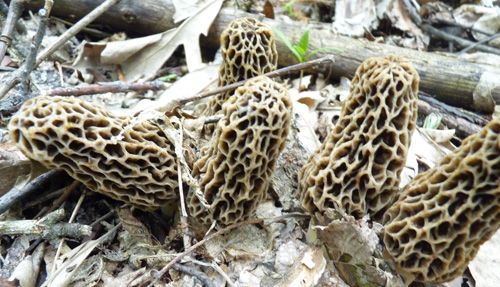
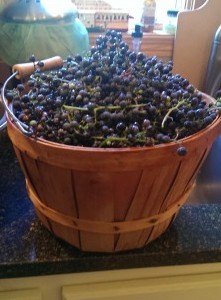
A cool breeze predicted autumn as I picked wild grapes this morning . These wild grapes have overgrown our amur maples and will get cut back when the lawn restoration work is done later in the fall. That will hardly diminish their presence though because wild grapes grow all over our woods, some branching out from vines thicker than my upper arm. The woods also provides morels in the spring.
Over the years I’ve highlighted the opossum, the great horned owl, wild turkeys, pileated woodpecker, woodchuck, salamander, newt, toads, frogs, dragon flies, deer, rabbits, chipmunks, squirrels, bumblebees, raccoons and snapping turtles that live on this property, too. A significant aspect of living in the exurbs is the diversity of wild flaura and fauna, often on the chunk of land on which you live. This is a melding of the human built and the wild.
The Denver Post recounts encounters with bears, mountain lions and rattle snakes. In Minnesota residents encounter bears and wolves, perhaps the occasional lynx. Most of these encounters occur because human habitation encroaches further and further into formerly wild lands.
These predators are certainly part of the wild eco-system, but the bulk of wild life are prey species, amphibians, reptiles and birds. It’s these we humans encounter most often and which we often discount, as if their small size or lack of tools for killing make them less significant. Yet the woodchuck, or land-beaver, that occupied a tree here for a day, is a wild animal just as much as the wolf or bear. So, too, the opossum and all those others that flee when humans arrive, who try to keep their visibility to a minimum.
We are co-habitants, not owners really, of this land. Though we will sell it to other humans, we are not selling the wild life. Their lives will adapt to the new humans just as they adapted to us, either by leaving or hiding or just going on about their day.
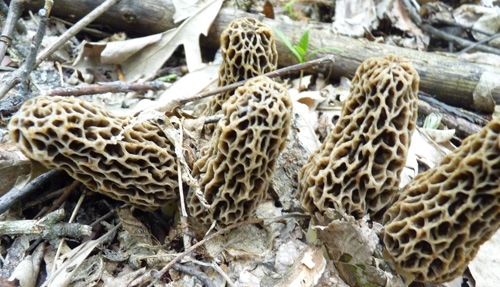
The wild flaura includes not only morels and grapes, but ironwood, jack-in-the-pulpit, oaks white, red and burr, elm, ash, black locust, cedar, nine-bark and rhus radicans, or poison ivy. Barring a clear cut of the woods, which I consider unlikely, they, too, will remain.