Lughnasa Lughnasa Moon
When the sun shines and the rains come, abundance follows.
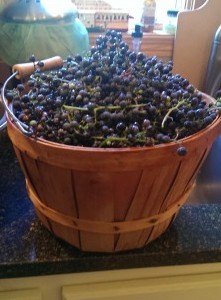
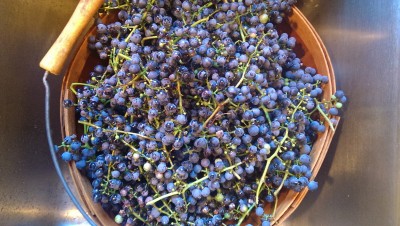
Picked today from the wild grapevines which love this land:
Lughnasa Lughnasa Moon
When the sun shines and the rains come, abundance follows.
Picked today from the wild grapevines which love this land:
Lughnasa Lughnasa Moon
Over the weekend and as deep into this week as I need to go, I’m packing up my former study. I’ve purged one file cabinet and consolidated its content into boxes for moving. A horizontal cabinet awaits attention. A large plastic tub full of art supplies went into the move with care pile. One small bookcase has been emptied and moved. The shop work bench I’ve used for storage is empty, too. That old printer, the one I bought in 1994, is in the truck and ready to go to a recycler. An HP laserjet, it still functions. That leaves three larger bookcases and some miscellaneous things on various surfaces, plus the art on the walls.
(what I hope to create in Colorado, my own version of this.)
When this room has been tidied up, the next and last big push begins. My study. This room has walls of books. Many will go in boxes with red tape, but most will not. The other areas have gone well, but this one will present some difficulty. So many projects. Some of the past, some of the future, some of today. Which ones do I imagine I’ll continue in Colorado? Which ones have enough spark to be valuable in the final third of my life? These are hard decisions for me and packing this room will be both valuable and difficult.
This is a chance to prune my work over the last third of my life, clear out the branches that have grown across each other. Take out that large branch that flourished then died. Increase the circulation amongst the remaining branches so they have air, can breathe. Pruning gives renewed vigor to plants and I hope to achieve the same thing when I pack up these materials, those closest to my heart, leaving behind what I no longer need.
Lughnasa Lughnasa Moon
In times before the pagan revival this holiday had the name Lammas, even among witches. Lammas, a modern English transliteration of an Anglo-Saxon word for loaf-mass, was celebrated on August 1st. The Roman Catholic imperial strategy of subjugating, then eliminating rival religions moved forward in part by absorbing and renaming other faith’s holidays.
It is not so easy, though, to stamp out folk religions. The old ways were held tight in rural areas and those doing so were called heathens (on the heath) or pagans, from the Late Latin paganus, or country-dweller.
Here’s an example. On Lammas parishioners would grind the first of the wheat harvest, then bake loaves of bread and take them to the church for blessing. According to this wikipedia site, many would then take the bread home, break it into four pieces and put them at the four corners of the grain storage building for protection against spoilage and rodents. So Lammas remained a first-fruits harvest festival, even under the Roman Catholics, but they replaced celebration of the grain itself with incorporation of the grain into the Catholic eucharistic symbology.
(a welsh corn dolly)
As the wheel turns, so does the nature of belief and faith. In this more pagan friendly world most neo-pagans, though not all, have returned to the original Celtic, Lughnasa. While I don’t align myself with any of the contemporary pagan splinters like Wicca, neo-paganism or Asatru, I do align myself with the impetus for the Great Wheel, the changing seasons themselves, and with the value of holidays to celebrate those changes. The Celtic holidays come from within my genetic heritage, so they make sense for me.
Sitting on the counter upstairs is a large laundry basket, the plastic kind that can be 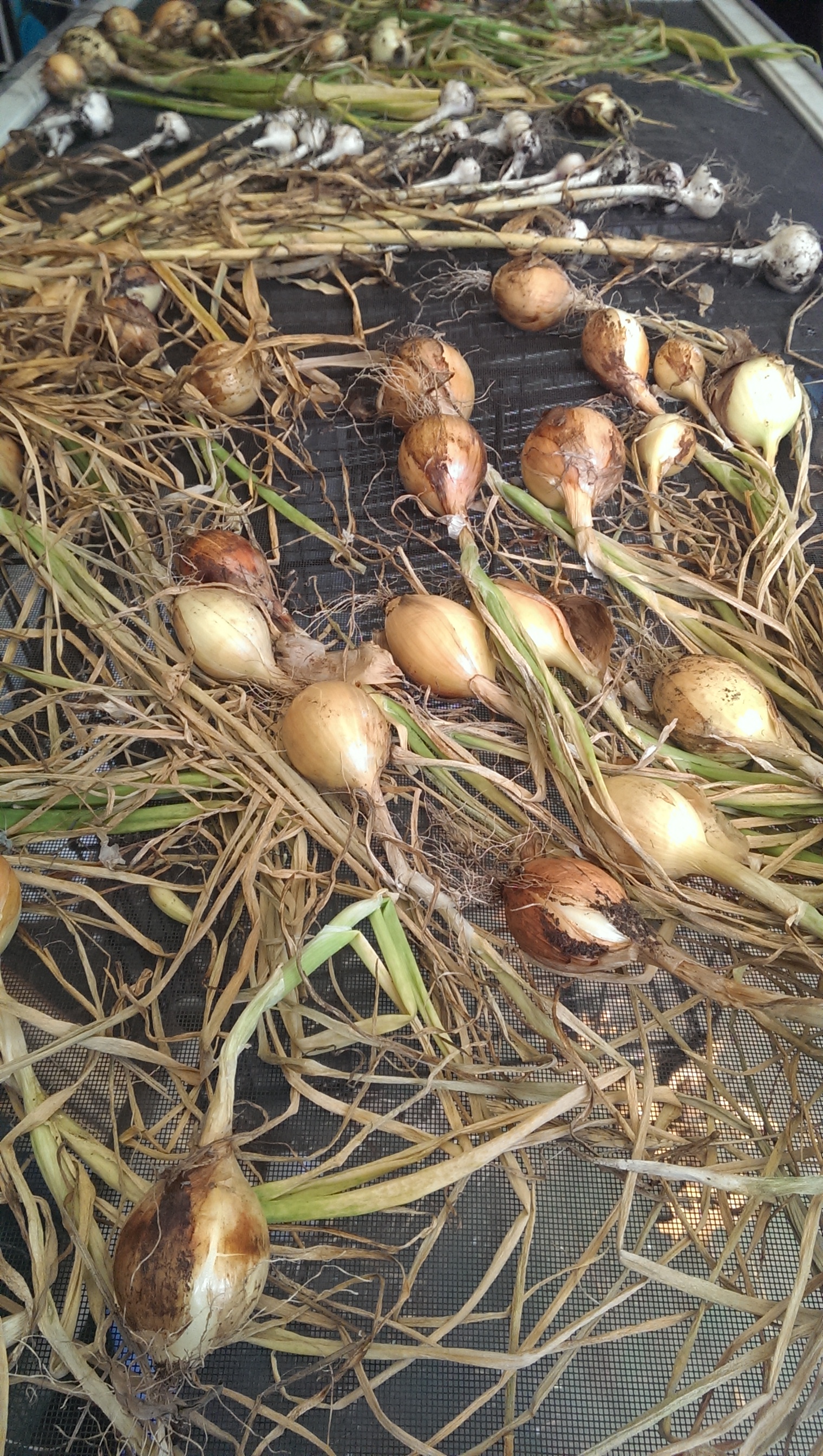 carried on the hip, filled with collard greens and chard. In the shed, drying, are yellow onions and garlic of different varieties. Downstairs, in the pantry, Kate has already stored bright orange jars of carrots, blood red jars of beets and jars the solid green of green beans. We have, too, eaten onions, chard, carrots, beets, green beans and collard greens already, so this is a good time to thank the land and the weather and the plants for the food they’ve already produced.
(onions and garlic, 2014)
In Celtic lands Lughnasa would have seen a corn maiden brought in from the fields in the first grain cart holding harvested wheat. (corn, in the British use, being wheat) And corn dollies would represent this symbol of the land’s fertility throughout the long, fallow months.
These holidays were not a single day (as we tend to celebrate them now, if we celebrate them at all), but were market weeks, when produce and crafts would come into a town and villagers and farmers would shop. Games were played, dances held, and marriages, of a 3-month or a year-and-a-day length could be entered. Both were considered trial marriages, the 3-month trial up at Samhain or Summer’s End.
Since these markets enjoyed the first fruits of many harvests, they were occasions tied to the rural life. In the United States Celtic peoples continued the Lughnasa heritage with county fairs and state fairs. Though the Minnesota State Fair is a much more expansive event than the typical Lughnasa festival, the Anoka County fair held recently or the 4-H fair held annually in my hometown of Alexandria, Indiana were probably similar.
In my world Lughnasa is much as it always was in terms of intention, a moment to stop and consider the strong bond between our land and our stomachs, our land and our survival. If nothing else these holidays make us pause and reflect on what’s happening in a world, the plant and animal world, that we might otherwise ignore. It’s for this reason chiefly that I think broad awareness of the Great Wheel and celebrations of its holidays could be a balm for an overheated world.
Summer Lughnasa Moon
So, continuing the subject from below, we might ask, what is faith? I will bring in my favorite definitionary, the O.E.D., but before we get to that I want to offer a couple of other observations. In the simplest, and therefore perhaps best, sense, faith is what gets you up in the morning. When you first wake, it comes to you that another day has started (another micro-life). What is it, on reflection, that makes getting out of bed worth it? Or, better, that makes getting out of bed seem possible at all?
Here’s my answer and I’m going to take a risk here and suggest that my answer is, roughly, universal. The body/mind that rises as you has confidence (Latin for with faith) that oxygen will be available. That food of some kind, either plant or animal, will also be available, if not today, then soon enough to sustain life. That your feet will land on the floor or the earth or the stone and not float up into the sky. That when your eyes open the visible world will flood into them once again so you can guide yourself.
Let’s extend this confidence. That the earth will spin and so the sun rise and set, the moon come and go. That our earth will speed its way around our star, tilted, with seasons appropriate to our place on it following as a consequence. That as those seasons come and go, the vast waters of our world will rise into the heavens and fall back to earth, splashing and rejuvenating all they touch. That as those seasons come and go, certain crops will grow and be harvested. Certain animals will be fed and will give their lives in a sacrifice for others so ancient as to be one of earth’s most holy acts.
This is the kind of faith that I believe we all, all native Terrans, share. It may sound trivial and inconsequential compared to the Book of Job or Genesis, the Rig Veda or the Diamond Sutra, but consider its great virtue: we know it to be true. We have to consult no wise men or women. We need no book or ritual. No institution decides whether gravity and the sunrise and the taste of tomatoes, the sweetness of cherries are correct. These are, quite literally, our birthright.
Now is the time for the O.E.D.
Faith, in its form understood from the Greek and Latin is:
1. Belief, trust
2. That which produces belief, evidence, token, pledge, engagement.
3. Trust in its objective aspect, troth; observance of trust, fidelity.
You may say, well. This is trivial. Obvious. And besides, faith, as Paul said, is faith in things unseen. Life is neither trivial nor obvious. Neither is its continuation. The wonder of this planet, so tiny compared to the vastness of the universe, swinging its way around Sol, only one star among a hundred octillion stars, nested inside one galaxy of ten trillion galaxies, is not trivial at all. Neither is it, speaking from the universe’s perspective, obvious.
And what, to agree with Paul, is more unseen than the future? Yet I have faith that these same matters which encourage me to rise each morning will sustain me, into and through the future. Even if that future is only this day, or this hour, or this minute.
Summer New (Lughnasa) Moon
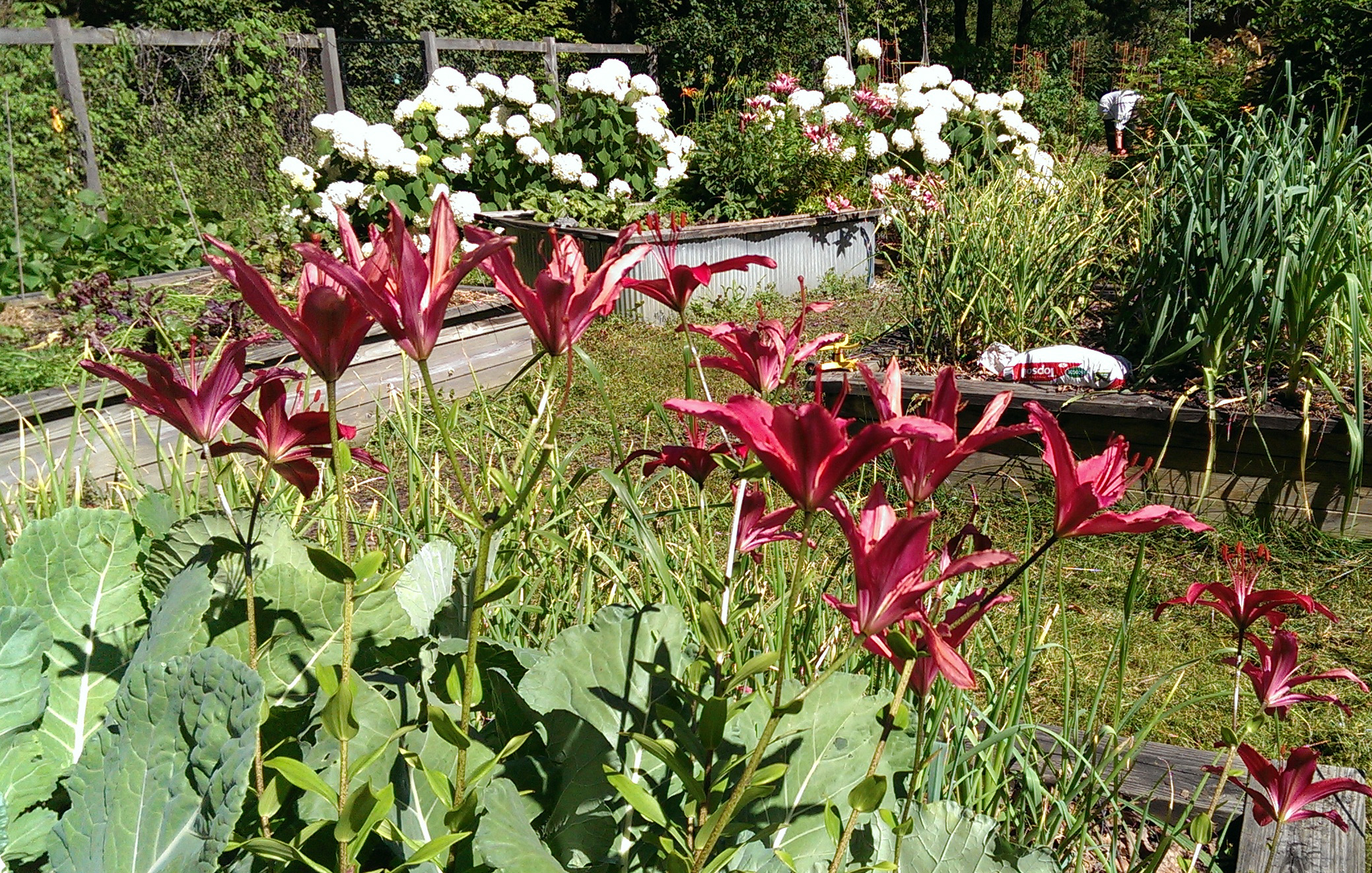 At first, as I dug my way into a new faith, it was about a symphony: the early crocus, snowdrops, grape hyacinths followed by tulips, then iris and hosta and bleeding hearts, giving way in July to a the bold notes of the asiatic lilies until the daylilies and clematis, both bushy and climbing, the liguria and the snakeroot began to dominate followed by the soft crescendo of asters and chrysanthemums. This literal rising and falling, in palates of color always framed by many shades of green, played out in my mind, a curious analog to the mental images inspired by listening to Mozart or Haydn or Pachibel.
Then, with Kate’s guidance vegetables came to have more and more importance. They too come in their own season, following their own melodic lines, as do the fruits and the nuts. Even, I would later learn, so did honey and the concerto of the honey bee.
Amending the soil with compost and peat moss and decayed leaves and hay, finding the  heirloom seeds for the vegetables we grow and the beautiful varieties of perennials like the iris and the lily, made the whole a process laced with memory and filled with change.
It is no surprise that the Great Wheel, the ancient calendar of a people whose blood runs in my veins, came into this earthy process as a celebration, as a sacred abstraction of a very real lived experience. This was not systematic theology. This was neither dogma nor holy book. No, this was and is the song of the earth herself, composed in her own medium, the plants whom her body supplies with nutrients and her body which receives their dead bodies to replenish herself.
So this is a material spirituality, a spirituality that lives in the praxis between human awareness and the earth’s ordinary wonders, a paradoxical sacredness created by the essential, the necessary bond between the human body and the plant body and the earth’s body. It may be, probably is, that paradox exists here only when seen against the various gnosticisms of the world’s many religions. In fact, a faith rethought and reimagined without religion entering into the mix needs no spirituality other than that mysterious, miraculous link that binds the entire web of life into one interdependent whole.
Summer New (Lughnasa) Moon
Into this house we’re born
Into this world we’re thrown…
Riders on the storm The Doors, “Riders on the Storm”
Reimagining faith. This has been a project of mine for over ten years. It started as an attempt to create a ge-ology as opposed to a theo-logy. (which, I just recalled, began long after a faith focus which saw me out in the woods and wild places of Anoka County for Celtic holidays.) My idea then was to put the earth in the place of God in a value system, a philosophical system for understanding life and its choices. In that vein I took a course on the systematic theologian Paul Tillich. If I could understand in close detail how a thinker like Tillich went about creating a theology, I might follow a similar path toward a ge-ology.
(Johann Wilhelm Cordes: Die Wilde Jagd” – Skizze zum Gemälde 1856/57)
The course was instructive, but not in the way I had imagined. Tillich’s work was too systematic, too neat and tied together with multiple logical bows. It was a product of the enlightenment, a philosophical system built on a clever and sensitive reading of the Christian theological tradition. It was not something I wanted to emulate, perhaps could not emulate. (Tillich was a really, really bright guy.)
After various fits and starts, I eventually set aside the ge-ology idea and turned toward reimagining faith. This idea came from feedback to a long ago post in Ancientrails where I referred to my spirituality as a tactile spirituality. Somebody appreciated this paradox, a material spirituality rather than an ethereal, post-Platonic soul based spirituality.
The starting point for both the idea of the ge-ology and reimagining faith is the Great Wheel. I’ve spoken elsewhere about how the Great Wheel has influenced my life and faith, but the short version is that following this ancient Celtic calendar through the seasons, and following through the season not as an intellectual abstraction but as a lived reality with flowers, vegetables, fruits and other plants subtly changed my understanding of faith.
I say subtly because it took me a long while to notice how deeply I had embraced it. Reimagining began as a second grand intellectual experiment like the ge-ology, but one focused on the Great Wheel. Not the Great Wheel as a pretty round calendar, nor as a neo-pagan liturgical calendar, though it is both of those things, but as experienced by the earth, through the changing seasons. It would not, in other words, proceed from the mind out, but from the ground up. Literally.
How was that going to happen? Didn’t know. Still not sure, but I did change the project a  third time to reimagining my faith. Trying to be less grand, less global, more in a realm for which I have both responsibility and authority.
Then, recently, I came across an article in Foreign Policy magazine. It’s premise was a rethinking, a reimagining of the U.S. military. What if we designed a military for today’s reality, was the question it asked.
Aha. That’s the question at the root of my quest. What if we designed a faith for today’s reality? This is similar to Emerson’s notion of a religion of revelation to us, not to them, but it is not the same. I’m not necessarily interested in religion, especially religious institutions which serve to fossilize and deaden lived faith. A religious institution is anathema to a lived faith since lived realities change constantly and religious institutions live to fight change.
So, I’m not interested in revelation since revelation is a Christian idea. What I’m trying to do is rethink, reimagine what faith can look like in a world shorn of classical metaphysics, in a world moving toward a dystopian climactic future, in a world… Well, that’s just the point, I think. We’re rethinking now in a world context, not in a given ethnic enclave, not even within with the broad outlines of Western and Eastern, but on the rough and watery surface of our planet. All of us now, together. What can carry us forward, help us understand who we are and what we need to do, for each other and with each other? For the planet and for the future of all living things.
I’d love to think I could answer those questions. But the truth is I can only make my best effort at answering them for myself. That’s the project I’m engaging right now, reimagining, rethinking my faith for today’s reality and for the future toward which and for which we live.
Summer New (Lughnasa) Moon
Russian scientists say they believe a 60-meter (66-yard) wide crater discovered recently in far northern Siberia could be the result of changing temperatures in the region. Andrei Plekhanov, a senior researcher at the Scientific Research Center of the Arctic, told the AP Thursday that the crater was mostly likely the result of a “build-up of excessive pressure” underground due to rising temperatures in the region.
Plekhanov on Wednesday traveled to the crater, some 30 kilometers (18.64 miles) from the Bovanenkovo gas field in the far northern Yamal peninsula. He said 80 percent of the crater appeared to be made up of ice and that there were no traces of an explosion, eliminating the possibility that a meteorite had struck the region.
Read more : http://www.geologypage.com/2014/07/66-yard-crater-appears-in-far-northern.html#ixzz38V5KlWeU
Follow us: @geologypage on Twitter | geology.page on Facebook
Summer Most Heat Moon
The increasing pace of the harvest is plant life telling us that the seasons that matter are 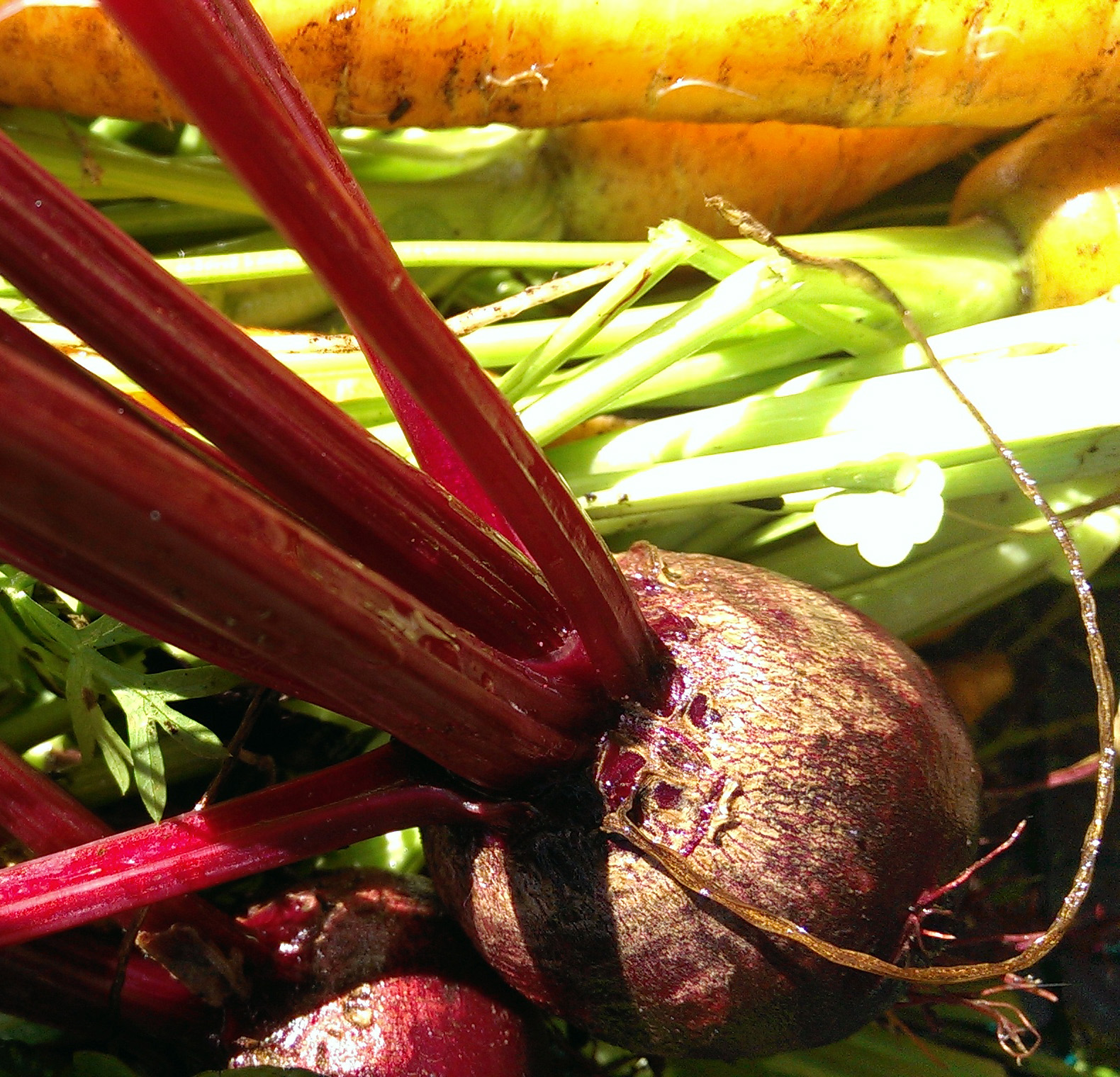 changing. What seems like the height of summer to us presages not more summer, but fall and the big harvests of September and October. That’s what the plants know and in their distinct and ancient language they’re reminding us the time to gather in foodstuffs is now. Right now.
Pressure cookers and canning kettles across the Midwest have begun to heat up, too. That’s another sign. 5 pints of carrots went into the jars today and beets go in tomorrow, green beans as well. In a less complex economy this work would decide whether some of us would live or die through the long winter. Even with our garden I’m grateful for grocery stores. We would have to devote so much more of our time and energy to growing food if it were not for them.
Still, it’s not bad to have a reminder that the complex market system that brings vegetables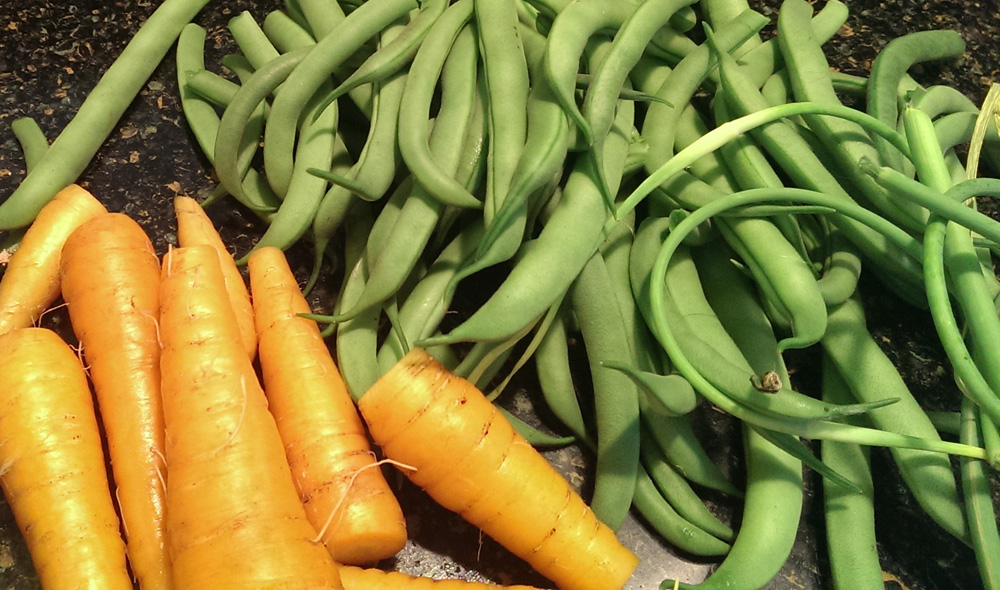 and fruits and meats and processed foods of all kind into our grocery stores is just that, a human system. That means it can be disrupted by war, by natural disaster, by disease, by insects, by normal seasonal fluctuations in temperature and by climate change.
It feels good to have those chicken-leek pies in the freezer. Those red glass jars of pickled beets and the golden ones of carrots. The jars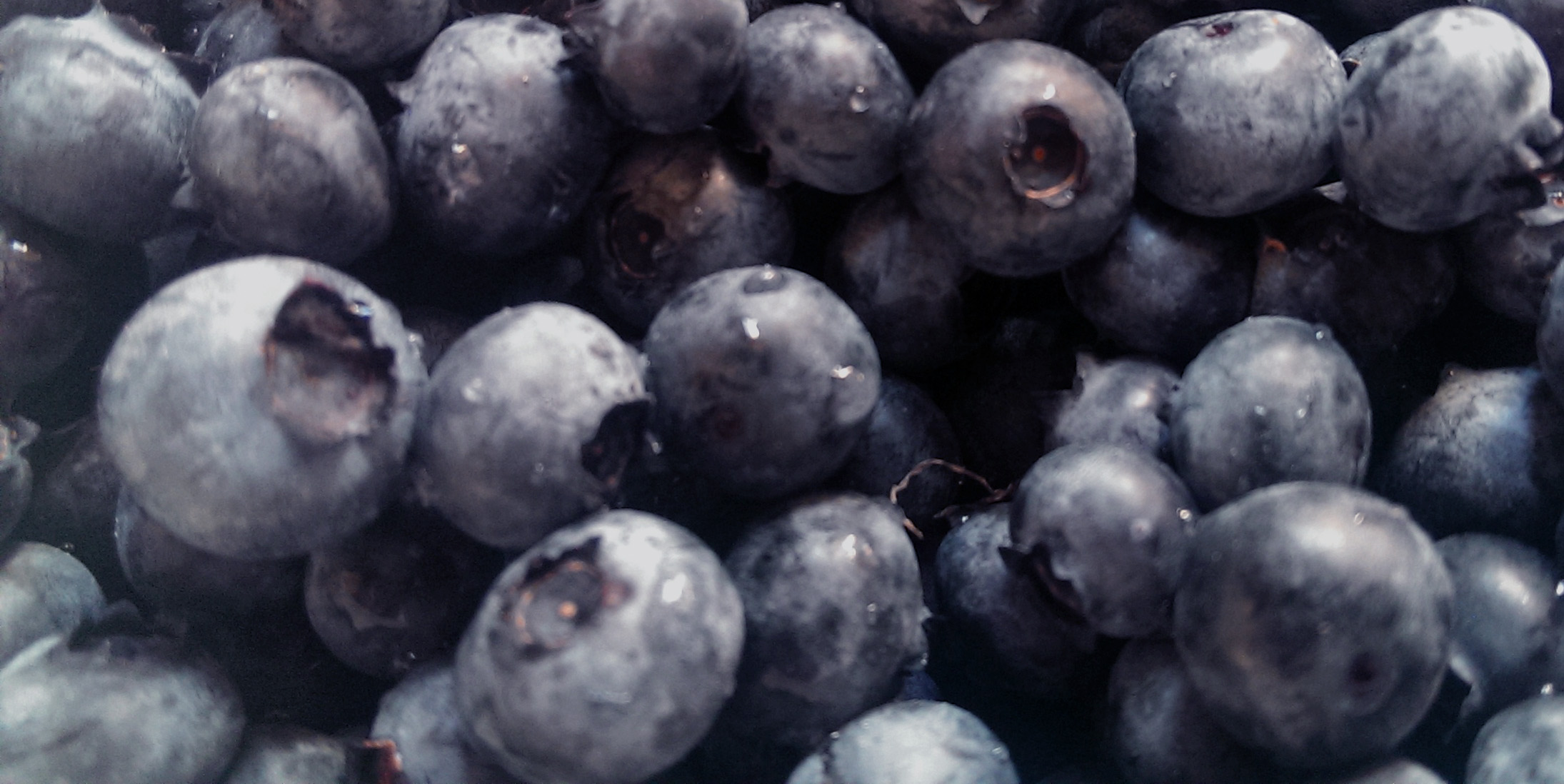 of honey and pints of green beans, tomatoes and sauces. Frozen greens and peppers. Dried onions and garlic. Grape jam, currant and gooseberry pies. All the various herbs dried. And last year all the apples and cherries, plums and pears. Next year, probably, too, with the help of bees. (but we won’t be here, most likely, to make that happen.)
Summer Most Heat Moon
In regard to work on a new food crop as a part of our move. I want to find a native plant, native to the eco-region of our new home, then work toward domesticating it with as much help as I can get from the academics. As I wrote this, I recalled that there is a Spitler apple, named after a great uncle who developed it. Maybe botany has a gene.
(a possibility, Creeping Thistle)
A pattern for translating the Metamorphoses is emerging. I will translate individual stories whole. For example, the one I’m working on now, Daphne, is in Book I:452-566. The preceding story of the Python was Book I:416-451 and the next one, Io. Argus. Syrinx., Book I:567-745 and the story of Phaethon ends Book I, running from 746-778.
Here’s the method I see from how I’m working right now. I will continue translating a few verses (4-7) a day, hopefully increasing these numbers somewhat over time. While doing these translations, I will consult my usual resources: Perseus, the commentaries, grammars and occasionally the consensus Oxford text going to the english translations only when I’m confused and find myself unable to move forward.
Once I get a story done, I will set it aside for a day to a week while I continue translating into the next story. At some point before a week passes, I will pick up the story from the preceding week and using my notes, retranslate it without reference to the translation I created. If I believe I have as good a literal translation as I can make, I will then proceed to trying for a more lyrical prose translation, one using the best english I can muster. Again, I will proceed by using the resources mentioned above, but not check the english translations.
Only after I have created my best english translation, and then only after letting it sit for a couple of weeks, a month, will I then work with my translation in light of other english translations, resolving conflicts and improving my translation where I can.
I’ve not yet decided whether I want to try to make a commentary or not. It’s a big, big project, but much of the work will be done already and I’m still a naive learner, therefore able to see what another newcomer might most appreciate or need.
When I put together the classics and art history, I find myself where I belong.
Summer Most Heat Moon
“so I wait for you like a lonely house
till you will see me again and live in me.
Till then my windows ache.”
― Pablo Neruda, 100 Love Sonnets
A good while back I sat down and wrote a list of my saints. These are writers, political activists, artists, naturalists, poets, film-makers, scientists, philosophers and others who have influenced my thinking, moved me toward various arenas of action. They are my mentors.
A bit later I sat down and began entering their birthdays onto my Google calendar so I could acknowledge them at least once a year. That’s why my calendar for today, July 12th, has three names on it: Julius Caesar, Henry David Thoreau and Pablo Neruda. What an odd threesome, a Roman general and the first emperor, a New England Renaissance naturalist and writer, a socialist Chilean poet.
Someday I plan a post that will feature most of my saints, a blog version of the Book of Saints, only these will be mine, an idiosyncratic list with very few outright religious folks on it.