Category Archives: Great Work

Ogallala Blue

Beltane                                                                                Early Growth Moon

A post written this time by Woolly Bill Schmidt.  My comment below.

From Bill:

We may be able to ignore the effect that humans have on global warming or even deny that it is happening.  It is difficult to explain away the effect that we humans (farmers in this case) are having on an important earth resource.  And the farmers are crying because they can no longer farm in ways that don’t make sense relative to what they are given.  Maybe it is time to pay attention to our local environments and live/farm within the limits of what is provided by earth environments.  Tapping the aquifers to irrigate farm land is like shooting yourself in the foot.  The aquifer is not infinite and pretty soon you don’t even have enough water to drink.

Here’s a link to a New York Times article about the plight of Kansas (Midwestern) farmers who have robbed the aquifer and now it is drying up.

“And when the groundwater runs out, it is gone for good. Refilling the aquifer would require hundreds, if not thousands, of years of rains.

The irony of using insane amounts of water for fracking to get more oil would be laughable if it were not so sad. Literally hundreds of millions of gallons of water per day are being used for this process, poisoned by who knows what chemicals and with a fraction, if any, of that water being recovered.”


This is the cost of pumping 1,600 gallons per minute to irrigate farm land.  And on page 2 of this article, the same farmer is continuing to drill more wells.  Reminds me of a song:  Pete Seeger “Where have all the flowers gone” —  “When will we ever learn.”


My Willa Cather Moment With This Problem

I’ve told this story to the Woollies and others many times, I imagine, a sort of recurring tale like so many offer to others, unaware of their repetitiveness.  But, it’s worth retelling.

Twice I’ve visited Red Cloud, Nebraska, a small town on the Kansas/Nebraska border, and home to Willa Cather, a favorite American regional author of mine:  Death Comes for the Archbishop, O’ Pioneers, The Professor and many others.

In the Willa Cather Center there I remember, back in 2005 or so, speaking with the folks behind the desk.  It was really hot, 107 or so, and we got to talking about climate change and agriculture.  Since I have a long standing interest in the Ogallala Aquifer, I asked about irrigation.

The conversation became animated because it turned out that in the spring, when the farmers began irrigating their fields, the towns wells would go dry.  It seems they’ve pumped the aquifer out enough that the volume of water available in their area can’t sustain the needs of both town and country.

Here’s a good resource on this issue, which nuances it:  Ogallala Blue.
A Grounded Faith

Beltane                                                                         Early Growth Moon

I walked through the garden alone, while the dew was still on the beet seedlings and apple blossoms.  Oh, wait.  That was roses, wasn’t it, from the old gospel tune.

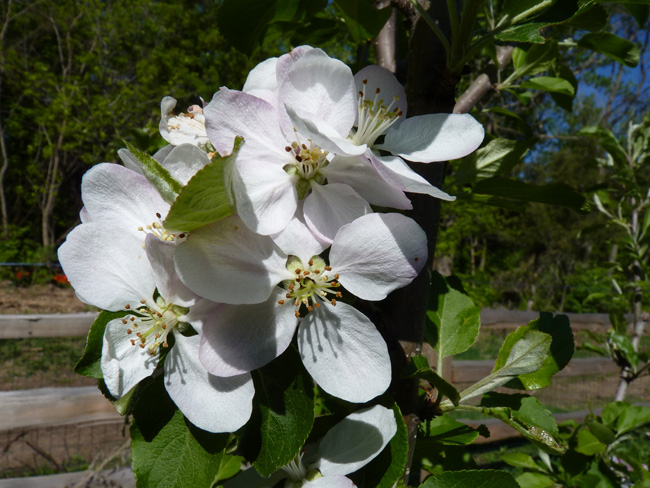
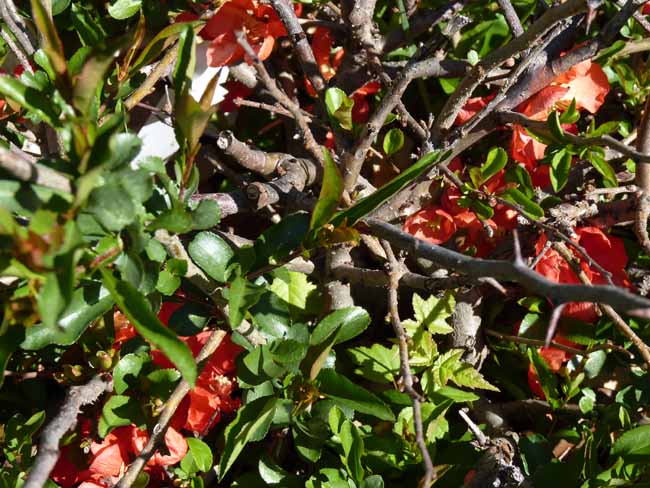
If you want a moment of intense spirituality, go out in the morning, after a big rain, heat just beginning to soak into the soil, smell the odor of sanctity, in this case fertility, coming up from the plants and their medium, see the beets and kale and carrots and cucumbers and sugar snap peas on the rise, look at the onions and garlic and leeks filling out, getting greener, taller and fatter.  Take a stroll past the cherry blossoms, the pear and plum blossoms, the apple blossoms that came out yesterday, past the bee colony hard at work, over to the blueberries and check out the new growth on the hard pruned wild grapes.   The sand cherries and quince and even the currants with their modest, tiny green flowerettes, all showing to the bees their best and sweetest offerings.  Each petal, each flower, each stalk, each leaf is a miracle, a wonder of the evolutionary path on which that particular organism travels, its genetic ancientrail.

(our quince)

That walk, by the way, is not the walk of an individual, self-reliant and independent, but of a dependent creature glorying in the symbiotic relationship between his cells and these plants.  This is a community enterprise, the humans here, Kate and I, in partnership with the vegetables, the flowers, the fruit, the bees.

(our honeycrisp tree in bloom)

Which reminds me of the other partners, or co-habitaters at least, all the wild animals that live in the soil here, the gophers and earth worms and grubs and snails and voles, those who use the trees the squirrels, the woodpeckers, pileated and red-tailed, crows, hawks, Great Horned owls, robins, chickadees, blue birds, those who live on the land, under buildings and in brush piles the rabbits, chipmunks, woodchucks, opossums, raccoons, mice, the interlopers the wild turkeys, the deer, the coyote.  And of course, the woods themselves the ironwood trees, the poplar, ash, cottonwood, red oak, burr oak, cedar, spruce, yes even the black locust and the buckthorn.  The grass, yes, the dogwood yes, the amur maples yes, the alicanthus yes.

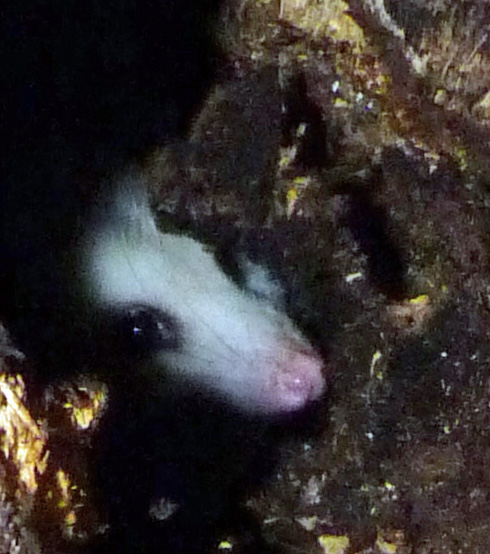
(a baby opossum in a dead tree in our woods)

We all share this land, to which we have the deed, but so little else.  When Kate and I leave, as we will one way or the other, the rest will continue, unaffected, unmoved by our passing.  Land is not for owning, but for cohabitation.  We know this, if we bother to look.

Welcome, Growing Season!

Beltane                                                                                  Early Growth Moon

We have turned the corner on winter it seems and now will begin the gradual invasion of a more southerly clime, with heat and humidity climbing like kudzu broken free from the Confederacy.  We are two distinct climates in one here in Minnesota.  The one for which we are best known and with which most of us here identify is the polar influenced late fall, winter and early spring.  Cold, often severe, snow and a long fallow time typify this one.

The second, one for which we are not known at all, but which we know well, is the briefer Northern summer in which all signs of that polar influence wane then disappear, giving way to temperatures often reaching the 90’s and sometimes into the 100’s–this has happened more lately of course–and dewpoints moist enough to make being outside like wrapping yourself in one of those turkey cooking bags sold around Thanksgiving and sticking yourself in your oven.

This means, the good part, that we can grow crops that mature in under 120 days or so, leeks stretch that, but I’ve done it consistently.  This is long enough to get most garden vegetables including tomatoes, peppers and others that require frost free conditions when planting. (which shortens the season).

The bees, long adapted to cold climate, are fine with these temperature swings; it’s the multivalent attack of pesticides, mites, loss of habitat, mite borne viruses or viruses aided by the mite weakened bee and reliance on bees not bred for hygienic behavior (cleaning out diseased larvae before they can infest the colony).

Our cherry, plum and pear trees all blossomed in Monday’s record heat.  The apples have not, yet, and I’m glad because once their blossoms fall I have to get out the ladder and bag each fruit set.  And, this year I’m getting more aggressive with the damned squirrels, those tree bandits.

It’s time to get out there and dig several holes in the ground, mash it up, put it in a plastic baggy and send it off to the lab.

Gotta Get Out More

Beltane                                                                              Early Growth Moon

My docent class is on a 5 day jaunt to Chicago.  Were it not for Kona’s vet visits, I’d be there, too.  This is a full week now since I sent in my resignation to the MIA.  Nada.  Silence.  Nothing.  12 years.  Almost as weird as the weather.  It’s like the Institute has organizational autism.

It’s been a full day with work outside and inside, a quiet evening reading.

Though I can see that the chained mornings and the Latin in the mid-afternoons is very productive, I’m also seeing a desire in myself to get out more.  Kate had to sort of drop kick me into it, but now that she has I realize the path I’ve chosen will increasingly isolate me and us, if we’re not very intentional about getting out.

To that end I signed up us for a fund raiser for CSA Roots, apparently the former Community Design Center with which I did a lot of work in the late 70’s and early 80’s.  This fund-raiser features a hand-crafted, all locally sourced meal at the Heartland Restaurant across from the former site of the St. Paul Farmer’s Market.  Appropriately enough the dinner is on June 21st, the Summer Solstice.

We’re also planning a trip into the American Swedish Institute this week to see the Sami exhibition and eat at the Institutes new restaurant.  Hmmm.  Do most of our activities involve food?  Which by the way is ok since I’ve lost at least 14 pounds on this lower carb diet in addition to increasing the nutrient load of my food consumption and, the point of it, lowering my blood sugar well below levels of concern.


Soil

Beltane                                                                            Early Growth Moon

The soil temps have exceeded 50 so I’ve got to get out there with the carrots and chard, hoping the tomatoes and peppers come soon.  They need to get in the ground.  I’m going to look at soil improvement over the next few years.  I’ve always done some amendments, composted manure goes on all my beds at the end of the growing season and I often lay it down as mulch once the temps get hot, then cover it with leaves, but I’ve not done any other fertilizing or soil supplementing, largely because I grow organic and I just don’t understand the organic soil supplement process.

Bill Schmidt hooked me up with some e-mails from an outfit in Farmington, International Ag Labs, and their stuff looks doable, though still somewhat complex for me.  I’ll need to look into it further, but it seems to have a focus that makes sense to me.  The basic thrust? Biosustainability created through soil improvement toward optimum soil health.  When you see the thin layer that is our atmosphere, the post below with the astronaut video, and then when you consider that it is the top six inches or so of soil that make plant life possible, you begin to understand how tiny is our margin of safety.

We can take active steps that ensure a healthy atmosphere and a healthy topsoil, why wouldn’t we do that?


Overview Effect

Beltane                                                                                              Early Growth Moon

“There have been household gods and household saints and household fairies. I am not sure that there have yet been any factory gods or factory saints or factory fairies. I may be wrong, as I am no commercial expert, but I have not heard of them as yet.”
G.K. Chesterton

The video below, 20 minutes long, came to me via friend and cybermage Bill Schmidt through his daughter, Moira.  I include the two quotes along with it to emphasize a subtle point.  Chesterton was looking anthropomorphically at the locus of fairies, gods and saints, ok as far it goes, but he neglects the much longer tradition of nymphs, dryads, fairies of the woodlands and fields, holy wells, sacred mountains, places of pilgrimage and, most tellingly underlined in this wonderful video, the dynamic, vital oasis in the midst of the vacuum of space:  Earth.

(John Byam Liston Shaw  angel offering the fruits of eden)

We live already, as Bill likes to point out, in paradise.  We are, unfortunately, working hard, very hard, through the godless, saintless and fairyless world of commerce–Chesterton surely had this right–to expel ourselves from paradise.  There is no east of Eden in space.  If we lose this paradise, there is not another for us to inhabit.

“Heat-Trapping Gas Passes Milestone, Raising Fears  The level of the most important heat-trapping gas in the atmosphere, carbon dioxide, has passed a long-feared milestone, scientists reported Friday, reaching a concentration not seen on the earth for millions of years.”   NYT yesterday

I enclose the second, seemingly far out of context, quote which comes from our money manager because it highlights a fall in the prices of copper, platinum and paladium.  This fact, falling commodity prices, rather than science or political will, are the main things that will work in favor of stopping the Polymet mine near the Boundary Waters Wilderness Area and its follow-on mines that await only its successful completion of its environmental impact statements.

(expulsion, Masaccio)

“PolyMet expects to mine copper by late 2015   One day after announcing plans to raise $80 million in cash, officials of PolyMet Mining Corp. on Thursday said they are moving headlong toward permitting and, eventually, construction of Minnesota’s first copper-nickel mine.”  Duluth Tribune

We should not, must not, leave these decisions to the whims of the market.  We must develop the political and personal will to say no.  Hard?  Yes.  Necessary?  Listen to the astronauts and look at the thin layer of atmosphere that is all that protects us from the harsh reality of the space we inhabit.

“Commodities markets. It wasn’t all bad in April: natural gas futures rose 9.0%, cocoa futures gained 9.1%, and wheat futures rose 6.3%. Now for the bad news: gold fell 7.8% last month to an April 30 COMEX close of just $1,474.00. Silver cratered 14.6% in April; copper fell 6.4%, platinum 4.3% and palladium 9.2%”


OVERVIEW from Planetary Collective on Vimeo.

Cancer in the morning, the numinous in the afternoon

Spring                                                                                 Planting Moon

Got up with the sun this morning, needing to pick up Kona between 7:00 and 7:30 am in Blaine.  Having the sun out and being up early both put my mood into high in spite of the significant cash outlay for Kona’s needed care.

Imagine my surprise when I looked at the weather report.  6-8 inches of new snow.  Tonight!  Then, maybe 70 by the weekend.  OMG!

Had Kona over at the vets by 9:40 am where I got the good news that her heart murmur has disappeared and the bad news that her tumor was cancerous.  Kate was in the room from Denver, Colorado via Verizon wireless and my Droid phone.  We discussed the options with Roger and decided to go ahead, as I wrote below, to have it removed.

Back home.  Nap.  A long nap since my back, unconvinced by the meds and the rests I’d taken, continued to ouch.  A lot.  Couldn’t take the best meds because I had to drive out to Stillwater, then into St. Paul and home after that.

Stillwater was the bee pickup.  My two pound package of Italian hygienics are now buzzing on top of the dryer in the basement.  I sprayed them with sugar water, will do so again before bed, once more in the morning, then again just before I hive them around 6 pm tomorrow.  That way they have full tummies when hived and are less likely to go adventuring. Which would serve no good purpose right now anyhow.  I had planned to hive them tonight, but the snow.  Comes down hard and wet right now.

St. Paul was to see John Desteian, my longtime Jungian analyst, I started to see him in 1986 or ’87 and saw him for a long time after my divorce from Raeone.  I’ve seen him off and on over the years, last in 2006.

I want to see what I’m trying to tell myself through my dreams of loss and being lost.  As I imagined, we headed in the general direction of faith, though not retrieving a lost faith so much as redefining faith, Reimagining Faith, in light of the pagan, existentialist, flat-earth metaphysics of my current world view.

As always, John asked the good questions.  Pointed me, this time, toward an essay by Heidegger called “The Last God” and understanding the essence of the numinous.  I’ll have a month to ponder that since my next appointment is on May 23rd.  He’s been a useful, valued guide and Jung my chief spiritual adviser.  Sounds like that run will continue.

Back home to an oxycodone, spraying the bees with the sugar water, crating the dogs and relaxing.  Quite the day.  Cancer in the morning, the numinous in the afternoon.  A lesson there.

Oh.  Had a vicarious feeling of pride when I learned John now runs an international training institute for Jungian analysts based in Zurich, the Mecca and Jerusalem of Jungian thought.  Here’s the link.


Niicugni

Spring                                                                           Planting Moon


Still thinking about the performance last night.  The direct to the emotions connection with movement.  And the book  Where the Heart Beats: John Cage, Zen Buddhism, and the Inner Life of Artists.  In this book the author discusses the dynamic interaction between Cage’s elevation of sound, all sound, to music or at least potentially musical and the thoughts of choreographer/dancer Merce Cunningham who saw movement, all movement, as dance, or at least potentially dance.

In particular Cage wanted to decouple music from dance so that dance did not interpret music and music did not happen as background for dance.  This lead them to have concerts where music would happen, then dance, then music, then dance.  And, the music might be banging pots, someone reading the New York Times want ads or the scrape of a chair on the floor while the dance might be walking, running, jumping, embracing.

Last night I followed the movement of salmon upstream as Emily and Aretha lay on the floor and made sinuous, flowing motions with their whole bodies.  I cheered in my heart when they threw up their arms, cringed when they showed snarling faces and hoped when they shed their skins.

These links between their movement and my heart happened because my body felt their movements, all those mirror neurons firing, firing, firing sending me a message not from the dancers, but from my own body as stimulated by them.  This is not intellectual processing at all.  It’s kinesthetic.  By embracing silence throughout the work except in very episodic short monologues Emily’s work created niicugni, her people’s (Yu’pik) word for Pay Attention, Listen.

This work had great coherence with the lighting provided by the fish-skin lanterns, created in the traditional Yu’pik manner.  In a masterful lighting design the lanterns flickered, came on and off, featured this part of the stage or that through being hung at varying heights and lit separately.

Emily has topics in the first two elements of her trilogy that are close to my heart:  home and the land.  What is home?  Where is home?  Why is home?  Can we have more than one home?  Do we have more than one home?  How much relationship does home have to the land?

Land.  Mother earth or grandmother earth.  That without which we do not survive.  The womb from which we are born and the grave to which we return.  How do we remember the land?  Honor her lifegiving powers?  What does it mean to be connected to the land?

These are essential question, never minor or subsidiary, but at the heart of each persons, each animals, each plants life and its living.  It is a canard I know, but modern civilization does distance us from the idea of home and especially from the land itself.  It is always there, supporting us, feeding us, connecting us but so often we assume it, ignore it, abuse it, poison it.

Emily’s work is important.  Thanks Allison for introducing me to it.


Fish Skin Lanterns

Spring                                                                       Planting Moon

Kona’s temp is down and she’s resting comfortably.  I’ll pick her up in the am.

Went over to Cecil’s Deli in St. Paul for dinner with Joy and Ginny, two docent friends.  That was fun. Cecil’s is an old Highland Park hangout from our days on Edgcumbe.  It’s an authentic Jewish Deli and always a fun place to eat.  I had a pastrami omelette.

After the dinner, we went over to O’Shaugnessy on the University of St. Catherine’s campus to see Emily Johnson and her collaborators perform Niicugni. Niicugni is a Yu’pik word meaning Pay Attention, Listen.

This is the second part of a trilogy, the first one focused on home, what it is, how we know it and experience it.  This performance focuses on the land and our always relationship to it, yet how we can become distanced from it so easily.  Reminds me of the quotes I posted from Chief Luther Standing Bear just below.

Emily and her co-dancer and collaborator, Aretha, (one of 5 members of Catalyst) tried to imagine how they could be in two places at once on the land.  Much of the movement in the performance grew from improvisation based on that idea.  The idea behind it, the intention of the piece, was to memorialize the fact that at any one point in time the land beneath our feet is connected to some other land, all other land, yes, but in particular land that may hold special meaning for us, like home if we are not at home.

Much of the work had little to no narrative line and included collaborators from three groups:  urban farmers, (I forget right now.) and people who learned the Yu’pik art of fish lantern creation.

Allison, also a docent friend and a dancer, learned how to sew the fish skin lantern and made one that hung in the lobby of the auditorium.  Many of the some 50 fish skin lanterns were the main lighting for the entire hour long performance.  Salmon are a primary food source for the Yu’pik in Alaska, Emily’s people and her home.  To make the fish skin lanterns the sewers skin the fish, then scrape all that could rot off, a process that can take up to 16 hours for each skin and four are used in the making of the lanterns.  So, a lot of work and work related directly to living from mother earth.

The intriguing part of the performance with the collaborators from the three different groups is that she gathers different groups together each place she performs the piece and choreographs their involvement so it integrates with her work.

In case you’re interested here’s a video on making fish-skin lanterns.

Emily Johnson Makes a Fish Skin Lantern from Emily Johnson on Vimeo.