Summer Waning Summer Moon
A few pictures from the near past:
Ruth at the Zoo

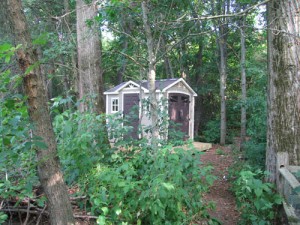
The Playhouse in the Woods
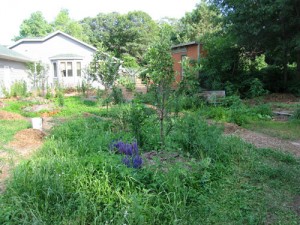
The Orchard: July, 2009
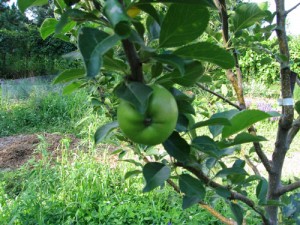
Our Fruit: July, 2009
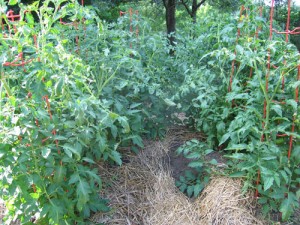
Suntrap with Tomatoes: July, 2009
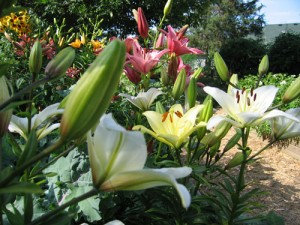
Leftover Lilies: July, 2009
Summer Waning Summer Moon
A few pictures from the near past:
Ruth at the Zoo
The Playhouse in the Woods
The Orchard: July, 2009
Our Fruit: July, 2009
Suntrap with Tomatoes: July, 2009
Leftover Lilies: July, 2009
Summer Waning Summer Moon
Weeds. Weeds, by definition, are a plant out of place. This is, if you think about it, a curious definition. Why? Because the hardiness and persistence of most weeds indicate that it may be everything else in the garden that is out of place. So, we may have to admit that the true definition is anthropocentric one. Weeds are plants out of place in the horticultural preserves we call gardens and landscaping.
An article in the Scientific American got me thinking about this, as did this mornings work removing quack grass and other hardy locals from the clover in our orchard. The Scientific American article has the provocative subtitle: The Real Price of Flowers. The underlying message is this: plant what grows where you live. This means you will have much fewer energy inputs than if you maintain out of zone plants. Most experienced gardeners know this, though some pride themselves on their ability to grow out of zone plants. Here the trick is to get them to survive our tough winters.
The Minnesota Zoo, when it began, had a similar zoological mission: contain animals that live in the climate of the 45th latitude. They had (and have) a smaller tropical indoor exhibit that includes Komodo dragons, Gibbons, Tapirs and Toucans, for example, plus a coral reef, but in the main they have native Minnesota animals: moose, wolves, beavers, wall-eye, muskie, pileated woodpeckers. There are also many that thrive in our climate: pumas, wolverines, lynx, otters, fishers, musk ox, Amur tigers, grizzly bears, snow leopards, sea otters. I say had because it now has a summer African exhibit and I wish it didn’t because I like the original mission.
Permaculture attempts to take this general notion and apply it to our horticultural and agricultural practices. That is, permaculture emphasizes plants that work together, that live in the climate, soil type, eco-system native to the location of the garden or farm. This allows the least outside inputs like fertilizer, pesticides, even tilling and other mechanical techniques.
We need to know more about the plants we call weeds. After all, they live here, too.
Summer Full Summer Moon
Zoos have their detractors, but to this guy they stir a sense of wonder. Two star tortoises walked their sandy space at an elegant trot. Made me wonder what speed seems like to a tortoise. Were they flyin’? Hey, dude, slow down. Not sure, but when the tortoise in front slowed, the other, tail-gating so close that his head was under the rear of the others shell, would bite the leader on the right leg. This always made the other guy surge ahead.
Not far from these guys a lone komodo dragon hung behind a tree, his forked tongue flicking in and out, carrying scent inside to his olfactory sensors. He looked ornery and ready to act on it. Just beyond him otters slept next to each other, a couple belly up, legs splayed out, the picture of contentment. Gibbons swung on their impossibly long limbs from branch to branch, occasionally letting out their ear piercing and maniacal cry. Right next to them was a tree kangaroo. You’ve never heard of them? Neither had I, but there he was, up in the tree no less.
On the Minnesota Trail the wolverines were active. They dug in a hole with great vigor, one pacing in the stream while the other worked, then shifting places.
Ruth and Gabe loved the coral reef tank filled with all manner of fish in colors so exotic no painter could accurately depict them. They would be called slaves to bright colors if they did.
After lunch we went on a mono-rail ride. That’s ok, a novelty, but better for the little ones than for me.
Our last stop was the Grizzly Coast exhibit, a batch of animals native to the Kamchatka Peninsula. The grizzly bears captivate every one. One guy swam in the water, making a play for the salmon at the bottom of the pool, but not a very serious play. He had been fed earlier. Just keeping his reflexes sharp.
We were there right at four hours which wore Grandpa out. Now a nap.
Summer Full Summer Moon
The extended family got in the car and drove to the Osaka this evening. Ruth, three years old, downs sushi without aid of soy sauce and extra wasabi. Gabe distributes food put before him in an arc around his high chair, smiling and gracious the whole time. Jon, Jen and I share a common liking for raw fish prepared by Japanese chefs. Ruthie may be part of that, too, but I wonder what she’ll say when she discovers its raw fish.
The big puppies are inside tonight. Another test of their domestication.
Tuesday night the trash goes out here and I took the large plastic container down to the end of the driveway. As I did a whitetail deer, a doe, perked her ears up and looked right at me, about 150 feet away. We both stood motionless, with the exception of her ears, for five or six minutes. I looked at her, she looked at me. It was a sweet, natural moment between two species that have thrived in the suburban environment. She will, no doubt, try to gain nutrition from our vegetable and flower gardens, but, then, so do we.
The domesticity of the setting does not change that she is a wild animal. She comes and goes with no permission needed or given. Her visibility has its limits, usually we see deer around dusk, as tonight, but they are always somewhere nearby, tucked into a grassy bed or browsing in a hidden meadow. The same is true of the groundhog, the Great Horned Owl, the gray squirrel, red fox, rabbits, mice, snakes, salamanders and frogs. Without the wild animal we would have no other against which to measure the degrees of our taming. We, too, were once wild. Now we live our lives inside right angles, with imitation suns and recorded music.
There are, though, those moments, like tonight, when the domestic and the wild come close, brush each other in passing. We can stand for a bit, gazing into one another’s realm, but the moments are fleeting, tendrils of time like the high cirrus clouds. We return to the house or the brush, relieved we had a place to go, a safe place, a familiar place.
Some of the same occurs each night when we look at the moon or the distant stars. They represent places that, until 1969, no human had ever reached, even now the numbers are tiny. 12 men have walked on the moon, all between 1969 and 1972. The moon is a wilderness, as is the deep space that surrounds it. Wilderness will tolerate a human presence, but only if we agree to limit ourselves. If we do not, we can destroy the wildness and once gone it is difficult to retrieve.
Except, there are times when we stand and look wilderness in the eye until it twitches its white tail and gracefully exits.
Summer Full Summer Moon
The garlic harvest is in the shed drying. The mature bulbs now lie, a bit dirty, on an old screen I use for drying vegetables we intend to store. It was a good harvest and, if last year is a rule, it is enough garlic to last us the full year until next July. Some of these bulbs, about half, come from cloves I grew two years ago. Very satisfying.
I dug up a bit of a potato plant to see if they’re ready to harvest for new potatoes, but they are not.. The potatoes ranged from tiny, about the size of the tip of my little finger, to one that would cover about half of my palm. The last time I grew potatoes was on my farm, The Peaceable Kingdom. One fine September evening I took a hit of mescaline and lay among the potatoes, the sky blue overhead. The potatoes grew, visibly, as I lay there, shaking gently and rising slowly from the soil. I could feel the tubers beneath me swell. It was a direct and wonderful connection to a garden. Wish the rest of the time had been that pleasant.
Moving stuff around in the basement so Jon can build us a wall for our storage cellar. That’s next.
Summer Waxing Summer Moon
The six cubic yard of mulch pile has become several piles of mulch at strategic locations along the paths and beds of last year’s orchard installation. Now it awaits distribution, looking like debris fields from some recent wooden mountain slide. Mulch serves many purposes in the garden. Winter mulch keeps the ground cold during spring’s heaves as the earth thaws and refreezes. Summer mulch helps in weed suppression, keeps the ground cool to avoid plants getting overheated and helps hold moisture in the soil during hot weather.
Mulch in the orchard serves mainly to suppress weeds and to give a uniform look to the beds and paths, but it has one important purpose that Paula Westmoreland of Ecological Gardens taught me. She says the breakdown of wood chips gives a different boost to soil chemistry, one more favorable to perennial plants while straw works better for annual plants like vegetables. I don’t understand it, but she seemed very confident.
I drove into Panera’s in Northeast for a meeting with Dan Endreson, outgoing legislative committee chair of the Sierra Club and Margaret Levin, its executive director. We went over the past patterns of developing agendas for the upcoming legislative session. Dan made me a disc of all the documents that had been useful for him and the committee over the last four sessions while he’s been active.
It’s fun to get into a responsible role in an issue area I feel is important and in an aspect of the work that involves politics. The future looks like lots of meetings, phone calls and work in or around the capitol.
The kids are on their way back here from a 4th of July spent in Chicago with Jen’s family. Herschel will be happy to see his family again.
Summer Waxing Summer Moon
As american as stock-car racing, country music, Walden Pond and the Beach Boys, another long hot summer is well under way. The neighbors love fireworks and each fourth of July they show off the good stuff they’ve picked up. Some of it is impressive for local effects. Flowering showers with a boom at the end. Fiery pinwheels with whistles. Percussive blasts.
Rigel and Vega did not get as upset tonight as they did last night. Reassurance and familiarity are a powerful antidote.
The harvest continues and picks up speed. Tonight I made a dish with chard and beet greens, topped with baked beets in Balsamic vinegar. There was, too, roasted turnips covered in olive oil, pepper and Kosher salt. Potato crusted wild Cod finished the meal.
The Seed Saver’s Exchange calendar that hangs on our kitchen wall has this quote under July’s photograph of heirloom tomatoes, onions and bell peppers: “When the harvest begins to flow is the gardener’s joy.” It’s true.
Digging up turnips and beets, cleaning and cooking them feels so good when they’ve come direct from the garden. Though there are political reasons for having one, ecological reasons and aesthetic reasons, the real payoff from a garden is fresh food, grown in a manner you know and in a place with which you are familiar, even intimate.
There are certain activities that just seem congruent with life. Among them are picking, cleaning and cooking your own vegetables. When I dig up the turnips and the beets, I remember the day their seeds went into the ground, one at a time. Their first shoots. Their growth over time. All part of my life and theirs.
Another tradition of the fourth at our house is a meal with dishes cooked from our own sources. Hope yours went well, too.
Summer Waxing Summer Moon
A strange sensation today as I walked up the long flight of stairs at 2828 University Ave. SE. Not deja vu exactly, I knew was this not a relived moment of my past, but a definite sense of having been here before, walking in to a strange room, meeting people, shaking hands, thinking further down the road.
It was the celebration of the Blue/Green Alliance’s opening its new offices. The mayor’s of Minneapolis and St. Paul, RJ Rybak and Chris Coleman gave speeches, Ellen Anderson and Melissa Hortman were there along with others including Mark Andrews, former Hennepin County Commissioner. There were labor leaders, leadership of the Sierra Club and a number of other folks whose personal and political lives pull them somehow into the orbit of labor and/or environmental politics.
I met Michael Porter, a guy from Macalester who runs their intern program. I shook hands with Mark and saw Margaret Levin, executive director of the Sierra Club and Joshua Low who has done great work as the Green part of the Blue/Green Alliance.
Crowded rooms make hearing a difficult task for me, so I look to get away when I can, but it felt familiar to be there, getting ready for something months away, the second session of the 2009-2010 legislature.
This particular group and what they represent give me real hope in a couple of different directions. Labor unions have had a tough go of it over the last twenty years or so and this represents a new and promising direction. David Foster, the executive director of the Blue/Green Alliance, put it this way in a speech in Germany recently: I want every job to be a green job and I want every green job to be a union job. Sounds right to me. Second, the environmental movement has often looked away from the difficult politics of economic justice, yet no lasting change in environmental policy will take place if those in the lower income sectors of our economy have to bear the brunt of it.
Summer Waxing Summer Moon
The escape artists of our local pen had to remain outside when I drove into the Sierra Club meeting. They did not break out again. In this case they need an incentive to escape. That usually consists of a human in a place not immediately accessible to them. I was gone; Kate was gone; ergo, no incentive.
This was the baton passing moment for the legislative committee. Josh introduced me as the person taking over from Dan Endreson, who had filled the job for the last four years. I enjoy politics, enjoy talking politics and enjoy the strategy and execution. This position will be a lot of work, but a type of work that energizes me.
The heat which sat on us for a couple of days has modulated a bit downwards and the night is pleasant.
The waxing summer moon is the slimmest of slivers, a nursery rhyme moon in need of a cow.
Waning Days of Beltane Waning Dyan Moon
We near midsummer; it’s only 15 hours away. The Summer Solstice, the hot sister of my favorite holiday, the Winter Solstice, comes to Minnesota at 12:47 am tomorrow, the early hours of father’s day.
To celebrate I plan to work outside in the garden and do some pre-Raphaelite reading, maybe look for a PRB take on midsommer.
To start, this morning I checked on the bees. There are many, many more bees than came in the small wire and wood box in April. They come and go, searching the area for nectar and finding plenty at this time of year with the bumper crops still ahead. Nectar flow precedes honey flow and we are hind leg deep in pollen and nectar.
The bees did not meet the threshold of 8 sides substantially covered with brood that indicates the need for another hive box. Maybe next week.
There must be a trick to getting the smoker lit and working. It has challenged my bee-keeping more than the bees so far. In order to use it you have to a fuel burning, then smother it, but not put out the coals so the fuel will continue to smolder, producing smoke for the duration of your hive check.
Like many learning curves this one imposes a double penalty. While taking time to keep the smoker lit and producing, I can not work the hives. Once in the hives, which I work slowly anyway because I’m still learning, the smoker punking out (pun!) puts me at risk from angry bees. Meanwhile back to the smoker which means I’m not checking the hive. Normal learning process. Frustrating and exhilirating.
Now for some deadheading, trellis building and potato and beet mounding. Check you on the flipside.