Friday

Samhain                                                             Fallowturn Moon

Boy, my Latin was not working for me today.  Like I had elephants tugging to keep my thoughts from surfacing.  I failed to go back over it, to check my work.  Over confident, I guess. Anyhow, felt slow, thick.  Not a good feeling.  It does, however, make me want to double down, get more consistent with my work.

Kate’s been gone yesterday and today at a supportive care cme (continuing medical education).  She’s prepping for what we’ll need, hopefully a couple of decades from now.  She wants to renew her medical license when it comes up in three years and she has to have some number, I think 75, of hours of continuing ed to qualify.  Keeps her head in the world of medicine though she’s very happy that her body is out of it.

Gertie continues to improve, bouncing with a three-legged, then a tender fourth legged, gate.  She’s decided to ignore the plastic cone on her head so she just barrels into doors, gates, people, furniture.  This means she’s feeling better and that’s good; it also means she’s cranking her nuisance quotient up a notch.  Not so good.
Woolly Art

Samhain                                                       Fallowturn Moon

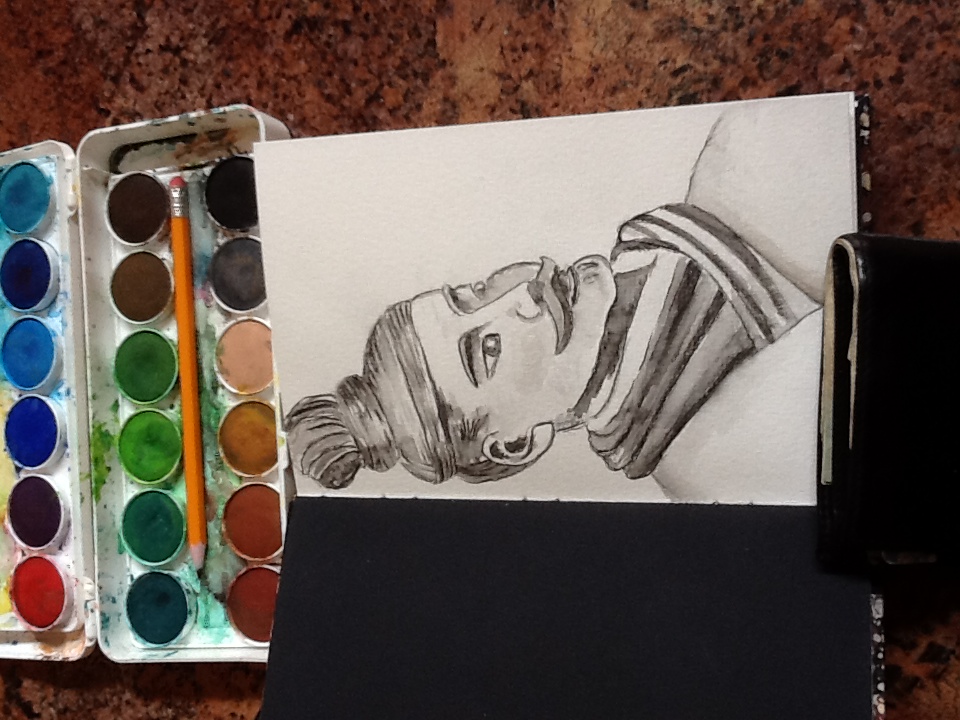
I’ve asked the Woollies for American cinquains in response to our tour of the Terra Cotta warriors.  Already have two responses and we’ve not gone to the museum yet.

From Bill Schmidt:

Wonder. . .

Why men of clay,

Buried many eons

Show us rustic, simple beauty.

Awesome.

From Mark Odegard:


Samhain                                                     Fallowturn Moon

Listened to a brief lecture on the Delian Hymn to Apollo, then checked my work for my time with Greg this morning.  I’m trying to learn transformational grammar to use as an aid to translating.  I don’t have it down.  Yet.

The American Cinquain

Samhain                                                                Fallowturn Moon

November Night

by Adelaide Crapsey 

Listen. . .

With faint dry sound,
Like steps of passing ghosts,
The leaves, frost-crisp’d, break from the trees
And fall.


Adelaide Crapsey

was born in 1878. She is known for developing a variation on the cinquain now referred to as the “American cinquain.”*

*a class of poetic forms that employ a 5-line pattern. Earlier used to describe any five-line form, it now refers to one of several forms that are defined by specific rules and guidelines.

Adelaide Crapsey invented the modern form, known as American Cinquain[2][3] inspired by Japanese haiku and tanka,[4][5] akin in spirit to that of the Imagists[6].

The first, fundamental form is a stanza of five lines of accentual verse, in which the lines comprise, in order, 1, 2, 3, 4, and 1 stresses.

Then Crapsey decided to make the criterion a stanza of five lines of accentual-syllabic verse, in which the lines comprise, in order, 1, 2, 3, 4, and 1 stresses and 2, 4, 6, 8, and 2 syllables. Iambic feet were meant to be the standard for the cinquain, which made the dual criteria match perfectly.                 wikipedia