Among the Buckthorn

Summer                                            Solstice Moon

Cleared buckthorn, again, from the area around the grandkid’s playhouse and the fire pit, leaving in serviceberry and small ash trees. Rejuvenating the understory is difficult to impossible with buckthorn present since it chokes out most things shrub size and below.  In certain areas of our woods it’s a remediable problem, those areas not on the boundaries with the neighbors.

Sitting outside now in the evening, watching the fire, has me more tuned up to work in the woods, since up to this point the woods have been an amenity, but not a place where we spent much time or energy.  This kind of work is hard labor, perfect as an alternative to the computer, the mind, the writing.

A local guy, biologist Mark Davis of Macalester College, has a different take on invasive species like buckthorn:

“Davis…believes it’s time to raise the white flag against non-native species. Most non-native species, he said, are harmless—or even helpful.

In a letter published in the journal Nature this past June, Davis and 18 other ecologists argued that these destructive invasive species—or those non-native species that cause ecological or economic harm—are only a tiny subset of non-native species, and that this tiny fraction has basically given all new arrivals a bad name.”

As may be.  As may be.  But I still don’t like the way buckthorn crowds out the serviceberry, ninebark, dogwood, columbine, trillium and jack-in-the-pulpit.  Somehow it doesn’t seem to deter the poison ivy.  If it did, well…
The Beginning of the End of Summer

Summer                                                             Solstice Moon

July 4th is the midpoint of summer for me.  It’s not in terms of the calendar or meteorology, but in my visceral sense of times ongoingness, the one that tells me when I am, I now am between the 4th and Labor Day.  I suppose that harkens back to school days when there would be the 4th of July parade, then Labor Day marked the beginning of school.  What remains is a vestigial feeling that the next big thing to happen is the ringing of school bells.

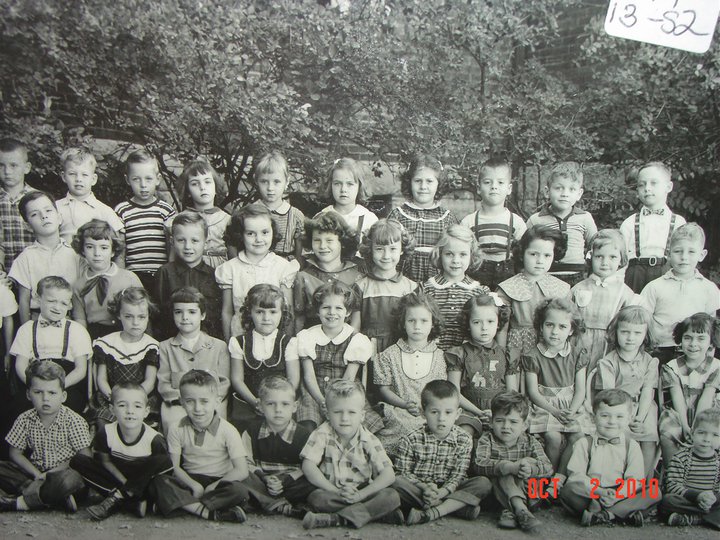
(that’s me, second from the left on the first row)

The school bell has long ago faded and even the summer pace of work is gone, for me now almost 25 years.  Yet that sense that summer has reached its climax and now speeds its way toward the denouement still sends its signals.  The garden does pick up speed now with plants maturing, more and more vegetables ripening, fruit, too.  The arc of the garden though does not know Labor Day, does not have a building and a bell in its lexicon.  It knows the growing season, the gradual warming, then cooling of the daytime and nighttime temperatures.

With Latin on hold I’ve begun to work outside a bit more regularly since I no longer feel as crunched for time in the mornings.  That means I can participate more fully in the garden’s life.  Many garden plants, especially vegetables, run through their entire life cycle during the growing season, going from seed to stalk to leaves to fruit, then senescence.  The school year that I inherited was one sensitive to this rhythm.  It allowed the kids to come home from school during the months their labor was crucial on the farm, during the height of the growing season.  The need for that passed long ago as the number of family farms has steadily declined.

Yet like my inner sense of time the school system continues on, its memory of the days of the family farm institutionally intact.