Fail. Not so epic.

Lughnasa                                                     Lughnasa Moon

Fail. Failed. Failure. I set out, in 1992, to write novels and publish them. Though I worked hard, wrote six novels, and tried to learn the craft, I failed, or have so far failed to sell a single one. There is no way to paint this as something other than failing. I had a plan, a set of expectations and did not achieve them. In other words I spent 22 years striving toward something I did not accomplish.

I have been afraid to look back on the last 20 plus years and acknowledge this. Why? Well, who likes to fail? I find myself wanting to reframe them, put them in a different paradigm, redefine success, but to be honest with myself I have to say what is.

Were my expectations reasonable? Doesn’t matter. They were what I claimed as defining my work and they are a fair measure.

There. Having said that I can move on to the second and more important question, am I failed man because of this? No. And I can say that without reaching for the other matters, happening over the same time, that had positive results. Why? Because the measure of a man is different from the measure of a man’s accomplishments or lack of them.

It’s funny, but I feel no shame in writing this. No glory either. Just an it’s time to say this and move on feeling. Yes, all this has the root beliefs of middle class white male USA culture entwined about it on all sides. Yes, this need for notches on the public belt or on the office door reaches deep and wide, but I admit freely to being complicit with them.

That is, I’m proud of my achievements. I cannot be proud of my achievements and not acknowledge my failure. So consider this my admission of having come up short.

Now then. What’s different? Virtually nothing. The last 22 years passed and I have arrived at 67. The Dilbert cartoon this morning in the Tribune said it very well and reminded me of a conversation recently with friend Tom Crane.
 

Boys and their Tractors

Lughnasa                                                            Lughnasa Moon

Into St. Paul this morning for another America Votes meeting at the Minnesota Nurses Association. Solid, information packed as usual.

On the way in I listened to a radio discussion of masculinity and on the way back an Ira Flatow Science Friday story on regenerative farming. NPR is listening to my brain.

Men in America has its main hook in the changes since the 1970’s in men and women’s education status. Women have pushed ahead of men, or girls ahead of boys steadily, until today girls dominate boys in all of the academic disciplines through high school. While in itself this is neither alarming or surprising, when joined to the decline in manual labor and other manufacturing jobs, a disturbing picture emerges. Men begin to look left behind in the contemporary labor market. There are a lot more matters to discuss here. Another time.

Regenerative farming pushes forward the no-till farming movement, moving beyond merely sustainable agriculture to an agriculture that positively enhances the soil. In this show a number from the book The Soil Will Save Us by Kristin Ohlson got my attention. She says that if 11% of the worlds agricultural land were to convert to no-till farming the resulting natural sequestration of carbon dioxide would balance the climate change equation. Don’t know if this is true, but it’s intriguing.

It took me immediately to rain follows the plough which I mentioned here not far back. That was the belief that created the vast agricultural lands of the plains where industrial agriculture has combined with center pivot irrigation to drain the Ogallala aquifer and destroy the once ten foot deep top soil created by prairie plants. If that land were to convert to no-till agriculture, water use would plummet and the plains could begin to heal themselves. Might be the 11% right there.

Slow, steady

Lughnasa                                                        Lughnasa Moon

After picking the wild grapes, the garden study packing. With some minor exceptions it is now clear and all the furniture in it, three bookshelves, two file cabinets, a work bench, a drafting table and a desk (which sounds like a lot I know) can go either to the consignment shop or into storage for staging.

(Albert Bierstadt-Estes Park, Colorado, Whyte’s Lake)

The bookshelf that held all my gardening related books is, too, almost empty. After I parse the files, quite a few, I’ll be ready to begin in the study itself. Kate has gotten a good start both downstairs and upstairs. We’re making progress, slow and steady, just like we planned.

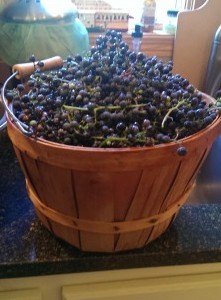
Kate made grape jelly today from the grapes I picked, 24 quarter pints and 12 half pints. As we watched the end of State of Play, the musical clicking of jelly jars sealing punctuated the evening. In spite of my low carb ways I sampled it. Pretty damn good.


Wild, Wild Grapes

Lughnasa                                                                 Lughnasa Moon

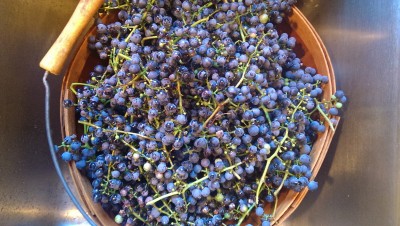
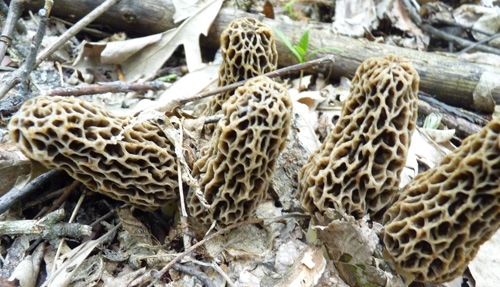
500P1030676A cool breeze predicted autumn as I picked wild grapes this morning . These wild grapes have overgrown our amur maples and will get cut back when the lawn restoration work is done later in the fall. That will hardly diminish their presence though because wild grapes grow all over our woods, some branching out from vines thicker than my upper arm. The woods also provides morels in the spring.

Over the years I’ve highlighted the opossum, the great horned owl, wild turkeys, pileated woodpecker, woodchuck, salamander, newt, toads, frogs, dragon flies, deer, rabbits, chipmunks, squirrels, bumblebees, raccoons and snapping turtles that live on this property, too. A significant aspect of living in the exurbs is the diversity of wild flaura andIMAG0506 fauna, often on the chunk of land on which you live. This is a melding of the human built and the wild.

The Denver Post recounts encounters with bears, mountain lions and rattle snakes. In Minnesota residents encounter bears and wolves, perhaps the occasional lynx. Most of these encounters occur because human habitation encroaches further and further into formerly wild lands.

These predators are certainly part of the wild eco-system, but the bulk of wild life are prey species, amphibians, reptiles and birds. It’s these we humans encounter most often and which we often discount, as if their small size or lack of tools for killing make them less significant. Yet the woodchuck, or land-beaver, that occupied a tree here for a day, is a wild animal just as much as the wolf or bear. So, too, the opossum and all those others that flee when humans arrive, who try to keep their visibility to a minimum.

We are co-habitants, not owners really, of this land. Though we will sell it to other humans, we are not selling the wild life. Their lives will adapt to the new humans just as they adapted to us, either by leaving or hiding or just going on about their day.

The wild flaura includes not only morels and grapes, but ironwood, jack-in-the-pulpit, oaks white, red and burr, elm, ash, black locust, cedar, nine-bark and rhus radicans, or poison ivy. Barring a clear cut of the woods, which I consider unlikely, they, too, will remain.

A Serging We Will Go

Lughnasa                                                              Lughnasa Moon

Love is a funny thing. Made me enter my first bid on E-Bay for a machine I didn’t understand. Still don’t. And I won! Strange how much fun it can be to get somebody to take your money.

What was it? A serger. In this case a Bernina 1300 MDC with overlock stitches. I did enough research to know that having an overlock stitch was good. And that the price was more than reasonable.

The body of the serger came last Friday and its accessories came today. All to the receiving dock formerly known as “front porch.”  The arrival of the accessories occasioned a birthday week outing to the St. Cloud Sewing Center where the serger goes to the sergery for a spruce up and professional review.  Looked fine to me, but what do I know from serging?

On the way up to St. Cloud we ate at Russell’s in Big Lake, dining for the first time on dill pickle soup. It was very good. The entertainment was a young man trying to learn how to waterski slalom style and a gaggle of Canadian geese who paddled away from the shore in a straight line, maybe 10 birds altogether. From what I saw the geese knew what they were doing. The waterskier not so much.

The day was a northern summer ordinary miracle. On these days when the dewpoint is low, the clouds high and puffy, the sky blue and temperatures in the mid-seventies, each day feels as if it could go on forever, an Elysian field created just for those of us crazy enough to live Minnesota.


A Cloud Blocking The Sun

Lughnasa                                                            Lughnasa Moon

A word about depression. I’ve experienced melancholy and perhaps one bout of true depression, back in 1975 after my first divorce, but I know the real deal when I see it. As I think I’ve written here before, three of my aunts were manic-depressive. One aunt spent the bulk of her life in a mental hospital, another was in and out and the other starved herself to death. It’s a subtle beast, depression, not at all like the usual presentation of the slump shouldered, gloom faced lump in a chair.

No, the depressed person can push right up against life, engaging in work and social life, perhaps with less energy, but that’s often not noticeable. A mix of obligation, habit and denial can even make a depressed person seem normal, even to those closest to them. Robin Williams worked hard, it said in the paper today, in spite of his depression. This suggests that yesterday might have been different, worse than the other episodes of addiction and depression he suffered, but that may not be true.

This might be the time when the impulsive met the depressive, the time when, just for a terrible moment, the idea of death outweighed the struggle for life. It could be that had someone accidentally interrupted this moment he could still be working today. This is not at all blaming someone else, rather I’m pointing to the deadly consequence of entertaining, even for a moment, the notion of self-extinction.

Yes, existentialists, and I count myself among them, see suicide as a possible affirmative choice in a meaningless world. If life has become unbearable, for whatever reason, the decision to end it needs to be taken seriously, not discounted or abjured. And perhaps especially because I feel this way I’m sensitive to the effects of a momentary mood, a flight of dark fantasy, that may have irrevocable results. These moods are not the same as an existential choice, being overtaken by a feeling of worthlessness or dead-endedness is not a choice; rather, these are situations of capture when the self becomes hostage and even victim to psychic weather.

Moods, as the weather systems of the psyche, have great power and in our interior world we often mistake weather for climate. That is, we take the mood as indicative of a general state of existence, when it is really a thunder shower or a cloud blocking the sun.

We humans, and our lives, are so fragile, so vulnerable.

Fame and Race. Four letter words

Lughnasa                                                                      Lughnasa Moon

Robin Williams and Lauren Bacall, both dead. Celebrity is a harsh idea and exacts a penalty from both those who perceive it and those perceived to have it. Celebrity has to do stand in work in American culture for nobility, since the land of freedom and equality for all insists on not discussing its class system. As a result certain of us who become well-known thanks to athletic gifts or a handsome face or an ability to become someone else, perhaps also those who have a lot of money or political visibility, musical talents and in the rarest of cases here, literary ones, have an elevated stature.

In the same period, the deaths of Michael Brown and Eric Garner point to a grimmer side of our passion for those seen to be above the culture’s average and that is our disregard for those seen to be below it. Seeing does not make it so, however, in either case. Lauren Bacall and Robin Williams are not more than the rest of us just as Michael Brown and Eric Garner are not less than the rest of us. But perception in a media saturated public square is often all we have to go on.

Who among you who read this knew Robin Williams or Lauren Bacall, Michael Brown or Eric Garner? If you did, you may have grounds for knowing what kind of persons they were, but for the rest of us, we “know” them only through news report in the case of Brown and Garner and their work in the instance of Williams and Bacall. Neither way of knowing comes close to the fullness of personal acquaintance.

Yes, this is obvious I suppose, except it isn’t. Celebrity carries its own luster, a stage light cast by approval or notoriety. Racism carries its own dimmer light which shades the person from full view, making them appear less than they are while celebrity luster makes people seem more. Both are inaccurate and do a disservice to the people effected.

Racism and celebrity might rarely be considered in the same paragraph, but together they reveal the deep chasm between what we think we know and what is actual. They both teach us to rely on secondary characteristics for taking the measure of a person. And, in both, we lose and so do those we see through those lenses.

Ashes to Ashes

Lughnasa                                                                  Lughnasa Moon

Mary recommended that Kate and I watch Life on Mars and then Ashes to Ashes. These are BBC programs, linked with Life on Mars first and Ashes to Ashes second. All told there are five seasons of 8 programs a season. This is an unusual television experience, a high-minded drama with police procedurals as the episode’s main action driver, but with a long delayed rationale, made clearer only in the final minutes of the very last episode. This is exceptional television and worth following through to the end.

BBC makes a lot of excellent shows, but this is the best of the batch that I’ve seen.

I should add that Kate basically figured out the end. Smart gal.


Memory Train Passing

Lughnasa                                                                     Lughnasa Moon

The garden study packing, nearly done, came to a halt due to a need for some more packing supplies that won’t arrive until Wednesday. But it’s close to empty. By packing up the garden bookshelf tomorrow, I’ll be able to finish that whole area when the new plastic file holders come.

That means Wednesday the biggest push of the project will get underway. The culling and packing of the study itself. In some ways it may go quicker than the garden study, but there are many more books involved. There will not be though, in here, the picture I found today of my two and half-year old self trying to crawl while my mother and a post-polio rehab specialist looked on. My neck is on the floor, curved up at angle.  I’m looking up at the photographer. Brought a pang of empathy for that little guy, long dissolved into the man, but still present.

Nor will there be the hot picture of Kate taken beside the Siah Armajani bridge between Loring Park and the Walker Sculpture Garden. Or the polariods of Mary and Dad, of our house on E. Monroe Street and the one on Canal. Each of these stopped me and I had to wait for the memory train to pass before I could cross the intersection and get back to work.

Also, I packed in a red tape box, sell, my copies of three volumes of St. John of the Cross. To anyone else they would be have been old books, fat paperbacks that cost $1.65. To me though they were the touching gift of a fellow philosophy student at Wabash College, a senior, who saw something in me and wanted to share his passion. Yet now 40 years removed, even that connection no longer made me want them.

They were not the only decisions like that. Books, for me, often entrain memories in just the same way a photograph or a travel souvenir does. That makes these choices hard sometimes and feelings slow the process down. Taking a year makes a lot of sense.