Repopulating the Earth

Spring                                                          Bee Hiving Moon

Had a down few days, not really sure why, maybe just chemical tides among the synapses, but they seem to be receding now.

The morning was with Ovid, pushing almost to the end of the Deucalion and Pyrrha story, the repopulating of the earth after the flood.  The stones which this pair threw over their backs have now begun to soften, become supple and transform into the bodies of men and women.

Deucalião_e_Pirra   Giovanni_Maria_Bottalla_-_

Conundrums

Spring                                                          Bee Hiving Moon

Got my first semi-encouraging rejection today.  Missing doesn’t fit their needs, but they encouraged me to send future work to them.  Could be the gentle let down, but it sounded non-formulaic and sincere.

I’m in a bit of a stuck place right now in regard to the Unmaking trilogy of which Missing is the first book.  Since it takes a year + to write, then some more to revise and edit each novel, committing to finishing the trilogy could take up to three or four years.  I’m not getting any younger and I don’t want to spend that much time on something without a commercial future.

I have other projects that have a energy, three actually.  One of them in particular has a big book feel to me, but I’m not ready to start it.  It needs more research and language skills more advanced than those I have now.

So, I’ll let the submission/rejection cycle play out over a few more agents and if necessary consider electronic publishing, then decide about picking up Loki’s Children.  It is about a third written with material from Missing I cut out during revision.

What Do You Choose?

Spring                                                                   Bee Hiving Moon

Despair.  It’s easy to find among those who follow climate science and climate change.  Or, immigration.  Or, poverty.  Or, war. Or, availability of medical services in the U.S. even with Obamacare. Or, agriculture as usual.  And no wonder.

Climate science shows that we have 3.6 degrees of warming baked-in with the current carbon dioxide load in the atmosphere and that if things don’t change drastically by 2050 that number could increase between 2 and 6 times, or just to be brutal, between 7.2 degrees and 21.6 degrees!  And, current measurement shows co2 emissions increasing, not decreasing.

That’s due in part to fighting poverty in the world’s two largest countries, India and China. Their growing economies have coal burning or wood burning energy use at their heart, plus as their middle-classes grow they all want cars.

The American way of agriculture, so productive and revered throughout the world, depends on two unsustainable practices:  the constant injection of chemicals and herbicides into and onto depleted soil and irrigation using aquifers with very slow recharge rates.

You understand these issues, I’m sure you do, and you probably find them as far from solution as I do.  So why don’t we just go on that final road trip?  In an electric car of course.

We won’t go on that final road trip because the last thing to escape Pandora’s box was hope.  And, yes, hope is an anodyne or can be, I know that.  But the long read of history suggests it is the doomsayers whose predictions prove overblown.  On our way in to see Mountaintop yesterday we drove past the local 7th Day Adventist church.  In their denominational history is an American story of the end predicted, and re-predicted, then re-predicted again.  Here’s a line from the Wikipedia piece on Millerism:  “October 22, 1844, the day Jesus was expected to return, ended like any other day [28] to the disappointment of the Millerites. Both Millerite leaders and followers were left generally bewildered and disillusioned.”

Malthusian estimates of the final carrying capacity of the earth have been overturned time and time again.  Even the mad doctrine of mutually assured destruction lived up to its policy promise rather than its often contemplated nuclear holocaust.  The War to End All Wars.  Well, we know how that turned out.

We’re very good at despair because we project potential disastrous scenarios into the future as if the most extreme occurrences are the most likely.  In fact, the opposite is true. The most extreme occurrences are just that, most extreme.  They are the black swans of human culture.  Yes, black swans happen, as the book of the same name shows, but they are rarely the black swans we have predicted.

Who, for example, would have predicted that one man, Thomas Midgley, would produce two chemicals that threatened millions of people, unintentionally?  Midgley is the man responsible for lead in gasoline as a successful anti-knock agent.  He also invented Freon, non-toxic itself, but in combination with chemicals in the upper atmosphere it creates an ozone eater.  It produced the well-known ozone hole.  BTW:  “He contracted polio when he was 51. As he lost the use of his legs, he invented a harness to get himself out of bed. On Nov. 2, 1944, he tangled in the gadget. It strangled him.”  Engines of Our Ingenuity, #684.

Our current Thomas Midgley is laboring away somewhere right now, solving some problem with a lethal solution.  Only he or she doesn’t know it.

But back to despair.  It is the emotional equivalent of Midgley’s harness.  It begins as an assessment of possibilities, moves to an acceptance of a certain gloomy situation, and ends as a tangle in which some of us, like Midgley, end up strangled.

(Pandora, Rossetti)

Here is the nub of hope, anodyne or not.  What is most disastrous has not happened. Today we can choose to live differently, live toward the possible solution rather than wrap ourselves in seemingly inevitable defeat.  No amount of despair will move us toward a better tomorrow.  Just a bit of hope can.  This is not pollyanna thinking, it recognizes life has crushing defeats and sorrows.  The question is one of choice.  Do you choose to live toward the bleakness or toward the sunrise.  As for me, I’m turning toward the east.

Catching Fire

Spring                                                                     Bee Hiving Moon

And, in the evening we saw the Hunger Games:  Catching Fire.  I read these books quite a while ago and enjoyed them.  They combine a clever teen fighting for her life and the life of those she loves with a dystopian future modeled on ancient Rome.  The movies are flashy because the books offer up great visuals.  In fact, one of my favorite parts of this movie was the sequence at President Snow’s home where the capital’s gliterati were out in all their decadent attire.  It reminded me of the French era when women would wear representations of naval engagements in their hair.

The Quarter Quell game itself was less interesting, kill or be killed on screen is a teen version of the movie where some bored white guys hunt street people for fun.  It plays better in a book where the inner lives of the characters are clearer.

This is a movie about making money from movies, but it was entertaining in its way.  It was not, however, profound.  And it might have wanted to be.


Mountaintop

Spring                                                              Bee Hiving Moon


Back from the Guthrie and the Penumbra presentation of Mountaintop, a play focused on Martin Luther King’s last night alive in the Lorraine Motel in Memphis, Tennessee.  As it neared the end, it picked up emotional punch using a clever device that I won’t reveal. The pathos of a man about to die because he stood up for love, for justice, can sound wooden on the page, but to see a real man struggling with acceptance, to hear a real woman empathize with him, that’s different.  That’s the power of theatre.

There’s a good metaphor used in it, one you may have heard before, but which was new to me.  The civil rights movement, the movement for the poor is not a sprint, but a relay race, with one generation handing on the baton to the next.

When we discussed this play briefly at Christos on Monday, I made the observation that when our generation dies out, the generation who experienced King, Malcom and that whole era will die out, too.  That means these characters will pass into history, become captive to interpretation and canonization.  A certain amount of that has happened already.

That will be a shame because those years, the 60’s and early 70’s, were so alive and vital. The air crackled with change, with big questions, with thoughts of matters far beyond the vocational worth of a college diploma.  And we lived it.  It is our direct heritage and I like very much the notion of the baton.

I’m in that part of the race now where the baton is stretched out ahead of me, ready to lay in the hands of another, but my race is not yet run.  I’m accelerating, to keep the team ahead.


Saturday

Spring                                                                Bee Hiving Moon

Business meeting.  Money continues to come in and go out.  Life in advanced stage capitalism.  Third life, that is.

The rain today waters in the nitrogen I put down yesterday and soaks the seeds, giving them that first shot of liquid and snugging them in their rows.  The chill, raw temps are why I did that yesterday afternoon.  This is the next week’s weather, roughly, according to the weather forecasts.

Kate and I see Mountaintop at 1 pm today at the Guthrie.  Bill Schmidt’s description of it made it interesting to me.  Also, in all these years of theater going, I’ve never seen a Penumbra presentation.  Looking forward to this one.

A kind thought to all those recovering or about to begin recovering from one medical intervention or another.  Especially Tom’s thumb and Frank’s back.

Rejection. Planting.

Spring                                                     Bee Hiving Moon

One rejection showed up in my mailbox already from this morning’s submissions.  That’s quick turnaround.  Unfortunately.  Still, no submissions, no rejections.  No submissions, no sale.  So, on we go.

I did get the beets and carrots planted:  Early Blood and Golden beets, Danvers and Paris Market carrots. The vegetable growing season has begun.  One of the more frustrating gardening chores is planting carrot seeds.  They’re tiny, stick to each other and your fingers and go in 1/4″ apart.  Right. Sort of.  As close to that as possible, but sometimes multiple seeds fall and have to be spread out.  If you’ve done it, you know what I mean. Beets are larger, an irregular sphere with studs, easy to grip and they go in 2 inches apart. That is doable.  Now we wait.

Oh.  I did clean up the surface of the bed, then spread the nitrogen, rake it in, then level the bed before hand.  So I was out there a couple of hours, maybe a bit more.  It’s been a productive day so far.

Queries and Cool Season Crops

Spring                                                           Bee Hiving Moon

Got Missing queries sent off to 7 agents who represent young adult novels.  I’ll pick up the other three next week and establish a new list of fantasy submissions.  Feels good to have it sent off, routine.  Book buying by publishers, agent’s choices for what they represent, even what the public chooses to read are all highly subjective decisions.  That’s why multiple submissions over a period of time represents the only way of making sure you’ve give a work a fair shot.

The cold season crops will go in the ground this afternoon after the nap.  The weekend and next week looks either cold or wet, so today is the best shot.  Beets and carrots, that’s our cool weather crops, but I’ll plant a lot of each.  We love both beets and carrots.  I spent some time this morning checking planting and nitrogen requirements.  I still have to lay down nitrogen since I left that out of the broadcast last fall.


Wish I’d Known the Son-of-a-Bitch Wanted to be a Millionaire.

Spring                                                                      Bee Hiving Moon

Kate and I saw Nebraska the other night.  This movie was pitch perfect for heartland small town dialogue.  The images it created of Billings, Montana, Hawthorne, Nebraska,  and Lincoln, Nebraska felt taken from my recent adventure driving between my surprise incursion point into Kansas and Highway 80 in mid-Nebraska.  Small rural towns in the midwest have suffered, a lot, over the last 50 years.  They’re run down and often sparsely settled though that trend has begun to ameliorate somewhat.

There were as well images of striking beauty, especially a wide-angle shot of a slightly rolling field with bales of rolled hay sprinkled throughout.  If not for the black and white, it could have been painted by Breughel.  The big sky and vast horizons of the drive from Billings to Lincoln are also beautiful, the stark aesthetic of the plains.

Not only because it was black and white, but because of its tight focus on family and strangeness (remember Mom lifting her skirt to the gravestone?), too, this film reminded me of Ingmar Bergman.  These were everyman characters dealing with everyday issues:  a desultory  job, American hucksterism and its unwitting victims, a long distanced father and son closing the gap, a slow revelation of Woody and David’s largeheartedness.

It will, unfortunately, only serve to convince bi-coastal sophisticates that the rural midwest is unredeemable, shabby and coarse, low-browed.  It cannot and does not try to show the agricultural culture that lies behind the small towns and cities and lives it portrays.  It also cannot show the slow but persistent erosion of rural life as farming has gone corporate and the kids leave home for Chicago, Minneapolis, Denver, even Lincoln and Omaha.

This is not a criticism of the movie, but a wistful longing for an artful representation of growing food, tending livestock, some way of showing the heartland as just that, the heart of a great nation and a food producer for the world.

The Organ Recital

Spring                                                                    Bee Hiving Moon

News from folks I know.  Tom’s thumb is now hidden beneath protective layers and will remain so for a while.  He reports things went well, but he’s wondering where his right forearm went.  He used to have one.

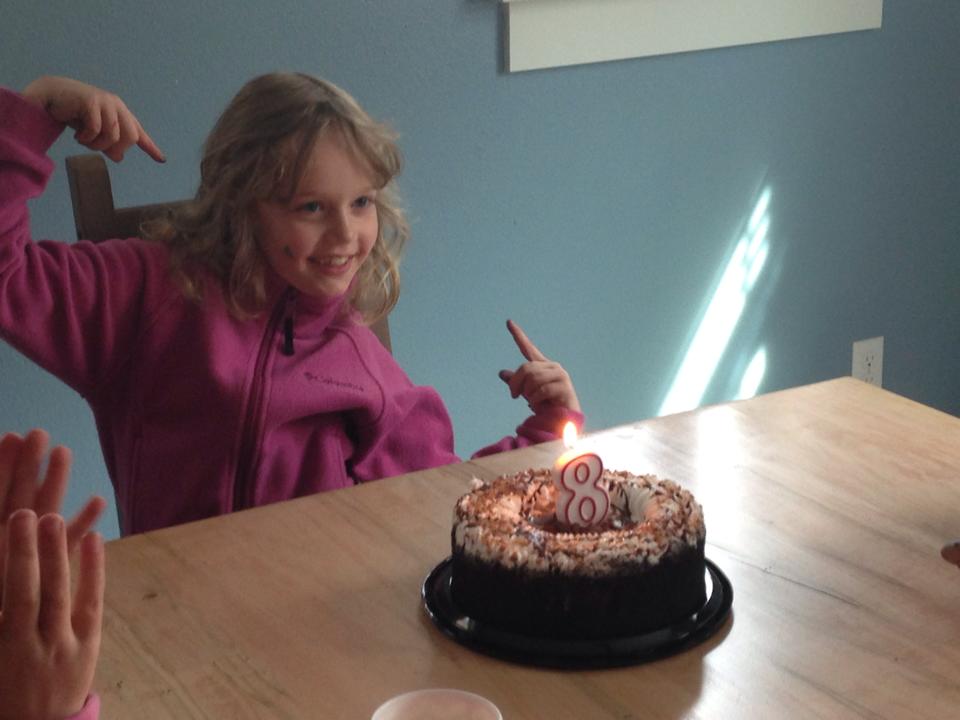
Ruth is 8 and has ridden in a car with no car seat.  This is a milestone birthday for her. She Ruth's 8thhas a boot for her foot hurt in a teeter-totter accident. Too, she gets her own bicycle which she told me she could ride over to Grandma’s.  Jen’s mother is moving to Denver in July.

Bill and I play sheepshead once a month and the hospital trend continued when Roy called up to say we couldn’t play because Judy, his wife, had to be under observation after a procedure earlier in the day.  She’s doing better now.

Kate’s battery and can (pulse generator) replacement incision has healed nicely and the bandage, an itchy thing, has come off.

Frank’s up next on Monday.  Back surgery.  Here’s to him continuing the streak of positive medical news.