Up Early

Imbolc                                                  Black Mountain Moon

One of those nights. In spite of the warmth of my electric blanket I was awake at 3 a.m. For good. So I got up, let the dogs out, fed them, but didn’t go get the paper. (too early) It’s now 5:45 and I’m planning on working on Latin as soon as I finish this. Why waste the time?

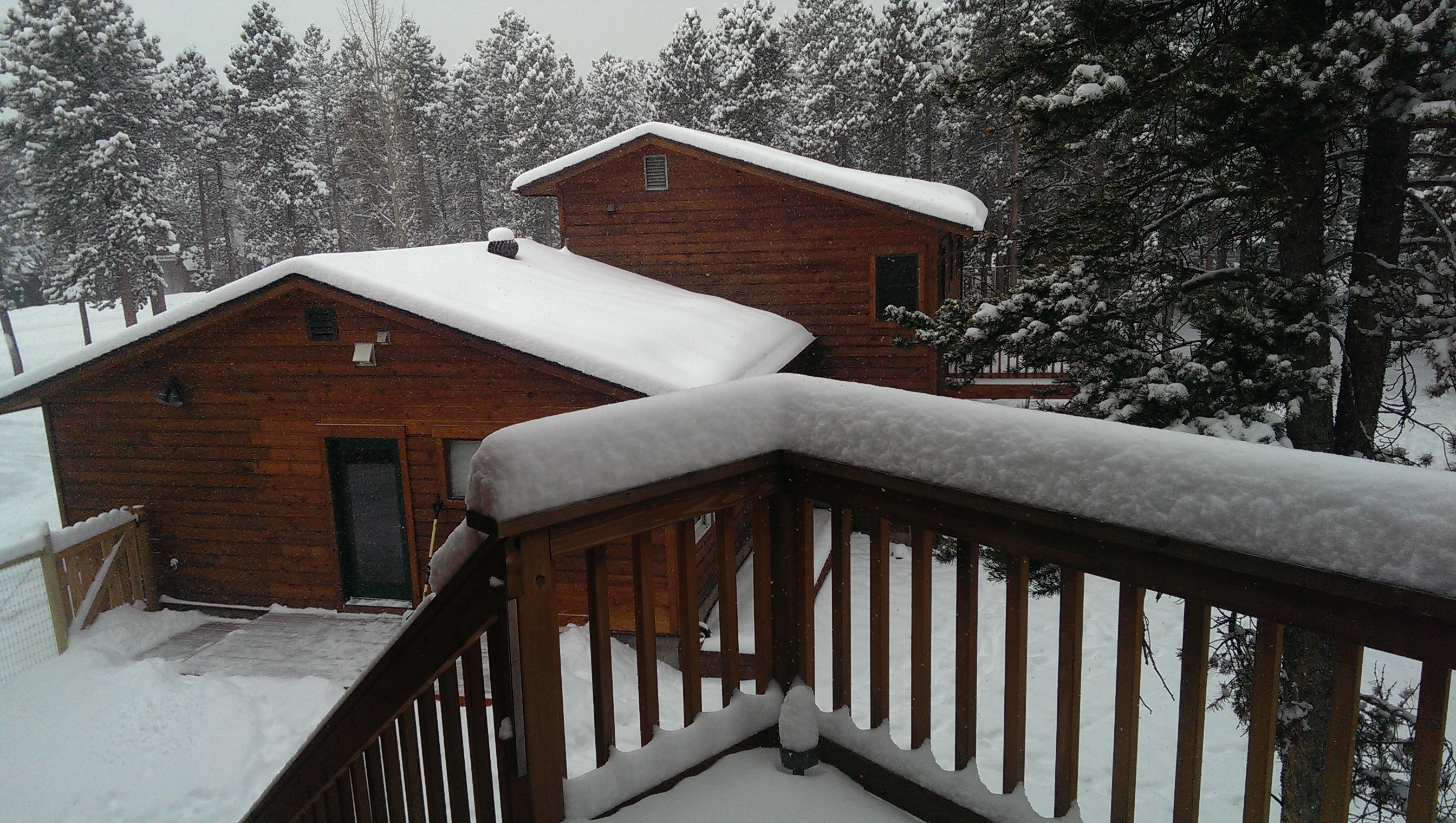
There was more snow on the deck this morning. Not so much, maybe an inch. I’d say we got 10 inches over the weekend. Snow here is both more present-it snows more often-and less. It melts soon after coming. This week the weather will be cool enough to retain the snow on the grounds, but it should be sunny enough to melt the driveway.

I’m trying to increase my work. The long preparation for, then the execution of the move, distracted me at points, especially over the last couple of months. We needed our focus on the move and that’s where it was. Now though I want to write a new book, continue the work in Ovid and Caesar, dig into art scholarship, especially in aesthetics and Song Dynasty China, and get more deeply into my Reimagining Faith project by focusing on the concept of emergence.

We have a plan for a modest garden using raised beds designed around horse watering troughs. They have a root-centric bottom up watering system and come ready to use. All we’ll have to do is site them and fill them with soil. I purchased material for a Flow Hive set-up like the one posted below, but it won’t come until November, so I’ll give the bees a pass this year. In April I take the first of several classes in a Native Plant Master program.

Exercise is two-thirds of the way back to pre-move intensity and I’ve added three days.

All this happens wrapped in regular visitation with grandchildren, Jon and Jen, going to movies, reconnoitering Denver and our immediate area around home: Jefferson County, Park County, Evergreen.

Settling in. Becoming native to this place. A process.


Validation

Imbolc                                                      Black Mountain Moon

Validation comes at odd points, often years later. In this Atlantic article, the Miracle of Minneapolis, the author, with the aid of Myron Orfield, links the Twin Cities’ blend of more abundant affordable housing and wealth to regional government. Somewhat valid.

Here’s the valid part: “While many large American cities concentrated their low-income housing in certain districts or neighborhoods during the 20th century, sometimes blocking poor residents from the best available jobs, Minnesota passed a law in 1976 requiring all local governments to plan for their fair share of affordable housing.” op cit

The invalid part is this. Even with these kind of laws on the books there are powerful forces that still work against the development of affordable housing. The NIMBY movement can marshal usually white middle and upper-middle class folks against multi-family housing. In Andover, for example, the city council time and again denied applications to build multi-family housing, denials premised in large part on the number of police calls to the two instances of multi-family housing (excluding senior citizen housing). This dynamic plays itself out in wealthy neighborhoods and suburbs across the Twin Cities.

Here in the Denver metro area another force, the market, stands in the way of affordable housing. Rents are high and single family homes are in short supply as well as increasingly unaffordable for new home buyers. This dynamic pushes against the development of affordable housing because normal development is so profitable.

Although some action has been taken in Minnesota and a few other states, the minimum wage is another barrier to affordable housing. Even affordable housing has to be paid for and often folks in the low wage sector: convenience stores, walmart employees, waitresses and bar-tenders, grocery store clerks and baggers, retail workers simply don’t earn enough to afford even reduced cost housing.


Here’s the validation. Back in the 1970’s and early 1980’s I was part of a Twin-Cities wide movement of neighborhood activists who advocated for and built affordable housing. We did this through the creation of Community Development Corporations (CDC’s), neighborhood level organizing and in-depth participation in city political races as well as city council deliberations. Most of the affordable housing in Minneapolis and St. Paul-I can’t speak to the suburbs-would not have been built without this committed core of ground level workers, activists and  community developers alike.

(I chaired the West Bank CDC during its most expansive phase of building in the late 1970’s. See pic.)

On the West Bank, where we built 500 units of affordable housing during my time there, we also pressed this movement further by organizing worker-owned co-operative businesses. We were trying to deal with the wage side of the affordable housing equation as well as reducing the cost of housing to begin with.

These were exciting and productive times with different city and state level initiatives being pushed forward by different groups. This all tailed off in the 1980’s.

“In the 1970s and early ’80s, we built 70 percent of our subsidized units in the wealthiest white districts,” Myron Orfield said. “The metro’s affordable-housing plan was one of the best in the country.”

The region’s commitment to dispersing affordable housing throughout the metro area has since diminished.” op cit

This decline exactly parallels the rise of Reagan and the subsequent gathering storm of the Moral Majority followed by the Teaparty movement and the war on terror. The way to achieve and maintain gains for the poorest of our citizens are known and replicable. They do require political will at several different levels of our society and this current society has broken faith with the idea of communal responsibility. This is the great evil of our time, worse than wars or Ebola or terrorism because the cost in damaged lives is so much greater.

Marital Bliss

Imbolc                                        Black Mountain Moon

When I married my Norwegian bride back in 1990 (25 years this March 10th), I did not fully appreciate how different our body thermostats were. I’ve come to enjoy cooler air around me, wearing sweaters and sweatshirts, sometimes a layer on top of that, feeling like a pensioner in an English apartment with a coin-operated heater.

We sleep in the equivalent of a cold dorm, heat turned off in the room and the window open during the winter. I like this, too, except. Except when my blankets became inadequate. Then I would have a hard time getting warm enough to go to sleep. Frustrating when you’re tired.

Yes, I ordered an electric blanket. Why I didn’t do this long ago is a mystery. I think I just wanted to use what we had available. Now, going to sleep is blissful. Warm body, cold head. Just right.


The Snow Has Come

Imbolc                             Black Mountain Moon

The snow has come. Three times I’ve shoveled a couple of inches off our deck, maybe more, and there was an equivalent amount on it when I put the dogs to bed.

While I worked out this afternoon, I watched the snow through the window of the loft. There is a pristine, ancient beauty as the snow falls among the lodgepole pines. In a deciduous forest the trees would be bare, resting sentinels, waiting out the snows and the cold. Here the pine’s red bark and green needles, their dominance in the landscape gives a solemnity to the snow.

The montane ecosystem has had pines and snows for a long time. Our presence here is as voyeurs, not integral parts. That may change, as the journey from visitor to inhabitant, to co-habitant grows longer and our stay here takes root in this rocky soil and thin air. Now, for now, we watch from a distance, still new.

There will not be a warm-up following this snow. No free solar snow removal. The cub cadet will work tomorrow morning. If the predictions are accurate, it will work again on Monday morning, too.


Sheepshead

Imbolc                                  Black Mountain Moon

Forecasts of 16-20 inches didn’t stop me from driving 45 minutes into Denver to play sheepshead. We had vigorous snow showers in the mid-afternoon, then nothing. No snow on the way in though there was heavy snow in southern Denver and in the close burbs coming back at 10:00 pm.

Cards were better for me last night. We had 7 players and 5 handed is the preferred form of the game. We had enough all evening to play it. The dealer and the person to their right sitting out didn’t seem as disruptive last night, partly because we had a round table.

We played for $.10 a point, the first time I’ve played sheepshead for money. When I left at 10 pm, I picked up my dime in winnings and left it on the table as a tip for the waitress. (whom I had tipped when I checked out, too.) That sounds like I didn’t do too well, but the only other player in the plus column was Terry, the Wittenberg, Wisconsin retired dairy farmer. He had 40 points when I left. Everyone one else sat in negative numbers, the best -5. So not too bad.

The drive from Conifer to the Village Inn goes on 4-lane Highway 285 north until Sheridan Avenue, then 285 continues as Hampden Street. It’s also four-lane most of the time, sometimes six, but has stop-lights. I actually enjoy the drive through the metro area, seeing the changing neighborhoods, the different retail and residential configurations.

Once I turn north on Colorado Avenue, the drive gets even more interesting. There is a stretch with several Mediterranean spots: The Marrakech, the Shawirma Palace, The Beirut. Just beyond them are some Asian restaurants including a couple of sushi joints. Colorado is a main street running from Hampden all the way into the northern neighborhoods of Denver.


Dialectic: Reason or Soul

Imbolc                                     Black Mountain Moon

When Kate and I went out last night, we went to a Regal cinema and afterward across the street to the Macaroni Grill for dinner. We could have been in any upper middle class retail enclave in the country. While there is a soothing, predictable quality to these often brick or stone centers, virtues not insignificant in a huge and varied nation like our own, we both commented that we could have been on France Avenue in Edina. In fact, we couldn’t tell the difference while inside the theater and eating at the Macaroni Grill. That’s ok once in a while, but visited frequently these standardized spaces can, like the electric light bulb, begin to blur, then obfuscate the true nature of a place.

Becoming Native to This Place, the book by Wes Jackson of the Land Institute which I quote from time to time, is the antithesis of this form of shallow standardization. He insists, like Aldo Leopold in his land ethic and Wendell Berry in his work on his family’s farm in Kentucky, that we root ourselves, both literally and figuratively in the place where we live. Particularity, not universality is key to their thought.

The core goal of Die Brücke, a movement among young Dresden based artists at the turn of the last century, was to embrace the German/Nordic soul, one based in the particular physicality of the soil and geography of Germany and the people’s nurtured by it, and give expression to that particularity, not the universality presumed by the application of reason.  Die Brücke rejected the Enlightenment’s emphasis on reason, distanced themselves from art’s classical tradition, favoring the Fauves, other key French artists like Cezanne and Gaugin and the Dutch Van Gogh.

This dialectic of reason and soul is a main theme of this new millennium, one with its trailhead deep in the ancientrail of Western philosophy. It may be the main theme of my life, a driving energy behind most of what I do.

Birdman

Imbolc                              Black Mountain Moon

This is for Allison, who told me to see this movie two months before I got around to it. Kate and I just got back from seeing Birdman at the Denver West Cinema.

Still digesting, willing to see it again. Soon. First, it grabbed me emotionally like a stage production. It had me in the story the whole time. Its meta-nature, a film about a play taken from a short story and written by a used-to-be comic book action film hero, Birdman, who also stars in the play could have suffocated a lesser work, but the weaving in and out of these various artistic forms was done well, not jarring at the transition points.

The acting, especially Michael Keaton, Edward Norton and Emma Stone, was bravura, taken to the edge of emotional intensity over and over again.

This is a movie about passion, about love, about hope and dreams, about going as far with a project as possible. It is a movie about art and the fragile humans who create it.

Keaton deserves to win an academy award for his performance, as do Norton and Stone. Keaton’s weariness and wariness overlaid by his taking a huge artistic risk in bringing this show to Broadway comes across in so many scenes, but in none more clearly than the magical realism of the Birdman sequences. The tension between his Hollywood, movie star past and his dream of doing something worthwhile in live theater clash.

At one point he is in despair about his play (again) and throws himself off a building, an apparent suicide. Instead he flies along the streets of Manhattan, balding and wearing a Columbo wrinkled overcoat: in appearance he’s the middle-aged man who has put his life up for judgement on Broadway, in flight though he is once again Birdman.

Any of us who have put our dreams on paper, canvas, stage, film, or in digital media will find this film a fellow traveler with our own journey. My novel manuscripts, stacked in bankers boxes in the loft, traveled with Keaton as he paced the back halls of the theater.

If you’ve not seen this movie, see it. It’s a work of art.

Here. And Not.

Imbolc                                   Black Mountain Moon

IMAG0948

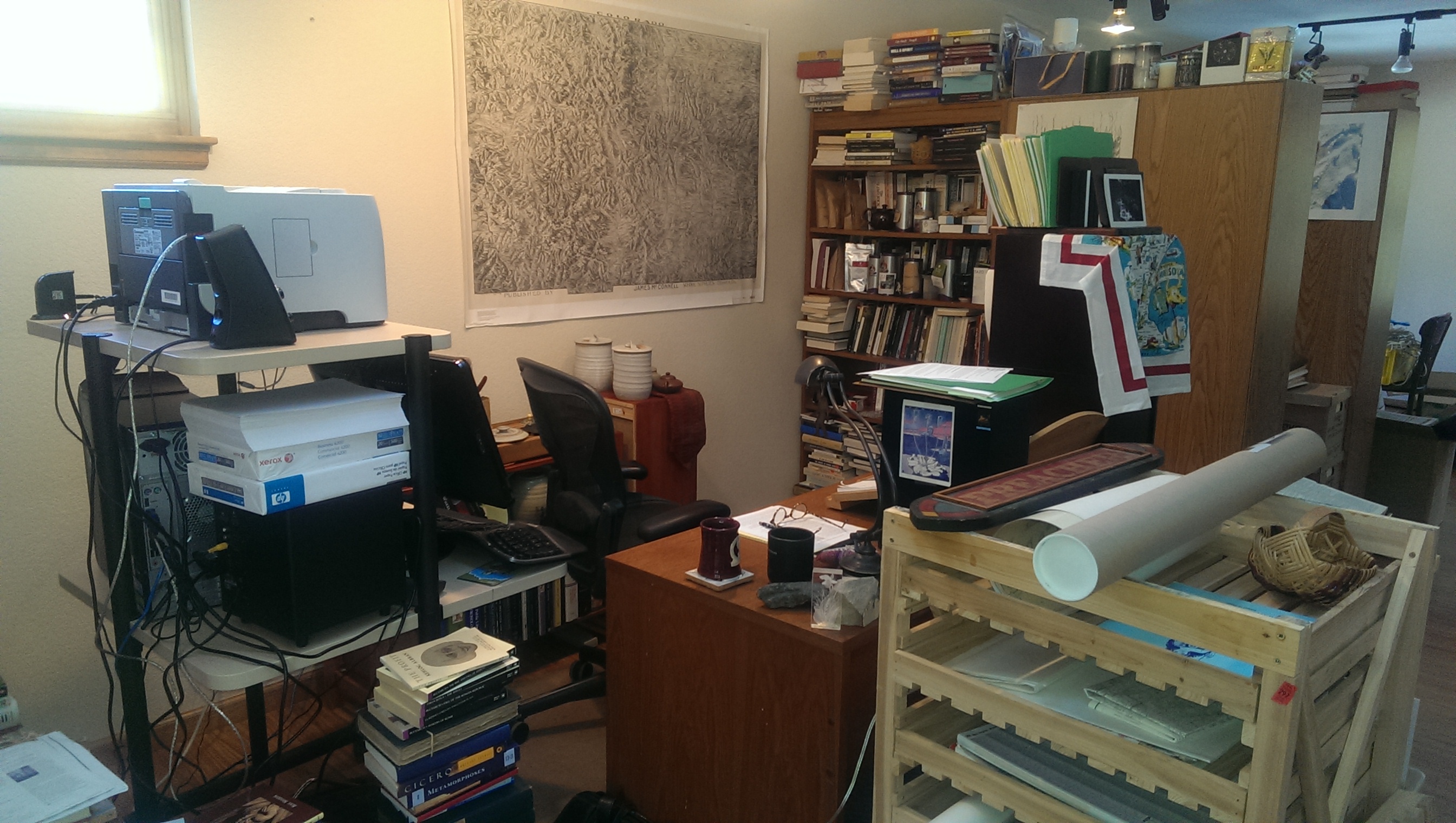
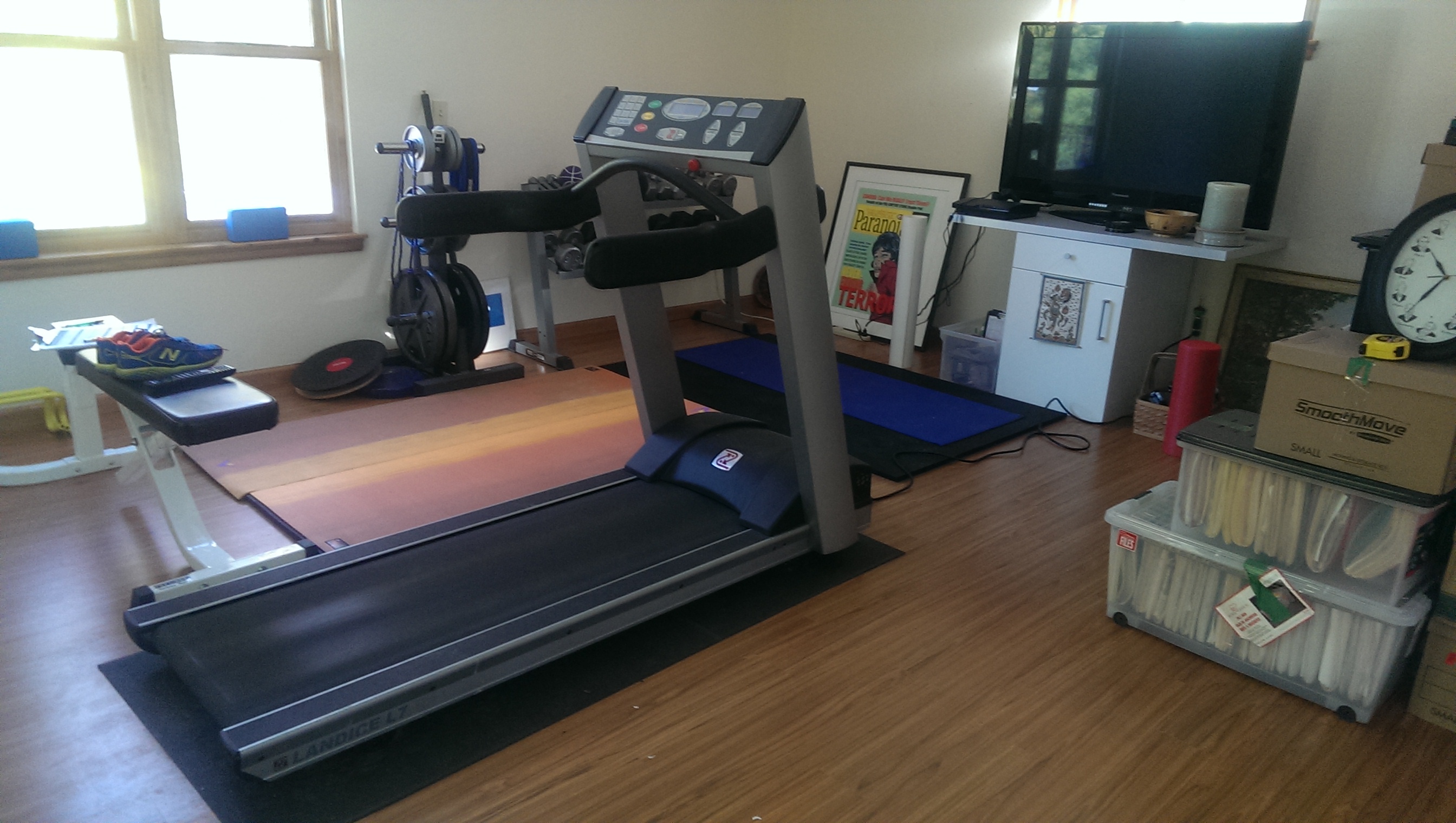
With the books in organized clumps, art still in boxes, files in the horizontal file, journals, dvds and novel notes stacked together in banker’s boxes, and the exercise area functional I’ve reached a stasis in terms of organizing the loft. Kate got back to sewing yesterday, making a table runner from a pattern both she and Annie bought this last week. Her sewing area has also begun to take shape with her table, cutting surfaces, stash, sewing machine and Matilda (the dress mannequin) in usable, if not permanent places.

We await now the new Stickley table we purchased for downstairs, which will make that space more flexible when entertaining or during family game nights. The reading room, the bedroom, the living room and the kitchen all have usable, if not permanent configurations. The garage and the homeoffice remain hangouts for the cardboard set, art in the latter and mostly gardening/beekeeping/tools in the former.

Over the next few weeks Jon will install built-in bookshelves up here, attach my pull-up bar and help us IMAG0950hang art in the house. He’ll also develop plans for linking the house and the garage, a current problem spot for us. Why? There’s no straight line into the house from the garage and no path that can be cleared. We have to move through the snow to get to the truck or upstairs to the loft. Not a big deal, but one that could be better.

Kate went in yesterday and had a day as grandma, doubled with Barb’s presence. They were at Barb’s apartment with Gabe and Ruth who were out of school for teacher’s conferences. In one of those mysterious moments we humans have from time to time, Kate went from Minnesota grandma to Conifer grandma, a change that began at the birthday cum house warming celebration on Saturday. She’s now fully here (as I sense it) and in the life she dreamed about as we prepared for and executed the move.

There’s a bit further for me to go. I got a very sweet book from Ruth as a birthday present, a compilation of IMAG0942poems and images about Grandpop plus comments from her. I feel completely here as Grandpop and did perhaps sooner than Kate, but the Self that has begun to grow here, a Colorado, Western Self has barely emerged. In part I need to get my old rhythms back, the ones I mentioned yesterday: Latin, writing, art history, exercise, sheepshead, perhaps some political work. But, too, I need new rhythms: exploring Colorado and the near West with Kate, hiking and snow-shoeing in the mountains, learning the history and the geology and the biology of the land we now call home. It will be the dialectic between the old, stable patterns and ones possible only because we live here that will finally get me all the way here. For now, I’m neither fully here nor fully gone from Minnesota. Liminal. Again, still.


Oliver Sacks

Imbolc                                         Black Mountain Moon

“A MONTH ago, I felt that I was in good health, even robust health. At 81, I still swim a mile a day. But my luck has run out — a few weeks ago I learned that I have multiple metastases in the liver. Nine years ago it was discovered that I had a rare tumor of the eye, an ocular melanoma. Although the radiation and lasering to remove the tumor ultimately left me blind in that eye, only in very rare cases do such tumors metastasize. I am among the unlucky 2 percent…

It is up to me now to choose how to live out the months that remain to me. I have to live in the richest, deepest, most productive way I can…

I feel a sudden clear focus and perspective. There is no time for anything inessential. I must focus on myself, my work and my friends. I shall no longer look at “NewsHour” every night. I shall no longer pay any attention to politics or arguments about global warming.

This is not indifference but detachment — I still care deeply about the Middle East, about global warming, about growing inequality, but these are no longer my business; they belong to the future. I rejoice when I meet gifted young people — even the one who biopsied and diagnosed my metastases. I feel the future is in good hands.”

Oliver Sacks, a professor of neurology at the New York University School of Medicine, is the author of many books, including “Awakenings” and “The Man Who Mistook His Wife for a Hat.”

Back in the books

Imbolc                                Black Mountain Moon (new)

Back into Caesar and the Gallic wars. Better than I expected, worse than I hoped. I’ve not lost the corpus of knowledge I’ve gained working with Greg, but retrieving it and using it is far from facile. I remain a committed classicist in training, so I’ll get back to pre-move skill levels and move beyond them. Lots to read and think about. My goal is to integrate my work in the classics with my work in art history and literature, mostly around the work of Ovid. Just how I’ll do that is not clear. Yet.

It was the same last night at my workout. Sustaining it proved difficult, especially when my fitness tracking watch refused to function. This may seem like an odd problem, but the feed back from the watch: calories burned, average heart rate, maximum heart rate, training load reinforces my work. No reinforcement, less incentive.

Fitness, classics, art history, writing and political work have been my focus for many years now. They will be here, too, along with traveling the West, the mountains, high altitude gardening and bee-keeping. And all of this woven into the fabric of inter-generational family life, the missing component of our life in Minnesota.