
Beltane Sumi-e Moon
| Today’s selection — from What It’s Like to Be a Dog by Gregory Berns. Experimentation with dogs suggests that they understand human words as verbs (action items), but not as nouns (abstract symbols):
“How do animals treat names? If an animal doesn’t have the faculty to understand that words are symbols, it is unlikely that they can translate their names into a sense of self. More likely, animals learn that a particular utterance means something interesting is about to happen and that they’d better pay attention. Whenever someone said (to the dog Callie) ‘Callie,’ Callie directed her attention to whoever made that noise. I never got the sense that she equated her name with ‘me.’
“The experience of animal trainers would support the attention grabbing function of names. ‘Callie, sit,’ is thought to be more effective than ‘Sit, Callie.’ … Callie responds better to the first because her name gets her attention for the subsequent action. The reverse order requires her to remember the action that precedes her name. …
“We humans take it for granted that a name refers to the whole object. But there is no reason to expect other animals to think like us when it comes to language. Dogs could be feature-bound where we humans take a gestalt view. The evidence was scant, but a few studies did support my idea that dogs mapped words to objects in a fundamentally different way from humans.
“In 2012, Daniel Mills, a psychologist at the University of Lincoln in England who had published extensively on canine cognition, described how a single dog generalized from learned words. Again, the dog he used was a border collie. The dog was taught to associate a nonsense word (dax) with a furry object in the shape of a blocky U. Then, the researchers presented the dog with slightly different objects to see which ones he would choose as most similar. These objects varied in size, shape, and texture, but otherwise had similar characteristics. When humans do this task, they typically generalize to shape, a behavior that appears around age two. But Mills found that the dog he studied tended to generalize initially on size, and then later on texture, but never by shape. Size and shape are global properties of objects because they are defined by the whole thing. But texture is a local property, only discernible up close.
“Beyond the question of global versus local properties, when I began my work with Callie and the [toy] hedgehog it was not clear whether dogs understood that words referred to objects. In most language tests, the words are nouns, which humans have no problem understanding as referring to things. Even two-year-old children get this. But it could be that when Callie heard ‘hedgehog,’ she interpreted it not as a noun but as a verb-object action meaning ‘get hedgehog.’ It may seem like a subtle difference, but if we are to communicate with animals, we need to know whether they interpret words as actions or things.
“It is easy to teach dogs tricks. But tricks are actions. Teaching dogs that words could refer to things turned out to be much harder than teaching them to perform certain actions when they heard certain words. It may be that most dogs cannot understand that words can refer to objects. After all, the only way a dog can demonstrate knowledge of a word is to interact with an object in some way. In a dog’s mind, a word may be a command to do something. …
“If the semantic space of dogs is organized around actions rather than objects, then this would explain why they failed the usual tests of self-awareness, namely, the mirror test. Humans know that a reflection is a visual representation of something or someone. We take it for granted that the reflection is not the thing itself. But this cognitive operation requires the mental hardware for symbolic processing of things. If dogs’ brains are not wired to symbolically represent things, then they do not have the ability to link their reflections with a sense of self.
“This would not mean that a dog doesn’t have a sense of self. It would just mean that a dog doesn’t have the ability to represent that self abstractly, either by name or visual image.” |


 In other trade folk news I had Will out on Tuesday to talk about stump grinding. Two years ago I cut down about 60 trees for fire mitigation. I can do it, but I can’t leave stumps cut very close to the ground, too hard for me to hold the saw steady far below my waist. Lots of centrifugal force on a chainsaw blade and I tip it into the ground. Instant dull blade. With 60 I’m not going to do it. He’s not gotten back to me with a bid because he usually bids stump removal by the inch diameter and I think he’s shocked at the potential cost.
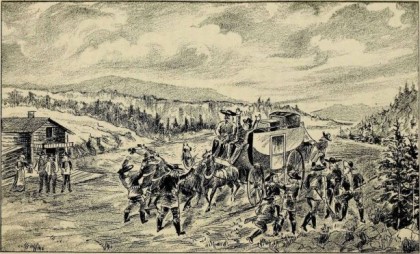 One night they found the gang around a camp fire somewhere still in the Webster area. The Militia, which I think was modeled after the Texas Rangers, did not what any upstanding law enforcers would do. They went in with guns hot, lighting up the night with muzzle flashes. All dead, except a small group, maybe 2 or 3, who escaped with the loot. No one saw them leave and they ran in the dark so they didn’t pay attention to where they ran.
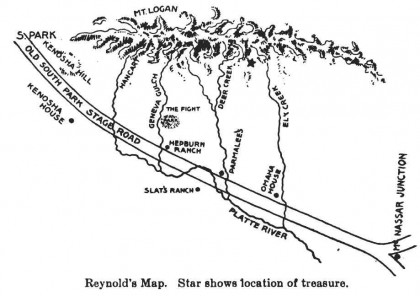 Yes. They dug a hole or found a small cave or animal den, stashed the loot and ran on to escape the militia. They lived long enough to mention to somebody that they’d stuck a knife in a tree to mark the sport. But the militia caught up with them later. Dead. So somewhere in the mountains around the former townsite of Webster is a tree with the tang of a knife protruding, probably about 20 feet up now, allowing for the growth of the tree.