The Blood of the Lamb

Spring                                                   Mountain Spring Moon

There are historic occasions that are of major cultural significance, then there are occasions of historic significance on a smaller scale. Last night Jen  hosted her first seder. It felt good to drive over to their home (see above for the route) for a holiday, especially passover. One of the characteristics of Judaism that has long appealed to me is its emphasis on worship and holidays centered in the home.

Many of the most memorable holidays like Hannukah and Sukkoth are observed in the home. And, in fact, passover, a key holiday for Jewish identity along with Rosh Hoshanah Purim and Yom Kippur, is largely a home based celebration. I’ve been to several over the years, but none of them were as sweet as this one.

A Rabbinic Haggadah guides those gathered through this old, old ritual. Traditional estimates place the Exodus, the story at the heart of pesach, or passover, in 1300 B.C.E. Perhaps three thousand years old pesach links each Jewish family and their seder guests to a time of liberation from bondage, making freedom from slavery an essential part of Jewish identity.

To join family in a celebration with this much history makes my heart glad. Though the metaphysics of Judaism do not appeal to me, the long march, the ancientrail of Jewish identity held constant throughout millennia by these very same observances does. And I felt privileged to be there.


Seasonal Visitation

Spring                                            Mountain Spring Moon


Drive down the mountain to Aspen Park, get on Hwy 285 to Denver, get just past the ring road, Highway 470, and suddenly you’ve located spring. Pastures in the horse enclosures are green. Lawns on the houses tucked into the eastern facing slope of the foothills. Green.

In Denver itself, on residential streets, gay daffodils and colored hyacinths add yellows and pinks and blues and whites to the green. Nature’s most festive season is underway. At 5280 feet. Not so much at 8,800. Here the snow lingers, what lawns there are, not many, remain brown. There is not the earth shaking itself awake after a long winter’s slumber here. Not yet. No mountain spring for now. But the season can be visited not far away.

Habitual

Spring                                          Mountain Spring Moon

New morning habit in process of forming. I’m going to protect the time from 5:45-11:00 am for work with timeout for breakfast. After long experience, I know that I don’t do well if my work times get interrupted. This means I’ll need to make appointments for the afternoons in the future. Yes, this potentially interferes with my workout regimen, which begins at 4:00 pm each day. And, yes, it could disrupt my nap, but I think the advantages outweigh the hassles.

It also means I’ll not be posting here until mid-day, nor will I check e-mails, do other kinds of work on the computer until the afternoon or evening.

What will I be doing in those morning hours? Latin. Moving forward with my translation of Book VII which I plan to be my first complete book translated. There are 15. Writing. I’ll be working on Superior Wolf, writing and researching.

It’s odd, but the sunny disposition of Colorado really leans toward the outdoors, not like the cold and gloomy winters and early springs in Minnesota, where staying inside just made sense. This focus on mornings spent with the mind will have outside interference. I’ll have to focus harder on getting in hikes, plant identification, exploration in the time I have available.

I’ve been taken over the last few weeks with an idea from the Baghavad Gita, action with out attachment to the results. In the Gita this notion prunes karma, since it is the entrapment of desire that bends karma one way or the other. With no focus on the result the action cannot produce bad karma. This is not the way I see it though I understand this more orthodox approach.

Instead I find the idea of action without attachment to the result as a way to cut the final cord tying me to the bourgeois desire for achievement. It was this strain of thinking that cut across my cerebral cortex when living large popped up. In other words I learn Latin with no final end in mind. Being an amateur classicist is what I will do, defining the realm in which I will act. Just so the writing. Writing novels, being a writer is what I will do, what I have done. But the results of that action? Not important. Grandparenting. Gardening. Bee keeping. All the same.

So creating the atmosphere in which I can act is critical. Creating an atmosphere in which I succeed, not so much so.

Living Large

Spring                                                   Mountain Spring Moon

Over the last couple of days an e-mail exchange between two friends used, twice, the phrase living large. As sometimes happens, this time I looked at it and said, huh? What does that mean? So I looked it up in the urban dictionary and another online slang dictionary. Here’s what they had:

able to pay for and enjoying a very expensive style of living.  Vacations in the hot spots, a huge apartment in the city, cars, servants – that’s my idea of living large!

phr. Doing okay. (The response to How ya living?) I’m living large. How you doing?

Living with an extravagant or self-indulgent lifestyle.

In a cascade came another phrase: How then, shall we live? then, Peter Singer’s new book: Doing the Most Good. Then, what? And, living well is the best revenge.

I’ve always been struck by the power of unspoken, perhaps even unknown motivators, things that might have entered our psychic world unnoticed, sort of sliding in under our usual filters. My suspicion is that living large is such an unspoken, often unknown motivator.

The idea of being able to spread out in your world, to recline at your ease where and when you want underlies many an entrepreneur’s aspirations. It drives many during the long years of getting professional degrees, especially in the law and medicine. Those kids shooting hoops on inner-city asphalt, the rapper with the gold medallion around the neck, even the drug dealers and pimps, all want to live large. And, you might say, why not?

Yes, there’s the American dream. And, now the Chinese dream. In both cases you might say the dream is to live large in relation to poverty, to the uncertain rungs on society’s socioeconomic ladders. In that original dream the goal is a stable life, one with a home, enough food, savings, health care, education for the kids. And, yes, for many, maybe most of humanity, over most of history that goal would have been unattainable. In that sense these modest dreams represent living large.

But these kind of dreams have a way of metastasizing, like body builders on steroids, like an unchecked cancer. Instead of being a dream they become a nightmare of needs turned into desires and desires turned into lust. In this, its more usual sense, I think living large represents the corrupting influence of late-stage capitalism, where to gain more becomes its own rationale. Living large is not an aim, it’s a manifesto of unchecked wants that will, somehow, be satisfied.

Living small. Now there’s an aim.

Tourists

Spring                                   Mountain Spring Moon

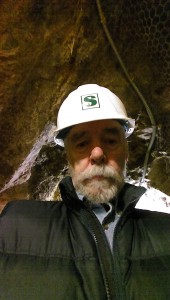
IMAG1001Gabe and I had an adventure yesterday. We went to the Agro Mine Tour, ate lunch at Beau Jo’s Pizza in Idaho Springs and finished off the day with a soporific soak at the Indian Hot Springs, also in Idaho Springs.

The mine tour itself is a cheesy, tourist-trappy thing with a clunky video, corny presentations and a self-guided tour after that. Still, the Double Eagle Mine, Gage is at its face (end) in this photo is remarkable in that it was dug by hand, by two men over the course of one year. About three hundred feet long, maybe five and a half feet tall and about 4 feet or so in width, it’s a monument to persistence, if nothing else.

The rest of the tour focuses not on a mine, but on the Agro mill, which in its prime, produced $100,000,000 worth of gold when gold was at $18-35 an ounce. It was fed by the Agro tunnel, a 4.5 mile tunnel dug through solid rock to remove waste water from various mines and to create a small railroad to deliver ore buckets to the Agro mill.

The Agro mill closed in 1943 when, on the last blast of the day, four unlucky miners IMAG1000dynamited a wall holding back water filling up an abandoned silver mine. The resulting flood geysered water from the tunnel for 9 hours. In addition to killing the miners the flood weakened walls and caused cave-ins along the tunnels length making the railroad tracks no longer usable.

The mill itself went down in stairstep like levels since most of the work proceeded through the aid of gravity. The Agro tunnel fed ore in from the top of the mill and the processing went in stages toward the bottom. A structure made of wood it looked like an unsafe place to have worked.

Idaho Springs is about 30 minutes outside of Denver to the west and well into the mountains. The Colorado Mineral Belt, which begins in the San Juan Mountains in the far southern part of the state, makes an arc up through Leadville and finds its terminus just a bit further north from Idaho Springs. Along this arc lie most of the mines in Colorado, many of them producing, like the mines the Agro Mill serviced gold, silver, copper, lead and zinc. Some have molybdenum and other metals. There’s a big, working molybdenum mine outside of Leadville.

Idaho Springs is a tourist town, primarily, located on either side of a long main street paralleling I-70. It has some residential housing, but not much. Service stations, inexpensive motels, restaurants, curio shops, a knife shop, a hardware store which sells gold panning supplies, that sort of thing.

And the Indian Hot Springs. The facilities, both the main building and the adjoining motel, saw their better days many years ago. The springs, though, deliver. Gabe and I swam in a large pool of water, 100 degrees +. There are, too, hot springs caves, a men’s and a women’s cave where clothing is optional.  Kids under 16 are not allowed in the caves.

After all that, it was back to Denver and a quick exit so Grandpop could beat the rush hour traffic on the way home.


The Biological Arc

Spring                                              Mountain Spring Moon

Wild. Wilderness. These ideas have established themselves as a filter in my mind, a sort of osmotic membrane that pulls notions out of books, magazines, my own thoughts.

Last night, as I went to sleep, wild and civilized kept pushing through various permutations. I recall best the idea that life itself is a wild adventure, a biological arc, for us mammals it extends from conception through birth to death. This idea sets to the side the notion of civilization as counterpoint to the wild and focuses on inanimate material animated. And not only animated in the human instance, but aware. And not only aware, but self-aware, knowing the biological arc, knowing our location in that arc at any one point in our life.

This is a radical, wild variation on the cold vast wilderness that seems to be our solar system, perhaps our whole universe. If we conceive, we humans on earth, of wilderness as a spot where nature can proceed according to its rhythms, ruled and influenced only by its own law-as it does in the vasty reaches of space, then we might consider the role within it, of an individual tree or wolf or rabbit or stream or mountain.

In a wilderness that really represents an unbroken continuity with the deep biological and geological past a particular tree is still, just like each living instance of the human, the inanimate animated. The tree reaches down with its root system-let’s imagine this tree is a bristlecone pine-into the soil beneath its trunk and develops an intimate relation with the minerals, the biome beneath the surface and available water.  It transforms the riches found there into more bristlecone pine. This individual tree, this bristlecone pine, in this pristine wilderness is an agent of literal metamorphosis, taking the inanimate and making it animate.

No less would an individual human in a pristine wilderness or one in the heart of its polar opposite, a contemporary megacity, accomplish the same magic. With one crucial exception, of course. Photosynthesis. The bristlecone pine not only reaches into the soil beneath, but into the air above and pulls out gases, incorporating them through its leaves into its whole body, mixing those gases with material drawn up from the soil. And one more. It takes the furious wild energy spawned in the nuclear fusion reactions of our sun and uses it to drive this process of animation.

In this sense then the individual bristlecone pine in the wilderness and the human on the streets of Shanghai are both radicals. That is, they both animate the inanimate, take up the elemental shards of the primeval universe and reshape them into patterns not native to their physics.

Within the biosphere, the realm of the living, most of its constituents live, then die. The magic drains out of the individual fish, the domestic cat, the high flying condor, the deep swimming whale. They release the elements they have animated back to cycles linked directly to the act of cosmic creation.

In humans this biological arc goes from conception through live birth to death. Both ends of this continuum, this biological dialectic, are, relative to human civilization, moments deeply wild. They participate only lightly and then inconsequentially in the world of ideas, technology, skill, labor, culture. They both represent key inflections of our wild nature: coming to individual life and leaving it. These moments are not mediated by culture, rather they rip into its fabric and insert or remove individuals from its complex ministrations.

So each of us is wild and free at the moment of our birth and our death. The question then is how much civilization constrains our inherently wild nature. I’ll consider this in another post.

Vulnerable & OK

Spring                           Mountain Spring Moon

Quick note to say I’ve moved past the mood of the last post. Business meeting this morning with Kate at the Wildflower. We shared some of our mutual vulnerabilities: mortality, worthiness, relationships with kids and grandkids. In that unusual alchemy of love vulnerabilities shared become a source of strength and self-forgiveness. 25 years now of letting each other in, hearing and the seeing each other, loving each other. A gift beyond measure.

Fortuna, Fortuna Why Hast Thou Forsaken Me?

Spring                                      Mountain Spring Moon

Into Denver to the Village Inn last night to play sheepshead. We had 10 people, so two tables of five which is ideal. Not sure whether I’m more timid in a new group, got bad cards or am just playing poorly, but I got clobbered last night. Disappointed. Let it get to me on the way home. Disappointed in that, too.

Putting it out there like that helps me see the evening more clearly. I go for fun and come back unhappy? Hmmm. Something’s not right there. With my attitude. I do miss my old sheepshead gang, the three ex-Jesuits: Bill, Ed and Dick and the Dorothy Day Catholic, Roy. We had a solid, human bond.

The Village Inn is in Denver, just past I-25 on Colorado Boulevard. It collects loners. A goth girl with a bumper-stickered laptop, a Chinese man and his autistic brother, “I would like 4 crackers. Could I have 4 crackers, please? I need 4 crackers.” A guy with a bad comb over, denim ranch jacket, looking at his philly steak sandwich with careful intent.

It also hosts, on Friday evenings, two different groups of card players, ours and a pinochle, canasta crowd that always has the table set in a small alcove. We end up with a round table, plus a couple of other tables. The atmosphere is one of faint urban desperation decorated with bright colors and cheery waitresses.

The sheepshead crowd is Polish Catholic Church for Wisconsinites and their friends. We come together, talk about the Packers, use German language terms like schneider and maurer, and play this odd game. Could be Milwaukee or Wittenberg or Sturgeon Bay. For two or three hours. Then it’s back to Colorado and Shadow Mountain.

Born To Be Wild

Spring                                 Mountain Spring Moon

In late April, early May I will attend my 27th retreat with the Woolly Mammoths, this year in Ely at the YMCA’s Camp du Nord. Often we have a theme and I suggested the following:

Been thinking about topic and theme. Seems like Ely area cries out for considering the wilderness, the wild within and without. What does it mean to be wild? In your life? In your heart? In and with your passions? Does wildness have anything to say to the third phase? How does wilderness feed us, heal us? Why? Another aspect of the same idea. What is to be human and wild? How do humans fit into the wild? Do we? Can we? It seems to me this is much of what Will Steger has dealt with.

As I’ve begun to consider these questions, take them into my heart, my civilized and my wild heart, they’ve begun to pull information out of the surrounding atmosphere. As often happens once we focus on something.

One source that has been prodding me over the last week is a book, The Great Divide: A Biography of the Rocky Mountains, by Gary Ferguson. In the first chapter on Mountain Men comes this observation. Richard Slotkin, an American studies professor at Wesleyan University suggests that a main theme of early America was the shredding of conventional European mythology and getting to a more primary source, the “blood knowledge” of the wilderness. Since was the time of Emerson and Thoreau, too, both of whom were instrumental in the turn away from European influence and toward development of American letters, American thought, American literature and who were, again both, focused on the natural world as a source of inspiration, it seems this tendency to turn our back on “civilization,” whether European then, or decadent American late-stage capitalism now, and look to the wilderness for guidance is an integral aspect of the American character.

It may be less so now than then, but nonetheless, it endures. Look at the heritage of John Muir, Aldo Leopold, the outdoors ethos of Minnesota, Colorado and Alaska (to name state cultures I know), the idea of the West.

In this same chapter Ferguson counterpoises the Easterners romanticization of the mountain men as true individuals living with unfettered freedom with the civilized and European inflected culture of the East Coast. This was true, he says, throughout the 19th century. In fact, many of the mountain men worked in companies of 20-30, with some trapping, some hunting, some cooking, some taking care of supplies and pelts. They also tended to travel with their families and were surprisingly well-educated. About 1/5 of the mountain men left memoirs and many were fluent in both Latin and Greek.

I mention this because when our gaze turns toward the Boundary Waters Wilderness, the Rocky Mountains, the Sierra Nevada range or the expanses of wilderness in Alaska, to mention only a few of the wild areas in the U.S. alone, we often look toward them as places of healing, zones where civilization can be shed, as mystical bounded lands within which magic of a sort is still possible.

In fact though these are simply places where the hand of civilization has been light-though not absent. Witness acid rain, the extinction or near extinction of apex predators, and now the slow creep of climate change. And the need for a word like wilderness, the notion of wild occurs only when its dialectical opponent, civilization, has become ascendant.

So, to consider the wild in our hearts, in our lives, in our country we need also look at how civilized we are. What being civilized means. What needs civilization meets that wilderness does not and the reverse. We must also consider that the dynamics of these questions are bound up, in a particular way, with the American experience, with our sense of who we are as a people and a nation. It is not enough, in other words, to imagine the wild heart, but we must also attend to its gilded cage. It is not enough to seek the blood knowledge of the wilderness, but we must also attend to the context, our everyday home, where that knowledge has been lost.

Spring               Mountain Spring Moon


Finished checking my translation of Medea and Aeson, Book VII:159-237. Took a good while, a lot longer than it took to do the roughed out translation, but the work held up pretty well. This time through was especially useful for those areas where I’d had trouble. The context was clearer, having translated most of the story already, and the time away gave me clarity, too.