Under the Planting Moon

Beltane                                Waxing Planting Moon

Under the planting moon a large batch of potatoes will hit the soil, companion planted with bush beans.  Nasturtiums go in today, too.  I may have to replant a few things I optimistically sowed a couple of weeks ago.  I knew better.

Finished Wheelock chapter 15.  Gonna let that sink in for today, then I’ll hit the Ovid tomorrow.

Kate and I head out to the new Hindu Mandir in the northwestern burbs tonight for a tour and a meal.  Should be fun.

Goin’ outside.

Latin

Beltane                                  Waxing Planting Moon

An all day Latin day.  I know, a beautiful day and I stayed inside with Wheelock.  Well, I worked outside all day yesterday and will work outside some more further on in the week.  I’ve discovered that, for me, when learning Latin, sticking close to one unit and working with it in a solid block of time allows me learn, integrated and reinforce new ideas.

Today the focus was on cardinal and ordinal numbers, ablative and genitive particulars.  I’m not quite done, but I got far enough along that the new stuff has begun to sink in.  My goal is to finish the chapter, then spend another block of time on Ovid.

If I wait until the weekdays, things begin to interfere and I don’t have the large chunk of time I need when confronted with new material.  I always perceived myself as a poor language student, now I think I never devoted enough time to it.

It feels good, learning new things then putting them to use in translating Ovid.

Bee Diary: May 16, 2010

Beltane                                                     Waxing Planting Moon

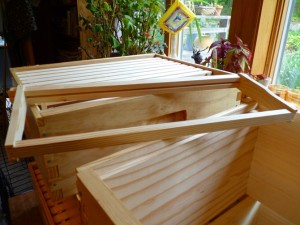
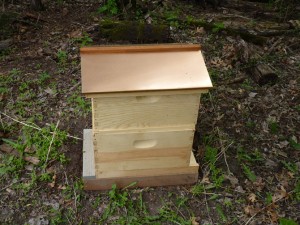
The bee project here has two active workers, a woodenware maker and a bee keeper.  Kate has put together 7 honey supers and 70 frames plus four, and counting, hive 05-15-10_bees_woodenware1colony31boxes and 26 frames.  Without her patient and careful craftswomanship, the hives would not exist.  I’m just no good at the fine, repetitive tasks involved in woodworking, but she is.  She brings an artisan’s hand to her work.  As a result we have beautiful hives.

A possible identity for our hives has begun to take shape.  Artemis is one of the many bee goddesses, but she is a familiar name, at least to some, so Artemis Honey is a strong possible name.  A common offering to Artemis was honeycakes, so we might be:  Artemis Honey, The Honeycake Honey.  When we start getting enough honey to exceed our use, including gifts, then we’ll start selling at farmer’s markets.  We’ll need a name, a label, a brand.  We’ll include a  honeycake recipe with every container sold and Kate has agreed to bake up some honeycakes to use as samples at our stands.  Let us know what you think.

Checked the crops today and harvested parsnips.  One resisted leaving its happy home in the raised bed.  It came out well over a foot long.  Smelling the tiny roots off the parsnip just after pulling, amazing.  A sweet, earthy, pure scent.  Wish I could bottle it.

When I left the MIA on Friday, I noticed on my walk back to the car, a migration of caterpillars.  I believe they were swallowtail butterflies in there can’t fly yet stage.  All of them, scores if not hundreds, chose northeast as their route across the warm concrete sidewalks that run between the Children’s Theater and the MCAD campus.  At first I just noticed their numbers, then I saw their common journey.

Where I wondered, did they begin?  So, I followed them back, moving against the small, humping crowd until I found a crabapple tree along an MCAD sidewalk.  Looking up I noticed caterpillars soon to head north by northeast eating their way out to the end of small branches, then, as the branch bent under their weight, falling to the grass.  Why they decided on their direction, I have no idea.

The world still smells of lilacs

Beltane                             Waxing Planting Moon

from a difficult time in my life:lilacs-10340

The world still smells of lilacs

A star rises from my heart

Into the dark, dark sky.

You and I.

As other celestial objects

Wheel and slowly turn

The star shines.  An urn

Reflects the star light,

It contains the dust

what remains of us.

The star o’er sheep once played

A hope that grew

From a babe into

A savior, a christ,

A man who loved and died.

It watches as we are tried

In the crucible of time

And found wanton.

Left for abandon.

Oh, well.  I loved you once.

The star traverses the sky

Watching, as we die

The death of personal crucifixion

A penalty which seems too harsh.

Yet, a bird sings on the marsh.

The sun rises rosy-fingered,

Eggs are hatching.

Gates are latching.

The world still smells of lilacs

Bee Diary: May 15, 2010

Beltane                                        Waxing Planting Moon

Colony 1, the parent colony, got a reversal of the two hive boxes today.  I checked the honey supers and they have some honey, a very modest amount, but they still have a lot of comb to draw out, so the honey will come when that work finishes.  This colony has bees all over the place and they were ornery today, buzzing, circling, hitting the screen of my veil but not stinging.  They flew up in concentric tornadic columns from the hive entrance, making the noise that sends wise predators running.

Ah, well.  The beekeeper goes where wiser beings fear to tread.   With smoke, slow movements and a work plan I’ve not the found the bees difficult, but that one day where I 05-15-10_bee-diary_0002670defied common sense and peeked in without the bee suit or smoke, I did.  The multiple stings I took color my movements and my tolerance of the task at hand, making me want to move quicker, get done a bit sooner that good beekeeping suggests.  My hope is that repeated visits to the hives combined with good management practices will slowly drain that anxiety.

Colony 2, the child colony, has the old hive box from the parent and a new, young marked queen.  I didn’t see her today, but I did see larvae, so she’s there and at work.  After I checked for swarm cells, I closed colony 2 back up.  Finally, colony 3, the package colony hived about 3 weeks ago had worked through their initial bucket of syrup, so I had to come inside and make a new one for them.  The pollen patty was good.  Again, there were larvae and the comb looks fresh and beautiful.  I closed them up and declared this week’s bee duties discharged.

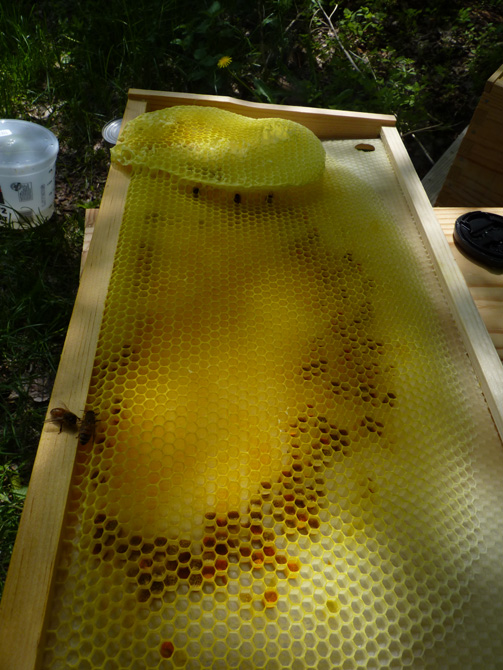
I’m sending the picture here into the UofM to ask about the pancake shaped additional comb the bees have built.  I’m also going to ask about black streaked comb.  I couldn’t find the frame, I think it’s in the parent colony, but I saw it when I made the divide.

Bee Plan for the Weekend

Beltane                                     New Moon (Planting)

The sun.  The sun.  We’ve been doing a great imitation of Seattle for the past week, cool and rainy.  Today and tomorrow we’ll have plenty of sun.  I’m glad because I have to check on my division (#2), see how their doing; check on my package colony (#3), see if they’re drawing out comb, the queen’s laying brood; and, finally, I have to check the two honey supers on the parent colony (#1) and see if I have to add supers, as well as doing a reverse on the two hive boxes.  The reverse follows, roughly, the amount of time it takes a queen to migrate into the next hive box.  This way, she lays eggs in the bottom hive box, then moves up into the top one, lessening the chance that the colony will feel crowded and want to swarm.

Tomorrow, too, I’m going to take my new digital camera and shoot pictures of the pancake comb I’m seeing, as well as the dark, splotchy comb.  I’ll send the pictures to Gary Reuters at the UofM to get his take on them.

The sun after a long stretch of Aunt Roberta dull, gray days makes me feel great.  Work to be done and time to do it.

Kate continues to look forward to her hip surgery as the pain in her right hip has become excruciating.  I’ll be glad for her when its better.

Bee Diary: May 13, 2010

Beltane                                  New Moon

On Tuesday night I attended my first meeting of the Minnesota Hobby Beekeepers Association.  Down a muddy road near the practice field for women’s soccer at the corner of Larpenteur and Cleveland in St. Paul, part of the St. Paul campus of the U. of M., lie a small, old complex of buildings that house the bee research facilities for the UofM.  They’re not much to look at.  The bee yard has knock down chain link fence around its blue, gray and tan hive boxes.  A building that would fit well on a run down farmstead in northern Minnesota seems to house bee equipment and a more modern, but well used building with a truck dock and sliding door completes the place.

It would be a mistake to take this as a reflection of the quality of the work done by Marla Spivak, her bee wrangler Gary and a small flock of grad students.  Some of the finest bee research on colony collapse disorder has been done here as well as the development of a strain, the Minnesota Hygienic, specifically bred to combat it.

When I arrived, the loading dock area had a crowd of maybe 50 people, most, like me, under dressed for the 43 degree rainy weather.  A smattering had bee suits.  We had been asked to bring them since there would be a live demonstration of dividing a hive.  I brought mine and put it on, not to protect me from the bees but from the chill in the evening air.

Two young female grad students got out the smoker, cracked the hive boxes and went through the various moves necessary to complete the division of an over-wintered colony into a parent and a child colony.  I did this a couple of weeks ago, so it was review, but helpful anyhow.  I had not, for example, tilted the queen cage up so the syrup would not drown her in case it entered her cage.  I had also forgotten to remove a frame way earlier, though I did do that on the day I divided the colony.

This was very informal with frames passed around so folks could see larvae, identify drone cells, that sort of thing.  There were a lot of absolute newbees there.  I felt I had a bit of experience on them, but not much.

After that we retired to Hodson Hall on the campus about a quarter of a mile from the bee yard.  There we sat in tiered seats, an entomology class room, evident by the row of glass cases outside containing japanese beetles, cotton moths and water borne larvae.  This was informal, too, consisting of a few presentations.

One guy had a method apparently used in Canada to increase the field force available to one set of honey supers.  This involves two hive boxes set side by side with a queen excluder over half of each.  A board covers the exposed part of each hive box.  This allows two queens to lay eggs, increase the number of worker bees.  The honey supers get filled up quicker and with better drawn comb for comb honey.

Another guy brought a beautiful top-bar frame in with a free formed comb.   Then we had pizza, mingled a bit, heard another presenter, and left.  This will be a useful group as time wears on.

Paddling

Beltane                                 New Moon

Boy, I’m just keeping my head above water right now.  Finished my Latin this morning and managed only two verses of Ovid before my tutoring session.  This afternoon I have to get ready for a tour tomorrow morning.  Over the weekend there is more bee work to do and more garden work to do, too.

I also need to find enough time to finish chapter 15 in Wheelock, a few more verses in Ovid and  plan the final meeting of the Sierra Club’s executive committee.  I’m not complaining, this pace keeps me alive, moving forward, just observing that this period has had a confluence of activity.

The Self

Beltane                                   New Moon

In theology and philosophy an anthropology reveals how the system views the human.  The Cartesian split between body and mind is an anthropology as is Freud’s id-ego-superego.  A familiar medieval anthropology is the body-mind-soul, a tripartite division.  From just these three examples you can see that anthropologies often get layered one upon the other rather than displacing each other.  We assume the Cartesian anthropology when we cannot imagine mind moving or directly affecting anything in the material world, but we might also believe in the medieval body-mind-soul division when it comes to the afterlife.  We may also, in our daily lives, use Freud’s work to analyze our own motivations and dilemmas.

One of the valuable lessons seminary taught me was that we each have our own theology, our own psychology, our own metaphysic, our own philosophy, our own anthropology.  That is, we all have conclusions, though they may be unformed and unsystematic, about the nature of the sacred, the operations of the human mind, the way the universe is really put together, our own views on beauty, truth and justice.  We each, too, have our own anthropology, gleaned from our years of experience as an example of the kind as well as our years of observation of others of our kind.

Here’s my anthropology in summary.  We are unique, solitary and complete within ourselves, yet each of us yearns for the other, some contact, some intimacy that suggests our unique and solitary nature does not condemn us to life alone.  This tension between our isolated existence and our yearning for connection is unresolvable, creating a great deal of suffering, though also creating the purest joy most of us ever know.

We live our lives, when we live them most richly and well, with what I call the Self constantly with us.  The Self is not a perfect you, nor a successful you, rather the Self is the you that can contribute your individual gift(s) to others.  This means that the authentic life, the life lived toward the fullest expression of the Self, is, ironically, the one lived most fully for the other.

Stripping away cultural roles, parental expectations, linguistic and moral customs, seeking the you that calls you forward into richness and toward harmony with the whole of creation is our only real task in this life.  It is not easy, in fact it is hard, and prone to manipulation and deception both from within and without.

If you can, however, pare away the not-you, get down to the core, the place where the seeds of your true Self are, you can nurture those seeds until they grow strong, bloom, bear fruit.  It will be a rare fruit, a strange fruit, a fruit with a flavor and a vitality only you can bring to it.  This journey, the ancient trail inscribed over the temple to Apollo at Delphi, Know Thyself, is the only path that leads to solid ground.  Until you come to know  yourself, you stand on sand that can shift under you.

Death Came Calling

Beltane                                     Waning Flower Moon

Yesterday death came to call.  Dizziness and nausea took over my body while my mind raced back to October, 1964, trying to inhabit, again, the mind of my mother as the stroke hit her, trying to imagine the transition from vitality to powerlessness, wondering what thoughts came to her as she fell to the floor in the basement of the United Methodist Church.  Pushing this thought back, far from me, get thee behind me death, I wondered if she had done the same, imagined that this was like all the other times, a bit more severe than most perhaps, but surely something that would lift.  It didn’t.  She died a week later.

Death had come to call on me as a reminder of the future in the guise of a dark moment of the past.  All that work on Latin, I thought.  Then, just as quickly, would you have done something else?  No.  The answer is no.  At that moment a peace settled over me, if this was my time, so be it.  It’s just fine.  If not, I’ll get downstairs and study my i-stem nouns and ablatives.

Then, today, in a lecture, Nietzsche posed a hypothetical:  What if a demon came to you and said, “You will live and relive your life.  All of it.  The pains and the sorrows, the joys and accomplishments, all of it, even this visit from me.  And you will relive it not only once, but over and over.”  What is your response?  If you can say, Thank you, oh divine one, then you have lived an authentic life and have come to rest with who you are.  Nietzsche called this the myth of eternal recurrence.

I find I’m on the Thank you side of the demon question.  Yes, I’d like another helping please.

Much of my attitude toward life seems to have its roots in Nietzschean thought.  Strange that I’m just now discovering this.