Worlds Opening Up

Imbolc                                     Waning Wild Moon

On the way into St. Paul tonight I listened to lectures on Epicureanism, Stoicism and Skepticism.  These were especially relevant and resonant for me since Latin is the native language of many who took them up, though their roots were in Greece.  They got me excited about reading Cicero and Polybius, maybe Marcus Aurelius in the original.  It was a fun intersection current learnings.

Of course, in St. Paul, I play sheepshead with a group who have had varying relations with a Latinate institution, the Roman Catholic Church.  Mostly Jesuits, or ex-Jesuits rather, they have lived inside an institution directly influenced by the Latin language and Roman political culture.

The  card gods smiled on me tonight, sending me several wonderful hands.  This does not always happen so it’s fun to play them when they come.

Vita brevis, ars longa

Imbolc                                       Waning Wild Moon

Sheepshead tonight.  We seem to pass around the points, playing as if each person should get a turn at the head of the list and everyone a turn in the barrel.  Always a good time.

Tomorrow a public tour.  Stuff I enjoy.  Historical.  Highlights.  I’m still seeking a way to understand this world into which I emerged, a swimmer on the path to become a walker.  Objects, material objects, created by people with skilled hands, wild hearts and a need to create tell a part of the story.  They tell it from the inside out, the human experience filleted and boned, served up for others.  As I learn more, the ancientrail of the creator lays itself more and more open to me, oracle bones crackling in the fire, fish hooks made from bone, statues of bronze and brass, people molded from clay, ornaments from gold.  How do we wrap ourselves in the terrible passage of time, time that has seen the creators dead, dead long ago, gone, often, usually, nameless, yet the stuff they shaped continues on their journey, small capsules from the ancient past.

We see it and walk past it, looking for the next best thing, passing by the cycladic figures, the woman of LaMouthe, the Greek vases, the section of wall from Ashur-bur-nipals splendid palace, walking on past them to see the show, the Louvre show or the modern galleries, some of the objects in those places made by people still alive, still breathing, their hands still working while the sculptor who shaped the rock into the plump representation of a woman does not.

Museums are strange, often scary places if we look for the ghost, the hand behind the object, the living person with five fingers and a mother, creating with no thought that 15,000 years later–yes, 15,000 years later–we would pass by, maybe glance down, maybe not.  And what of 15,000 years from now?  17, 010 a.c.e.  Will someone walk past, glance down, wonder about who cared for this object, these objects, all those many years ago?
It’s a Bright, Shiny Day

Imbolc                                         Waning Wild Moon

The day began with another bright morning shining through the bedroom window.

Allan Grundmeier, aka the Grout Doctor, came to wash my steam bath in acid.  He’s done.  Gregg came to by give an estimate on removing and replacing the shower door.  Lois came to clean the house.  Kate took Emma to the vets to clean up a wound on her back.

I did more research for my tour tomorrow at 1:00 pm, highlights of art from 1600-1850 looking at ukiyoe prints from Japan, Honthorst’s Denial of St Peter and Rembrandt’s Lucretia.  After that I fed the dogs and prepped myself our phone call with Greg, the Latin tutor.  The Latin has gotten tougher, but the learning still seems to be happening without much agony, largely thanks to having Kate in the loop.

A nap and I’m back, ready for some more work this afternoon.  No novel today because sheepshead’s tonight and I need to get my workout in, too.

Simple, eh?

Imbolc                                                    Waning Wild Moon

Tomorrow Allan, the Grout Doctor, operates on the steam bath.  It’s been in place for 12 years or so and has some missing grout, some iron deposits, some loose tile.  He’ll give it an acid bath.  Sounds like the act of a vandal, but no, we’re going to pay him to do this.  After the acid bath some other folks will come and take out the current door.  Then, Allan will return to remove tiles and fix grout.  The door people will come and replace the door. Allan will come back and seal the entire steam bath.  Then he’ll come back  one more time and seal it a second time.  Hopefully, by this time, the tomatoes will be ripe and we’ll be able to send some home with him.

Simplicity may exist; it might.  Somewhere.  The world, however, has layers of complexity all the way down and all the way inside and all the way outside.  Think of it.  Our own cells, the cells that constitute our bodies, our very selves, are a minority population, only a 20th of the total cellular life in and on our body, the other 19/20 composed of microbes living in symbiotic relation with us or just living on or in us.  Complexity outside the human body begins with the other 6.8 billion people out there, but includes all the other animals, plants, fungi, rocks, water, air, chemicals everything and then of course we leave the earth and there is the solar system and our local galaxy and our local region and then the rest, all the rest.  In the end though there may be nothing quite as complex as the human mind, consciousness, which consists of a blooming, buzzing confusion (to borrow from William James) of synaptic pulses, stored memories and sensory input.

The Sun! The Sun!

Imbolc                                        Waning Wild Moon

On these days I often think of Fantasy Island, when Tatto would say, The plane!  The plane!  I want to run outside in the street and yell, The sun!  The sun!  After a long run of dreary weather the sight of the sun climbing higher and higher in the sky bucks us up and makes us eager for the end of winter.  By now we have earned our spring and the joys of the cold and snow have begun to fade when weighed against the possibility of flowers and vegetables and outdoor walks.

Most of us do not come to this place without some regret and I’m among them, a part of me yearning for the depths of winter with its ascetic cold and its spare landscape, but the gardener in me has begun to awaken, thinking of which vegetable to put in which plot, how much, what new flowers might look good.

Another 1,300 words in before Kate and I began to check our work chapter 6 of Wheelock.  She’s improving fast, as I knew she would.  Working together does make a difference, a major positive difference.  And just think how surprised the natives will be when we start using our newly acquired Latin on them.

What’s that?  All dead?  Really?  Whoa, that’s a pity, all this language and no place to speak it.

Sierra Club legcom tonight.  7:00 pm sharp.

An Author New To Me

Imbolc                               Full Wild Moon

An unusual day for me.  Up early, I got downstairs and had my 1,500 words in before 11:30.  I fed the dogs and began reading a short story, Duel, by Heinrich von Kleist, a German writer.  I read a remark about his work, that it was among the best in the German language, probably the best in the 19th century.  The writer of the article compared Kleist to Borges and said though that the author closest to him was Franz Kafka.  OK.  Borges and Kafka are two of my literary gods.  Kleist never wrote anything longer than a novella, didn’t leave much at all, a few short works, some plays and some anecdotes.  Someone collected them in one book.

This guy amazed me, as he would anyone, by the density and length of his sentences; yet also he impresses with their clarity and the fact that each phrase pushes the story further, not only further, but in a direction not predictable from what has gone before.  This story is maybe 12 pages long, but I didn’t get far in it, so mesmerized was I by his language.

Kate brought home lunch.  We ate.  I took a nap that knocked me out of the nuclear moratorium hearing today at the capitol.  I find myself increasingly unwilling to go into town for single events in the afternoon.  I wish it weren’t so, but there it is.

Then I worked on my 1600-1850 tour and this and thatted around until I missed my exercise.  I almost never miss exercise and never when I have the time.  Yet I did tonight.  It felt very transgressive.  Anyhow, I’m done with the night and we’ll start over tomorrow.  One good thing about exercise and me is that I have been at it long enough that missed nights, even missed weeks don’t throw me off.  I get right back up and start again.

Pragmatically Speaking

Imbolc                                     Full Wild Moon

“Human beings, by changing the inner attitudes of their minds, can change the outer aspects of their lives.” – William James

William James helped found and expand the American philosophical tradition of Pragmatism.  This is not a publicly well known school of philosophy, partly because it does not lend itself well to sound bites like dialectical reasoning, theory of forms, Occam’s razor, cogito ergo sum.

His quote teases us toward an important element of pragmatic thought, namely that truth is something we live into or toward rather than an absolute.  In fact, as this quote suggests, we can even change our own truth by changing our minds, our ways of thinking and the directions of our thoughts and in so doing, change our lives.

Pragmatism is a very American philosophical system, relying on the rough and tumble of human interaction with the world to get at what other systems find through deductive logic.  It’s messy and inexact, but it binds itself tightly to the human experience.

Here’s a nice paragraph from the Stanford Dictionary of Philosophy that will give you the flavor of James’ thought.  Pay special attention to the last sentence.

“James’s chapter on “Pragmatism and Humanism” sets out his voluntaristic epistemology. “We carve out everything,” James states, “just as we carve out constellations, to serve our human purposes” (P, 100). Nevertheless, he recognizes “resisting factors in every experience of truth-making” (P, 117), including not only our present sensations or experiences but the whole body of our prior beliefs. James holds neither that we create our truths out of nothing, nor that truth is entirely independent of humanity. He embraces “the humanistic principle: you can’t weed out the human contribution” (P, 122). He also embraces a metaphysics of process in the claim that “for pragmatism [reality] is still in the making,” whereas for “rationalism reality is ready-made and complete from all eternity” (P 123). Pragmatism’s final chapter on “Pragmatism and Religion” follows James’s line in Varieties in attacking “transcendental absolutism” for its unverifiable account of God, and in defending a “pluralistic and moralistic religion” (144)based on human experience. “On pragmatistic principles,” James writes, “if the hypothesis of God works satisfactorily in the widest sense of the word, it is true” (143).”

Full Wild Moon

Imbolc                            Full Wild Moon

Close to the horizon, appearing large and red, the Full Wild Moon lit the sky on my way home from the Vietnamese Restaurant where my Woolly brothers and I broke spring rolls together tonight.

The moon remains one of the under appreciated natural events, in my opinion.  It goes through its phases every 30 days, passing from absent through quarter, half, then full and then disappearing in the reverse order.  It’s presence in our sky affords an opportunity for beauty unsurpassed by mountain range, ocean view, desert and all we have to do is go outside at night and look up.  The moon shows up in spite of city lights and its beauty shifts and changes, giving us an astronomical show free of charge, available to all.

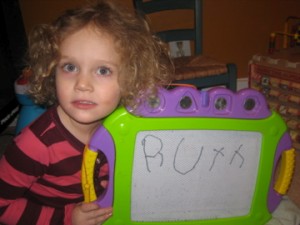
On another note.  The precocious grandchild:  I received this picture, a month in advance of her fourth birthday.  It came in an e-mail in which the subject line was:  All by herself!ruthwrites

I know.  Cute and a genius to boot!

Grandkids are special.  Each and every one.  Precious, too.

I sent them back an e-mail that read:  Great!  Now all she needs is her own checkbook.

49 Degrees!

Imbolc                                 Full Wild Moon

Paul Douglas says we reach 49 for an average high by the end of this month.  Wow.  That will be a dramatic change.

Right now the garden looks as it has since roughly mid-December, snow covered.  Today well defined shadows lead back to a bright sun shining in a clear sky.  The squirrel that took up house-keeping or food storage underneath the snow outside my study window seems to have abandoned his effort.  A rabbit comes by with some regularity to eat our shrubs.  We lost a wonderful, mature mugo pine to rabbits three or four years ago.

Rigel and Vega come back in every day with snow on their muzzles.  These big dogs love plunging into the snow for voles or mice they detect.  Every once in a while, they score.

Business meeting time.  Bye for now.

Food and Philosophy

Imbolc                                    Waxing Wild Moon

There and back.  To the grocery store.  Where, as I wandered the aisles, I got a feeling of wanting to eat a better diet.  Again.  This is not new.  It comes and goes.  Sometimes I eat great, other times I just eat.  Today I picked up some Cara Cara Navel Oranges.  I discovered them last week by accident. Boy are they good.  They look sort of like grapefruit (big chunks in the pieces), but taste almost like sweet tangerines.

On the way and back I listened to a lecture on Aristotle.  I know, I said I was fed up with this stuff, but, apparently not. Aristotle was hard for me when I studied him back in 1965.  He seems clearer to me now, more reachable.  His stuff makes more sense, but it isn’t as beautiful as Plato, nor as thought provoking.  At least to me.

The US lost to Canada in the gold medal hockey game.  Good.  When we rack up too many medals in either the summer or winter olympics, I don’t think it does our international reputation any favors.  Losing a few big ones, while devastating to the individual athletes, or team in hockey’s case, perhaps, the resulting good will is better for us.  Still, I’m proud we did well.