All posts by Charles

Kids, Chinese Heritage and Sheepshead + Buddhism

Lughnasa                          Waxing Artemis Moon

Whew.  Into the MIA for tours with kiddies from the Peace Games at the park across from the Museum.  I had two groups, one a group of girls mostly who were sensitive, responsive and imaginative.  A pleasure.  The second group was all tween boys who wandered, posed, paused and were harder to engage, though the sword did get their attention.

When finished, I knew I had to return at 5:45 and I had the option of staying, but I chose to drive back home and take a nap.  After an illness, I like to get as much rest as possible.

So, turn around at 5:00 pm and go back to the museum for a tour of the Matteo Ricci map with the Chinese Heritage Foundation.  They were a lively, bright group who could read the map!  That gave more insight into it.  Lots of good questions, conversation.

I left the museum at 6:45 and headed over to St. Paul to sheepshead.  The card gods smiled on me tonight.  After a slow start, I got some better cards.

Then, back home.  A long day.  On the drive I’ve been listening to more of the Religions of the Axial Age lectures.  The ones right now focus on Buddhism.  I’ve never found Buddhism appealing though certain elements seem helpful.  Since I’m a not a big believer in reincarnation or kharma, the Buddha seems to be solving a problem I don’t have.  After listening to the notion of no-self, I began to have a distinct puzzlement.  I don’t get how the notion of no-self and continuing rebirth co-exist.  I must be misunderstanding something.

Emperor of Ten-Thousand Calendars

Lughnasa                                     Waxing Artemis Moon

Two very different tours today:  Peace Games with small children in globs of 15 or so for 15 minutes and a Matteo Ricci tour for Chinese folks.  The first one is about fun, questions, seeking treasure and oh by the way this is art.   In the first room I have, a collection of modern Japanese ceramics, not very promising for  young kids, I’m going to have them look for something that looks like it came off an airplane and some flowers.  Then, if they seem interested, we’ll put together a group story.  In the next room there is a very cool piece in which an artist who is under pressure from the law is defended by characters from his prints.  I’ll tell the story there.  In the ukiyo-e gallery, we’ll be looking at netsuke.  The kids will decide which one is most like someone in their life.  In the next to last gallery I’ll tell the story of the Minamoto battles on the big screen, we’ll look at the samurai armor and swords.  If there’s time, we’ll hunt for animals in the last gallery.

The Matteo Ricci is something completely different.  This is an exhibit honoring a Westerner, Ricci, who visited China as a Jesuit, landing in Macao in 1583 and dying in Peking in 1610 while serving as court mathematician to the WanLi emperor.  While in Peking, he created a huge map in six large panels, a map of the world, the first to use Western and Chinese cartography.  Though Ricci had hundreds of these maps printed only 5 survived to the present day.  At least that was what was originally thought.  A London rare maps dealer found this map, the one on display at the MIA, in the collection of a private party in Japan.  It’s discovery caused one map scholar to name it “the impossible black tulip.”  The James Ford Bell Library at the university of Minnesota purchased it for $1,000,000.  It will complement their collection which “documents the history and impact of international trade prior to ca. 1800 C.E.”

It represents an interesting historical nexus, reformation and enlightenment era Europe visiting China in the final years of the Ming Dynasty, at a point when the Chinese had turned away from sailing in the age of sail and had begun to deemphasize foreign contacts just as European traders from the Dutch and Britain began to show up alongside the earlier and better established Portuguese and Spanish.  They were not alone.  It was in the early 1600’s that Japan closed the country to foreign trade and foreign visitors.

The Wanli Emperor, the Emperor of Ten Thousand Calendars, was in the last years of his reign when Ricci finally made it to Peking becoming the first Westerner in the northern capital established by the Yongle Emperor in the 15th century.  The Wanli emperor had started his reign well, executing military matters and administrative concerns with some skill.  He became disenchanted, however, with the infighting and moral attacks back and forth among Neo-Confucian scholar officials.  In response he essentially gave up the running of the country, leaving China with a faction fractured central government compounded by his imperial inaction.  The effect was to remove China from the world scene just as European exploration, commercial avarice and technological advancements grafted itself onto Europe’s own imperial ambitions.  The result of these two forces moving in opposite directions would change the course of world history, a change only now beginning to right itself from a Chinese perspective.

It was into this volatile mixture that Ricci brought European science, mathematics, art and, of course, religion.  Ricci became a literati, a member of the scholar-official class, mastering Chinese and the mores of the governing class.  His acceptance in those circles propelled him close to the Imperial court and found him buried in Peking after his death in 1610, an honor accorded to few Westerners.  He did not, however, convince many Chinese to become Roman Catholics.

I Sing The Body Electric

Lughnasa                                        Waxing Artemis Moon

The love of the body of man or woman balks account, the body itself
balks account,
That of the male is perfect, and that of the female is perfect.    “I Sing the Body Electric,” Walt Whitman

Coming to the end of another round of this summer bug, or rather virus, an intracellular interloper replicating at my expense.  Even though I’ve felt decentered, defocused and dis-eased, my body has gone on working, repelling these bad actors and throwing up barriers to their return.

Do you ever think about the daily miracle that is your body?  All the parts of it that have to work in homeostasis, levels of creatinine, thyroid hormones, testosterone, potassium and the gut with its legion of foreign bacteria working to aid our digestion and the lungs stealing oxygen from the atmosphere which has just enough that we can live and the ear which not only helps us hear but keeps us upright and steady; the nervous system wheeling electricity throughout the body turning this on, that off, moving this muscle, contracting the other, moving my fingers for example in the dance learned long ago in Alexandria-Monroe High School typing class; all that blood moving, moving, moving pulsing, delivering oxygen, energy to muscles and organs, pulsing through the heart, that fleshy pump working night and day, year in and year out, an organ we take notice of most often when it begins to fail or flail; not to forget the only organ connected directly to the brain, the eye with the optical nerve taking information back to the occipital lobe where it converts to actual images of what the eye has impressed upon it.  Amazing.

Let me say thank you to whatever long and distant chain has led from the foamy oceans of mother earth’s origins up through the one-celled, the multicelluar, the strange moving ones who finally made land and who went on to be dinosaurs and woolly mammoths and lions and tigers and bears oh my and me, too.  Each of us sit as the particular and current end-point of one line of protoplasm that could,  if we were god-like enough, be traced to its unique origin in, say, a small amoeba-like creature floating at the time in a place that would someday be called Australia.  Wonder of wonders, miracle of miracles.

Having said that what do you think of Mark Dayton?  I confess, I voted for him, in spite of my doubts, because he seemed the best bet to beat Emmer, a strange duck to have representing anybody except say, Michelle Bachmann and Sarah Palin if they constituted the whole of an odd sub-set of Minnesota voters.  We so need a Democratic governor and legislature over the next four years.  Without them budgets will get balanced on the backs of the poor, just witness the cock-up in GAMC that Warren Wolfe has covered so ably in the Star-Tribune.  Without them budgets will get balanced by trading short term gain for long term environmental degradation.  So, if you’re of the Democratic persuasion, give money, knock on doors, help them.  If you’re a Republican, take a really good long look at Emmer.  He’s a weird one and not right for this state.

Photo, Photo On The Wall

Lughnasa                                        New (Artemis) Moon

Sometimes thing go as planned.  Sometimes not.  The session with David Little (curator of photography) this morning did not go as planned.  For whatever reason we had an hour to spare, wandering the wonderful Bergman exhibition as Bill Bomash teased out clues to the stories behind the photographs.  A young girl, wanting to talk about her experience, joined the group and added her observations.  Who’s to say that was wasted time?

David Little comes out of a museum educators background and has a real feel for what is useful to docents.  He showed some new acquisitions including a surprise by Ansel Adam, a surrealist shot of a scissors and thread.  We also wandered into the 55 degree refrigerator, larger than a large meat locker, where the MIA stores it’s 11,500 photographs.  Cool, man.

He also talked about how he makes curatorial decisions, relationships with dealers and photographers, in particular as it relates to borrowing objects.  In the contemporary art and photography realm shows need relevance and he finds working with dealers and photographers much more expeditious than working with museums where the decision turn around for a loan can take as much as a year.

He and Liz Armstrong, the new contemporary arts curator, have a commitment to collecting and exhibiting work being made now and in the recent past.  The two of them, as well as Kaywin Feldman, have brought a fresh energy and verve to the whole museum and I, for one, am glad.  Not that the old museum was bad, it wasn’t, but the new folks have juiced things up, creating new ways to view and understand art.

We finished up with David Little over lunch.  He promised to get us some bibliography and to develop more in depth photography ed as new exhibitions are hung.  A good event with the timing slightly off.  The quality of the contact with David was high.  Thanks, Lisa.

Kate and I had a guy, Glenn, come up tonight and give us a presentation and bid on creating a water feature by the patio.  He seems to know his stuff and have a sensible plan to give us what we want.

Been fighting this same damned virus I had a month or so ago.  Kate says having clusters of illnesses is not unusual in that the body can retain a reservoir of the virus or bacteria.  Your body builds up antibodies and knocks it out at some point.  At least this time I have not had the pink eye or the ear infection.

So. You’re Undead. Now What?

Lughnasa                                   New (Artemis) Moon

What is it with all the vampire stuff around right now?  Those terrible Twilight movies.  The much better Vampire Diaries and the Gates on TV.  The Passage, which I just finished, written by a “literary” novelist.  Not to mention the background of Anne Rice and all those undead erotica books, I don’t recall what they’re called.  Is it about the outs and the ins?  Is it about the saved and the damned?  Is it about the need for mystery and wonder in an increasingly secular age?  There’s even a BBC series called Being Human.

I’ve not read or seen a really good vampire story, I mean really good, since Hammer Films “Horror of Dracula” with the exception of True Blood and Buffy the Vampire Slayer.  I enjoyed the Anne Rice material, her stuff about the Mayfair witches, too.  I also liked Stephen King’s Salem’s Lot.  True Blood, the HBO series is among the best ever in my opinion, right up there with Buffy.  I’m not sure what it says, either, that the ones I enjoy most are on TV.  I’m a literary and movie guy at heart, but the small screen does allow for character development and multiple story lines.

There’s a lot of media studies and cultural studies ink that has been spilled about the fascination with vampires.  I’m sure many of you who read this find them quite beside the point.  My guess is that they give us a way of exploring the notion of an afterlife without having to get to close to it.  The evil nature of the vampire prevents idolization, though much of contemporary vampire fiction plays with this received wisdom.

Even so, we wonder, what would I do if I had all the time I wanted?  What would I do?  What would I become?  If the only answer is, feed blood lust, well, that turns out to not be very interesting after a few dead bodies, but the question of love between an immortal and a mortal, that’s juicy.  What about power?  Would you seek wealth and control if you had eternal life on this earth?  What might you do if you loathed the thing being a vampire made you?  Self-loathing is a favorite distraction among teens and adults alike.  This question drives a lot of today’s Dracula derivative stories.

Whatever it is, and it’s probably each of these and more, there seems to be plenty of energy and money for turning out vampire stories.  Even bad ones.

What is Analysis for?

Lughnasa                                   New (Artemis) Moon

This month is the Artemis moon because Artemis is the goddess of honeybees and the name goddess for our hives.  Why this month?  Because the end of August is the usual time for honey extraction among beekeepers in our area.  Our brand new extraction equipment is in en route to us from Dadant Bee Supplies in 5 boxes of approximately 34 pounds each.  Some assembly required.

The honey labels, designed by fellow Woolly and graphic artist Mark (LockMan) Odegard, are spectacular.  Literally.  You’ll have to see them.  I’ll post an image when I have a photograph.  Odie offered to do this design work because he always wanted to keep bees himself.  His work displays  long study and careful craftmanship.

A short bit on a longer topic.  Analysis.  A New York Times Magazine piece, My Life In Therapy, raised a question I’ve pondered many times.  That is, does therapy accomplish anything? The author, Daphne Merkin, seems to say no, or mostly no; but, her criteria, character change, is, I think, precisely the wrong measure and gives rise to the dilemma that haunts her piece.

Ms. Merkin started in therapy early, at age 10, and has experienced several therapists, most of them Freudian if I read between the lines.  I didn’t get started so early, age 24 or so, but I saw therapists and counselors from several schools:  existentialist, bumbling pastoral counseling, Adlerian until I hit the big hole in my therapeutic road, treatment for alcoholism.  My month long stint in a Hazelden outpatient program spelled the end of my bouncing from this to that trying to sort out the unusual strategies I had for getting in my own way, many of them, near as I could figure out, related to grief over my mother’s sudden death at 46.

Getting sober made a lot of things come clear that had been foggy.  Without the medication and confusion of drinking, a lot of my life snapped into focus.  Not fast enough however to have prevented a second marriage while I was still drinking.  That marriage, like the first one, ended up in the divorce courts.

Raeone and I parted ways in 1988, but not before I sought therapy once again.  This time I landed, and I don’t recall how, in the offices of John Desteian, a Jungian analyst.  John himself and the Jungian paradigm in particular fit me.  Exploration of dreams, the linkage between imagination and self-knowledge and Jung’s special attention to the creative combined to move me forward on that most ancientrail of all, self-knowledge.  John encouraged me and forced me deeper in my self-exploration, helping me see the very real boxes I constructed, boxes that prevented me from getting to the core of my self and my true pilgrimage.

It took a long time, maybe 18  years off and on, perhaps mostly off, but at certain points weekly for a couple of years at a whack.  Over the course of time I did not go through a character change.  I went through a dramatic change in self-acceptance.  Those melancholic mood swings?  Yes, probably somewhat related to my mother’s death.  Now though they presage a return to creative activity, an ingathering of energy and self collecting itself for a push forward.  The ministry?  An aspect of my three-part self certainly– scholar, monk and poet–but not well related, since the monk is a meditative, solitary archetype for the religious life and the ministry has an extroverted, communal structure.  A better fit?  Writing, solitary work.

The writing has not been a royal road to success, measured in the externals of publishing and money-making and those are real measures.  It did, however, let me focus on creativity, on the domestic front:  cooking, husband, father, gardener and now bee-keeper and on the inner work of the religious or faith pilgrimage.  It’s not that I’ve not written, I have. Six novels.  Many short stories and essays.  This blog and many handwritten journals.  The shift did allow what I call my Self to lead me rather than the demands of the culture or my own ratocinations based on expectations from childhood.

No, I do not believe the goal of therapy or analysis is character change, a goal that may not be achievable at all.  Rather, I see the goal of analysis as the clarification of self, stripping away the accretions of fear, role, pleasing others, traps which cause us to shut some or even all of our self away as unworthy or unnecessary or unwanted,  and in that clarification coming to design a life congruent with the Self, one that nurtures and explores its unique possibilities.  This may mean dramatic role changes; it did for me, moving from the ministry to the study.  This may mean accepting parts of your self that seem unacceptable, for me melancholy and introversion and my need to write, all of which felt unwanted at one time or the other.  This may mean moving from a place of external success to a place of internal satisfaction.  It has for me.

Analysis with John Desteian, using the insights of Carl Jung, helped me achieve a goal I didn’t even know I had, becoming more like who I already was.

Working Outside

Lughnasa                                    Waning Grandchildren Moon

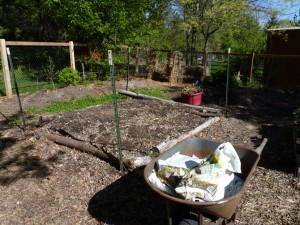
Plucked a couple of potatoes out of the ground for lunch.  Swiss chard and tiny green beans, onions, too.  Pruned back the wisteria.  It has imperial ambitions, take over the space next to it, then the tree and later, the lawn.  Cut out yellowed tomato leaves.  Not a good year for tomatoes so far, but luckily we still have some 2002 forward in glass jars thanks to Kate.  I had to stop while digging out quack grass next to the raised bed that held our onion crop.  Felt dizzy, sweating profusely.  The heat exhaustion I experienced in June seems to haunt me now.

The onions went  from their three day in the sun curing to the garden shed on the old sliding door screen for another month or so before they come inside.  The garlic is in potato670050210already.  The onions are on their way.  The potatoes and squash will make their way into the storage room last.  We still have chard and kale to freeze, beans to pick and freeze, tomatoes, carrots and various kinds of lettuce.  Soon the raspberries, the golden ones will begin to ripen, the wild grapes, too.  The hobby bee keepers say the state fair is the time to extract honey, so we’ll have that operation underway around labor day.

(the potato bed in May)

It’s not been the best gardening year for me, but we’ve still produced good food and we’ve added bees to the mix.  Anco impari, as Goya says, “I’m still learning.”

Why Go To A Museum? It’s Where Art Is.

Lughnasa                                         Waning Grandchildren Moon

Museums.  They’ve played an important role in my life since I was young.  In reading a report titled Museum’s 2034 I learned that most people like me can identify a key moment between age 5 and age 9 that cemented a strong relationship with museums.  Nothing comes to mind.  I may have had such an experience, but if I did I don’t recall it now.

My first memorable museum experiences came on the campus of Ball State University where the small art museum there drew me in on a regular basis.  At the time I had three refuges from the hectic life of a late 60’s college student:  the library, the sanctuary of a local Catholic church on weekday afternoons and the art museum.  In each one I could find my center, fend off the anxieties and confusions of having my whole world torn apart and rebuilt piece by piece.

I never found a comparable place anywhere I lived until I moved to the Twin Cities.  At that time the seminary, UTS, offered a quick tour of the Twin Cities for new students.  I chose the art focus and went for the first time to the Walker, the MIA and the Guthrie.  Over the 30 some years since then I’ve continued to go to all three though Guthrie attendance has waned over the last several years, as has those Friday evenings at the St. Paul Chamber Orchestra.

What is it about museums?  Those of us who visit them, who love them, tend to be promiscuous, visiting other museums when out of town, sometimes spending hours in their galleries, maybe even more time than we spend in our own museums.   We can’t get enough.  Of what?

Auto-didacticism must be a key motivator for all of us.  No one but ourselves makes us trek up the stone steps of the Chicago Art Institute or the Met or the National Gallery.  We enter sometimes with a plan, sometimes with a hope, sometimes as a seeker, waiting for a moment, an instance when an object meets us in the moment, rocks us back on our feet or pierces our heart or shifts the internal landscape of our mind.

I still remember the first time I saw Cezanne’s Water Lilies in Chicago.  I stopped and didn’t move for quite a while.  Singer’s Lady in White drew me in the same way in the National Gallery.  Breughel’s work in the Kunsthistorische.  Botticelli in the Uffizi.  The Sistine Chapel.  The Winged Victory of Samothrace.  Redon’s ethereal work in the Musee D’orsay. Goya’s Dr. Arrieta in our own museum.  What happens?  A living relationship begins with a work of art, a relationship that will not end until the work has been seen for the last time and not even, it ends not until the work fades from memory.  It is so much like falling in love.  Allowing another to enter into the intimate spaces, to lay itself down along the most inner corridors of the heart.  A line sometimes.  Cezanne moves me with his lines, so does Picasso.

And color.  Bonnard.  Monet.  Cezanne. Ukiyo-e prints.  Chinese silks and Japanese garments.

At least for me art is first a sensual experience, again the parallel with love.  It is a physical attraction, a force of its own, unexplainable and indefinable.  It is, later, a dialogue, but one always colored by that first, sense loaded encounter.  Museums offer the chance for these experiences and, therefore, I treasure them.

Memorable

Lughnasa                                            Waning Grandchildren Moon

Katie slipped her hands around my arm and stroked.  Then stopped and put some pressure on.  Then stroked some more.  Katie was my birthday present from a thoughtful wife.  She learned her trade from Sister Rosalind and the Sister’s school for massage.  I’m feeling knot and kink free.  Massage clears out the mind as well as the muscles.  As Katie moved around my body, memories came flooding back.  Mom’s hands on my neck when I had polio.  The Alexandria 4-H county fair.  That afternoon in Bangkok when I let a tiny Thai woman loose on my just ruptured achilles, not knowing what it was.  Steel fingers and pain.  Lots of pain.  Then the night I stepped in the sewer grate while my body moved forward and my right foot stayed in place.  Body memories, unlocked by Katie.

Memories have a fluid, slippery existence, just like Katie’s hands as she followed the process of my spine from neck to tail.  As I write about Mom and polio, an image of stuffing tissues into hardware cloth followed.  The float for homecoming for my class, seniors at last.  Being pulled away from that by who?  I don’t recall.  Then I was in Anderson, 9 miles away, at St. John’s hospital where my mother had been taken after collapsing while serving a funeral dinner.  After that the sculpted green plastic and aluminum tubing of waiting room furniture at Riley Memorial in Indianapolis.  Mom on a gurney, now 7 days after stroke, me riding with her as they took for an operation.  She reached away from me and said, “Son.”  The last words I heard from her.  The painful early morning talk with my father, should we remove the life supports?  Yes, we both decided.  Yes.  Then the funeral.  And the days and weeks and months after where I failed to integrate mom’s death as a powerful life lesson and instead took it as an emotional blast that rocked my very foundations.

Bangkok, stumbling away from the 7-11 and the amulet stand in front of it, hurrying to get to the ATM.  Traffic making me anxious, not careful.  Blinding pain, yet running anyway because of the traffic, the cars.  All the traffic and the cars.  The night air humid as the flashing neon of Chinatown bathed the sidewalk in alternating colors, like the northern lights.

As I know, we change our memories each time we access them, so all of these events, crucial as they are to my story, may not represent the truth at all, at least not the veridical, the actual truth.  But, in a more important way, they are the most truthful of all since they are the truth that has shaped my response to all these things and the thousands more accreted over the years of my life so far.  Even my account of the massage, who knows how close it is?  Yet the feeling lingers.  Good.  Feeling.

Bee Diary: August 6, 2010

Lughnasa                                     Waning Grandchildren Moon

Hive inspections today.  The package colony, the youngest of the three, began life here in late April.  Now it has three hive boxes full of brood and honey, a honey super full and has two near empties for the rest of what the summer offers.  I’m pleased I’ve gotten honey from this colony so soon.  The parent colony still has two full honey supers, a third nearing full and two near empties.  The divide has expanded itself to the necessary three hive boxes for overwintering, but early on filled the third hive box with honey.  Since then it has shown little interest in the two empty supers I put on a month or so ago.

The upshot of all this, at this point, is that we will have honey.  How much depends on the nectar flow over the next couple of weeks, but enough to justify purchasing extracting equipment.  It also means that I have two strong parent colonies going into next spring, the divide and the package, assuming, that is, that they survive the winter.  My mentor indicated that some people “knock the old queen on the head” in a parent colony, then requeen it.  If I decide to do this, it would see me next spring–again, assuming winter survival–with three parent colonies.  That would mean that in May I would have six colonies instead of four.

Right now four seems about right for what I’m trying to do.  I don’t have commercial intentions, though I may sell some honey.  I want honey for us, for friends and family, for gifts and I want to continue learning about bees.  I’ll decide over the next few weeks.

After extracting the honey, I also have to check my bees for mites and nosema.  A bridge not yet crossed.

Also spent time in the vegetable garden where I found my onion crop ready for harvest.  I pulled them out, whites reds and yellows, put them on another raised bed, now empty of its parsnips, so they can cure in the sun for three days.  Then, some weeks on a screen drying further and finally downstairs in the storage room cum shop.  Picked green beans from the plants I put in between the potatoes and also gathered in some swiss chard.  Greens tonight.  New potatoes aren’t ready yet.  I look forward to them.  Potatoes fresh from the garden are like a different vegetable.

Under my new schedule I’m supposed to work out now, but I’m going to do it after the nap.  At 4:00 pm I claim an hour of my birthday present from Kate, a massage at the oddly named, Massage Envy.