Category Archives: Woolly Mammoths

Svalbard

Summer                                                                            Solstice Moon

Friend Tom Crane and his wife Roxann are going polar.  Not bi polar, but north polar, getting all the way to the 78th parallel.  Pretty damned far north when you consider the pole itself is 90 degrees north.  On a long list of populated areas by latitude there are only three closer to the north pole and I’m guessing they’re not the kind of places you’d go to get lost in.

(Svalbard in brown on a polar projection.)

Two years ago Kate and I visited Ushuaia, Argentina, the fin del mundo, as it bills itself.  It’s where expeditions for Antarctica set forth.  By contrast it is only at the 68th parallel, a full 10 degrees closer to the equator than Svalbard.

This is one lonely location, though it’s not as isolated, interestingly, as the Hawai’ian islands.  But, I’ll bet when you’re there, it feels more isolated.  Tom says he’s drawn to this trip by the very high caliber naturalists who are along to give lectures and guide.

Svalbard came to my attention, as perhaps to yours, not as a tourist destination for an Arctic experience, but as the home of the Svalbard Seed Vault.

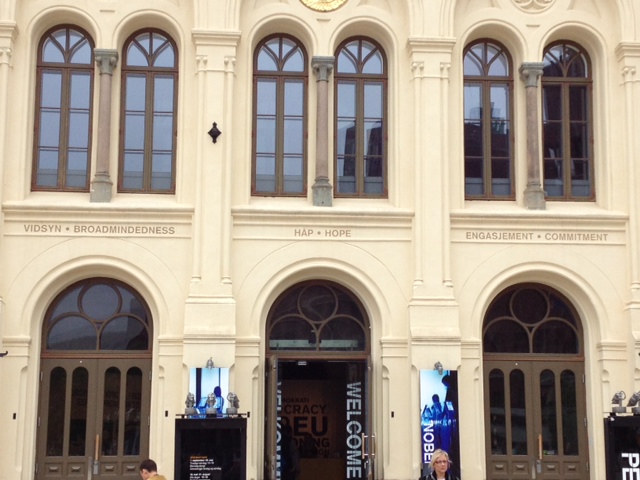
(The entrance and the portion under glass were designed by Norwegian artist, Dyveke Sannes.)

What is it?  Here’s a quick explanation from their website:

“The Svalbard Global Seed Vault, which is established in the permafrost in the mountains of Svalbard, is designed to store duplicates of seeds from seed collections around the globe. Many of these collections are in developing countries. If seeds are lost, e.g. as a result of natural disasters, war or simply a lack of resources, the seed collections may be reestablished using seeds from Svalbard.”

Here are two typically nordic answers as to why they chose this location, especially the last sentence of reason 2.

1. Svalbard, as Norwegian territory, enjoys security and political and social stability. Norway understands the importance of preserving Svalbard as an area of undisturbed nature, which is now an important research and reference area. The seed vault fits ideally into this concept.

2.  Svalbard has an isolated position far out in the ocean, between 74° and 81° N and only 1000 kilometres from the North Pole. The archipelago is characterised by an undisturbed nature. Permafrost provides stable storage conditions for seeds. Besides which there is little risk of local dispersion of seed.


Mark of Arabia

Beltane                                                                         Solstice Moon

The desert rambler has returned to visit.  Mark showed up at the backdoor this afternoon.
He went with me to the Woolly meeting at Bill Schmidt’s apartment.  Bill had a delicious meal and a very thoughtful video called Griefwalker. Stephen Jenkinson is a man who has chosen to live into death rather than away from it and has discovered great riches in the process.  Check out his website if that sort of living interests you.

(Mark two years ago)

Bill, Stefan, Mark, Warren, Frank, Scott, Mark Ellis and I were there.  Mark O. had a 60 mph car accident this last Friday, thankfully door to door rather than head to head, but scary with considerable to his car.  He reports some fears about driving now, understandable.  Warren’s making some moves on their various houses, of which they seem to have at least 2 too many and maybe 3.  Frank’s picking out burial plots.  Scott’s helping a friend deal with a schizophrenic relative who has ended up in a locked unit for her safety.  Stefan has begun to recognize that the racing, cramming pace of his life has begun to overtake him.  I talked about the shoulder pain and the p.t.

The Woolly meeting is here next time and, barring rain, we plan to make good use of the fire pit.


Bah!

Beltane                                                              Early Growth Moon

A challenge to every warm blooded Woolly Mammoth everywhere:

Now that Russian scientists claim to have retrieved a vial of blood from a thawing wooly mammoth carcass from the permafrost of Siberia, the scientific community has been buzzing with speculation that we could finally be on the cusp of bringing the wooly mammoth back from extinction. But even if we could do that, would we want to?

(I say, Let’s turn this picture around so they’re all following the one guy headed our way!)

Until now, the basic argument in favor of species de-extinction was that it offered humanity a chance to redeem itself for the wrongs committed over thousands of years. Humans, one could legitimately claim, have been mucking up the planet since time immemorial. As a result, many of the species that have been the targets of de-extinction efforts have been chosen because they seem to possess some basic fundamental right to survive. Often, they look much like species that have survived until today. If it hadn’t been for humans interfering with their natural habitats and delicate ecosystems, the argument goes, they would have been flourishing today.

Take the passenger pigeon, for example. Until 1914, the passenger pigeon was among the most plentiful species on the planet, numbering in the billions. Along the Eastern seaboard, residents could look up into the sky and see flocks of them flying overhead in such numbers that the skies went almost completely dark. And then humans got involved. Within a span of 25 years, the passenger pigeon had gone extinct, due primarily to commercial hunting and exploitation (e.g. passenger pigeon feathers were used for things like mattress filling). As a result, humans should feel at least a tinge of regret for wiping out the passenger pigeon.

But that same argument – a chance to redeem human wrongdoings over a wrongful extinction – doesn’t hold in the case of the wooly mammoth. The wooly mammoth, with its massive hair coat to preserve warmth, stood no chance for survival once the Ice Age ended. As Darwin first theorized, evolution is like an algorithm followed by nature. If an adaptation helps a species to survive and prosper, the adaptation will stick. If it doesn’t, it will eventually disappear from the gene pool. For better or for worse, certain species will go extinct when they can no longer adapt to their environment. It wasn’t just that wooly mammoths had heavy hair coats – they had all sorts of other adaptations that helped them thrive during the Ice Age, like huge tusks to clear away snow and ice. Bringing back the wooly mammoth would be tantamount to bringing back a species that deserved to go extinct.

To get around this argument, though, some scientists are starting to make the case that it wasn’t Mother Nature who did in the wooly mammoth — it was humans. Once the planet started to thaw out, humans came into contact with the wooly mammoth in greater numbers, and began to hunt them ruthlessly for their meat, bones and even skin. It’s essentially the passenger pigeon thesis, extended to the wooly mammoth. De-extinction fans will surely tell you that humans bear a type of evolutionary guilt for having wiped out the wooly mammoth, never mind climate change.

(the one in the middle looks sort of like Ode doesn’t it?)

Yes, de-extinction is a mind-blowing concept and it’s easy to understand why a number ofvery smart scientists are leading the charge to bring back extinct species. Most of the folks who turned out for the TEDx De-Extinction event in Washington, D.C. in March seemed to be good-intentioned scientists who were genuinely excited by the advances in DNA sequencing and cloning. In this TEDx video, for example, Hendrik Poinar invokes our childlike sense of wonder, suggesting that the wooly mammoth was a kind of Ice Age Babar who took a few wrong steps and unfairly got wiped out.

Even if we go with the Jurassic Park scenario – creating a highly-controlled environment (i.e. a theme park) where the wooly mammoth could conceivably flourish – it doesn’t reason that you can simply hit the “rewind” button on evolution. As some conservationists are already warning, bringing back a species like the wooly mammoth could lead to the disappearance of other species who share similar habitats. Once you bring back a new species, you have to start thinking about ecosystem effects — and about Butterfly Effects. Bringing back the wooly mammoth would require massive changes to existing ecosystems.

As a society, we need to recognize that the de-extinction of the wooly mammoth would be an evolutionary mistake. Just because we can do something doesn’t mean that we should. We often assume that evolution works in a purposeful fashion – upward and onward, with each successive step bringing us that much closer to perfection and increasing complexity. However, evolution does not necessarily follow a linear progression, enabling us to neatly re-trace our steps. There are jagged steps, hints and feints, that are impossible to replicate by simply “evolving backwards.”

At the end of the day, de-extinction implies that scientists have a better algorithm than nature does for determining which species should flourish, and which ones should not. If that’s not scientific hubris, then what is? As a result, the looming battle over de-extinction might end up being one of the few times in the history of the world that scientists and Creationists can line up on the same sideline and root for the same team to win.

 

Men Around the Woodfire

Beltane                                                                 Early Growth Moon

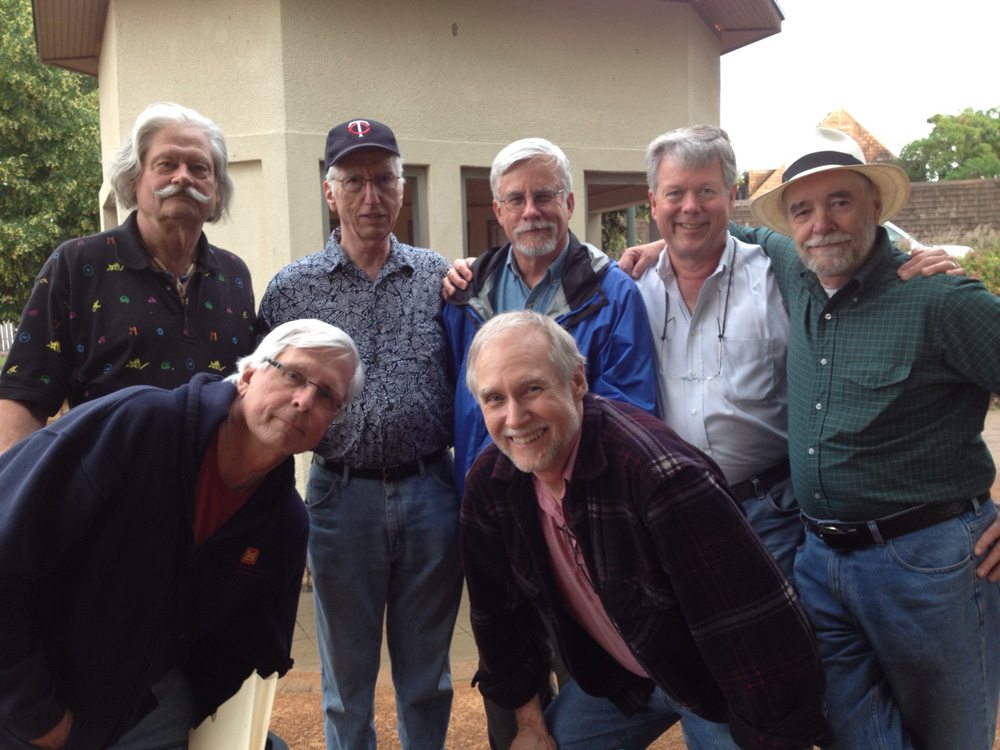
A gathering at the Woodfire Grill in St. Louis Park: Mark, Frank, Stefan, Tom, Bill and myself.  We spoke of Frank’s trip to Ireland and France, of Mark’s hunting down morels, of Tom’s single crystal which is on its way, of soil tests and gardens, Austin and the hill country of Texas, Michael Pollan’s new book: Cooked, and a book Mark is reading called the World through Drinks:  Beer, Wine, Coffee, Tea and Coca Cola. (plus one I can’t recall)

We meet, hear each other, see each other, then leave validated again.  Affirmed again.  Friends, still.

Crane Engineering

Beltane                                                                      Early Growth Moon

Out to Crane Engineering‘s 35th anniversary event.  It celebrated the time between Tom’s opening his consulting engineering business and today, with Crane Engineering’s 35 employees and three companies:  Crane Engineering, Crane Building Sciences and Crane Data Forensics.

(Tom is second from the right in the back row.)

Tom has electron microscopes, gas chromatographs, F.R.E.D. (forensic data computer by Data Intelligence), lots of other tools and a bunch of very smart folks.  Two of his guys are currently working the west Texas explosion that was in the papers a while ago.

Good food, a string quartet of laid off Minnesota Orchestra players, photographs and book by Ode.  A fun evening.  Most of the Woollies were there.

Minute Men

We sat, the four of us, old and getting older by the minute men, at a round table just like the one from Arthur’s court, poorly lit but filled with food and drink. (water)  The conversation ranged from a recent retiree wondering if he should be working on what he should do next or should he wait until the summer thinking deadline (self-imposed) had passed to the possible toxic effects of too much boron in the soil.

(Caspar David Friedrich, Stages of Life, 1835)

The herd goes its separate ways, especially in the summer months, so our monthly restaurant meetings are sometimes sparsely attended.  This one had Scott, Bill, Warren and me to carry on the conversation, now exceeding 25 years in length about our lives, our feelings, what’s showing up for us right now.

It Won’t Be Long Now

Beltane                                                                        Early Growth Moon

A poignant and salient answer to how to live the third phase came from an 18 year old Minnesotan, Zach Sobiech, who died yesterday of bone cancer.  Not much of a conversationalist or a letter writer, Zach’s Mom told him he needed to do something, something that would let people know he was here and leave them memories of him.  Diagnosed with osteosarcoma when he was 14, the cancer did not prevent him from writing and singing songs of his own.

He became an internet viral celebrity with the song, Clouds, downloaded over 3 million times.

Those of us in the third phase understand the challenge Zach faced.  Death was no longer an abstraction, but a certain visitor.  As he says in this song, it won’t be long now.  Oh, we may have 20 years or 30 years, compared to his 4, but the link is the moment when you come to know this life ends.  For good and for ever.

(Alphonse Osbert – Les chants de la nuit.)

How did he respond?  He dug into the riches of his Self, shrugged off the self-pity and depression, and turned those feelings into art.  This is the best and healthiest way to greet the coming of the Sickle Bearer.  Find out who you are.  Find out what best expresses your journey, the ancientrail that has been, is, your life.  Then open up that expression, put it outside yourself for the rest of us to learn from, to cherish, to embrace.  Because it won’t be long now.

Silly

Beltane                                                                                Planting Moon

This Woolly Mammoth group sounds silly.  I mean, Woolly Mammoth?  After all are we not men?

Then 26 years of meeting twice a month and an annual retreat.  Not so silly.  Now like the Velveteen Mammoth, rubbed so often that it’s become real.  We have grown old together and that seems like the prize in the Cracker Jacks box, one we didn’t even know was there.

Companions.  Friends.  A place to be who we are, even when it hurts.  And now a place to follow that last ancientrail together, with witnesses.

Warren the fly-fisherman.  Charlie the poet.  Stefan the painter and poet.  Mark the artist. Bill the connector.  Tom the child waiting to go outside and play.  Scott the musician.  Frank the shaman.  Paul the woodsman.  And myself, the gardener.

We are no longer our professions or our jobs, rather we are defined by our passions and our mutual affection.  Woolly Mammoths.  The herd moves along the trail, picking buttercups.

The 26th Annual Movement of the Herd: Woolly Mammoths on Retreat 2013

Beltane                                                                                     Planting Moon

Back home from the northshore, the 26th annual Woolly retreat.  Tom Crane rented a large house on Cascade Beach Road, its backyard sloped down to the gray waters of Lake Superior.  A knotty pine interior, very nice, but almost a cliche, held several bedrooms a large open kitchen and an enormous living room with cathedral windows, a floor to ceiling stone fireplace and a loft.

This retreat was different.  It was slower, less structured, far less structured and easier.  We spent time together as friends, heard each other in small groups and made treks into Grand Marais, Tofte and Lutsen lodge for meals.

On Saturday afternoon we met with a friend of Mark Odegard’s, Tom Peterson, a former DNR official in charge of the Northshore from Two Harbors to the Canadian border and inland several miles.  After we talked with him for a a bit, we folded ourselves into three vehicles and drove up the Caribou Trail, to Honeymoon Trail.  After a mile or two on the Honeymoon trail, basically a dirt road through unoccupied forest at the top of one of the Sawtooth Mountains, we found Wild Mountain Syrup.

Formerly a maple sugarer in the Taylors Falls area, this guy heard of a plot of a land, 320 acres, filled with sugar and red maples.  He drove up, saw it and bought it.  He now taps     19,000 trees each year and boils 40 gallons of sap for every one gallon of maple syrup.  He houses his operation in buildings which he dismantled from Almelund, Minnesota and moved piece by piece for reassembly.  They are square log and plaster constructions from Swedish farms.

Contemporary maple sugaring technology bypasses the iconic pails on the trees in favor of linked runs of blue plastic tubing, possibly as much as 100 miles of it at Wild Mountain Syrup.  A vacuum draws the sap out of the trees, down through the tubing where it flows into collecting drums and is then disbursed among concentrating tanks, large, open stainless steel vats.

This day the sap flowed through the tubing and out into the collecting drum like water with a tap turned on high.  It gushed out.

Later in the evening we stood around a fire on the shore of Lake Superior and gave to the fire matters we wanted to disperse from our lives.  I threw in a piece of birch bark on which I had written, my second phase man.  I marked a change on this retreat, a clear and final movement into this new time, this phase whose end  only death itself can bring.

Later yet we gathered around a poker table, six of us Scott, Bill, Stefan, Charlie, Mark and myself and played poker.  We laughed, bet and had that easy friendship men can have around a card table.  An important moment for the Woollies.

We drove back out of the gray and cold of the Northshore, no sun the whole time, to a sunny warm day.  Seemed right.