Category Archives: Bees

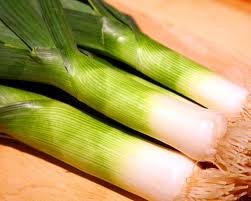
Baby Leeks Leave Home For The Raised Beds

Spring                                                                 Waning Bee Hiving Moon

Beets and leeks.  Carrots and spinach.  Lettuce and kale.  Sugar snap peas and sugar peas.  Garlic from last year.  Strawberries and raspberries.  A few missed onions.  Rhubarb.  leeksAsparagus?  We’ve got green things above ground, not far above ground, with the exception of the mighty rhubarb, but we have germination and lift out.

The bee yard has bees coming and going, busy doing what bees need to do at this time of year. They flit in and around with purpose and energy.  We were all working outside today.

It felt good to have Mark here helping, a sort of family experience.  A bit unusual in my life, but good.

When I transplanted the leeks the other day, I was proud of them.  A month ago they were just seeds in the packets from Seed Savers Exchange outside Decorah, Iowa and here they were, well underway in life, ready to go outside and grow in the wide world.  There are tomato plants still growing inside along with some kale and chard.  They won’t go until the last frost date is past, May 15 or May 20 depending on whose map you read.  Other things will get planted then, too.  Beans, in particular.  Cucumbers.

Today when I dug a trench to re-seat the irrigation head near our back deck, unearthed by Vega and Rigel two seasons ago, I got the trench finished and Gertie plopped herself right in it.  It was cool, she said, thanks.  I shooed her out of the trench and she got up willingly, only to lie down on the mound of earth removed.  Which, of course, I wanted to put back in the trench.  She looked up at me with a smile, sand bedecking the hair hanging below her mouth.

Celebrating in the Way of the Bunny

Spring                                                           Waning Bee Hiving Moon

When I pulled the grass plugs out of the entrance reducers, it was as if the bees had lined up, just waiting for me.  They streamed out, headed for nearest blooming thing.  Well, maybe not.  My understanding is that bees take short flights, then incrementally longer ones, then longer ones, until they’ve built up a knowledge base about the hive’s location.  Only then do they head off for the pollen and nectar available.  They vector using the sun, landmarks and the hive’s appearance.

Bees see color, though they see it in the infrared spectrum.  The colony, essentially a female commune, depends on the different tasks performed by workers, most of them dependent on age.  The  youngest bees serve as nurse bees, checking on larvae (instar), pupae health, cleaning the frame and building up comb if necessary.  The forager and defensive bees are the oldest bees in the colony with the exception of the queen.  They are also the crankiest, the most likely to sting and the fuddy-duddies who, if a new queen is not properly introduced, take offense and smother her.

(see the Guardian article on the pagan roots of Easter)

I wrote the first draft of Leslie’s end of the year evaluation today, too.  She has made great strides.  Though I would have thought it happened long ago, this likely will be the last time I have a working relationship with the seminary and, with the exception of the occasional sermon, Groveland.  It’s been fun to work with Leslie, but the church just does not hold the juice for me anymore.  Liberal religion is an interesting thought world, an anti-faith faith and for most of its adherents, a godless religion.  A strange animal indeed.

After the nap I went outside to finalize the planting scheme for this year.  I have a small moleskine notebook in which I record my planting schemes, primarily to keep my memory clear about rotation planting.  It can get complicated.  This was a blue sky, yellow sun day.  Birds sang and a light breeze blew through the trees, still leafless.  Writing in my notebook, I felt  a connection to the other gardens we’ve planted, the ones from which we probably still have tomatoes, beans, onions, chutney, sauces.  Each gardening year is its own event, never duplicated.  There are averages and likelihoods, but mother nature does not repeat with slavish devotion to detail, rather in the large strokes, warmer and wetter in summer, colder and drier in winter.

Later Kate came out and I consulted her about how many tomato plants she wanted, where she wanted the beans and the peas to go.  We marked them with the wonderful tomato cages we purchased three years ago, thick metal rods enameled orange, sturdy.  She set out to string netting for the sugar snap peas and I planted carrots, then leeks.  Mark smoothed out last year’s potato bed where this year we will plant beans and onions.  He put in several rows of white onions and when I left him was planting red onions.  Kate planted the sugar snaps and the dwarf peas, too.

I came inside to get ready for tai chi.  I’ve made a decision, at least for right now, about resistance work.  I’m going to continue my intensive aerobic work, focused on cardiovascular health, but I’m going to set aside the resistance work for now in favor of tai chi.  My reasoning is that the primary gain I wanted from resistance work is strength to avoid falls.  Tai chi, carefully cultivated and practiced, approaches the question of balance from a different perspective, whole body balancing and leg strengthening, movement centered over the foot.  I just don’t have the willingness to do 45 minutes + of aerobics plus tai chi plus resistance work.  At least not right now.  I will get some resistance work naturally during the gardening season.

The Early Growing Season

Spring ( it even looks like spring today!)                             Waning Bee Hiving Moon

This morning or early this afternoon I pull the grass out of the entrance reducers and the bees will be free to navigate from their new home.  Tomorrow I’ll check on the hive to see if the bees have remained focused in the middle of the hive box.  Otherwise the newbees have the run of the grounds and the air around here.  From now through fall we’ll be engaged in a delicate dance, first to prevent swarming, then to encourage adequate honey supplies for winter, then, if possible, production of surplus honey for sale.

One colony will receive the traditional treatment with three hive boxes, reversed and prepared for winter.   The other two get another hive box and after that, supers.  I’m trying to gauge how much sense it makes to struggle with overwintering since the odds seem stacked against it.

Veggies go in the ground, today, too, seeds and a few transplants–leeks, in particular.  Yesterday I moved the tomato seedlings to larger pots.  The seed potatoes are in a kitchen window, eyes beginning to bulge.  On Tuesday or Wednesday, I’ll cut the potatoes into chunks, each with an eye, then wait a day or two for a callous to form.  After that, in they go.

At that point the bees will be in their first week, all the vegetables with the exception of the post-frost plantings will be in the ground and the garden will have assumed its early growing season form.  At some point, too, I have to get out and work in the flower beds, the gardening that used to occupy all my efforts.  Now the perennial beds are established and I understand the patterns and problems they have.  Flowers are not as labor intensive as vegetables.

Bee Diary: April 23rd, 2011 Hiving

Spring                                                 Waning Bee Hiving Moon

The bees are in the house.  Mark and I drove out to Nature’s Nectar near Stillwater and picked up three three pound packages of Minnesota Hygienic bees.  On the way back the beespackagebees hummed in the back, a pleasant noise.

Tom and Roxann came up to watch the hiving, as did Pam from across the street.  It has a certain ritual feel, a rite of spring.

The wooden packages with wire sides have a feeder can of syrup suspended from the top, along with a queen cage and newly mated queen.  After setting up the hive boxes with 9 or ten frames each, the hiving process moves stepwise through spraying the bees with sugar water to make them less able to fly, then pulling the syrup can out, followed by the queen cage which goes in your pocket to keep her warm.  Four frames come out of the hive box, in the center, and the bee package rapped sharply against the remaining frames to jar the bees loose.  Once they have fallen, a buzzing moving mass to the bottom, the beekeeper spreads them out along the bottom and releases the queen.

I chose the indirect method of queen release this year, putting a small marshmallow in the end of the queen cage so the queen and the workers can chew their way through it in 3 or 4 hours.  The cage gets wedged between two frames, the hive cover and the telescoping cover go back on and the bee year has begun.

Daffodils Are Up. The Bees Are Coming. Growing Season Is Underway.

Spring                                              Waning Bee Hiving Moon

Tomorrow afternoon is the day the bee’s come to their new home.  They will have traveled by truck from Chico, California, spent a night at Jim’s Nature’s Nectar and will leave Stillwater for Andover around 2:00 pm.  Back home here at Artemis Honey they will go into their colonies, one per package, a tuft of grass tucked in the entrance reducer for the first 12 hours to keep everybody home the first night.  Sounds like 3 folks will come for the festivities.

Today is the first Latin day in three weeks.  I’ve had an unusually full period that eliminated the full day slots I like to use for translating Ovid. I find I have to get into a flow with it which takes some time.

In addition to bee hiving I have vegetables to plant this week, too.  Succession planting plus new veggies, cool weather veggies like peas and carrots.  My potatoes came two days ago.  They’re on a cookie pan while the eyes grow a bit more before I cut them up and plant them, probably late next week.

Mark will have been here two weeks tomorrow.  He takes long walks here in Andover, goes into the city with me when I won’t be long and takes walks in the city.  Still calming down after a tough period.

On to Diana and Actaeon.  I’m getting there with this story.  When I finish my first pass on the translation, mostly literal (which is not easy for me), then I’ll take on the next, equally difficult challenge, putting my translation into idiomatic English.  Prose, most likely.  Translating it as poetry feels like a different, more complex process, one I’m not ready to take on right now.

Also, Grandson Gabe’s 3rd birthday.

Bee Diary: Keep On Keepin’ On

Spring                                                           Full Bee Hiving Moon

The die is cast again for this season.  Three packages, three three pound packages with around 8,000 bees each will arrive on Saturday.  I’m glad Kate convinced me to buy the larger package since the shipments experienced a two-week delay due to bad weather in California.  Gotta dig out the syrup spray bottle.  Started defrosting the pollen patties left over from last year.  Once done a couple of times hiving bees is not a formidable process, but it does require execution of several steps.

I did learn why my divide failed.  When I requeened it in late summer after inadvertently killing the queen while checking for mites, I did what I thought was a slow release, but it turned to be a fast one.  I stuck a marshmallow in the end of the queen cage so that she and the workers could eat their way through it and come together in happiness and fertility for all.  In fact what I needed to do was put a piece of hard candy in the same place, something that takes four days for the workers and the queen to eat.  Over that length of time they become familiar with each other, old buddies, willing to cohabit without any smothering going on.

As you know, royalty is not beheaded or shot, unless you’re uncivilized like the 17th century English, but instead have the garrote. The same thing is true for bees.  To kill a queen the workers form a ball around her, known as balling (a different use of this term was popular during my college days), and plug up the holes through she which she breathes.  Not a violent, but a certain, death.

The queen is dead, long live the queen.  Yes, colonies will requeen themselves given time, but heading into the gales of November there is no time.  So the divide died an early death.

The parent colony, I think, died from American Foul Brood.  At any rate I burned the hive boxes, frames and foundations.  Scorched earth against this plague.

That leaves my strong package colony.  It looked good headed into winter.  Plenty of bees, what I thought was adequate honey supply and a fertile, young queen.  I’m not sure what happened here.  It could have been mites.  It could have been an inadequate honey supply.  It could have been its fate, woven elsewhere by Artemis and her court of virgin nymphs.  At this point I can only proceed with a completely new bee population and hope that last winter was an anomaly since it was from a weather perspective.

Anyhow perseverance is the route to wisdom in beekeeping as in so many of life’s endeavors.  So, in the immortal words of Robert Crumb, we’ll just keep on truckin’.

Bee Diary: April 18, 2001

Spring                                       Full Bee Hiving Moon

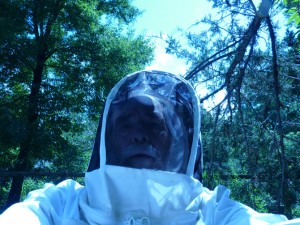
My bee pick up date and time has come.  I get my gals around 2:30 pm on Saturday.  I’m mostly ready, having prepared the hive boxes and the frames on Sunday.  I need a couple of entrance reducers and a bottom board, but that’s no big deal.  I have frozen pollen patties so I’m good there and the honey frames I’ve got in the hive boxes will feed my bees to begin, 06-27-10_beekeeperastronautmaybe enough to get them through to the dandelions.

This is a new season and I’m hopeful that my increasing experience will make it a successful one.  We plan to sell some honey this year, at least enough to cover package bee costs and equipment, perhaps turn a little profit.  That entails finding a bee-proof spot to do the extracting; I’m hoping the garage will work.

Went to see my dermatologist.  No skin cancer.  First time I’ve been checked, but, hey, this skin ain’t gettin’ more pliable.  He says once a year from now on.  Now on until.  Now on until death, I suppose.

Another busy day with Leslie at 11:30, dermatologist and Woollies tonight.  Heading out.

I Roll Over On My Belly

Spring                                              Full Bee Hiving Moon

OK.  Enough.  Uncle.  I give.  I yield.  I roll over on my belly.  Please let us have spring.  Snow?  More snow?  Just when the Himalayan inspired mounds of soot black snow have begun their glacial retreat?  This is not insult to injury, but insult to insult.  Well, all right.  If it’s coming anyhow, but could this be the last one for this season?  Please.  I have plants that need to get back to growing.

T’ai C’hi.  Coming along.  I am within one move of learning how to grasp the sparrow’s tail, then one more, the long whip, of having the basic moves in some sort of order and execution.  My teacher says, insists, promises it will all get easier.  But, it took her, she also says, 30 years to get her form to its current level.  Wait.  I’m not sure I have 30 years of T’ai C’hi practice in me.  On the other hand, maybe with T’ai C’hi…

T’ai C’hi feels like Latin for the body.  It’s taking all of my concentration to stay with it when I practice and the learning is slow.

Then there’s that radiation problem in Japan.  Good news on it.  The power company says it can have things cleaned up in 6-9 months.  6-9 months?  We’ll see.

This is the time to move the bees.  Bee colonies do not like to have their homes moved once they’ve learned where they are.  Even a move of 2 feet can be too much for them.  If you want to move existing colonies, you have to do it in slow, incremental steps.  Right now, since I have no bees, I can put the hive boxes wherever I want.  Still mulling.  I want to put them in the orchard, but that will entail switching out the gear from the front garden shed to the back shed where I currently have all the bee equipment.

Bee Diary: April 17, 2011

Spring                                                       Full Bee Hiving Moon

First full outdoor morning.  Took off all the hive boxes, cleaned every frame and the hive boxes, prepared hive boxes for the packages due next weekend.  The divide from last year’s parent colony had a lot of remaining honey, so I put four frames from it in each of two of the hive boxes for the packages.  In the other hive box I used honey from the package colony I had started last year.  A sticky job, scraping old propolis and wax off the frames, scraping dead bees off the bottom boards and into the garden (I’m told they make excellent fertilizer.), evaluating remaining frames for use in the upcoming year.

(Artemis Hives patroness goddess)

Now I have three single hive boxes with ten frames, four of honey and six with drawn comb.  Both of those mean the packages should be more efficient earlier since they will not spend energy drawing out comb.  Each of those hive boxes has its entrance reducer in to full obstruction, or, in one case, it sits flush on the foundation board, which seals it up.

I have to buy one new bottom board and three entrance reducers, other than that, I’m well set up for what will be my third year of bee keeping. I’ve got a long way to go before I’m proficient, but it’s beginning to be less of a mystery.

Mark and I both worked outside.  He moved limbs and compost material while I worked on the hive boxes and frames.  I only have one hive tool.

Bee Diary: April 17, 2011

Spring                                                                 Full Bee Hiving Moon

A full day of bees.  Mostly fun, but sitting for 8 hours just doesn’t have the appeal it used to.  What appeal was that?  Can’t recall.

The info on bee diseases and, again, the multi-valent character of colony collapse disorder keeps getting clearer.  Repetition is useful for this old brain. (I think a companion piece to This Old House could be This Old Brain)  The big problem is varroa mites.  Marla said the bees would have developed adequate resistance to the mites if they had been left untreated, as they have been in Africa, for example, but our wealthier, fix-it-now culture insists on medicine.  The result?  We have resistant varroa mites that are much more difficult to control.

The mites per se are not so much the issue; rather, they weaken the bees through sucking their vital fluids and serving as a vector for any number of bee viruses. This reinforces a long list of other interrelated negatives.  Lost pasturage in clover–reduced by adding fertilizer and decreasing crop rotation, different management practices for cutting alfalfa that reduce its bloom time, increasing pesticide use which further weakens the bees, herbicide use that kills bee friendly native plants (often called weeds) and the prevalence of monocultural planting of key ag crops like corn, wheat, beans create a dark synergy, a whirl of problematics that chip away at healthy bee populations, both native and domesticated.

A rolling loss of genetic diversity, an extinction event with no peer in the geologic record,* characterizes our impact, mostly intentional, on the landscape.  In making incremental decisions concerning agricultural methods, population, urbanization and our hungry, rapidly increasing demand for energy we have added co2 to the atmosphere, cut down forests, built farms in important watersheds (see the Mississippi and the Minnesota rivers as poster children for why this is a problem.), delinked corridors for wild animal travel and increased our dependence on smaller and smaller gene pools.  As the patenting of seed corn, wheat and rice, to give three important examples, has concentrated ownership of important food seed stores, the resistance to disease which has kept these key sources of human nutrition vital, decreases.

I mention this last because it is easy to see the bridge between our behavior in general and such problems as colony collapse disorder.  There are, thankfully, many solutions to these problems, but we have to have the will to act.  How many people will grow their own vegetables or participate in Community Supported Agriculture?  How many farmers will turn toward less intensive, and therefore less productive, farming methods in a time when larger farm sizes seem the only route to financial success?  The solutions all seem to lie in a spectrum of activities that support bio-diversity, emphasize sustainable energy and food production and reduce our reliance on steroid-like chemicals such as fertilizers.

The diverse pathways to a positive future give me hope.  Each of us can do a bit:  consume less gas, make our homes more energy efficient, grow some of our own food, patronize local suppliers, recycle.  We can also encourage systemic change in sectors like energy production, agriculture, urban development, defense and foreign policy.  Perhaps it’s time for a JFK moment:  Ask not what Mother Earth can do for you, but what you can do for Mother Earth.

*The background level of extinction known from the fossil record is about one species per million species per year, or between 10 and 100 species per year (counting all organisms such as insects, bacteria, and fungi, not just the large vertebrates we are most familiar with). In contrast, estimates based on the rate at which the area of tropical forests is being reduced, and their large numbers of specialized species, are that we may now be losing 27,000 species per year to extinction from those habitats alone.