Category Archives: Bees

Bee Diary: May 16, 2010

Beltane                                                     Waxing Planting Moon

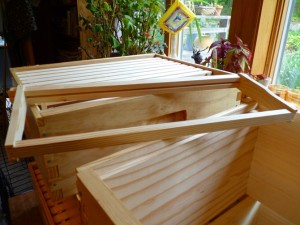
The bee project here has two active workers, a woodenware maker and a bee keeper.  Kate has put together 7 honey supers and 70 frames plus four, and counting, hive 05-15-10_bees_woodenware1colony31boxes and 26 frames.  Without her patient and careful craftswomanship, the hives would not exist.  I’m just no good at the fine, repetitive tasks involved in woodworking, but she is.  She brings an artisan’s hand to her work.  As a result we have beautiful hives.

A possible identity for our hives has begun to take shape.  Artemis is one of the many bee goddesses, but she is a familiar name, at least to some, so Artemis Honey is a strong possible name.  A common offering to Artemis was honeycakes, so we might be:  Artemis Honey, The Honeycake Honey.  When we start getting enough honey to exceed our use, including gifts, then we’ll start selling at farmer’s markets.  We’ll need a name, a label, a brand.  We’ll include a  honeycake recipe with every container sold and Kate has agreed to bake up some honeycakes to use as samples at our stands.  Let us know what you think.

Checked the crops today and harvested parsnips.  One resisted leaving its happy home in the raised bed.  It came out well over a foot long.  Smelling the tiny roots off the parsnip just after pulling, amazing.  A sweet, earthy, pure scent.  Wish I could bottle it.

When I left the MIA on Friday, I noticed on my walk back to the car, a migration of caterpillars.  I believe they were swallowtail butterflies in there can’t fly yet stage.  All of them, scores if not hundreds, chose northeast as their route across the warm concrete sidewalks that run between the Children’s Theater and the MCAD campus.  At first I just noticed their numbers, then I saw their common journey.

Where I wondered, did they begin?  So, I followed them back, moving against the small, humping crowd until I found a crabapple tree along an MCAD sidewalk.  Looking up I noticed caterpillars soon to head north by northeast eating their way out to the end of small branches, then, as the branch bent under their weight, falling to the grass.  Why they decided on their direction, I have no idea.

Bee Diary: May 15, 2010

Beltane                                        Waxing Planting Moon

Colony 1, the parent colony, got a reversal of the two hive boxes today.  I checked the honey supers and they have some honey, a very modest amount, but they still have a lot of comb to draw out, so the honey will come when that work finishes.  This colony has bees all over the place and they were ornery today, buzzing, circling, hitting the screen of my veil but not stinging.  They flew up in concentric tornadic columns from the hive entrance, making the noise that sends wise predators running.

Ah, well.  The beekeeper goes where wiser beings fear to tread.   With smoke, slow movements and a work plan I’ve not the found the bees difficult, but that one day where I 05-15-10_bee-diary_0002670defied common sense and peeked in without the bee suit or smoke, I did.  The multiple stings I took color my movements and my tolerance of the task at hand, making me want to move quicker, get done a bit sooner that good beekeeping suggests.  My hope is that repeated visits to the hives combined with good management practices will slowly drain that anxiety.

Colony 2, the child colony, has the old hive box from the parent and a new, young marked queen.  I didn’t see her today, but I did see larvae, so she’s there and at work.  After I checked for swarm cells, I closed colony 2 back up.  Finally, colony 3, the package colony hived about 3 weeks ago had worked through their initial bucket of syrup, so I had to come inside and make a new one for them.  The pollen patty was good.  Again, there were larvae and the comb looks fresh and beautiful.  I closed them up and declared this week’s bee duties discharged.

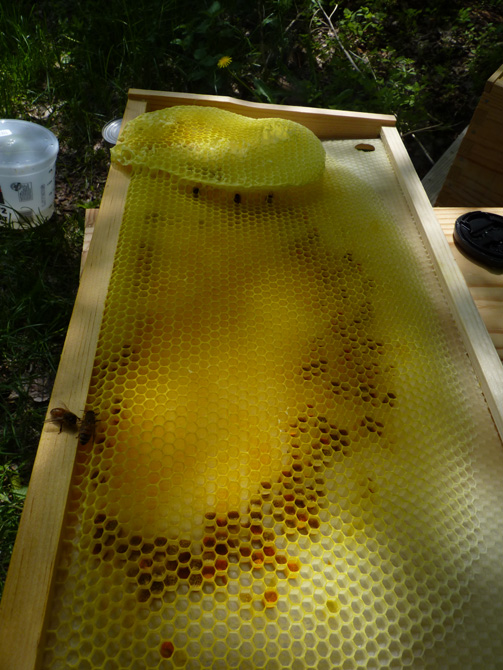
I’m sending the picture here into the UofM to ask about the pancake shaped additional comb the bees have built.  I’m also going to ask about black streaked comb.  I couldn’t find the frame, I think it’s in the parent colony, but I saw it when I made the divide.

Bee Plan for the Weekend

Beltane                                     New Moon (Planting)

The sun.  The sun.  We’ve been doing a great imitation of Seattle for the past week, cool and rainy.  Today and tomorrow we’ll have plenty of sun.  I’m glad because I have to check on my division (#2), see how their doing; check on my package colony (#3), see if they’re drawing out comb, the queen’s laying brood; and, finally, I have to check the two honey supers on the parent colony (#1) and see if I have to add supers, as well as doing a reverse on the two hive boxes.  The reverse follows, roughly, the amount of time it takes a queen to migrate into the next hive box.  This way, she lays eggs in the bottom hive box, then moves up into the top one, lessening the chance that the colony will feel crowded and want to swarm.

Tomorrow, too, I’m going to take my new digital camera and shoot pictures of the pancake comb I’m seeing, as well as the dark, splotchy comb.  I’ll send the pictures to Gary Reuters at the UofM to get his take on them.

The sun after a long stretch of Aunt Roberta dull, gray days makes me feel great.  Work to be done and time to do it.

Kate continues to look forward to her hip surgery as the pain in her right hip has become excruciating.  I’ll be glad for her when its better.

Bee Diary: May 13, 2010

Beltane                                  New Moon

On Tuesday night I attended my first meeting of the Minnesota Hobby Beekeepers Association.  Down a muddy road near the practice field for women’s soccer at the corner of Larpenteur and Cleveland in St. Paul, part of the St. Paul campus of the U. of M., lie a small, old complex of buildings that house the bee research facilities for the UofM.  They’re not much to look at.  The bee yard has knock down chain link fence around its blue, gray and tan hive boxes.  A building that would fit well on a run down farmstead in northern Minnesota seems to house bee equipment and a more modern, but well used building with a truck dock and sliding door completes the place.

It would be a mistake to take this as a reflection of the quality of the work done by Marla Spivak, her bee wrangler Gary and a small flock of grad students.  Some of the finest bee research on colony collapse disorder has been done here as well as the development of a strain, the Minnesota Hygienic, specifically bred to combat it.

When I arrived, the loading dock area had a crowd of maybe 50 people, most, like me, under dressed for the 43 degree rainy weather.  A smattering had bee suits.  We had been asked to bring them since there would be a live demonstration of dividing a hive.  I brought mine and put it on, not to protect me from the bees but from the chill in the evening air.

Two young female grad students got out the smoker, cracked the hive boxes and went through the various moves necessary to complete the division of an over-wintered colony into a parent and a child colony.  I did this a couple of weeks ago, so it was review, but helpful anyhow.  I had not, for example, tilted the queen cage up so the syrup would not drown her in case it entered her cage.  I had also forgotten to remove a frame way earlier, though I did do that on the day I divided the colony.

This was very informal with frames passed around so folks could see larvae, identify drone cells, that sort of thing.  There were a lot of absolute newbees there.  I felt I had a bit of experience on them, but not much.

After that we retired to Hodson Hall on the campus about a quarter of a mile from the bee yard.  There we sat in tiered seats, an entomology class room, evident by the row of glass cases outside containing japanese beetles, cotton moths and water borne larvae.  This was informal, too, consisting of a few presentations.

One guy had a method apparently used in Canada to increase the field force available to one set of honey supers.  This involves two hive boxes set side by side with a queen excluder over half of each.  A board covers the exposed part of each hive box.  This allows two queens to lay eggs, increase the number of worker bees.  The honey supers get filled up quicker and with better drawn comb for comb honey.

Another guy brought a beautiful top-bar frame in with a free formed comb.   Then we had pizza, mingled a bit, heard another presenter, and left.  This will be a useful group as time wears on.

When Do Many Avocations Become a Vocation?

Beltane                                       Waning Flower Moon

Beekeeping, it seems to me, must always fall under the avocational** rather than hobby* definition, because it engages one’s time in a manner similar to an occupation, only perhaps not in as time intensive a way.  Under the latter definition I have an avocational interest in gardening, writing, art, religion, politics and now Latin.
Add them all together, as I do in my life, and the result is a vocation composed of many parts integrated through my particular participation in them.

I like the idea of a hobby as an Old World falcon, that is, engaging the world with grace and speed, stooping now and then to pluck a prize from the earth below then returning to some nest high and remote to enjoy it.

Whoa.  Worked out last night at the new, amped up level, after advice given to me by an exercise physiologist.  My polar tech watch which monitors my heart rate began to fade so I didn’t have a reliable way of checking my heart rate.   Guess I overworked myself because when I finished dizziness hit me and nausea soon followed.  Kate was home last night so she took care of me, eventually giving me a tab of my anti-nausea med.  That calmed things down, but didn’t put me right.  So I went to bed early.  Even this morning my stomach was sore, like someone had removed it and wrung it out like a dish rag.  Kate says I may have too little fluid during the day yesterday combined with salty foods.  Combined with the more vigorous workout it upset my body’s homeostasis.  It put me temporarily in the same place as the benign positional vertigo.  No fun.  No fun at all.

Lunch today with Paul Strickland.  He still doesn’t know for sure why his hemoglobin levels dropped so far.  He had a five-hour iron infusion last week and his color is better as are other symptoms.  We talked about his and Sarah’s place in Maine which has the possibility of a large LNG port being created nearby.  This is Eastport, Maine, roughly, and borders Canada, so the Canadian government has a voice as well as environmental groups.  Sounds horrific, an example of big corporate power taking on a relatively weak local government.  Bastards.

More sleep after.  I have returned to near normal but I’m going to skip the workout tonight just to be sure.

I have never sought nor do I plan to seek retirement though most folks would call me retired and I so call myself at times in order to give folks a handle easily understood.

At 6:00 pm I’m going to my first meeting of the Minnesota Hobby Beekeeper’s Association. It raises an interesting question for me about the difference between a hobby and an avocation.

The first two definitions here are of the word hobby:

*1. Etymology: Middle English hoby, from Anglo-French hobel, hobé
Date: 15th century

: a small Old World falcon (Falco subbuteo) that is dark blue above and white below with dark streaking on the breast

2. Etymology: short for hobbyhorse
Date: 1816
This one comes from an entry on avocation:

: a pursuit outside one’s regular occupation engaged in especially for relaxation

** Etymology: Latin avocation-, avocatio, from avocare to call away, from ab- + vocare to call, from voc-, vox voice — more at voice
Date: circa 1617   : a subordinate occupation pursued in addition to one’s vocation especially for enjoyment

Bee Diary: May 9, 2010

Beltane                                        Waning Flower Moon

A new feature on ancientrails, the ancient trail of bee-keeping.  This diary will serve as my record of work with my colonies and a way to review the year’s learnings and prepare for next year.
colony2colony1

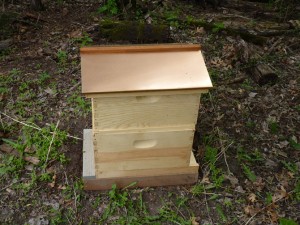
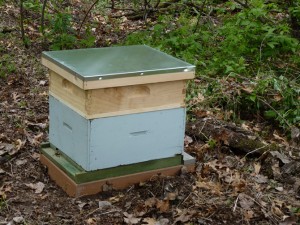
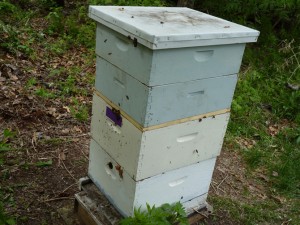
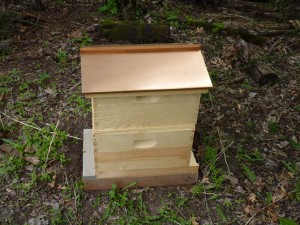
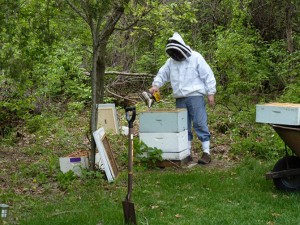
From left to right is colony 1, the parent colony of bees started with a package a year ago.  The parent colony has two honey supers on it now, the gray boxes, and a queen excluder which you can see as an unpainted strip of wood between the honey supers and the top hive box. The bottom hive box sits on a bottom board which rests on a leveled foundation, in this case bricks.  Colony 2, with the silvery metal cover, is the hive box, painted gray, and an empty honey super covering a plastic pail of 1 to 1 sugar syrup.  The green board underneath is the bottom board and the foundation in this and the next instance are a heavy plastic decking plank cut into small pieces.  Colony 2 was the third hive box on the parent which I divided a week ago and to which I introduced a new Minnesota Hygienic Queen on Monday.  The third box, with the copper top, which all the colonies will have eventually, is the colony started a two weeks ago from a 2 pound package of Minnesota Hygienics.   In the final frame I’m smoking the top hive box of the parent colony preparatory to an inspection of the frames.  Kate took this picture last Monday and the other pictures were taken on May 1.

Today I started by preparing the smoker, the metal object you can see in the picture with me.  This has taken a long time for me to learn and I finally have found a way to colony3keep it working for the 30-45 minutes I need to do my inspections and whatever work I need to do.  I now use hamstermebee670050210 bedding to start the fire, throw in some compressed wood pellets, pumping the bellows to create a flame and embers.  Then I put in smoker fuel, a cotton product that I assume is leftover material from spinning cotton into thread.  Once this has established itself I put on the suit, zip up the headpiece, cinch up the sleeves and put my pants into my socks.  I learned this last one the hard way when that bee crawled up my pant leg and stung me on the butt.
Each time you start work on a colony you smoke the entrance, which is to the back in the colony 1 photo and to the right side in 2 & 3.  Then, each you time you lift something, like the top or a hive box you put smoke under the object you’re lifting before you take it completely off.  The smoke calms the bees and, it just occurred to me, the beekeeper.  Often when you crack a hive box you have to use a hive tool to break the propolis the bees use to seal up their hive.  It’s a sticky, brownish substance that sets to a somewhat pliable but sturdy joiner.

Each time you check the hives you look for several different things:  swarm cells, which are really new queen cells indicating that a swarm is imminent, larvae which mean the current queen is at work and present–this is a situation bee-keepers call being queen right, disease, this one is tough for me since I’m not sure what I’m looking for and pest invasions like mice or ants. In addition to this general inspection there are also specific tasks related to each inspection since the goal is to disturb the hive as little as necessary while maintaining a good weather eye.

Today

Colony 1 (the parent colony with a year old queen):  I checked the honey supers to see if they were full.  They weren’t.  Had they been I would have added two more.  I also removed the queen excluder and checked a couple of frames in the top hive box and underneath it for swarm cells.  After setting the top box on the ground, I did a similar inspection of the bottom hive box, then reversed the two by putting the top box on the bottom board and the bottom box on top of it.  Queen excluder.  Honey supers.  Top board.  Hive box cover.  Done.

I noticed pancake shaped cells constructed on top of the cells on the frame foundation.  I have no idea what this means.  I saw a few swarm cells and what looked like a large number of drones, fat bodied male bees.  I also found larvae which meant colony 1 is still queen right.  You can kill the queen during an inspection.  That’s a buzz kill.  Ha.  If a colony is not queen right, it will not produce worker bees or honey.  This is one of the reasons you stay out of the hives as much as possible.  In addition, the bees know much more about being bees than you do.  Let them handle it.

Colony 2 (child of the parent with a few weeks old queen):  There was pancake shaped cell structures in this colony, too.  Again?  I did see larvae here and an empty queen cage, so colony 2 is queen right.  It looked to me like a lot of these guys were drones, too, but what do I know at this point?  There were a lot of bees and they did look and sound crowded–a lot of buzzing–so I added a hive box with ten frames and foundations, left the original hive body on the bottom board and put the empty on top.  Then I closed colony 2.

Colony 3 (package with few weeks old queen):  I lifted the copper hive cover, found the syrup pail still had plenty of syrup, smoked the hive box and lifted out a few frames.  There are larvae and the  beginning of the ovoid structure of brood, then pollen, then honey.  The pollen patty has had little activity, but I left it in just in case they need it.  After hiving a package, the population of the colony declines for the first 21 days as the queen lays and workers go out seeking pollen, many of whom will die.  After the brood begins to hatch and the nectar flow begins in earnest, the population will ramp up.  When 80% of the frames have brood, I’ll add another hive box on this colony.  Both colony 2 and colony 3 have the same task this year, build a strong parent colony, three hive boxes, that will over winter and divide next May.

Colony 1, if all things go well, should produce honey this year.  Next year and from then on, again assuming things go well, we’ll always have two parent colonies producing honey and two child colonies in the process of becoming parents.

Under any circumstances I go the Minnesota Hobby Beekeeper Association meeting on Tuesday, May 11th, and found what those pancake things are.  Until the next entry in the bee diary.

A Quieter Period of Time

Beltane                                            Waning Flower Moon

We had a light frost last night.  Many flowers are now gone, tulips mostly, and a few leaves have that sickly green color that comes from burst cells in the stem.  The weather service has predictions of 29 tonight, that means I’ll for sure have to cover the sensitive plants this evening.

A really busy week last week with several trips in and out of the cities, meetings or events at various times of day and three days in a row at the MIA.  It’s nice to have a few days where I can organize my time on my own.  Not like there’s nothing to do, of course.  My three bee colonies each will need inspection today or tomorrow and there’s weeding and other gardening chores.  Latin, chapter 14 in Wheelock, will put me half-way through this text, usually used for a year long college level course.  Then I’ll tackle my next four verses in Ovid.  There is also a tour to prepare.

This is supposed to be the last or next to last week of the legislative session, but the Minnesota Supreme court’s ruling on Pawlenty’s unallotments of last fall has thrown the whole situation into a big mess.  We may end up with a special session, in which case the legislative committee’s work is not yet done.  You may have seen that the Minnesota House voted to lift the moratorium on nuclear energy though with some important provisions.  Until such legislation is also passed in the Senate, worked out in conference committee, then signed by the Governor, it is not law.

The Garden, The Bees, And Touring

Beltane                                            Waning Flower Moon

After closer checking, all of the vegetables I’ve already planted can stand a light frost, most even a heavier one.  So, no worries there.  The herbs will require a blanky tomorrow night, as will the coleus Kate planted in the front.  Otherwise, we’ll be fine.  A few flowers will die, but that doesn’t kill the plant.  This is, again, a way that the world outside my door keeps my attention.

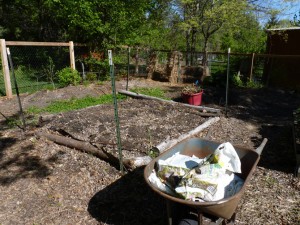
I will delay planting the potato/bush bean combination bed until this cold snap passes and the tomatoes and peppers haven’t come yet.  Oops.  I did, though, plant one potato670050210pepper plant come to think of it.  It will need a cover.  (the potato bed after soil amendment)

The Minnesota Hobby Bee Keepers Association does educational evenings once a month and allows new beekeepers to interact with veterans.  I plan to start attending on Tuesday night.  They will be discussing colony division, not discussing only, but also dividing a colony at the UofM’s on bee yard at the intersection of Larpentur and Cleveland.  We have to take our bee suits so we can watch up close.  I need a mentor, perhaps I’ll find one there.

The first tour of the day today, a group from St. Paul Central organized by Vitris Lanier, never showed up.  They never called.  Weird.  My second tour, my first ArtRemix tour, had eleven young women and a teacher.  These were students for whom the world of art was foreign territory, at least at first.  As the tour went on though, their curiosity got the better of them and they wanted to see how the Wu family reception hall was reassembled and what was in the Scholar’s study, then the garden.  We went upstairs to the Salon and Shonibare’s dress, then onto the dec arts gallery at their insistence.  All in all these kids developed an interest in what was in the museum and I went along to help them explore.  A successful tour, though it had little to do with ArtRemix.

Yeah, Mon

Beltane                                            Waning Flower Moon

Good bee news on two fronts.  In colony 2, the child colony, I inserted the queen using the slow release method, a piece of marshmallow covering her escape route which she and her new family will eat away over the next few hours.  Hopefully, this slow entry of her pheromones into the colony will encourage this colony to accept a strange queen.  In colony 3, the one begun from the 2 pound package a bit over a week ago, I checked the frames today and found larvae.  That means the queen survived my clumsy introduction of her using the quick release method, basically shake her out on a frame and then close up the hive.

At the moment, then, I have the parent colony with two honey supers on, the child colony, the division, with a new queen, and a third colony with its new life here under way complete with a laying queen.  The parent colony should produce a good honey flow this summer.  The child colony may produce a bit of honey but its primary job is to become a colony strong enough for division next spring.  That is also the task of colony 3.  The goal is to have two parent colonies next spring and two child colonies.  If I can maintain those numbers, we should have a lot of honey, some to give as gifts and some to sell at the farmer’s market.

I added my second copper top when I put in the new queen.  Soon I’ll order a copper top for the parent colony and next spring I’ll add the fourth one.  With the polyurethaned hive boxes and  honey supers, the copper tops will make our bee yard an aesthetic addition to the place.

Earlier today I attended a docent luncheon for Michele Yates, leaving for York, Pennsylvania on June 20th or so.  Allison’s place sits near 50th and France.  Her neighbor’s house has a Sotheby’s real estate sign.  That kind of neighborhood.  Her backyard has stone landscaping and orderly plantings all in vigorous growth.  She has a gracious home and entertains with elan.

Carreen Heegaard told the story of her 1988 honeymoon, nicely timed to coincide with Hurricane Gilbert.  She and her new husband Eric had chosen Jamaica as a destination because the prices were very reasonable.  They spent the first night of their Jamaican vacation in Peewee’s Bar, perched high above the ocean, Peewee’s being one of the few nearby buildings that had concrete walls.  She described the sound of nails popping out as the train-sounding winds peeled back the corrugated roof exposing all those huddled under a long table to the pounding surf and rain.

The highlight of her story, which had many, involved their trip to the grocery store after Gilbert had passed.  In Carreen’s  words, “There we were, a Minnesotan (Eric) and a Canadian (Carreen), standing in line with a grocery cart while the store was being looted.”  Says so much about cultural variance.

Man About Town

Beltane                                    Waning Flower Moon

We were both a bit achy from yesterday’s garden-a-thon, but it’s that good kind of ache that comes from things accomplished, the kind of things outside, those things that often feel more substantial, more real than the reading and writing.

Today has busy on it, too.  In an hour there’s a going away party for Michele Yates, a sweet woman, an artist, a French citizen long ago, now American for the most part.  We’ll miss Michele, we being the docent class of 2005.  We’re a close group, again for the most part.  We met every Wednesday for two years, not to mention hours of practice tours, parties, that trip to New York, enough time to bond with each other and as a group.  Michele is part of us and she’s leaving, so we need to say good-bye.

I leave Michele’s party to visit my dermatologist, not exactly a 9 on my thrillometer, but one of those important self-care things, like teeth cleaning and annual physicals.  Dr. Pakzad, a thin, intense guy comes in white coat, hurried but kind, confident.

In between Dr. Pakzad and the Woolly restaurant evening tonight, I have to get in a nap, queen my divide and check the package colony for larvae.  It’s doable, but it will be a whir.

Tomorrow morning I’ll go with Kate for her first visit to Dr. Heller, who does the minimally invasive hip replacements.  This visit should determine whether Kate has the right pathology for a hip replacement.  I hope she does.  She throws her right leg out as she walks, trying to find a movement that doesn’t cause pain.  With no luck.

37

The Way takes no action, but leaves nothing undone.
When you accept this
The world will flourish,
In harmony with nature.

Nature does not possess desire;
Without desire, the heart becomes quiet;
In this manner the whole world is made tranquil.