Beltane Moon of the Summer Solstice
When ancientrails came into being, it was to fill time while I healed from surgery to repain (ha, I meant repair, but this covers it, too) an achilles tendon rupture. I was off my feet for two months, crutches after that.
This morning I enjoyed the results of another surgical procedure, the total knee replacement I had on December 1st of last year. The work out I got from On the Move Fitness has strengthened my abductors and adductors, giving me more ease with hiking over rocks as well as climbing and descending on the trail.
Today Rigel really, really wanted to go with me. I had to get some stuff out of the car and left the door open. She crawled in and sat up, regal Rigel, in the seat, ignoring me when I asked her to come out. She was hurt that I wanted her to give up a spot she’d earned on her own. So, I took her.
As a result, I stopped at a spot where I’ve seen cars parked many times, a spot where there is no trailhead, no named trail. It’s close to our house and I decided to do a shorter hike since Rigel, hardly leash trained, needed to stay in the car. It was cool, low 50’s, but I didn’t want her in there too long.
The trail I found ushered me out, after maybe half a mile, onto a series of rocky cliffs that overlooked Shadow Mountain. It’s the first vantage point I’ve found, in the two and half years we’ve been here, where you can actually see Shadow Mountain. That was exciting. The vista was almost pristine, with very few houses visible. Unusual up here, so close to the city. Here’s what I saw.


 Kate continues to struggle with dry mouth, a very sore throat and other symptoms of Sjogren’s syndrome. She’s lost weight as a result. Lab tests don’t suggest anything terminal going on, but her distress is significant. If you know Kate, you know she has an energizer bunny mode, but she’s been on the battery depleted side of that equation for a while now.
 A new seasonal reality for us: pine pollen. All these lodgepole pines insist on involving on us in their reproductive orgy that happens this time of year. A fine yellow dust settles on everything. Coming in easily even through screens, it’s especially apt to settle on things electrical, so the computers and the tv and the microwave all have a coating. It also coats our solar panels, reducing their efficiency. If it rains, a yellow scrim settles over the driveway, pooling where the water does. I wish these pines could figure out a more direct way to make more pines.

 With the first draft of Superior Wolf finished I’m taking this week to do various tasks up in the loft that I’ve deferred. Gonna hang some art, rearrange some (by categories like Latin American, contemporary, Asian) and bring order to some of my disorganized book shelves. I want to get some outside work in, too, maybe get back to limbing and do some stump cutting, check out nurseries for lilac bushes.
 Even so, reimagining is beginning to exert a centripetal force on my thinking, book purchasing, day to day. For example, last night as I went to sleep a cool breeze blew in from the north across my bare arms and shoulder. It was the night itself caressing me. I went from there to the sun’s warm caresses on a late spring day. The embrace of the ocean or a lake or a stream. The support given to our daily walking by the surface of mother earth. The uplift we experience on Shadow Mountain, 8,800 feet above sea level. These are tactile realities, often felt (0r their equivalent).
 Next, eliminate the metaphorical. If we do that, we can immediately jump into a holy moment, a moment when the bonds that tie us to grandmother earth are not figurative, but real. The breeze on my bare arms and shoulders is her embrace. The sun on my face, penetrating my body, is him in direct relationship with me, reaching across 93 million miles, warming me. The ocean or the lake or the pond or the stream cools me, refreshes me, hydrates me, acts of chesed, loving-kindness, from the universe in which we live and move and have our being.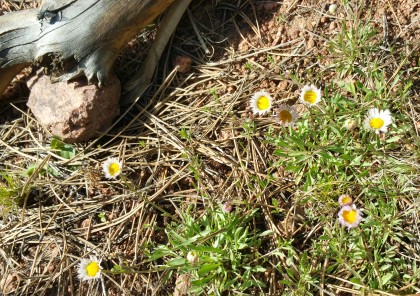
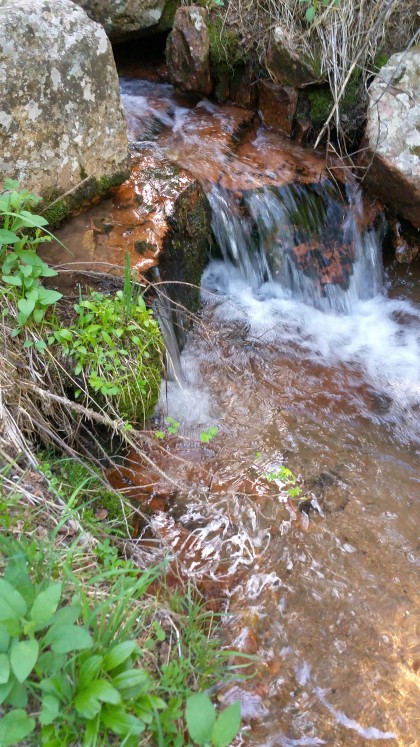
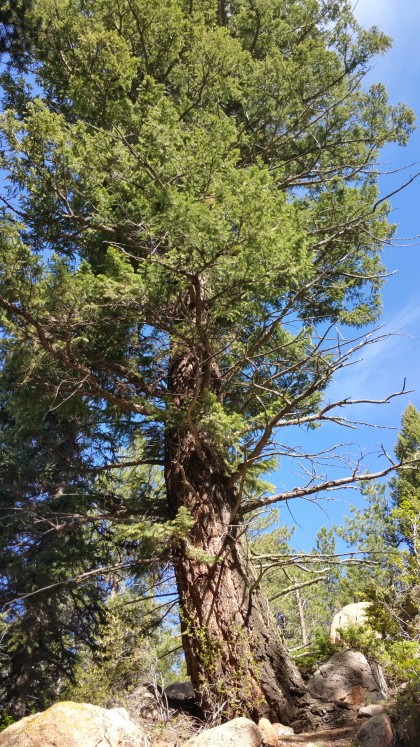
 While hiking and thinking about Reimagining, I realized I’m taking an atelier approach to it. Ateliers train would be artists in the classical mode, using lots of drawing, life models and work with perspective. They’re considered conservative in today’s art world, a sort of throwback to the artist/apprentice studio that dominated art education for so many centuries.
 Yet what I really want to do is rethink what faith is, why we go to the places that we go to for spiritual nourishment and whether there might be a real faith, an approach to the religious life, that emerges naturally from the world in which we live and carry on our daily lives. That is, one without a charismatic founder or an ethnic base, a faith which would help us see the holy ordinary, that would expose the ligatures that bind us to this planet, to the plants and animals and minerals and atmosphere, expose them and help us see them as the loving embrace that they are, not only as limits to our lives.
 While the world burns, at least the Trump world, kabbalah suggests a bigger world, more worlds, right next to this one. There is, as Rabbi Jamie said, a bigger picture. I learned a similar lesson from Deer Creek Canyon during my cancer season two years ago. These Rocky Mountains, still toddlers as mountains go, were and will be present when we are not. In their lifetime humanity will likely have come and gone.
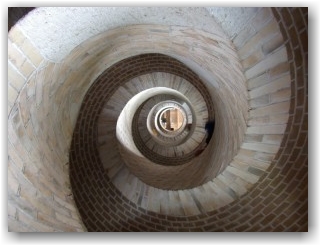 Yet. We do not live either in the deep geological past nor in the distant geological future, we live now. Our lives, our mayfly lives from the vantage point of geological time, come into existence and blink out, so we necessarily look at the moment, the brief seventy to one hundred year moment into which, as Heidegger said, we are thrown.
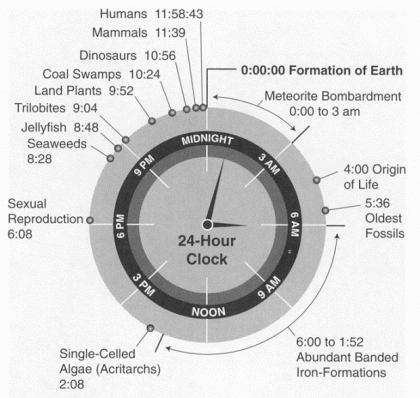 Somehow we have to realize that though our lives are small compared to the immensity of the universe and the imponderable nature of time, they are everything while we have them. As for me, I find all this comforting. Putting my efforts in the larger perspective gives me peace, putting them in the immediacy of my life gives me energy. We will not complete the task, no, we will not. But we are not free to give it up either.
 Heavy rain yesterday afternoon, felt like being back in the humid East. Black Mountain is no longer white; it’s green with its lodgepole and aspen looking healthy. It’s gone from white haired old man to green man. Good to see. Cub Creek, Maxwell Creek, Bear Creek and Blue Creek are all full. The snowpack is well above average. A much better scenario for this summer. Thankful.
 Jon goes to see a house today. 1225 Ironton Street in Aurora is easy biking distance to his school. Kate goes to see an ENT today hoping for some answers about a persistent dry mouth and sore esophagus that makes eating painful. Easy to write the sentences, more difficult to express the complex emotional and relational impacts of both appointments.