Category Archives: Our Land and Home

Home

Samhain                                                                   New (Winter) Moon

As some of you know, I’m fascinated by the concept of home.  As we age, we fight with what powers we have to remain in our home.  Not only do we want to live in our home, we want to die in it, too.  That’s a pretty strong commitment.  What is it about home?  Why is this such a powerful idea?

A friend who has written for years about aging says it’s about what we know and especially in old age not wanting to trade what we know for what we don’t.  I imagine he’s got a good chunk of it.  Home is not only where the heart is; it’s where your pillow is and the living room and the kitchen you know.  It’s a place of memory and a place of projected peace, or at the very least projected familiarity.

Much as I respect my friend’s work and his thinking, his explanation doesn’t satisfy me. Familiarity is powerful, but the notion of home goes beyond that.  At it’s root, I suspect, is the nomad’s intimate relationship with a certain territory that could provide roots and berries in one season, tubers and fruits in another and game in another.  The linkage, the primal linkage, lies, in other words, with place and not just any place but the place that gives us sustenance.

As the neolithic revolution took hold and the hunter/gatherers began to stay more and more in one specific spot, no longer wandering throughout the year, but tending gardens and fields and livestock, the larger definition of home territory got whittled down to the village, perhaps to a small farm.

Then, when urbanization began its slow, inexorable rise home territory became associated in a diffuse way with a city, but the more particular sense of personal territory shrank to a few rooms, perhaps a house.  Note that now the territorial definition at the most intimate level is no longer related to the land, to the place that gives sustenance but to a human artifice, a built object and, in all likelihood, a built object over which you have no control

Urbanization passed the 50% mark worldwide sometime ago and the centripetal attraction of cities only grows as time goes on.  Thus, for many if not most of the world’s population the terrain of home shrinks year by year and recedes further and further from its natural roots.

Even so we don’t want to leave our condos, our apartments, our townhomes. Home is that one spot in the vast vacuum of space and on this tiny patch of life-sustaining rock that we call earth that is ours.  It is the remnant of the hunter/gatherer’s territory, and it is the one to which we belong. And note please, it is not it which belongs to us.


Why I Live Here

Samhain                                                             Thanksgiving Moon

I have decided, over and over again, to remain here in Minnesota.  Leaving occurs to me from time to time, more often now the direction considered is north, beyond our borders where the politics, health care and weather all seem more sane.  Even with those attractions, and they are considerable, Minnesota and in particular the Twin Cities Metro always trumps any competition.

The arts here are a wonder.  Having the MIA and the Walker in a small market city like Minneapolis doesn’t amaze us, because, after all, they are here.  But it would if you considered them in a national, even international light.  The Guthrie is only the most visible island of a large theatrical archipelago, boasting more seats than any other metro area in the nation outside of New York City.

The St. Paul Chamber Orchestra is a gem.  Again, nationally.  The Minnesota Symphony used to be an internationally renowned organization, as recently as two years ago, before dimbulbs began a series of self-inflicted wounds.  Dance, local rock music, glass and clay arts, printmakers and galleries all thrive here.  Jazz, supported by KBEM of internet renown, flourishes.

There are substantially more dining options now than when I moved here in 1970.  More than Kate and I can visit before they disappear.

Writers in Minnesota consistently publish and make the national book news.  The Minnesota Center for Book Arts and the Loft provide outside academia support for the literary community.

Healthcare is as good as it gets. Anywhere.  Hawaii and Minnesota are tops in the US and good US healthcare is as good as there is anywhere.

When policy makers divided the land in the Upper Midwest and created Minnesota they included the intersection of three US biomes:  prairie, deciduous forest (Big Woods) and the boreal forest.  The Wisconsin glaciation scoured out numerous lakes and the Great Lakes.  Though flat our terrain is remarkable for its diversity and its  pristine nature in the north where the moose and the wolf still live.  At least for now.

Where else do you get all these things?  Nowhere else.  That’s a large part of why I stay. Another, equally large part, is friends.  The Woolly Mammoths, the MIA docent class of 2005, the Sierra Club and various past political activity has peopled my life with friends. They’re here and I am, too.

In the past, too, I valued the Minnesota political culture which showed compassion to the poor, effectiveness in government and sound stewardship of the state’s natural resources. A long desert of mean policy makers, eyes and hearts captured by the great god money, have devastated much of that culture though I continue to believe it exists.

The common good, defined broadly, is just that.  Our future depends on an educated work force, receiving a decent wage, a hand-up when life turns sour and a healthy environment in which to work and live.  These have seemed and still seem to me the necessary elements of a civil society.

Missing Gone.

Samhain                                                          Thanksgiving Moon

It’s off to the copy editor.  Missing is gone.  Now in the hands of another.  The first of many, I hope.  Whew.  Wipes forehead of 2+ years of ink-stained effort.  Well, digital disappearing ink, of course.

Now then.  Forward with Loki’s Children using Dramatica.  Forward with Lycaon’s tale in Ovid.  Forward into that garage.  An outside task for the colder days.

Then I’ll get started on pruning the forest.  First up there, clearing the new beeyard.  That will get the woodpile built up and drying begun for 2015.  Any splitting will wait until January when frozen sap will help the process along.


The Seasonal Turn

Samhain                                            Thanksgiving Moon

Waiting now on the soil to freeze so I can lay down mulch.  One of the odder parts of gardening, putting the blanket on after the bed goes cold.  Planting garlic in September is another oddity.  Both make sense, but they are counter-intuitive.  Mulch over bulbs, especially newly planted bulbs, guards against frost-heaves in the spring, displacing bulbs, throwing them closer to the surface than desired.  Garlic, like tulips and crocus and daffodils, needs a cold winter to prepare itself for the spring.  They’re both fall planting.

(Anatomy_of_a_Frost_Heave)

Getting the mail from our mailbox out on the road requires dressing up.  I put on my down coat for the journey a moment ago.  Watch cap and gloves, too.  My jeans let the cold right through to my legs, but legs are hardier than feet and torso and hands, more willing to put up with the chill.  The top of this head, long a follicle desert, also demands covering. In the summer sun and the winter cold.  Burning or freezing.

We look outside at the garden, the orchard, the bees.  There is some winter interest there, grasses and flower stems, the bare trees and in our particular case the evergreen cedars, our planted white pines and norway pines, colorado blue spruce, but we admire them from within, no longer carried out among them with trowels and spades.  Our work out there is, for the most part, finished until April.

The turn of work goes inward, work we can do at home.  Kate will sew, do needlepoint, quilt.  We both will read and watch movies.  I’ll write, translate, take a class or two.

Waiting also for snow and the transformation of our world.  It’s one of the delights of living here.

Asleep

Samhain                                                                        Thanksgiving Moon

Another implication of the fallow season had escaped me, at least at the level Jim Gilbert describes in a recent phenology column in the Star-Tribune:

Hibernation is a winterless life chosen by reptiles, amphibians, insects and some mammals. During the winter untold millions of animals — including toads, frogs, salamanders, snapping turtles, garter snakes, bats, woodchucks and mosquito larvae — are hibernating across Minnesota.

We often miss the warm period lives of these creatures because many of them are small, secretive and prefer to remain well away from humans.  Their winter lives, in the millions, untold millions Gilbert says, never massed together in my mind.

(this wonderful piece by Travis Demillo.)

Walking in our woods right now there are thousands of salamanders, toads, frogs, garter snakes, woodchucks, various insects, ground squirrels and gophers in a state of suspended animation, dreaming small animal dreams until the weather becomes more suitable for their life again next year.  It gives the woods a haunted, Snow White sort of atmosphere with so many of its active and vibrant lifeforms stilled to the point of coma.  And by intention.  Well, evolutionarily adapted intention that is.

Here’s a lifted glass to their long night, a safe sleep and a welcome return.


Good-Bye Garden. See You On the Flipside.

Samhain                                                          Thanksgiving Moon

The transition from growing season to fallow season creates a sudden release from one IMAG0604domain of chores.  No more spraying, harvesting, weeding, checking the health of the plants.  No more colony inspections.

Many baby boomers, the paper says, have migrated to downtown apartments citing outdoor work and home maintenance as primary motivation.  While that once might have made sense to me, now I wonder.  The outdoor work, as long as I’m able, keeps me active, close to the rhythms of the natural world.  It gives more than it takes.  Cut off from it in an apartment doesn’t sound appealing.  If you don’t like it, if it takes more than it gives, then, yes.

I know that feeling. Home maintenance would take far more than it gives if I felt IMAG0944 Kate and me1000croppedresponsible for doing it myself.  So I can understand wanting to move away from that.  In an apartment the building takes over the plumbing, the furnace, the windows, the doors. Even there, however, being responsible for seeing that the maintenance gets done, though it does feel burdensome, maintains our agency.  And I like that.

More than any of these matters, though, is the single word home.  This is home.  Though we could, I don’t want to create another one.  At least not now.

Crossing Over

Samhain                                                               Samhain Moon

Javier delivered three wheelbarrows of two-year dry oak.  I’ve cut up the ironwood and cedar, split and stacked them.  This morning I cut five four foot lengths off the ironwood’s branches and upper trunk.  They will not be split and will go on the outside of the bonfire. The heat of the fire will ignite them through the bark and they’ll provide a long-lasting flame.

Kate’s gathered together makings for smores, mulled cider and snacks.  She’s also drilled pumpkins with arrows, clever and cute.  She’s also found fall color napkins and plates.  We’ll have bottled water and a warming house, complete with crystal chandelier that used to hang over the piano.

The center piece of the evening will be the fire.  And I’m planning a big one.  We’ve had a wet week so the fire danger is nil.

Doesn’t sound like too many folks can make it. Andover creates a good deal of resistance for city folk, the distance a good ways for an evening out.  We’ve gone low key with this one anyhow, figuring we’d learn what kind of work is necessary to pull one off.  We plan a winter solstice bonfire and one for Beltane, too.  We may skip the summer solstice due to the potential for fire problems.

(welsh holy well)

Tonight the ancestors can move more freely from the Otherworld, as can the folk of faery. At least so my Celtic ancestors believed.  It is interesting to consider that Mexican and Latino cultures also celebrate a similar idea as do some in the Christian church.  The anthropologist in me says that means there’s something here, something the folk beliefs have recognized, perhaps in some precognitive way.

Samhain, 2013

Samhain                                                                    Samhain Moon

Tonight is Samhain, also known as All Hallow’s Eve, and Halloween.  An abbreviated thick description (see post below for thick description) for this Samhain, in this place, 3122 153rd Ave N.W., Andover, Minnesota could begin with any aspect gathered in to this day and its night, but we’ll begin with the firepit.

Kate and I hired Javier Celis to finish a firepit begun several years before by me, worked on by brother Mark two years, but needing some finishing work.  Javier and his crew made the granite paving stones, from a cobbled street in Minneapolis, into a neat circle, lined the firepit with ground stone and put crushed marble around the outside of it.  They also laid down landscape cloth and thick mulch over the entire area, a former compost pile.

Kate’s family had a firepit in their home in Nevada, Iowa and we both enjoyed them at other’s homes.  The firepit hearkens back to campfires of native americans and pioneers here in the U.S., warming, lighting and provided heat for cooking.

The fire itself pushes back further to a fundamental separation between hominids and their close primate relatives, the domestication of fire.  Who knows how it happened? Embers from a lightning struck tree conserved overnight by accident?  A fire on the veldt which left grasses aflame and led to their use as early kindling?  This basic transition, an elemental moment, as essential to our future as a container for water, lives on in our fascination with fireplaces and bonfires.

Bonfires, especially, may be linked, probably are linked, to the fear of night stalking predators, meat eaters for whom human meant food.  So we feel safe around a bonfire, huddled around it, just a bit of the thrill left over when that thrill came from the very real possibility of death by fang or claw.

In the Celtic tradition, which we celebrate tonight, the bonfire had sympathetic magic at its core.  In the spring, on Beltane, the fire transferred its vital energy to the soil where it could quicken the seed and ensure a successful planting.  The opposite end of the year, Summer’s End, or Samhain, finds the bonfire a way of ensuring our warmth and protection from the cold and hungry months ahead.

My Celtic roots run through Ireland, the Correls, and through north Wales, the Ellises, and, perhaps, through County Kent, the Keatons.  The Correls came as potato famine immigrants in the late 19th century and we have no information about the Keaton immigration though it might have been in the same era.  The Ellises we know came here first in 1707 when Richard Ellis was put ashore by a greedy sea captain, sold as an indentured servant to pay his fare.  His mother had paid his fare in Dublin, Ireland where her husband, a captain in William and Mary’s occupying army, had recently died.

Searching in my own and the more general Celtic past led me to the Great Wheel of the Year.  It has gradually become a center point for reimagining my faith, helping me find the rhythms of the year and of human life as key sacred moments.  Thus it is, at least in part, that we go to our firepit this year, to build a bonfire and say the names of our ancestors, standing there around the universal symbol of human protection, warming our hands and waiting as the Great Wheel turns from the bounty of the growing season to the Great Rest of the fallow time.

Wood and Leeks

Fall                                                                   Samhain Moon

Split wood from the two cedars and the ironwood stacked.  Plenty of kindling sized wood, some paper, smaller sized chunks of wood, plus two pallets to break up and split.  Then, out there, lying yet in the woods, the tapering trunk of the ironwood plus two thick branches, waiting to be cut into true bonfire sized logs for the outside of the fire.  Thought I might have to buy some wood, but no.  All I need right here.

All the leeks harvested, the tops trimmed off and waiting in the hod for the hoses to thaw out so I can wash the roots outside.  It’s chicken pot pie day here at Artemis Hives and Gardens.  After, that is, a visit to the city to see Audacious Eye and have lunch.

There will be three pots, a chicken in every pot, boiling away with garlic and onions, celery and carrots sauteed first, then the water, then the chicken.  The leeks in another pot, also boiling.  After some time, corn and peas and pearl onions into the chicken pots.  At that point the chickens come out and get plopped onto cookie sheets where the flesh comes off and gets cut up into smaller chunks.  Which get put back into the pots, again one chicken each.

Get out the pie tins with pie dough in them and the box of Pappy’s dough so it can soften.

Add the leeks to the pots and thicken with corn starch or Wondra.  Tricky step, probably will do it in smaller bowls.  The thickened chicken broth with chicken, peas, corn, leeks, pearl onions, carrots and celery spread out in the pie tins.

Flatten that Pappy’s with a rolling pin, always flouring the surface, make it big enough to cover the pie tin, put it on like a night cap, crimp the edges, make marks in it to let the steam out.  Toss in the oven.  Wait a while.

Chicken pot pies.  Most will be frozen, probably all but one.

Splitting the Logs

Fall                                                             Samhain Moon

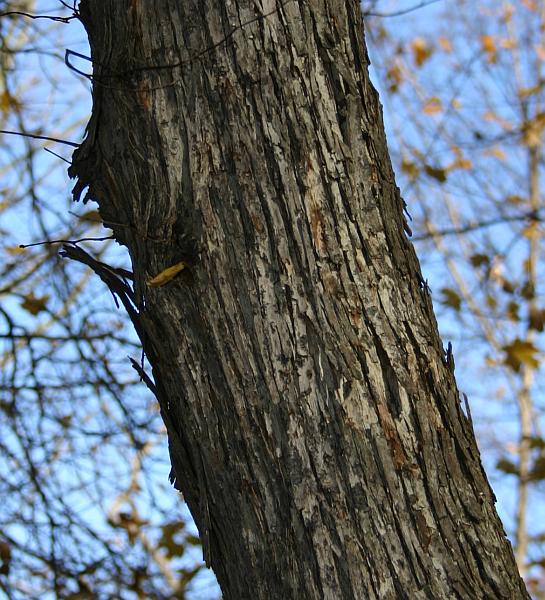
The dead tree I felled yesterday was an ironwood.  It’s the densest wood around here andironwood_bark_IMG_0206_rsz2 having a new chain on the chain saw was a good thing.  Splitting it this morning was a challenge.  On many of the logs the first action was the maul bouncing back into the air, perhaps a small dent only in the log’s surface.  After two, three, four whacks or so, it did split into satisfying semi-circular chunks.

Ironwood has a BTU rating of 24.7 per cord (4′ by 8′ by 16″), putting it in the top range of firewoods, along with black locust (of which we also have plenty), oaks (ditto) and beechnut (none), hard maple (none) and hickory (none).

Working directly with the wood, my power mediated only by the maul, feels good.  The immediate feedback, even the shudder up my arm, and the crack of the log splitting gives me a sense of connectedness to the tree and to the fire for which I will use it.  Even though the chore became onerous, I’m sure, a family that heated with wood and had no other options, would retain this personal, physical linkage with the forest and the heat for their home.